Mini Husky Dog Breed vs. Klee Kai: What’s the Difference?
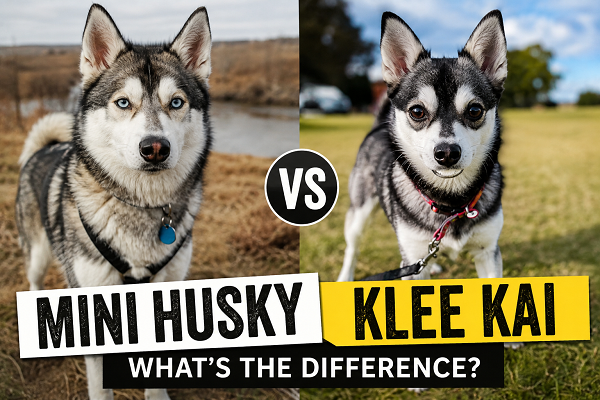
A “mini husky” is not a recognized breed. It’s a loose label for a small Siberian Husky, a Husky cross (like the Pomsky), or sometimes a Klee Kai that a seller is advertising under a catchier name. The Alaskan Klee Kai is a real, registered breed. It was developed in Alaska in the 1970s, the United Kennel Club recognized it in 1997, and the American Kennel Club moved it into its Miscellaneous Class on June 25, 2025.
In daily life, the Klee Kai is usually smaller (about 5 to 22 pounds), more reserved with strangers, and rarer and pricier. A mini husky is whatever its parents were, so its size, temperament and health can vary a lot.
Table of Contents
- Introduction
- Quick Answer: Is a Mini Husky Real?
- What People Mean by “Mini Husky” (Label Decoder)
- What Is an Alaskan Klee Kai?
- Size and Appearance Compared
- Temperament: Which Dog Fits Your Home?
- Exercise, Training and Apartment Life
- Heat, Cold and Coat Care
- Health Problems and Life Expectancy
- Cost of Ownership
- How to Verify What You’re Buying
- Which One Should You Choose?
- A Handler’s Note
- FAQs
- Conclusion
Introduction
You see a tiny, fox-faced dog with a Husky mask and a curled tail. The caption says “mini husky.” The next photo says “Alaskan Klee Kai.” Same dog? Different dog? Honestly, it could be either, and that confusion is exactly where people lose money and end up with the wrong dog.
I’ve spent more than 14 years working with high-drive dogs, and spitz-type breeds like these come up all the time when people ask what “small, wolfy, and manageable” looks like. Here’s the problem: the name on the advert tells you almost nothing about what’s actually in the puppy. And a dog that’s wrong for your daily life gets loud, destructive and unhappy fast.
In this guide you’ll learn what a mini husky really is, how it differs from the Klee Kai, and how size, temperament, exercise, health and cost compare. You’ll also get something most pages skip: a simple checklist to verify what you’re buying before you pay a deposit.
Quick Answer: Is a Mini Husky Real?
Not as a breed. No major kennel club, including the AKC, UKC and FCI, publishes a standard for a “Miniature Siberian Husky.” The Siberian Husky standard itself has no small version. AKC, UKC and FCI standards all describe males at roughly 21 to 23.5 inches and 45 to 60 pounds, and females at roughly 20 to 22 inches and 35 to 50 pounds.
So when someone says “mini husky,” ask one question: what are the parents? The answer decides everything.
What People Mean by “Mini Husky” (Label Decoder)
This is the part many comparison pages blur. The same two words can describe four very different dogs.
| What the seller calls it | What it usually is | Can you predict the adult dog? |
|---|---|---|
| Mini husky | A small purebred Siberian Husky (an undersized or low-end-of-standard dog) | Fairly well, but it’s still a Husky in a smaller coat |
| Mini husky | A line of Huskies bred small, generation after generation | Depends on the breeder’s records and health testing |
| Mini husky / Pomsky | A Husky and Pomeranian cross (or a Pomsky bred to a Pomsky) | Poorly. Puppies in one litter can lean Husky or Pomeranian |
| Mini husky | An Alaskan Klee Kai marketed under a popular nickname | Well, because the breed has a written standard |
A few things worth knowing about the crossbred version:
- The Pomsky is a hybrid, not a breed. The first recorded Pomsky litter came in 2012, and because of the size gap between the parents, breeders use artificial insemination, with a female Husky and a male Pomeranian.
- Size is a gamble. Breeders often sell Pomskies in rough size bands, but a puppy can still end up closer to one parent than the other.
- Other crosses exist. Some sellers cross Huskies with Shiba Inus or other small dogs to shrink the frame.
One popular comparison page even claims the mini husky is usually the smaller of the two. That can’t hold as a rule. A toy Klee Kai is under 10 pounds, while a “mini husky” might be a 30-pound Husky-Pom mix or a small purebred Siberian. The label simply doesn’t tell you size.
What Is an Alaskan Klee Kai?
The Alaskan Klee Kai (often written AKK) has a documented history, and that’s the biggest difference between it and any “mini husky.”
Linda Spurlin started developing the breed in Wasilla, Alaska, in the early 1970s. She worked with Alaskan Huskies and Siberian Huskies, and breed histories say the Schipperke and American Eskimo Dog were added to help lock in the smaller size. The name comes from an Athabaskan phrase that roughly means “small dog.”
Registry timeline:
- 1988: The breed was introduced to the public, and Spurlin contacted the AKC about recognition.
- 1995: The American Rare Breed Association (ARBA) recognized the breed.
- 1997: The United Kennel Club (UKC) recognized it.
- October 2020: The AKC accepted it into its Foundation Stock Service.
- June 25, 2025: The AKC approved it for the Miscellaneous Class, with the Alaskan Klee Kai Club of America as its parent club.
Miscellaneous Class is a step toward full AKC recognition, not the finish line. Breeds typically stay there for one to three years while the parent club builds numbers and runs judges’ education. So if a breeder tells you the Klee Kai is “fully AKC recognized,” that’s a flag worth questioning.
The breed is also still rare. The Alaskan Klee Kai Association of America has cited fewer than 10,000 puppies born through 2018, and litters are small, often one to five puppies. That’s why good breeders keep waiting lists.
Size and Appearance Compared
Both dogs share the facial mask, upright triangle ears and curled tail. Beyond that, the differences show up.
The Three Klee Kai Sizes
The breed standard recognizes three size classes, measured at the shoulder:
- Toy: up to 13 inches, under 10 pounds
- Miniature: over 13 up to 15 inches, roughly 10 to 15 pounds
- Standard: over 15 up to 17 inches, roughly 15 to 22 pounds (sources vary between 20 and 22)
Here’s something buyers rarely hear: a single litter can contain all three sizes. So a “toy” label on a young puppy is a prediction, not a promise. Ask the breeder how big the parents are and how the older siblings turned out.
Side-by-Side Table
| Feature | Mini Husky (varies by parentage) | Alaskan Klee Kai |
|---|---|---|
| Recognized breed? | No | Yes (UKC, ARBA, AKC Miscellaneous Class) |
| Adult height | Anywhere from small-dog to near-Husky size | 13 to 17 inches (three size classes) |
| Adult weight | Depends on parents; a small Siberian can still run 35+ lb | About 5 to 22 lb |
| Build | Often stockier, closer to a sled dog | Lighter bone, more fox-like |
| Predictability | Low to moderate | High (written standard, tracked pedigrees) |
| Temperament | Usually outgoing, Husky-like | Usually reserved, alert |
| Typical life span | Similar to parent breeds (around 12 to 15 years for Huskies) | 12 to 16 years |
| Availability | Easy to find | Rare, waiting lists common |
Temperament: Which Dog Fits Your Home?
Looks are the bait. Temperament is what you live with for 12 years.
A Small Siberian Husky or Husky-Type Dog
A mini husky that’s genuinely Husky-bred keeps the breed’s social, pack-minded personality. It’s usually friendly with strangers and other dogs, playful, loud in a “talkative” way and independent. Huskies are famously poor guard dogs because many greet visitors like old friends.
The Alaskan Klee Kai
Klee Kai were shaped toward a more cat-like, selective temperament. Expect these traits:
- Deep bonding with family, wariness with new people
- Real watchdog instinct (they’ll announce visitors, but their size rules them out as guard dogs)
- High intelligence with an independent streak
- A need for early socialization, or that wariness can slide into fearfulness
Two Quick Scenarios
The dinner-party test. Your friends arrive. A Husky-type dog bounces over for pets. A Klee Kai often watches from a distance, barks once or twice, then decides whether you’re all okay. Neither is wrong; you just need to want the right one.
The visitor-with-kids test. Both can do well with children raised alongside them. Still, I’d supervise either one, and I’d teach children to leave a resting dog alone. Klee Kai in particular need positive early exposure to kids, not a sudden meeting at 10 months.
Exercise, Training and Apartment Life
Both breeds are smart, and both can outsmart a first-time owner. Here’s how I’d plan their days as a handler.
Daily Exercise Targets (Handler Guidelines)
| Husky-type “mini husky” | Alaskan Klee Kai | |
|---|---|---|
| Physical exercise | About 60 to 90 minutes of running, hiking or structured play | About 45 to 60 minutes split across walks and games |
| Mental work | 15 to 20 minutes of training or puzzle games | 15 to 20 minutes of training or puzzle games |
| Warning sign of too little | Digging, howling, fence-testing | Escalating barks, “AKK scream,” shredding things |
These are guidelines, not hard rules. A one-year-old will need more than a nine-year-old, and a dog doing agility needs more than a couch companion. If you want a deeper framework for matching exercise to drive, read our guide on how often to exercise a working dog. The principles apply well to spitz breeds.
Training Tips That Actually Work
- Use rewards, not pressure. Both breeds shut down or dig in when handled harshly. Short sessions with food or play reward the behaviour you want.
- Teach recall early, and don’t trust it off-leash. Husky-type dogs have strong prey and roaming drive. Even a well-trained one can bolt.
- Escape-proof the yard. Both breeds climb and dig. Check fence height and the base of the fence before the puppy comes home. Klee Kai are known to find gaps in fences when unhappy.
- Socialize on a schedule. For a Klee Kai, plan calm, positive meetings with different people, surfaces, sounds and vehicles through the first months. Don’t flood the dog; go at the pace where it stays curious.
- Teach quiet on cue. Both are vocal. Reward the pause between sounds and add the cue word once the quiet happens reliably.
Can They Live in an Apartment?
A Klee Kai fits an apartment better, mainly because of the smaller body and lower exercise demand. But “small” doesn’t mean “quiet.” Thin walls and a bored AKK can cause real neighbour problems. A Husky-type dog can live in an apartment too, but only if you reliably deliver the exercise, which many owners can’t. If you’re comparing options, our list of the best small dog breeds for apartments shows what truly low-energy dogs look like.
If early groundwork feels overwhelming, my e-book Beyond the Bark: Inside a Pro Handler’s Playbook for Raising the Ideal Dog walks through the same structure I use with working dogs: clear routines, consistent rewards and calm leadership from day one.
Heat, Cold and Coat Care
Here’s a gap I rarely see covered. Both dogs have a double coat built for cold. If you live somewhere hot, humid or tropical, that matters.
- Do not shave the coat. The undercoat insulates against heat as well as cold, and shaving can damage coat growth and expose skin to sun.
- Exercise at dawn and dusk. Midday walks in the heat are risky for any spitz breed.
- Provide shade, airflow and cool water. Indoor air conditioning or a fan helps a lot.
- Watch for overheating. Heavy panting that doesn’t settle, drooling, weakness or collapse are emergencies. Cool the dog gradually and call a vet.
Grooming Routine for Both
- Brush 2 to 3 times a week, daily during shedding
- Expect heavy “coat blow” twice a year
- Bathe only when needed (every 6 to 8 weeks is plenty for most dogs)
- Trim nails every 3 to 4 weeks and clean ears weekly
Neither breed is hypoallergenic, so if allergies are a concern, spend time with an adult dog of the breed before committing. Many Klee Kai are also noted for being tidy, self-grooming dogs, which helps with odor between baths.
Health Problems and Life Expectancy
This section decides whether you’ll love your dog for 14 years or spend them in vet clinics.
Alaskan Klee Kai Health
Because the breed is young and small in numbers, health testing matters. The AKC lists these breed-club-recommended tests for Klee Kai:
- Patella (kneecap) evaluation
- Cardiac evaluation
- Ophthalmologist (eye) evaluation
- Thyroid evaluation
- Factor VII DNA test
Conditions reported in the breed include:
- Juvenile cataracts: hereditary eye clouding that can start young
- Patellar luxation: a loose kneecap, common in small dogs
- Factor VII deficiency: an inherited clotting disorder
- Thyroid disease: including autoimmune thyroiditis
- Heart murmurs and liver disease: less common, but reported
Life expectancy usually runs 12 to 16 years.
“Mini Husky” Health
It depends on the parents. A small purebred Siberian can face Husky issues such as hip dysplasia, eye disease and hypothyroidism. A Pomsky can inherit problems from either side, such as eye conditions from the Husky parent or patellar luxation from the Pomeranian. And extreme smallness chosen for looks can add its own risks.
The Rule I Give Every Buyer
Ask for written test results for both parents before you pay a deposit. If the breeder says “they’re healthy, vet checked,” that isn’t the same as a cardiac exam, eye exam and genetic test with a result you can read.
Cost of Ownership
Prices swing by country, breeder and demand. Treat these as typical reported ranges, and check current local prices before budgeting.
| Cost | Mini Husky / Pomsky-type | Alaskan Klee Kai |
|---|---|---|
| Puppy price (typical range) | Roughly $600 to $2,500, depending on whether it’s a small Husky, a cross, and the breeder’s testing | Often $2,000 to $3,500+ from breeders who test |
| Wait time | Short | Often months to a year or more |
| First-year setup | Vet, vaccines, spay/neuter, crate, gear | Same |
| Ongoing yearly care | Food, vet, parasite control, grooming tools | Same, with potentially higher cost if eye or joint issues appear |
Here’s the logic that matters more than any single number. A cheap puppy with no testing can cost more over its life than an expensive tested one. A single knee surgery or eye condition erases a lot of savings. Budget a cushion for the unexpected, whichever dog you choose.
How to Verify What You’re Buying
This is the section that can save you real money.
Your Pre-Deposit Checklist
- Ask for the parents’ registration papers. For a Klee Kai, look for UKC, ARBA, AKC Foundation Stock Service or Miscellaneous Class records, or equivalent in your country.
- Ask for health test results for both parents. For Klee Kai, that means patella, cardiac, eye, thyroid and Factor VII results.
- Meet at least the mother. Check her temperament, size and condition. Ask how big the father is.
- Ask how big the older litters grew. If every promise is “teacup” or “tiny,” be careful.
- Ask what the dog actually is. If the breeder says “mini husky” and can’t name the parent breeds, walk away.
- Get a contract and a return policy. A good breeder will take a dog back for life.
Red Flags
- Constant availability of “rare” puppies for sale
- Photos only, no visits and no parent dogs
- Pressure to pay a deposit immediately
- “Rare colour” or “teacup” pricing
- Papers that don’t match the parents or look recycled
Registration claims are a common scam point. Our guide on how to spot fake AKC registered dogs shows the paperwork checks that apply here too.
One more option: rescues. Spitz-type dogs and their crosses land in shelters regularly, and a rescue can match you with an adult whose temperament is already known.
Which One Should You Choose?
Choose a Husky-type “mini husky” (with a clear, tested parentage) if you:
- Want a friendly dog that greets everyone
- Have a secure yard or reliable trails
- Can deliver 60+ minutes of real exercise every day
- Don’t mind a stubborn, talkative dog
- Accept that adult size and temperament may vary
Choose an Alaskan Klee Kai if you:
- Live in a smaller home and want a more compact dog
- Prefer a dog that bonds closely with its family
- Will invest in early socialization
- Don’t mind (or want) a watchful dog that alerts to visitors
- Can wait for a litter and budget for a higher price
Choose neither if you:
- Work long hours with no daily outlet for the dog
- Want a quiet, low-energy, easy-to-train first dog
- Need a dog that’s calm around every stranger from day one
Both breeds suit owners who already understand spitz behaviour: the independence, the vocal range and the need for a job.
A Handler’s Note
I’m Cpl. Rofiat Muritala, a Nigerian Army military working dog instructor and handler with more than 14 years of experience at the Nigerian Army Dog Centre. My work covers dog selection, foundation obedience, behaviour shaping and performance evaluation in real operational settings. I don’t breed Klee Kai or Pomskies, so for breed-specific health science I rely on the breed clubs and the AKC’s published testing recommendations, and I’ve named them above so you can check the sources yourself.
What I bring to this topic is the handler’s view. Whatever the breed, I look at three things: how the dog handles pressure, how quickly it recovers, and whether its needs match the owner’s real routine. Looks never make the shortlist.
FAQs
1. What is the difference between a mini husky and an Alaskan Klee Kai?
A mini husky is an informal label for a small Siberian Husky, a Husky cross or a Husky-type dog, and no kennel club recognizes it as a breed. The Alaskan Klee Kai is a recognized breed with a written standard, tracked pedigrees and recommended health tests.
2. Is a Klee Kai the same as a Pomsky?
No. A Pomsky is a Husky and Pomeranian cross, while the Klee Kai is a separate breed developed in Alaska in the 1970s. They can look alike in photos, but the Klee Kai is far more predictable in size and type.
3. Are mini huskies and Klee Kai good with kids?
Often yes, when raised with respectful children and supervised. Husky-type dogs tend to be more outgoing. Klee Kai can be loving family dogs, but they need early, positive socialization because many are reserved with strangers.
4. Which breed barks more, a mini husky or a Klee Kai?
Both are vocal. Husky-type dogs often howl and “talk.” Klee Kai have a wide vocal range, including a loud scream-like sound when bored or stressed. Exercise, mental work and a trained quiet cue help with both.
5. Which is better for a first-time owner?
Neither is truly a beginner breed. A friendly Husky-type dog may feel more forgiving if you can meet its exercise needs. A Klee Kai may suit someone with some dog experience who is ready to socialize carefully and wait for a well-tested puppy.
Conclusion
So what’s the real difference? “Mini husky” is a nickname that can mean four different dogs, while the Alaskan Klee Kai is a distinct, registered breed with a predictable size range and a more reserved personality. Size gets the clicks, but temperament, exercise, health testing and honest sourcing decide whether you end up with a happy dog.
Here’s what I’d do next:
- Decide your real daily exercise time, then pick the dog that fits it.
- Ask any seller what the parents are, and get that in writing.
- Insist on health test results for both parents.
- Budget for training, fences and a vet cushion.
- Plan socialization before the puppy comes home.
Want more breed guides and training tips like this? Subscribe to our weekly articles roundup newsletter and get new posts in your inbox.

Her work centres on obedience, detection, protection and operational readiness. She favours proven methods built on repetition, consistency and real-world conditioning, so that both dogs and handlers are prepared for high-pressure tasks.
Rofiat represented the Nigerian Army Dog Centre at the Nigerian Army Day Celebration (NADCEL) 2026, where she led demonstrations in obedience, explosive detection, agility and tactical movement. Through articles, training content and documentaries, she shares field-based insight into how structured training, clear communication and trust between handler and dog affect performance and reliability.
She is the author of Beyond the Bark: Inside a Pro Handler's Playbook for Raising the Ideal Dog, a practical guide that helps dog owners and handlers apply professional training principles in everyday situations.
- Westminster Dog Show 2026: Winners & Full Results - October 17, 2026
- 10 K9-Approved Tricks to Teach Your Dog (Step-by-Step) - October 16, 2026
- COBA National Dog Championship 2026: Full Guide - October 15, 2026