K9 Advantix Dosage Chart & Safety Guide for Dogs
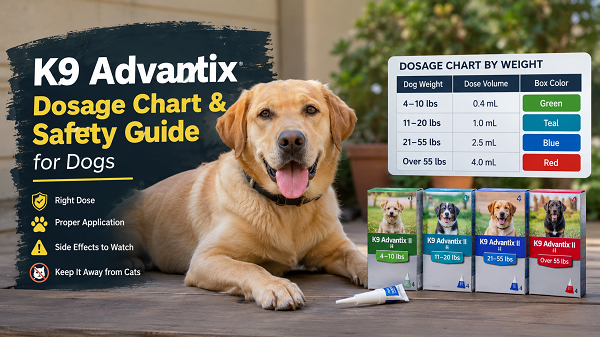
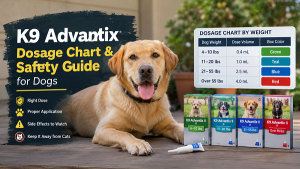
K9 Advantix II is dosed strictly by weight, not by breed or age past 7 weeks: 0.4 mL for dogs 4–10 lbs, 1.0 mL for 11–20 lbs, 2.5 mL for 21–55 lbs, and 4.0 mL for dogs over 55 lbs. Each pre-measured tube is applied to 2–3 spots along the back, from shoulder blades to tail base, once a month. Never split a tube between two dogs, never apply a larger dog’s dose to a smaller dog “to save money,” and never let it anywhere near a cat, permethrin (one of the three active ingredients) is fatal to cats even in tiny amounts.
Table of Contents
- Quick Answer
- What Is K9 Advantix II, Exactly?
- K9 Advantix II Dosage Chart by Weight
- How to Apply It Correctly (Step by Step)
- Puppies, Toy Breeds and Sensitive Dogs
- Normal Side Effects vs. Signs You Need a Vet
- The Cat Problem Nobody Explains Well Enough
- If Your Dog Is Overdosed or Reacting Badly
- K9 Advantix II vs. Frontline, NexGard and Seresto
- Retreatment Schedule, Storage and Missed Doses
- What It Actually Costs
- A Handler’s Take
- FAQs
- Final Word
Introduction
I’ve lost count of how many times a handler or a first-time dog owner has messaged me a photo of a K9 Advantix box asking, “wait, which one do I actually use?” It’s a fair question. The packaging looks almost identical across all four sizes, the tubes are the same shape, and the weight bands printed on the box are easy to misread if you’re standing in a pet store aisle with a squirming dog and three other errands to run.
Here’s the problem: this isn’t a “close enough” product. K9 Advantix II contains permethrin, a pyrethroid insecticide that’s genuinely effective against fleas, ticks and mosquitoes, but also genuinely capable of causing tremors, vomiting, and worse if the dose is wrong for the dog wearing it, or if it ends up on a cat in the house. Get the weight band right and it’s one of the more reliable, budget-friendly parasite preventatives on the market. Get it wrong and you’re looking at an emergency vet visit.
This guide walks through the exact dosage chart, correct application technique, the difference between a normal mild reaction and one that needs urgent care, and the cat-safety issue that trips up more households than you’d think. I’ll also flag where this product fits (and doesn’t) compared to other options like Frontline, NexGard and Seresto, so you can make an informed call for your own dog.
Quick note before we start: this article covers general product information and label guidance. It isn’t a substitute for advice from your own veterinarian, who knows your dog’s health history, current medications, and breed-specific sensitivities.
What Is K9 Advantix II, Exactly?
K9 Advantix II is a monthly topical (spot-on) parasite preventative made by Elanco, applied directly to a dog’s skin rather than given orally. It’s built around three active ingredients working together:
- Imidacloprid (8.8%) – kills fleas on contact
- Permethrin (44%) – repels and kills ticks, mosquitoes, and biting flies, and adds a knockdown effect against fleas
- Pyriproxyfen (0.44%) – an insect growth regulator that stops flea eggs and larvae from developing, breaking the reproduction cycle in the home
That three-ingredient combination is what separates it from single-ingredient products: it’s one of the few widely available topicals that also repels mosquitoes and biting flies, not just fleas and ticks. It’s labeled for dogs and puppies 7 weeks of age or older, and it protects against ticks that carry Lyme disease, anaplasmosis, Rocky Mountain spotted fever, tularemia, ehrlichiosis, bartonellosis, canine hemoplasmosis, and babesiosis, depending on the tick species in your area.
It starts working within hours of application, kills fleas within 12 hours, and continues protecting for about four weeks, and it becomes waterproof after the first 24 hours, so a bath or a rainy walk the next day won’t strip the protection.
K9 Advantix II Dosage Chart by Weight
This is the part where accuracy actually matters. The product comes in four fixed doses, color-coded on the box, and the tube is sealed opaque so you can’t “eyeball” a partial dose even if you wanted to.
| Dog’s Weight | Dose Volume | Box Color | Active Ingredients Delivered |
|---|---|---|---|
| 4–10 lbs (1.8–4.5 kg) | 0.4 mL | Green | Full label concentration for small dogs |
| 11–20 lbs (5–9 kg) | 1.0 mL | Teal | Full label concentration for medium dogs |
| 21–55 lbs (9.5–25 kg) | 2.5 mL | Blue | Full label concentration for large dogs |
| Over 55 lbs (25+ kg) | 4.0 mL | Red | Full label concentration for extra-large dogs |
A few things the box doesn’t spell out clearly enough:
- The dose isn’t a simple linear scale. Notice that 2.5 mL (large) isn’t half of 4.0 mL (extra-large), and 1.0 mL isn’t half of 2.5 mL. Elanco’s formulation accounts for surface area and metabolism differences between size classes, which is exactly why one buyer’s attempt to measure out a “half dose” from an extra-large tube for a smaller dog is specifically not recommended, the concentration curve doesn’t work that way.
- Weigh your dog before buying, don’t estimate. A dog that’s 19.5 lbs today might be 21 lbs after a growth spurt or a few extra treats over winter. Weigh at the vet or on a home scale within the last month, not from memory.
- Multi-dog households need separate, correctly sized tubes for each dog. Buying one extra-large box and rationing it across three dogs of different sizes is a real (and dangerous) habit some owners fall into to save money, several product Q&A threads document owners doing exactly this, and it’s not something manufacturers or vets endorse.
How to Apply It Correctly (Step by Step)
Getting the dose right on paper doesn’t help if the application technique is sloppy. Here’s the label-accurate method:
- Have your dog standing, not lying down, for easier, even application.
- Part the fur down to visible skin at 2–3 spots along the topline, starting between the shoulder blades and working back toward the base of the tail. Larger dogs need application spread across more spots (up to 4–6 for extra-large dogs) so the solution doesn’t pool in one place and run down the fur.
- Place the tube tip directly on the skin, not on top of the fur, and squeeze gently to release a portion of the dose at each spot.
- Use the entire tube. Don’t stop partway through even if it looks like “enough”, the full volume is calculated into the weight-band dosing.
- Avoid the eyes and mouth entirely. If any product does contact the eyes, rinse slowly and gently with water for 15–20 minutes and call your vet or a poison control line.
- Keep kids and other pets away from the application site until it dries, roughly 24 hours, and don’t let your dog groom itself or another housemate pet in that window.
- Dispose of the empty tube responsibly, it still carries pesticide residue, so it shouldn’t go in a bin pets or kids can access.
This sequence matches the manufacturer’s own EPA-registered label instructions for application, and it’s worth following exactly even if you’ve used the product for years, since skipping steps (like applying to a lying-down dog) is one of the more common reasons product runs off into fur instead of skin and underperforms.
Puppies, Toy Breeds and Sensitive Dogs
The label cutoff is 7 weeks of age, but age alone isn’t the only variable worth thinking about.
Growing puppies change weight bands fast. A 7-month-old pup on a growth curve toward 22 lbs might currently weigh 16 lbs, sitting right at the edge between the medium and large dose. In cases like this, vets generally advise dosing for the current weight, not the projected adult weight, and re-checking the weight band monthly during the growth phase rather than assuming last month’s box size still fits.
Small and toy breeds report reactions more often. This isn’t unique to K9 Advantix, it’s a pattern seen across permethrin-based topicals generally: dogs under roughly 10–15 lbs have less body mass to buffer a full dose, and breeds like Chihuahuas, Yorkies, and Maltese show up disproportionately often in adverse-reaction reports for pyrethroid products. If you own one of these breeds and you’re nervous about a first application, doing it in the morning (rather than at night) means you can monitor for a few hours and still reach your vet’s office the same day if anything looks off.
Senior dogs and dogs on other medications should be cleared with a vet first if they’re on anything metabolized through the liver, since permethrin is processed hepatically. The label itself notes no confirmed drug interactions, but “no confirmed interactions” and “cleared for your specific dog’s health profile” aren’t the same thing.
Normal Side Effects vs. Signs You Need a Vet
Most dogs tolerate K9 Advantix II without incident. But “most” isn’t “all,” and knowing where the line sits between a normal adjustment reaction and a genuine emergency saves a lot of 2 a.m. panic.
| Category | What You’ll See | What To Do |
|---|---|---|
| Mild & common | Temporary itching or scratching at the site, mild redness, slight drooling right after application | Monitor. These typically clear within 24–48 hours on their own |
| Moderate | Vomiting once or twice, mild lethargy, loose stool | Call your vet for guidance; usually manageable at home with monitoring |
| Severe / urgent | Repeated vomiting, tremors, incoordination or stumbling, excessive drooling that doesn’t stop, dilated pupils, disorientation | Contact your vet or an emergency animal hospital immediately |
| Critical | Seizures, inability to stand, extreme body temperature changes | This is an emergency. Go to an emergency vet now |
Rare side effects can include temporary dermal irritation, itching, tingling, or burning at the site, and these are generally considered part of the “mild” category above rather than a sign something has gone wrong.
If you suspect an actual overdose (wrong tube size applied, or your dog somehow licked or ingested product), the general first-aid step recommended by poison control resources is to offer a bite of something tasty like plain cooked chicken to clear the bitter taste from the mouth, then contact your vet. Don’t wait for symptoms to “prove” it’s serious before calling; permethrin toxicity can escalate over several hours.
The Cat Problem Nobody Explains Well Enough
This is the single most important safety note in this entire guide, and it’s the one most owners genuinely don’t know until it’s too late: K9 Advantix II must never be used on cats, and cats should be kept away from a freshly treated dog.
Permethrin, the tick- and mosquito-repelling ingredient that makes this product effective, is safe for dogs at labeled doses but can be fatal to cats, because cats lack the liver enzyme needed to metabolize pyrethroids efficiently. This isn’t a minor sensitivity, it’s one of the most common preventable poisoning calls veterinary toxicology hotlines receive every flea season, almost always from cat owners who either grabbed the wrong box off a shelf (dog and cat flea products often sit side by side) or didn’t realize a treated dog could pass product to a cat just through normal household contact.
Cats can pick up permethrin toxicity from grooming a treated dog, rubbing against one, or even from shared furniture, though direct contact and grooming are the higher-risk routes. If your household has both dogs and cats:
- Keep the treated dog separated from any cats for at least 24 hours after application, until the product is fully dry and absorbed.
- Store unused tubes somewhere a curious cat (or child) can’t access them.
- Double-check every box before opening it. Dog and cat versions of similar-sounding products are packaged close together at most retailers, and the difference in active ingredients between them can be life-or-death for a cat.
If a cat does show signs of permethrin exposure, drooling, tremors, twitching, agitation, or seizures, that’s an emergency requiring immediate veterinary care, often including a bath to remove residual product and supportive treatment.
If Your Dog Is Overdosed or Reacting Badly
Step by step, here’s what to actually do:
- Bathe the dog in lukewarm water with a mild dish soap that cuts grease (many vets specifically recommend original Dawn) to remove residual product from the coat and skin. Don’t scrub aggressively, that can worsen skin irritation.
- Call your vet or an emergency animal hospital and describe exactly what happened: which product, what dose relative to the dog’s weight, and how long ago it was applied or ingested.
- Have the product box or label in hand when you call. Poison control lines and vets will want the EPA registration number and active ingredient percentages, and Elanco’s own product support line for questions or reporting side effects is 1-888-545-5973.
- Don’t induce vomiting unless a vet or poison control specifically instructs you to. This applies whether the product was applied topically and licked, or accidentally ingested from an open tube.
- Monitor closely for the next 24–48 hours even after symptoms seem to settle, since some neurological signs can be delayed or come in waves.
K9 Advantix II vs. Frontline, NexGard and Seresto
A lot of “which flea and tick product is best” articles skip this comparison entirely or oversimplify it. Here’s an honest breakdown:
| Product | Type | Kills Fleas | Kills/Repels Ticks | Repels Mosquitoes | Cat-Safe Household? | Frequency |
|---|---|---|---|---|---|---|
| K9 Advantix II | Topical | Yes | Yes (repels + kills) | Yes | No, permethrin is toxic to cats | Monthly |
| Frontline Plus | Topical | Yes | Yes (kills, less repellency) | No | Yes, safe formulation for cats too | Monthly |
| NexGard | Oral chew | Yes | Yes (kills only) | No | Yes, no topical residue risk to cats | Monthly |
| Seresto | Collar | Yes | Yes (kills + repels) | No | No, same caution around cats applies to some Seresto formulations | 8 months |
The trade-off in plain terms: K9 Advantix II earns its keep in mosquito- and biting-fly-heavy regions, since it’s one of the few options that actually repels those pests rather than just killing fleas and ticks. But that repellency comes from permethrin, which is exactly the ingredient that makes it a hard no for multi-pet homes with cats. If you have cats in the house, an oral option like NexGard or a cat-safe topical like Frontline removes that risk entirely, even if it means giving up the mosquito protection.
Retreatment Schedule, Storage and Missed Doses
- Standard schedule: one full dose every 4 weeks (30 days), applied on roughly the same date each month.
- Severe infestations: the label does allow earlier retreatment during a heavy active flea outbreak, but not more often than once every 7 days, returning to the normal monthly schedule once the infestation is under control.
- Missed a dose? Apply as soon as you remember and resume the monthly cycle from that new date, don’t double up to “catch up.”
- Storage: keep tubes at room temperature, out of direct sunlight, and away from pets and children until use. Once opened, use the full tube immediately, it isn’t designed to be resealed or split across sessions.
What It Actually Costs
Pricing varies by retailer, region, and pack size (2, 4, or 6-month supplies), but as a general market range, expect roughly $10–$15 per monthly dose for small dogs and $15–$25 per dose for extra-large dogs when bought in multi-packs, with per-dose cost dropping noticeably on 6-month boxes compared to single 2-dose packs. Buying a full 6-month supply upfront is usually the better value if your dog’s weight is stable and you’re confident in the correct size.
If you’re building out a broader home health-and-training reference for your dog, my e-book, Beyond the Bark, covers preventative care routines like this alongside training fundamentals, worth a look if you want one resource instead of piecing information together from a dozen tabs.
A Handler’s Take
In 14+ years working with military and civilian K9s, tick-borne disease has been one of the more consistently underestimated threats to working dogs, more so than most handlers expect going into the job. Dogs that spend real time in brush, treelines, or tall grass, whether that’s a patrol K9 or a family dog on weekend hikes, pick up ticks at a rate that surprises most owners the first time they actually run a hands-on tick check after a walk. A reliable monthly preventative isn’t optional gear for a working dog, it’s baseline equipment, on the same level as a properly fitted collar or a K9 harness built for actual use, not just looks.
That said, the dosage discipline matters as much as the product choice. I’ve seen more reactions caused by a mismatched weight band or a rushed application than by the product itself failing to work. Weigh the dog, match the band, apply it properly, and it does its job quietly in the background.
If you’re also working through a puppy’s early health milestones, it’s worth reading alongside our guide on core puppy vaccines and scheduling, since parasite prevention and vaccination protocols are usually built out on the same timeline by most vets. And if your dog has ever shown sudden vomiting or lethargy that worried you, whether or not it was linked to a flea treatment, our piece on urgent puppy symptoms that need immediate attention is a useful gut-check on when “wait and see” isn’t the right call. We’ve also covered safe dosage rules for household items dogs get into, same underlying principle: weight-based dosing isn’t a suggestion, it’s the whole safety system.
FAQs
1. Can I cut a K9 Advantix II tube in half for two smaller dogs?
No. The dosing isn’t linear across weight bands, and splitting a tube risks under-dosing one dog (leaving it unprotected) or over-dosing the other. Always buy the correctly sized tube for each dog’s actual current weight.
2. How long after applying K9 Advantix II can my dog get wet or be bathed?
The product becomes waterproof after 24 hours. Try to avoid bathing or swimming in the first day after application so the full dose has time to absorb.
3. Is K9 Advantix II safe for pregnant or nursing dogs?
This isn’t specifically addressed as “safe” on the standard label the way age and weight bands are, so pregnant or nursing dogs should only be treated on your vet’s specific recommendation, given the added variable of puppies or a developing litter.
4. My dog ate a tiny bit off another dog’s fur. Is that dangerous?
Ingestion of small amounts is generally considered unlikely to cause serious poisoning, but it can still happen in rare cases, and neurological signs like tremors can occur. Rinse the mouth with cool water and monitor closely; call your vet if you see drooling, vomiting, or any behavior changes.
5. What’s the difference between K9 Advantix and K9 Advantix II?
K9 Advantix II is the current, reformulated version and is what’s sold under the K9 Advantix name today. Older “K9 Advantix” (without the II) product from years back had a slightly different formulation; if you find old stock, check the manufacture date and active ingredient percentages against the current label before using it.
Final Word
The dosage chart for K9 Advantix II isn’t complicated once it’s laid out clearly: weigh your dog accurately, match that weight to the correct box color and volume, apply it to skin (not fur) at 2–3 spots along the back, and never let it near a cat in the house. The product itself has a strong track record for flea, tick, and mosquito control when used exactly as labeled, most of the genuine safety incidents trace back to a mismatched dose or a cat’s exposure, not the product failing on its own terms.
If you’re ever unsure which weight band fits your dog, or your dog is showing anything beyond mild, short-lived irritation after application, your vet is the right call over guessing. And if parasite prevention is one piece of a bigger puzzle you’re building out for your dog’s care routine, subscribe to our weekly newsletter for more practical, no-fluff guides like this one straight to your inbox.
This article is for general informational purposes and reflects publicly available product labeling and veterinary guidance current as of 2026. It is not a substitute for direct veterinary advice for your individual dog.

Her work centres on obedience, detection, protection and operational readiness. She favours proven methods built on repetition, consistency and real-world conditioning, so that both dogs and handlers are prepared for high-pressure tasks.
Rofiat represented the Nigerian Army Dog Centre at the Nigerian Army Day Celebration (NADCEL) 2026, where she led demonstrations in obedience, explosive detection, agility and tactical movement. Through articles, training content and documentaries, she shares field-based insight into how structured training, clear communication and trust between handler and dog affect performance and reliability.
She is the author of Beyond the Bark: Inside a Pro Handler's Playbook for Raising the Ideal Dog, a practical guide that helps dog owners and handlers apply professional training principles in everyday situations.
- K9 Advantix Dosage Chart & Safety Guide for Dogs - October 19, 2026
- How to Set Up & Use Bousnic Dog Training Collar - October 18, 2026
- Westminster Dog Show 2026: Winners & Full Results - October 17, 2026