10 K9-Approved Tricks to Teach Your Dog (Step-by-Step)
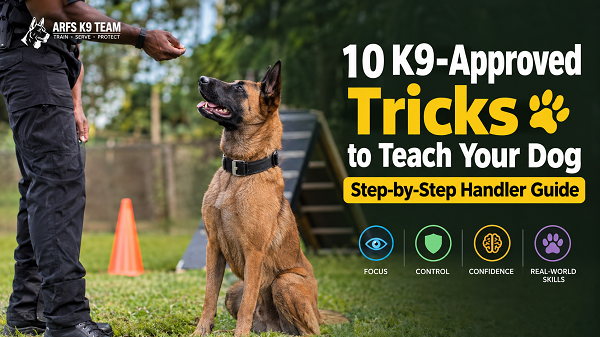
The best tricks to teach your dog are the ones that build focus, control and confidence, not just party moves. Working-dog handlers start with Watch Me, Touch, Shake, Spin, Back Up, Leave It, Place, Find It, Speak/Quiet and Roll Over. Teach each one in 5 to 10 minute sessions, using a marker word and small treats. Most dogs learn the basic version in 2 to 14 days. Reliable performance around distractions takes a few weeks.
Table of Contents
- Why “K9-Approved” Tricks Are Different
- 5 Ground Rules Before You Start
- The 10 Tricks
- Trick 1: Watch Me
- Trick 2: Touch
- Trick 3: Shake
- Trick 4: Spin
- Trick 5: Back Up
- Trick 6: Leave It
- Trick 7: Place
- Trick 8: Find It
- Trick 9: Speak and Quiet
- Trick 10: Roll Over
- Quick Comparison: Difficulty and Timeline
- A 4-Week Learning Plan
- Which Tricks Need Extra Care
- Troubleshooting: When Your Dog Won’t Get It
- From Tricks to Titles and Working Skills
- Why Trust This Guide (Trainer Note)
- FAQs
- Final Thoughts
Introduction
Ever watch a police K9 handler work a busy train station and wonder how the dog stays glued to them? It isn’t magic. It’s a stack of small skills, taught one at a time, and many of them look a lot like the tricks pet owners teach for fun.
Most lists of tricks to teach your dog stop at roll over and play dead. Cute, sure. But they skip the part that matters: why a trick is worth teaching and how to make it stick. Owners end up with a dog that rolls over in the living room and ignores them at the park.
This guide fixes that. You’ll get 10 K9-approved dog tricks, the same skills handlers use as building blocks for real work. You’ll get step-by-step teaching methods, honest timelines, safety warnings and troubleshooting. Whether you own a Labrador or a Belgian Malinois, you can follow along.
Why “K9-Approved” Tricks Are Different
A pet trick is about the audience. A K9-approved trick is about the skill hiding inside it.
Take Touch, where your dog bumps your palm with their nose. At a party it’s adorable. In the field, it’s a way to move a dog past a distraction, call them back, or get them into position for a vet check. Same trick, different purpose.
Handlers teach tricks that build one of five things:
- Focus (Watch Me)
- Impulse control (Leave It, Place)
- Body awareness (Spin, Back Up)
- Calm handling (Shake, Roll Over)
- Scent skills and confidence (Find It)
The training method matters too. CIA K-9 trainers say the goal is to make your dog want to do the behavior. They use food, toys, play and an upbeat voice, and they don’t force it. Their lead trainer says dogs learn more when they choose the behavior themselves. That’s the philosophy behind every trick below. If you’re curious how the pros build on it, our guide on how military working dogs are trained shows the full pipeline.
5 Ground Rules Before You Start
Get these right and every trick gets easier. Get them wrong and you’ll fight your dog on all ten.
1. Pick a Marker and Use It the Same Way Every Time
A marker is a sound that says “yes, that exact thing earned a reward.” Use a clicker or a short word like “Yes!” Say it the instant your dog does the right thing, then deliver the treat. Aim to mark within a second or two. Late marking is the number one reason tricks fall apart.
2. Use Small, Soft Treats
Pea-sized pieces work best. Big treats slow you down and fill your dog up. Most working dogs also love a toy or a game of tug as a reward, so try both and see which lights your dog up.
3. Keep Sessions Short
Short sessions beat long ones. One trainer recommends 5 to 10 minutes, a few times a day, ending while your dog is still happy. I’d add this: if your dog starts yawning, sniffing the floor, or wandering off, you already went too long.
4. Change Locations Once the Trick Works
Practicing only at home won’t help your dog listen elsewhere, so move to the backyard, the park and walks. Handlers call this “proofing.” A trick isn’t finished until it works in a new place.
5. Watch Your Energy
Dogs read you like a book. CIA trainers put it this way: “What you’re feeling runs straight down the leash to the dog.” Had a rough day? Skip the session. A grumpy handler teaches slower than no handler.
The 10 K9-Approved Tricks to Teach Your Dog
Each trick below includes the steps, a realistic timeline, the mistake I see most, and a pro tip. Teach them in this order. Each one builds on the last.
Trick 1: Watch Me (Eye Contact)
Why handlers love it: Every other skill starts with your dog looking at you. It’s the on-switch for the whole team.
How to teach it:
- Hold a treat in your closed hand, arm down at your side.
- Wait. Don’t speak. Your dog will sniff, lick and stare at the hand.
- The moment your dog glances at your face, mark and reward.
- Repeat until your dog looks at your face right away.
- Add the cue “Watch” as the eye contact happens. Then build from one second to three, then five.
Timeline: 2 to 5 days for a one-second stare. Two to three weeks to hold it around real distractions.
Common mistake: Holding the treat up by your face. That teaches your dog to follow the food, not look at you.
Pro tip: Say the cue once. Repeating it teaches your dog that the first “watch” doesn’t count.
Trick 2: Touch (Nose Target)
Why handlers love it: It’s an easy way to move a dog, get their attention, or bring them close. It also doubles as a backup recall.
How to teach it:
- Hold your flat palm about 5 to 8 cm (2 to 3 inches) from your dog’s nose.
- Most dogs sniff it out of curiosity. Mark the instant the nose touches.
- Reward from your other hand.
- Add the cue “Touch.” Then move your hand higher, lower and farther away.
Timeline: 1 to 3 days. It’s one of the fastest tricks on this list.
Common mistake: Pushing your hand into your dog’s face. Let the dog move to the hand.
Pro tip: Once your dog knows Touch, use it to sail past a distraction on a walk. “Touch, touch, good!” beats tugging the leash.
Trick 3: Shake (Paw)
Why handlers love it: It teaches a dog to hand over a paw without a fuss. Working dogs need pad checks after long days on rough ground. A dog that offers the paw makes that job easy.
How to teach it:
- Ask for a sit.
- Hold a treat in your closed fist at chest height. Your dog will paw at it.
- Mark the moment a paw lifts. Open your hand and reward.
- Wait for the paw to land in your open palm before you mark.
- Add the cue “Shake.”
Once your dog gets it, you can fade the treat from your hand and use an empty, open hand instead.
Timeline: 2 to 4 days.
Common mistake: Grabbing the paw yourself. Some dogs hate it. Let the dog place the paw.
Pro tip: Teach both paws. Use “Shake” for the right and “Other” for the left.
Trick 4: Spin (Twirl)
Why handlers love it: It builds coordination and body awareness. Pets Best notes that spinning helps a dog’s coordination and body awareness. It’s also a handy energy burner before a training session.
How to teach it:
- Hold a treat at your dog’s nose and draw a small circle at hip height.
- Your dog follows the treat. Mark and reward when the dog finishes the turn.
- Make the circle bigger each round until you get a full spin.
- Fade the lure into an empty hand motion. Add the cue “Spin.”
- Teach the other direction with a different word, like “Twist.”
Timeline: 2 to 5 days.
Common mistake: Luring too fast. Dogs skip the turn and lose interest.
Pro tip: Do this on a non-slip surface. Slippery floors make dogs hesitate or hurt their joints.
Trick 5: Back Up
Why handlers love it: It teaches your dog where their back legs are. That skill helps in agility, in narrow spaces, and in getting a dog out of your doorway. If you want to build on it later, try our easy dog agility exercises.
How to teach it:
- Stand in a hallway, facing your dog. The walls stop your dog from turning around.
- Take a small, calm step toward your dog’s chest.
- The moment your dog steps back, mark and reward.
- Build up to two, then four, then six steps.
- Add the cue “Back” once your dog moves without you stepping in.
Timeline: 5 to 10 days. It feels odd to dogs, so be patient.
Common mistake: Rushing toward the dog. That looks like pressure. Small, slow steps work.
Pro tip: Put a plank or a low board behind your dog’s front feet. It helps them learn to move back without stumbling.
Trick 6: Leave It
Why handlers love it: This one can save your dog’s life. Dropped medication, chicken bones, a dead animal on a walk: a good Leave It stops all of it. It also protects your dog around food on the ground during work. Our list of essential protection dog commands covers where Leave It fits in a control routine.
How to teach it:
- Put a treat in your closed fist. Let your dog sniff and nudge.
- Wait until your dog backs off, even for half a second.
- Mark, then reward from your other hand.
- Once your dog ignores the closed fist, use an open palm.
- Next, put a treat on the floor and cover it with your foot.
- Then uncover it. Then drop it from a height.
- Add the cue “Leave it” only when your dog reliably backs off.
Timeline: 1 to 3 days for the closed-fist game. Two to three weeks to work on the floor and around real distractions.
Common mistake: Giving your dog the treat they were told to leave. The reward always comes from somewhere else. If the dog gets the tempting item, you just taught them to ignore the command.
Pro tip: Practice with low-value items first. Save the chicken for week three.
Trick 7: Place (Go to Your Mat)
Why handlers love it: Every K9 needs an off switch. Place teaches your dog to settle on a spot while you work, greet guests or load gear.
How to teach it:
- Put a mat or bed on the floor.
- Reward any step toward it. Then a paw on it. Then all four paws.
- Once your dog stands on the mat, ask for a sit or down.
- Add the cue “Place” as your dog steps on.
- Build duration first (seconds, then minutes). Add distance next. Add distractions last.
Timeline: 1 to 2 weeks to learn it. Several more weeks to hold a long stay.
Common mistake: Increasing distance, duration and distraction all at once. Change one at a time.
Pro tip: Use the same mat everywhere: home, car, vet, friend’s house. The mat becomes the dog’s “calm zone.”
Trick 8: Find It (Scent Game)
Why handlers love it: This is where pet tricks meet real detection work. A dog’s nose holds roughly 300 million scent receptors, compared with about 6 million in a person. Find It lets your dog use it.
The CIA’s K-9 program uses the same idea. Its trainers show dogs learning to search boxes for explosive scents through play. Your living room version is smaller, but the principle is the same: searching pays off.
How to teach it:
- Show your dog a treat, then toss it a step away. Say “Find it!”
- Repeat until your dog dashes toward the spot on the cue.
- Next, drop the treat under a towel. Your dog has to nose around to get it.
- Then hide treats in different rooms. Start with easy spots.
- Let your dog work it out. Don’t point.
Timeline: 3 to 7 days for the basic game. Weeks to months for harder searches.
Common mistake: Making it too hard too soon. A dog that fails three times in a row starts to quit.
Pro tip: In my experience, ten minutes of scent work tires a dog more than a thirty-minute walk. It’s perfect for rainy days.
Trick 9: Speak and Quiet
Why handlers love it: Guard and alert dogs need a bark they can turn on and off. A pet owner needs the “off” more. Teaching both gives you control over barking instead of a battle with it.
How to teach Speak:
- Find what makes your dog bark: a squeaky toy held out of reach, or a knock at the door.
- The moment your dog barks, mark and reward.
- Add the cue “Speak” as the bark happens.
- Once your dog knows the cue, drop the trigger.
How to teach Quiet:
- Ask for “Speak,” then let your dog bark two or three times.
- Hold a treat near the nose. Most dogs stop barking to sniff.
- Mark the silence and reward.
- Add the cue “Quiet” and slowly extend the silence.
DogTime suggests adding the hush cue only after your dog has mastered speaking. I agree. Teach Speak first, then Quiet.
Timeline: 1 to 2 weeks for both.
Common mistake: Rewarding barking that happens by itself. Only reward barking on the cue.
Pro tip: Practice Quiet more than Speak. You’ll use it more.
Trick 10: Roll Over
Why handlers love it: A dog that rolls onto their back trusts you. That trust matters at the vet, during grooming, and when you need to check for ticks, wounds or hot spots.
How to teach it:
- Start with your dog in a down.
- Lure the nose toward the shoulder blade so your dog tips onto one hip.
- Mark and reward that side-lying position. Pets Best calls this step the “flop,” a good half-step toward a full roll.
- Lure a bit farther each round until the dog rolls onto the back, then all the way over.
- Add the cue “Roll over” as the roll happens.
Timeline: 1 to 3 weeks. It’s the hardest trick on this list.
Common mistake: Skipping the side-lying step. Break it into small pieces, or your dog will feel wobbly and quit.
Pro tip: Use a carpet or a yoga mat. Rolling on hard floors is hard on a dog’s spine.
Quick Comparison: Difficulty and Timeline
| Trick | Difficulty | Typical timeline | Real-world K9 use |
|---|---|---|---|
| Watch Me | Easy | 2–5 days | Focus, handler connection |
| Touch | Easy | 1–3 days | Recall backup, movement control |
| Shake | Easy | 2–4 days | Paw and pad checks |
| Spin | Easy | 2–5 days | Body awareness, warm-up |
| Back Up | Medium | 5–10 days | Positioning, agility, space control |
| Leave It | Medium | 1–3 weeks | Safety, impulse control |
| Place | Medium | 1–2 weeks | Settling, duration, calm |
| Find It | Easy to Medium | 3–7 days | Scent work, mental exercise |
| Speak / Quiet | Medium | 1–2 weeks | Alert bark, barking control |
| Roll Over | Hard | 1–3 weeks | Trust, health checks |
These are rules of thumb from handler experience, not guarantees. Every dog learns at their own pace.
A 4-Week Learning Plan
Ten tricks in one weekend is too much. Here’s a pace that works.
- Week 1: Watch Me, Touch, Shake. These are easy wins that build confidence.
- Week 2: Spin and Back Up. Now you’re building body awareness.
- Week 3: Leave It and Place. Start the slower, impulse-control skills.
- Week 4: Find It, Speak/Quiet and Roll Over. Finish with the fun and the tricky.
Keep practicing the old tricks as you add new ones. Two or three short sessions a day beats one long one.
Which Tricks Need Extra Care
Not every trick suits every dog. Here’s where to slow down.
- Deep-chested breeds (Great Danes, German Shepherds, Weimaraners, Standard Poodles): These breeds face a higher risk of bloat, also called GDV, a life-threatening stomach twist. Skip spinning and rolling right after meals. A common rule is to wait at least an hour or two after eating. Ask your vet for advice on your dog.
- Puppies under 6 months: Keep sessions very short and avoid repeated jumping or twisting. Their joints are still growing.
- Senior dogs and dogs with joint problems: Skip Roll Over and any trick that needs sudden twisting. Focus on Watch Me, Touch and Find It.
- Dogs with hip or spine problems: Check with your vet before teaching Back Up or Roll Over.
- Hard floors: Use a mat for every trick that involves spinning or lying down.
None of this replaces your vet. If your dog yelps, limps or refuses a trick they normally love, stop and get them checked.
Troubleshooting: When Your Dog Won’t Get It
Every handler hits a wall. These fixes work most of the time.
- Your dog ignores you: You’re probably in a place that’s too exciting. Go back to a quiet room.
- Your dog gets it once, then forgets: That’s normal. Practice the trick in five short sessions before you call it learned.
- Your dog seems frustrated: Make it easier. Drop back to a step they already know, reward it, and end on a win.
- Your dog only does it for treats: Start mixing in praise and play. Reward every second or third success with a toy or a game.
- Your dog does it at home but not outside: Add distractions one at a time. Try the trick in the driveway, then the street, then the park.
Dogs also show you when the lightbulb goes on. CIA trainers point out that each dog has a signature sign that shows they’ve started to understand, like a head tilt. Learn your dog’s version and you’ll know when to move to the next step.
From Tricks to Titles and Working Skills
Tricks aren’t only for fun. They open real doors.
AKC Trick Dog titles. The AKC offers five Trick Dog titles, earned in order, and dogs must be at least four months old to earn them. A dog with a Canine Good Citizen title needs only five tricks for Novice instead of ten. At the Intermediate level, you fade the lures you could use at Novice. Several tricks in this guide, like Place, Spin and Leave It-style impulse control, fit right into those checklists.
Working-dog foundations. Watch Me, Touch, Place and Leave It show up in every serious obedience and detection program. Find It turns into scent work. Speak/Quiet turns into controlled alert barking. Master these ten and you’ve built the same base handlers use before advanced work.
If you want a deeper look at the handler mindset behind this approach, grab our e-book, Beyond the Bark.
Why Trust This Guide (Trainer Note)
I’m not going to hide behind “experts say.” Here’s where this advice comes from.
- Hands-on experience. ARFS K9 Team handlers have worked Military Working Dogs in public obedience, agility, tactical movement and explosive detection demonstrations at the Nigerian Army Day Celebration (NADCEL) 2026. We’re based in Lagos, but these methods work anywhere.
- Method backed by respected programs. The reward-based, dog-chooses approach here matches the principles the CIA’s K-9 trainers describe. The trick framework lines up with the AKC Trick Dog program.
- Honest limits. Timelines here are ranges, not promises. We flag safety risks and tell you when to call a vet or a professional trainer.
- Written for real dogs. Every step comes from what works on living-room floors, not just in textbooks.
FAQs
What are the easiest tricks to teach a dog first?
The easiest tricks to teach your dog first are Watch Me, Touch and Shake. Most dogs learn the basic version within 1 to 5 days, and each one builds skills you’ll use in harder tricks like Leave It and Place.
How long does it take to teach a dog a new trick?
Simple tricks like Touch or Shake take 1 to 5 days of short daily sessions. Harder ones like Leave It, Place or Roll Over take 1 to 3 weeks. Making the trick reliable around distractions can take longer, so keep practicing in new places.
What age can I start teaching my dog tricks?
You can start as soon as your puppy settles in, around 8 weeks, with very short, playful sessions. The AKC says you can work on trick foundations at any age, though dogs must be four months old to earn official Trick Dog titles.
Do I need a clicker to teach tricks?
No. A clicker gives a crisp, consistent sound, but a short word like “Yes!” works just as well. What matters is that you use the same marker every time and reward right after it.
Can you teach an old dog new tricks?
Yes. Older dogs learn just fine. Adjust for stiff joints by skipping high-impact tricks like Roll Over, and lean on mental games like Find It, Watch Me and Touch. Check with your vet first if your dog has any health issues.
Final Thoughts: Start Small, Stay Consistent
Here’s what to take away. The best tricks to teach your dog aren’t the flashiest. They’re the ones that build focus, self-control and trust: Watch Me, Touch, Shake, Spin, Back Up, Leave It, Place, Find It, Speak/Quiet and Roll Over.
Here’s your action plan:
- Choose a marker and small treats today.
- Start with Watch Me and Touch this week.
- Keep sessions to 5 to 10 minutes, a few times a day.
- Move to a new location once your dog gets it at home.
- Stop if your dog seems sore, and call your vet.
Want more handler-tested training advice delivered weekly? Subscribe to our weekly articles roundup newsletter and get practical K9 tips in your inbox.

Her work centres on obedience, detection, protection and operational readiness. She favours proven methods built on repetition, consistency and real-world conditioning, so that both dogs and handlers are prepared for high-pressure tasks.
Rofiat represented the Nigerian Army Dog Centre at the Nigerian Army Day Celebration (NADCEL) 2026, where she led demonstrations in obedience, explosive detection, agility and tactical movement. Through articles, training content and documentaries, she shares field-based insight into how structured training, clear communication and trust between handler and dog affect performance and reliability.
She is the author of Beyond the Bark: Inside a Pro Handler's Playbook for Raising the Ideal Dog, a practical guide that helps dog owners and handlers apply professional training principles in everyday situations.
- K9 Advantix Dosage Chart & Safety Guide for Dogs - October 19, 2026
- How to Set Up & Use Bousnic Dog Training Collar - October 18, 2026
- Westminster Dog Show 2026: Winners & Full Results - October 17, 2026