5 Easy Dog Agility Exercises to Start Today
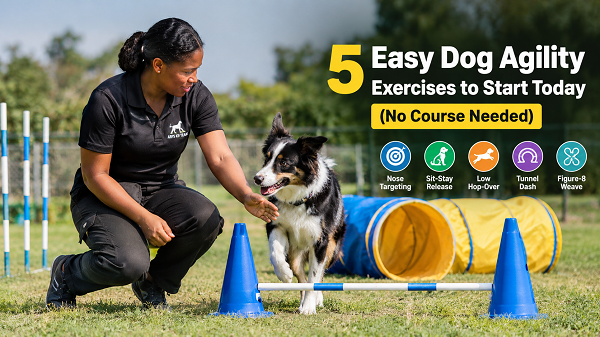
You don’t need a backyard course or a training center membership to start dog agility. The five easiest exercises to begin with today are nose targeting, the sit-stay release game, the low hop-over, the tunnel dash, and the figure-8 weave. Each one builds a real agility skill (focus, impulse control, jumping form, obstacle confidence, and body awareness) in 5-10 minutes a day, using items you already own. Most dogs show visible progress within a week of daily short sessions.
Table of Contents
- Why These 5 Exercises (Not the Obstacles You’d Expect)
- Safety First: What to Check Before You Start
- Exercise 1: Nose Targeting
- Exercise 2: The Sit-Stay Release Game
- Exercise 3: The Low Hop-Over
- Exercise 4: The Tunnel Dash
- Exercise 5: The Figure-8 Weave
- Your First-Week Training Schedule
- Mistakes That Slow Down Beginners
- When You’re Ready for More
- FAQs
- Conclusion
Introduction
Here’s a problem I see constantly with new agility owners: they buy a full obstacle set, a tunnel, some jumps, a set of weave poles, dump it all in the backyard on day one, and wonder why their dog just… wanders off and sniffs the grass instead.
The gear was never the problem. The sequence was.
Agility is a handling sport before it’s an obstacle sport. Your dog has to trust your body language, hold a stay, take a cue, and keep working when there’s something new and exciting in front of them, long before any of that translates into a clean run through a tunnel or over a jump. Skip that groundwork and you get a dog who “knows” the obstacles but falls apart the second you add speed, distance, or distraction.
So instead of another list of “how to teach the tunnel, the A-frame, the weave poles” (you can find that everywhere, including our own DIY Dog Agility Equipment guide if you want to build that gear later), this article gives you five foundational exercises most beginner guides skip entirely. Two of them use zero equipment. All five are safe for puppies with a bit of adjustment, and all five directly transfer into faster, more confident obstacle work down the line.
By the end, you’ll know exactly what to do today, how many reps, how to tell if your dog is ready to progress, and what to avoid so you don’t set your training back by weeks.
Why These 5 Exercises (Not the Obstacles You’d Expect)
Dog agility has exploded as a sport. The American Kennel Club’s agility program logged nearly 1.2 million entries and over 4,400 trials in a single recent year, and that’s just the competitive side. The at-home, just-for-fun side of the sport is even bigger. But almost every popular beginner article jumps straight into “build a tunnel, buy some poles, set up a jump,” which skips the two things that actually determine how fast your dog progresses:
- Focus and handler connection – can your dog read your body and stay engaged with you around new objects?
- Impulse control – can your dog hold a position while excited, then release cleanly on your cue?
The five exercises below cover both of those, plus the three obstacle skills (jumping, tunnel confidence, and weaving/body control) that show up in almost every course design. Think of it as building the engine before you worry about the racetrack.
Safety First: What to Check Before You Start
Before your dog does a single hop over anything, run through this checklist. It takes two minutes and prevents the injuries that sideline agility dogs for months.
- Age and growth plates. A puppy’s growth plates (the soft cartilage at the ends of the long bones) stay open until roughly 10-12 months in small breeds and up to 18-24 months in large and giant breeds. Repeated jumping or hard landings before that window closes can cause lasting joint damage. Puppies can absolutely start the targeting, sit-stay, and low tunnel-crawl work below; save real jumping and tight weaving until your vet confirms growth plates have closed.
- A vet clearance if your dog is older, overweight, or has a known joint issue. Agility is a full-body sport. Hip or elbow dysplasia, arthritis, and obesity all raise injury risk.
- A soft, non-slip surface. Grass, dirt, or a rubber mat. Avoid hardwood, tile, or concrete for anything involving jumping or sharp turns; a study on injury risk in agility dogs found that surface and turning strain are recurring contributors to soft-tissue injuries.
- A 2-3 minute warm-up. A loose-lead walk or gentle trot to get blood flowing before any jumping drill.
- Short sessions. 5-10 minutes, once or twice a day, beats one long 30-minute session. Dogs (and handlers) lose precision when they get tired, and tired dogs land jumps badly.
Exercise 1: Nose Targeting
What it builds: focus, willingness to move toward a target on cue, the foundation for sending your dog ahead of you to an obstacle later.
What you need: treats and your hand (or a wooden spoon/target stick).
How to teach it:
- Hold your open palm a few inches from your dog’s nose.
- The instant they sniff or touch it, mark with “yes” and reward.
- Repeat 8-10 times, then start moving your hand slightly left, right, and up before they touch it, so they learn to follow the target.
- Once they’re reliably following your hand, add the cue word “touch.”
- Start presenting your hand near (not on) low objects, a step stool, a rolled towel, so your dog gets used to targeting near obstacles.
Reps and timeline: 10-15 touches per session, 1-2 sessions a day. Most dogs “get it” within the first session and are targeting confidently within 3-4 days.
Common mistake: rewarding a nose-bump that’s inches away from your hand. Only reward actual contact, or the behavior gets sloppy fast.
Exercise 2: The Sit-Stay Release Game
What it builds: impulse control at the start line, one of the biggest gaps in self-taught agility dogs. In real courses, a dog that can’t hold a stay while you get into position false-starts constantly.
How to teach it:
- Ask for a sit. Take one step back.
- If your dog holds the sit, step back in and reward.
- If they break the stay, calmly reset without a reward, no scolding, just no reward.
- Gradually increase distance (2 steps, 5 steps) and add a release word like “go” or “break” that means “now you can move.”
- Once your dog holds a 5-second stay at 6-8 feet, add mild distraction: bounce a toy, wave a treat, take a jog past them.
Reps and timeline: 5-8 reps per session. Expect a solid 5-second stay within a week for most adult dogs; puppies may take two to three weeks since impulse control matures with age.
This is also where working on general obedience pays off directly. If your dog’s sit-stay is still shaky, it’s worth a short detour to our 5 Dog Obedience Training Commands That Work guide before pushing agility-specific impulse control, since agility performance sits on top of basic obedience, not instead of it.
Exercise 3: The Low Hop-Over
What it builds: jumping form and confidence, without the joint stress of a full-height jump.
What you need: a broomstick, pool noodle, or low bar laid across two low supports (or just laid flat on the ground for very young or very cautious dogs).
How to teach it:
- Start with the bar flat on the ground, or raised only 2-4 inches for adult, structurally mature dogs.
- Lure your dog over it with a treat or toy, rewarding the moment all four paws clear it.
- Once they’re moving over it confidently, add your target hand from Exercise 1 on the far side.
- Add the cue “over” or “jump” as they clear it.
- Only raise the height once your dog is confidently, calmly clearing the current height, several inches at a time, never more.
Age and height guidance: For puppies under 10-12 months, keep the bar on the ground; you’re teaching the concept of “go over,” not building jump height. For adult dogs, competition jump heights are set relative to shoulder height, but for home practice, staying well below your dog’s shoulder is plenty until they’ve built real jumping technique.
Common mistake: raising the bar too fast to “test” the dog. Growth plate injuries and soft-tissue strains both happen most often when height increases outpace the dog’s conditioning.
Exercise 4: The Tunnel Dash
What it builds: confidence moving through an enclosed space at speed, one of the more common early fears in agility dogs.
What you need: a play tunnel, or a blanket draped over two chairs to fake one.
How to teach it:
- Prop the tunnel open so your dog can see straight through it.
- Have a helper (or set a treat trail) at the far end.
- Let your dog explore it at their own pace first, no pressure, no luring through if they’re hesitant.
- Once they’ll walk through calmly, reward the instant they exit.
- Gradually add distance, calling them through from farther away, then add the cue “tunnel” as they enter.
Reps and timeline: 3-6 run-throughs per session. Confident dogs often nail this in one session; nervous dogs may need several days of just “exploring” the tunnel with no pressure to run through.
Common mistake: forcing a hesitant dog through by pulling the leash or pushing from behind. That builds a negative association fast. Let confidence come from the dog choosing to go in.
Exercise 5: The Figure-8 Weave
What it builds: body awareness, tight turning, and hind-end control, the exact skills that make weave poles (one of the hardest obstacles for most dogs to master) click faster later.
What you need: nothing. Just your legs and a treat.
How to teach it:
- With your dog on one side, lure them with a treat through your legs into a figure-8 pattern as you take a couple of steps.
- Reward generously the first several times they complete a full figure-8.
- Once they’re following the lure smoothly, fade the treat and use a hand signal only.
- Add the cue “weave” once the pattern is consistent.
- As a variation, set two cones about 3 feet apart and have your dog weave between them and back, which more directly mimics the entry angle of real weave poles.
Reps and timeline: 5-10 figure-8s per session. Most dogs pick up the pattern within a week; the tight-turn coordination keeps improving for weeks after that.
Your First-Week Training Schedule
| Day | Focus | Time |
|---|---|---|
| 1-2 | Nose targeting only | 5-10 min, 2x/day |
| 3-4 | Add sit-stay release game | 10 min, 2x/day |
| 5 | Add low hop-over (ground level) | 10 min, 1-2x/day |
| 6 | Add tunnel dash | 10-15 min, 1x/day |
| 7 | Add figure-8 weave; run all 5 in one short session | 10-15 min |
Keep every session upbeat and end on a win, even a small one. If your dog is struggling with something, go back to the previous, easier step rather than pushing through frustration on either end of the leash.
Mistakes That Slow Down Beginners
- Skipping the foundation and going straight to obstacles. This is the single biggest reason home-trained agility dogs plateau early.
- Training too long. Agility is high-arousal for most dogs; sessions over 10-15 minutes usually produce sloppier, not better, reps.
- Raising jump height or difficulty too fast. Progress in inches, not feet.
- Training on a full stomach or right after a meal, especially with jumping drills.
- Punishing hesitation. A dog that balks at a tunnel or jump isn’t being stubborn; they’re telling you the step is too big. Break it down further instead of pushing through.
- Ignoring the mental side. A tired, distracted, or over-aroused dog won’t learn a new motor pattern well. If your dog seems checked out, it’s often a general exercise and enrichment gap rather than an agility-specific problem; our guide on how often you should exercise a working or high-drive dog is worth a look if this sounds familiar.
When You’re Ready for More
Once your dog is running through all five exercises confidently, cueing off your hand and voice instead of a lure, and staying engaged for a full 10-15 minute session, you’re ready to move on to a structured obstacle sequence. Our Agility Training for Dogs: A Beginner’s Fast Guide walks through introducing real jumps, contact equipment, and full weave poles step by step, and our DIY Dog Agility Equipment guide shows you how to build a full starter kit cheaply.
If you enjoy watching how far this kind of foundation training can go, it’s worth noting that the same core skills, focus, impulse control, and obstacle confidence, are exactly what’s behind how military working dogs are trained for far more demanding obstacle and detection work. The exercises scale; only the stakes change.
And if you want the fuller handler’s playbook on building drive, control, and a rock-solid working relationship with your dog beyond agility, my e-book Beyond the Bark goes deeper into the handling philosophy behind everything above.
Trainer Note
I’m Rofiat Muritala, a K9 handler and certified trainer with 14+ years working alongside military and civilian dogs, agility demonstrations included (most recently guiding a Military Working Dog through a live agility course at the Nigerian Army Day Celebration, NADCEL 2026). The exercises below are the same foundation drills I use to get any dog, working line or family pet, ready for structured obstacle work. They’re not flashy, but they’re the ones that actually hold up under pressure.
FAQs
1. What age can a puppy start agility exercises?
Puppies can start non-jumping foundation work, targeting, sit-stay games, gentle tunnel exploration, as early as 8-10 weeks. Hold off on real jumping and tight weaving until growth plates close, typically 10-12 months for small breeds and up to 18-24 months for large and giant breeds.
2. Do I need special equipment to start agility at home?
No. Three of the five exercises here (targeting, sit-stay, and the figure-8 weave) need no equipment at all. The other two can be improvised with a broomstick and a blanket-and-chairs tunnel before you invest in real gear.
3. How long should a beginner agility session last?
5-10 minutes is ideal for most dogs, once or twice a day. Longer sessions tend to produce fatigue-driven mistakes rather than better learning.
4. My dog is scared of the tunnel. What should I do?
Never force it. Let your dog explore the tunnel at their own pace with no leash pressure, reward any curiosity, and only ask for a full run-through once they’re comfortable standing near and sniffing it. Rushing this step is the most common cause of long-term tunnel avoidance.
5. Can older or less athletic dogs do agility exercises?
Yes, with modifications. Keep jumps at ground level or skip them, shorten sessions, and get a vet check first if your dog has any joint history. Targeting, sit-stay games, and gentle figure-8 weaves are low-impact enough for most senior dogs to enjoy safely.
Conclusion
You don’t need a full course, a training center membership, or even a single piece of store-bought equipment to start real agility training today. Nose targeting, the sit-stay release game, the low hop-over, the tunnel dash, and the figure-8 weave cover the focus, impulse control, jumping form, obstacle confidence, and body awareness that every agility dog needs, and you can start all five with what’s already in your house.
Run through the safety checklist first, keep sessions short and upbeat, and progress in small steps rather than big jumps (literally). Do that consistently for a week, and you’ll have a dog who’s genuinely ready for real obstacles instead of one who just looks the part.
Internal resources referenced in this article:
- Agility Training for Dogs: A Beginner’s Fast Guide
- DIY Dog Agility Equipment: Easy Homemade Setup Guide
- 5 Dog Obedience Training Commands That Work
- How Often Should You Exercise a Working Dog
- How Are Military Working Dogs Trained?

Her work centers on applied training across obedience, detection, protection, and operational readiness, with a strong focus on Military Working Dogs (MWDs) and security K9 programs. Rather than relying on theory alone, Rofiat emphasizes proven training methods built on repetition, consistency, and real-world conditioning principles that prepare both dogs and handlers for high-pressure tasks.
Through articles, training content, and documentaries, she shares experience-based insights from the field, highlighting how structured training, clear communication, and trust between handler and dog directly impact performance and reliability.
Drawing from years of frontline experience, she is also the author of “Beyond the Bark: Inside a Pro Handler’s Playbook for Raising the Ideal Dog,” a practical guide designed to help dog owners and handlers apply professional training principles in everyday situations.
She remains committed to responsible K9 development, continuous skill refinement, and practical education for handlers, trainers, and dog professionals.
- How Many Teeth Do Dogs Have? Puppy vs Adult Chart - September 22, 2026
- What Colors Do Dogs See? (Dog Vision Spectrum) - September 22, 2026
- Is Cinnamon Bad for Dogs? Safe Dosage by Weight - September 21, 2026