Shar Pei Guarding Behavior: How to Train & Socialize
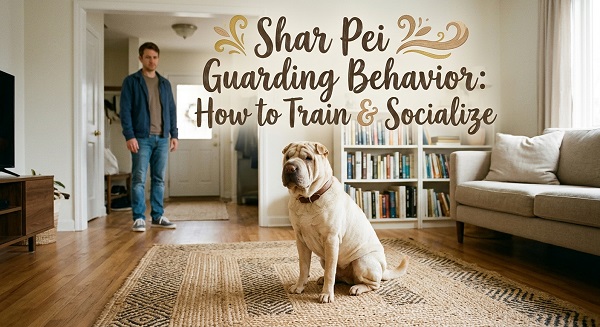
Shar Pei guarding behavior is a natural, inherited instinct. The breed started as a Chinese farm dog that watched property and livestock, so most Shar Pei are wary of strangers and loyal to their family. You can shape that instinct with early socialization (ideally from 8 to 16 weeks), calm reward-based training, and a clear visitor routine. Rule out pain first, because eye, skin and joint problems are common in this breed and can make a guarding dog look aggressive.
Table of Contents
- Introduction
- Why Shar Pei Guard: The Instinct Behind the Behavior
- Guarding vs Aggression: Where the Line Sits
- Rule Out Pain First (The Step Most Guides Skip)
- How to Socialize a Shar Pei: Timeline and Checklist
- Step-by-Step Training Plan for Guarding Behavior
- Fixing Common Guarding Problems
- What Not to Do
- Shar Pei With Kids, Guests and Other Pets
- A Handler’s Field Notes
- FAQs
- Conclusion: Your Next 7 Days
Introduction
Ever had a Shar Pei stare at your guest like it was reading their mind? That stiff, silent look is classic Shar Pei guarding behavior. It can feel impressive when the dog is calm. It can feel scary when the dog freezes, growls or lunges at the postman.
So here’s the problem. Many owners fall for the wrinkles and then get surprised by a serious, independent, suspicious dog. Some give up. Some punish the dog. Both choices make things worse.
In this guide, you’ll learn why Shar Pei guard, how to tell healthy watchfulness from real aggression, why pain matters more than most people think, and exactly how to socialize and train your dog. I’ll also share a week-by-week plan, a problem-fixer table and a short list of mistakes to avoid. This is a global guide, so the advice works whether you live in the US, the UK, Europe or anywhere else.
Why Shar Pei Guard: The Instinct Behind the Behavior
The Shar Pei is an ancient Chinese breed. The AKC says the breed has been in China since around 200 BC and recognized it in 1992. Early on, it worked as an all-purpose farm dog that guarded property, helped with livestock and hunted. Some dogs were also used in fighting for a time, although larger mastiff-type dogs later replaced them in the ring.
That job explains today’s dog. A farm guardian has to notice strangers, hold its ground and stay loyal to its own people. It doesn’t need to love every visitor.
Breed ratings back this up. The Westminster Kennel Club scores the breed 4 out of 5 for protectiveness, but only 3 out of 5 for good with strangers, good with other dogs and trainability. In plain words, your Shar Pei is built to be careful.
VCA Animal Hospitals describes the breed as showing one face to the family and another to the outside world. That matches what I see with wary guarding breeds: soft and clownish at home, stiff and distant with strangers.
Watchdog, Guard Dog or Protection Dog?
People mix these up all the time, so here’s a quick snippet-style answer.
A Shar Pei is a natural watchdog, not a trained protection dog. A watchdog alerts you. A guard dog deters and may hold its ground. A protection dog is trained to bite on command. Most Shar Pei fit the first two. Formal bite work isn’t a good plan for this breed, and I’ll explain why later.
| Role | What the dog does | Shar Pei fit |
|---|---|---|
| Watchdog | Notices and alerts, then settles | Excellent |
| Guard dog | Deters through presence, may stand firm | Good with training |
| Protection dog | Bites on command, stops on command | Not recommended for family pets |
If you want to understand how guarding instinct and obedience fit together, read our guide on Dog Obedience vs Instinct: How to Balance Drive and Control.
What Normal Shar Pei Guarding Looks Like
- Stands still and watches a stranger
- Gives a few deep barks, then looks at you
- Places itself between you and a new person
- Stays reserved and doesn’t rush to greet
- Relaxes once you show the person is safe
The key sign is that the dog recovers. It can switch off after the alert. That’s healthy.
Guarding vs Aggression: Where the Line Sits
Guarding turns into a problem when the dog can’t calm down, can’t listen to you or escalates fast. Here’s how I judge it.
| Healthy guarding | Problem behavior |
|---|---|
| Alert bark, then stops when you call | Barking keeps going and ignores you |
| Loose or slightly stiff body | Frozen, hard stare, weight forward |
| Accepts a calm stranger after a few minutes | Never settles, stays tense for the whole visit |
| Takes food from your hand during the alert | Refuses treats, stares past you |
| Warns first | Skips the warning and snaps |
What the Vet Data Says
This part matters, so let’s use real numbers. The Royal Veterinary College (RVC) VetCompass study looked at 455,557 dogs under UK vet care, including 1,913 Shar Pei. Vets diagnosed aggression in 5.2% of the Shar Pei each year, compared with 2.2% in non-Shar Pei. Males were more likely to be diagnosed with aggression than females.
That doesn’t mean your dog will bite. It means the breed has a higher baseline, so you should plan early rather than hope.
The Warning Ladder to Watch
Dogs rarely go from calm to bite in one step. Learn the ladder so you can step in early:
- Stops moving and goes quiet
- Hard stare, closed mouth
- Lip lick, whale eye or stiff tail
- Low growl or deep bark
- Air snap
- Bite
Never punish a growl. It’s the dog’s last polite warning. If you remove it, you may get a dog that skips straight to step 5 or 6.
Rule Out Pain First (The Step Most Guides Skip)
This is the gap I see on almost every page-one article about this topic. They talk about training and socialization, but they skip health. For a Shar Pei, that’s a big miss.
The RVC study found that entropion, where the eyelids roll inward, was the most common disorder. About 17.9% of Shar Pei were diagnosed each year, compared with roughly 1 in 200 other dogs. Entropion is painful. The lashes and hair rub the eye with every blink. A dog with sore eyes may also struggle to see, which can make sudden movements and strangers look more threatening.
Other problems can add to it:
- Ear infections: diagnosed in 16.4% of Shar Pei each year, versus 7.3% of other dogs, according to the same study
- Skin fold infections: moisture and bacteria collect between wrinkles
- Familial Shar Pei fever: an inherited inflammatory condition that causes fever and painful swollen joints, especially the hocks
- Thyroid problems: one vet clinic estimates about 1 in 5 Shar Pei are low in thyroid hormone, and it can affect mood and energy
Mar Vista Animal Medical Center also notes that the breed can react strongly to unwanted handling. That fits with pain, because a dog with a sore ear or skin fold will guard that body part.
Do this before any training plan:
- Book a full vet check, including eyes, ears, skin folds and joints
- Ask the vet to look at the eyelids closely, even in a puppy
- Ask about thyroid testing if your dog seems irritable or low in energy
- Note when the behavior started. A sudden change often points to pain or illness
Fixing pain won’t remove guarding instinct. It does remove the extra edge, and it makes training work faster.
How to Socialize a Shar Pei: Timeline and Checklist
Socialization is the best tool you have. And no, it doesn’t mean forcing your dog to love everyone. The goal is a dog that stays calm and neutral around normal life.
Why Timing Matters
The primary socialization window runs from about 3 to 12 weeks, and many experts treat it as fading out by 14 to 16 weeks. The American Veterinary Society of Animal Behavior (AVSAB) says puppies should get social experiences before they finish their vaccines, with sensible safety steps. Its position is that the risk from poor socialization outweighs the small infection risk in a controlled setting. It also notes that puppies kept from new experiences until after about 14 weeks can become fearful in those situations.
For a wary breed like the Shar Pei, that’s your biggest lever.
Shar Pei Socialization Timeline
| Age | Focus | What to do |
|---|---|---|
| 3 to 8 weeks | Breeder phase | Ask the breeder about handling, sounds, people and surfaces |
| 8 to 12 weeks | Prime window | Short, happy exposures daily. Carry the puppy in public if vaccines aren’t done. Join a vet-approved puppy class |
| 12 to 16 weeks | Window closing | Keep exposures going. Add new people types, sounds and places |
| 4 to 6 months | Consolidation | Repeat everything. Add calm walks past dogs at distance |
| 6 to 18 months | Adolescence | Expect more suspicion. Keep training steady and avoid overloading |
| Adult | Maintenance | Weekly new experiences so the skills don’t fade |
The Socialization Checklist
Use treats and keep every exposure short. Stop before the puppy gets stressed.
- People: men with beards, people in hats, uniforms, helmets, sunglasses, people using canes or wheelchairs, delivery workers, children (always supervised)
- Surfaces: tile, grass, gravel, metal grates, wet floors
- Sounds: doorbell, vacuum, traffic, thunder recordings, fireworks recordings at low volume
- Places: vet clinic lobby, car rides, pet shop, quiet street, friend’s home
- Handling: touching paws, ears, mouth, and gently opening the skin folds, paired with treats
Many trainers aim for a big number of people in the first months (some say 100 people in 100 days) as a handy rule of thumb. The exact number isn’t scientific. The idea is variety plus good experiences.
Socialization Isn’t Exposure
A puppy dragged through a crowded market and shaking in fear has been exposed, not socialized. Watch your dog’s body. If the tail tucks, the body lowers or the dog won’t take treats, you’re too close or it’s too much. Back off and try again at a lower level.
Starting Late or Adopting an Adult
If your Shar Pei is already past 16 weeks, don’t panic. Learning still works. It just takes more repetition and more distance.
- Start at a distance where your dog notices a stranger but stays calm
- Feed treats every time the stranger appears
- Move closer in tiny steps over days or weeks
- Never force a greeting
For a dog with a bite history or heavy fear, work with a qualified behavior professional rather than going solo.
Step-by-Step Training Plan for Guarding Behavior
Shar Pei are smart and independent. That means short sessions, high-value treats and calm consistency. Harsh methods backfire here. Aim for 5 to 10 minutes, two or three times a day.
Step 1: Build the Foundation (Weeks 1 to 2)
Teach the basics before you ask for guarding control:
- Name response: say the name, mark when the dog looks, reward
- Watch me: reward eye contact, building up to a few seconds
- Sit and down: reward with food or a favorite toy
- Place: teach your dog to go to a mat or bed and stay there
The “place” cue is the most useful guarding skill you’ll teach. It gives your dog a job other than watching your guests. If you also want a calm, safe retreat, our guide to how to crate train a puppy shows how to make the crate a peaceful spot.
Step 2: Teach “Thank You, That’s Enough” (Weeks 2 to 3)
You don’t want to remove barking. You want to control it.
- When your dog barks at a sound or sight, let it bark two or three times
- Say “thank you” in a calm voice and walk toward the dog
- Hand over a treat the moment the dog stops
- Give a cue like “quiet” only after the dog reliably stops
This tells the dog that you heard the alert and you’ll take it from here. That reduces the need for the dog to keep guarding on its own.
Step 3: Build a Visitor Routine (Weeks 3 to 5)
A guarding dog needs a predictable plan when the doorbell rings. Practice it with a helper before real guests come.
- Ring the bell. Say “place”
- Dog goes to the mat and gets treats
- Open the door with the dog still on the mat
- Guest enters and ignores the dog
- Guest tosses a treat toward the mat from a distance, without staring or reaching
- If the dog stays calm for 10 to 15 minutes, release gently
If your dog can’t hold the position, use a leash, a baby gate or a separate room. Management isn’t failure. It keeps everyone safe while training catches up.
Step 4: Teach Calm Greetings (Weeks 4 to 6)
Let the dog choose. Never push a Shar Pei toward a stranger.
- Ask guests to turn sideways and avoid eye contact
- Have them offer a treat on a flat open hand
- Let your dog sniff and walk away freely
- End the session while the dog is still relaxed
Some dogs only ever want to be polite and distant. That’s fine. A neutral Shar Pei is a success.
Step 5: Manage the Triggers (Ongoing)
Much guarding behavior is practice. Every time your dog barks at the window and the person leaves, the dog thinks it worked. Break that loop.
- Block window views with film or furniture
- Keep the dog off the fence line while you train
- Use a long line in the yard
- Reward calm behavior before the dog reaches the barking stage
Step 6: Teach Control Cues
Two cues help a lot with a strong-willed guarding dog: “leave it” and “out” (drop). We cover both in our list of 10 essential protection dog commands. Practice them daily in easy settings before you rely on them near a trigger.
Step 7: Make Handling Pleasant
Because Shar Pei can react to unwanted handling, teach vet-style touches early. Touch an ear, give a treat. Lift a paw, give a treat. Gently check the eyes, give a treat. Pair every exam-style move with something great.
Your 8-Week Plan at a Glance
| Weeks | Goal | Success sign |
|---|---|---|
| 1 to 2 | Name, watch me, sit, down, place | Dog lies on mat for 1 minute |
| 3 | “Thank you” and quiet cue | Dog stops barking within 5 seconds |
| 4 to 5 | Doorbell routine with helper | Dog stays on place for 5 minutes |
| 6 | Calm greeting with a known guest | Dog sniffs and walks away relaxed |
| 7 | Practice with unknown guest, dog on leash | No stiff stare, takes treats |
| 8 | Real-life test with a planned visit | Dog settles within 10 minutes |
Move back a step if the dog stops taking treats or stiffens. Progress is rarely a straight line.
Fixing Common Guarding Problems
| Problem | Likely cause | What to do |
|---|---|---|
| Barks and lunges at the window | Rehearsing the alert, plus reward when people leave | Block the view, redirect to “place”, reward calm |
| Growls at guests inside the home | Space pressure or fear | Use a gate, give distance, never force contact |
| Fence barking | Barrier frustration | Add visual barrier, supervise yard time, train recall |
| Stiff and silent with strangers on walks | Wary temperament | Cross the street, feed treats at distance, avoid greetings |
| Snaps when touched while resting | Pain or resource guarding | Vet check first, then teach “touch means treat” |
| Reacts to other dogs | Low early exposure or poor tolerance | Parallel walks at distance, avoid dog parks |
The breed also has a moderate to high prey drive, according to PetMD, and some Shar Pei show fear-based aggression when anxious in unfamiliar situations. So skip crowded dog parks. Controlled, small meetings work better.
What Not to Do
- Don’t punish growling. You remove the warning, not the feeling.
- Don’t use shock, prong or choke tools to “fix” guarding. Harsh methods raise stress and can raise aggression in a wary breed.
- Don’t encourage the dog to be “fierce.” Cheering when the dog barks at strangers teaches it to do more.
- Don’t skip vet checks. Pain hides under behavior.
- Don’t force greetings. Pressure turns suspicion into defense.
- Don’t leave a guarding dog unsupervised with visitors or children.
Should You Train a Shar Pei for Protection Work?
My honest answer: no, not for a family dog. Bite work needs a stable, confident dog with a clear off-switch. The Shar Pei’s wariness, skin and eye issues, and tendency to react to handling make the risk higher than the reward. A well-socialized Shar Pei that barks, stands firm and then listens already works as a strong deterrent. If you want true protection work, breeds bred for it, with working-line testing and a professional trainer, are a safer starting point.
Shar Pei With Kids, Guests and Other Pets
Most sources suggest the breed does best with older children who know how to be calm around dogs. Hepper adds that Shar Pei prefer to be left alone, which younger kids may not understand.
- Supervise every interaction
- Teach kids not to hug, stare at or corner the dog
- Give the dog a place where children can’t follow
- Never let a child’s friend run up to the dog
For other pets, introduce slowly. Keep first meetings short, on leash, and in neutral ground. Many Shar Pei live peacefully with other dogs when raised together, but don’t count on every dog being a friend.
A Handler’s Field Notes
When I work with wary, guarding breeds, three things decide success more than any fancy technique:
- Management first. Gates, leashes and closed doors stop practice of the bad habit while the good habit grows.
- Distance is a training tool. Most owners get too close, too fast. Double the distance and watch the dog relax.
- Consistency from the whole household. One person who lets the dog bark at the window can undo weeks of work.
If your dog has bitten, or if you feel unsafe, bring in a qualified professional. Look for a certified behavior consultant (such as IAABC or CPDT-KA credentials) or a veterinary behaviorist. Training advice online, including this article, can’t replace someone who sees your dog in person.
Sources used in this article: AKC breed information, Westminster Kennel Club breed ratings, VCA Animal Hospitals, the Royal Veterinary College VetCompass study on Shar Pei health, the AVSAB puppy socialization position statement, Mar Vista Animal Medical Center, PetMD and Hepper.
FAQs
1. Is a Shar Pei a good guard dog?
Yes, as a watchdog and deterrent. Shar Pei are wary, loyal and alert. They aren’t ideal as trained protection dogs. Early socialization and clear training keep that guarding balanced.
2. Why is my Shar Pei suddenly aggressive toward strangers?
A sudden change often points to pain or illness. Common causes are entropion, ear or skin infections and joint pain. Book a vet check first. If the vet finds nothing, work with a behavior professional.
3. When should I start socializing a Shar Pei puppy?
Start as soon as you bring the puppy home, usually around 8 weeks. AVSAB supports socializing before the vaccine series is finished, using safe, controlled settings. The most useful window runs until about 14 to 16 weeks.
4. Can you socialize an adult Shar Pei?
Yes. It takes more time and more distance, but adult dogs still learn. Start far from triggers, pair them with treats and never force contact.
5. How do I stop my Shar Pei from barking at visitors?
Teach a “place” cue, practice a doorbell routine with a helper and reward calm behavior. Let the dog give a short alert, then use “thank you” and a quiet cue. Block window views while you train.
Conclusion: Your Next 7 Days
Shar Pei guarding behavior comes from a farm-dog past, and you can’t erase it. You can guide it. The recipe is simple: check health first, socialize early and often, teach a clear “place” and visitor routine, and never punish a warning growl.
Here’s what to do this week:
- Day 1: Book a vet check for eyes, ears, skin and joints
- Days 2 to 3: Start “place” and “watch me” in short sessions
- Days 4 to 5: Add the “thank you” and quiet routine for barking
- Days 6 to 7: Block window views and set up your doorbell plan
Want the full system behind calm, confident dog handling? My e-book Beyond the Bark walks you through it step by step: Get Beyond the Bark here.
And if you’d like fresh training tips every week, join our weekly articles roundup newsletter: Subscribe at arfsk9team.com.ng/newsletter.

Her work centres on obedience, detection, protection and operational readiness. She favours proven methods built on repetition, consistency and real-world conditioning, so that both dogs and handlers are prepared for high-pressure tasks.
Rofiat represented the Nigerian Army Dog Centre at the Nigerian Army Day Celebration (NADCEL) 2026, where she led demonstrations in obedience, explosive detection, agility and tactical movement. Through articles, training content and documentaries, she shares field-based insight into how structured training, clear communication and trust between handler and dog affect performance and reliability.
She is the author of Beyond the Bark: Inside a Pro Handler's Playbook for Raising the Ideal Dog, a practical guide that helps dog owners and handlers apply professional training principles in everyday situations.
- Food Aggression Dog Training: Pro K9 Guide - November 21, 2026
- DIY Dog Scent Training: Easy 4-Week Home Guide - November 20, 2026
- Buckeye Puppies Review: 5 Red Flags to Check - November 19, 2026