Chesapeake Bay Retriever: Traits, Working Ability & Care
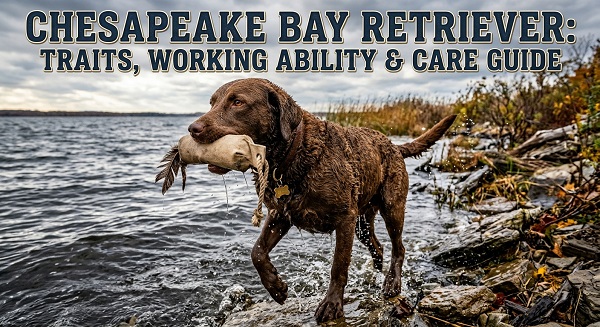
The Chesapeake Bay Retriever (the “Chessie”) is a strong, water-loving gundog from the United States. It was bred in the early 1800s to retrieve ducks from icy Chesapeake Bay water. Adults weigh about 55–80 lb (25–36 kg), live roughly 10–13 years, and need 1–2 hours of hard exercise daily. Chessies are loyal, smart and protective, but also stubborn, so they suit experienced, active owners best.
Table of Contents
- Introduction: Is a Chessie Really the Right Retriever for You?
- Chesapeake Bay Retriever History: Two Shipwreck Pups and a Duck Hunter’s Dream
- Size, Looks and That Famous Coat
- Chesapeake Bay Retriever Temperament
- Working Ability: What a Chessie Was Built to Do
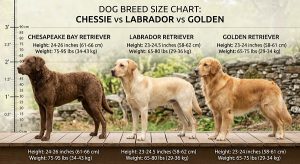
- Chesapeake Bay Retriever vs Labrador vs Golden Retriever
- Training a Chesapeake Bay Retriever
- Exercise Needs: How Much Is Enough?
- Health Problems, Lifespan and Health Testing
- Feeding, Grooming and Daily Care
- What Does a Chesapeake Bay Retriever Cost?
- Is a Chesapeake Bay Retriever Right for You?
- Handler Notes
- Recommended Products for Chesapeake Bay Retriever Owners
- Frequently Asked Questions
- The Bottom Line
Introduction: Is a Chessie Really the Right Retriever for You?
You’ve seen the photos. A wet, brown dog with amber eyes, hauling a duck out of freezing water like it’s nothing. Looks amazing, right?
Here’s the catch. The Chesapeake Bay Retriever isn’t a bigger, tougher Labrador. It’s a different animal. Chessies think for themselves, they guard their homes, and they’re wary of strangers. Plenty of new owners buy one for the looks and end up with a bored, loud, digging machine.
I’ve seen it happen with working breeds of all kinds. The problem is almost never the dog. It’s the mismatch between what the dog was built to do and the life it’s given.
In this guide, you’ll learn:
- Where the breed came from and why that history shapes its behavior today
- Real size, lifespan and health-testing numbers from breed clubs and kennel clubs
- How the Chessie compares with the Labrador and Golden Retriever
- A step-by-step training approach that works for strong-willed retrievers
- Costs, daily care and gear worth buying
Most top-ranking pages give you a quick breed profile. We’ll go further: working ability, a puppy timeline, honest “who should not buy one” advice and a gear list.
Chesapeake Bay Retriever History: Two Shipwreck Pups and a Duck Hunter’s Dream
Every breed has an origin story. The Chessie’s is better than most.
According to the AKC and the breed’s parent club, the story starts in 1807. A ship ran into trouble off the coast of Maryland, and two Newfoundland puppies, named Sailor and Canton, were rescued. They grew up around the Bay and turned out to be outstanding duck retrievers. They were bred to local dogs (never to each other), and over the next few decades those lines became the Chesapeake Bay Retriever.
A few facts worth knowing:
- Born for a hard job. Market and sport hunters needed a dog that could work in near-freezing water, in rough chop, all day. Some accounts describe it as a dog that hunted all night and guarded the catch the next day.
- First American retriever. It’s the only retriever breed that’s truly American in origin, and the AKC lists it as recognized since 1878.
- Parent club since 1918. The American Chesapeake Club has kept watch over the breed’s standard and health for more than a century.
- State dog. Maryland named the Chessie its official state dog in 1964.
Why does this matter to you? Because the breed was shaped by hunters who wanted toughness, independence and guarding instinct. Those traits are still in every Chessie puppy.
Size, Looks and That Famous Coat
How big is a Chesapeake Bay Retriever? Males stand about 23–26 inches (58–66 cm) and weigh 65–80 lb (29–36 kg). Females are slightly smaller at 21–24 inches (53–61 cm) and 55–70 lb (25–32 kg). Some breed-club sources list males up to 100 lb, but that’s heavier than the typical working dog.
The Double Coat
The coat is the breed’s signature. It has two layers:
- Outer coat: short, harsh and slightly wavy
- Undercoat: dense, fine and woolly, loaded with natural oil
That oil is what makes water roll off. It’s also why a Chessie can smell “doggy” and why you shouldn’t over-bathe one. The breed standard places more weight on coat than on almost any other trait, because a poor coat means a dog that gets cold and quits.
Colors
Accepted colors are shades of brown, sedge (reddish yellow) and deadgrass (straw to bunchgrass). They’re camouflage colors, picked so the dog blends into marsh and reeds. White is allowed only as a small spot on the chest, belly, toes or back of the feet.
Other Features
- Broad, round skull and medium-sized, yellow-to-amber eyes
- Webbed feet and a strong, medium-length tail that works like a rudder
- A powerful, muscular body with strong hindquarters for swimming
Chesapeake Bay Retriever Temperament
So what’s it like to live with one?
The AKC describes the ideal Chessie as bright, happy and affectionate, with quiet good sense. In real homes, that translates to something a bit more complex.
The Good
- Deeply loyal. Chessies bond hard to their family. They don’t rehome well, so they need a forever home.
- Smart and willing. They learn fast when training makes sense to them.
- Natural watchdogs. They’re alert and protective without being aggressive by default.
- Calm indoors. With enough exercise, many are mellow house dogs.
The Challenging
- Independent thinkers. The Orvis breed profile calls the Chessie the most headstrong of the retrievers. He’ll question your commands if they seem pointless.
- Wary of strangers. Reserved, not friendly to everyone. Socialize early and often.
- Can be dog-selective. Many do best with supervision around other dogs and small pets.
- Sensitive. Harsh corrections can backfire. Chessies shut down or dig in their heels.
Are Chessies Good Family Dogs?
Yes, in the right family. They’re protective and devoted with kids they know, but they’re big, strong and mouthy as puppies. Supervise all play with young children, and teach children how to treat the dog.
Are Chessies Good Guard Dogs?
They make great alert dogs. They bark when needed and can be imposing. But a Chessie isn’t a trained protection dog. If you want real protection work, that’s a separate, professional training path. For more on how instinct and obedience fit together, read our guide on dog obedience vs instinct.
Working Ability: What a Chessie Was Built to Do
This is where most online guides stay thin. Let’s fix that.
If you’re new to the idea, our guide on what a working dog is explains why bred-in purpose matters so much for behavior. A Chessie is a classic example.
1. Waterfowl Retrieving
This is the original job. Chessies are known for:
- Cold-water toughness. The oily coat and thick undercoat protect against ice and wind.
- Stamina. They keep going after other breeds tire.
- Marking and memory. Good ones remember where the bird fell and go straight to it.
- A soft mouth. The round, broad head and strong jaws carry large birds without crushing them.
2. Hunt Tests and Field Trials
The AKC runs hunt tests where retrievers are scored against a standard. The levels are Junior, Senior and Master Hunter. Chessies compete at every level. If you don’t hunt but want a “job” for your dog, hunt tests are a great, structured outlet.
3. Other Jobs Chessies Do Well
- Search and rescue and scent work. Their drive and stamina fit long search days, especially around water.
- Dock diving and water sports. Many love it.
- Obedience, rally and tracking. Strong-willed doesn’t mean untrainable. It means you need a plan.
- Therapy and service work. Less common, but some Chessies do well with the right temperament and training.
Why “No Job” Is a Problem
Breeders say a Chessie without working drive isn’t a true Chessie. That’s strong language, but the point is fair. If your dog has energy and drive and nothing to do, he’ll invent a job. Usually that’s digging, barking at the mail carrier or rearranging your garden.
Handler tip: Give your Chessie one “serious” job each week. A retrieve session, a scent game or a hunt-test drill. It does more for behavior than an extra walk.
Chesapeake Bay Retriever vs Labrador vs Golden Retriever
This is one of the most common questions I get. Here’s the quick comparison.
| Trait | Chesapeake Bay Retriever | Labrador Retriever | Golden Retriever |
|---|---|---|---|
| Weight | 55–80 lb | 55–80 lb | 55–75 lb |
| Temperament | Independent, protective, serious | Outgoing, eager | Gentle, eager to please |
| With strangers | Reserved | Friendly | Friendly |
| Trainability | Smart but stubborn | Very high | Very high |
| Coat | Short, wavy, oily | Short, dense | Long, feathered |
| Grooming | Weekly brushing | Weekly brushing | Several times a week |
| Best for | Experienced, active owners | Most families | Most families |
The bottom line: If you want an easygoing first dog, choose a Lab or Golden. If you want a tough, loyal, thinking dog and you have the experience, the Chessie is hard to beat.
Training a Chesapeake Bay Retriever
Chessies learn quickly, but they’re also the type to test you. Consistency matters more than force.
Step-by-Step Training Timeline
- 8–12 weeks: Foundation. Name recognition, crate time, bite inhibition and gentle handling. Start potty training right away. Our e-book Beyond the Bark walks you through a structured plan that fits retriever puppies well.
- 3–5 months: Socialization window closes. Safely meet new people, dogs, surfaces, sounds and water. This is critical for a breed that’s naturally wary of strangers.
- 4–8 months: Basic obedience. Sit, down, stay, come and loose-leash walking. Practice recall daily, with a long line.
- 8–14 months: Retrieving and water work. Introduce dummies, marked retrieves and swimming in calm water.
- 1–2 years: Proofing. Add distractions, distance and handler pressure. Expect an “adolescent attitude” phase here.
Training Tips That Work for Chessies
- Keep sessions short. Ten to fifteen minutes, a few times a day.
- Use rewards, not harshness. Food, tug and retrieves work better than force.
- Make it a game. A bored Chessie checks out.
- Be fair and firm. Say it once, then follow through. Repeating commands teaches him to ignore you.
- Build recall early. Strong, independent dogs need a rock-solid come command.
- Teach an “off switch.” Practice calm time on a mat. It saves your sanity later.
Common Mistakes
- Skipping early socialization
- Letting a puppy mouth and jump “because he’s cute”
- Using harsh corrections on a sensitive dog
- Under-exercising, then blaming the dog
Exercise Needs: How Much Is Enough?
Sources vary. Some breed guides say at least one hour a day, while UK sources like Purina UK say two or more. My rule: plan for 1–2 hours a day for a healthy adult, split into a few sessions.
Good activities:
- Swimming (safe, clean water)
- Fetch and marked retrieves
- Long walks over varied ground
- Scent games and hide-and-seek with toys
- Hunt-test training
Puppy rule: Don’t over-exercise growing joints. Avoid long runs, repeated jumping and forced fetch on hard surfaces until growth plates close, usually around 12–18 months for large breeds. Short play, swimming and free exploration are safer.
Want a deeper dive? Read our guide on how often to exercise a working dog.
Health Problems, Lifespan and Health Testing
How long do Chesapeake Bay Retrievers live? The AKC range is about 10–13 years. Surveys are a bit lower: a UK Kennel Club survey reported a median of about 10.75 years, and a US breed club survey reported an average around 9.4 years. Good breeding, a lean body weight and regular vet care all help.
Common Health Conditions
- Hip dysplasia. A joint malformation that can cause pain and arthritis. Stiffness after rest may be an early sign.
- Elbow dysplasia. Another joint concern in large breeds.
- Progressive retinal atrophy (PRA-prcd). An inherited eye disease that leads to vision loss. A DNA test is available.
- Exercise-induced collapse (EIC). A genetic condition that can cause weakness or collapse after intense exercise. DNA test available.
- Degenerative myelopathy (DM). A progressive spinal cord disease in older dogs. DNA test available.
- Von Willebrand’s disease. A bleeding disorder reported with increased frequency in the breed.
- Cataracts and other eye problems.
- Bloat (GDV). A life-threatening stomach twist in deep-chested dogs. Smaller, more frequent meals and no hard exercise around mealtimes lower risk.
- Adult-onset hair loss. Some Chessies develop a skin and coat condition studied in the breed. Talk to your vet if you see thinning.
Health Testing: What to Ask a Breeder
This is the section most competitors skip, and it’s the one that can save you thousands in vet bills and heartbreak.
The American Chesapeake Club’s health statement recommends that breeding dogs be free of hip and elbow dysplasia, PRA, other hereditary eye disease, EIC and DM. For CHIC certification (the OFA’s Canine Health Information Center program), the AKC lists these tests for the breed:
- OFA hip evaluation
- OFA elbow evaluation
- Eye exam by a veterinary ophthalmologist
- DNA test for DM
- DNA test for PRA-prcd
- DNA test for EIC
In the UK, The Kennel Club’s Assured Breeder scheme asks for hip and elbow scoring and the prcd-PRA DNA test.
Pro tip: Don’t just accept “yes, they’re health tested.” Ask for each parent’s actual results and look them up on the OFA database yourself.
This article is educational, not veterinary advice. Always check health concerns with your vet.
Feeding, Grooming and Daily Care
Feeding
- Choose a high-quality large-breed formula. Puppies need a large-breed puppy food to grow at a steady pace.
- Most adults do well on around two cups of quality kibble a day, split into two meals, but active hunting dogs need more. Adjust to body condition, not the bag.
- Chessies can gain weight easily. You should feel the ribs under a thin fat layer. Extra weight stresses joints.
- Feed two or three smaller meals to help lower bloat risk, and rest the dog before and after meals.
Grooming
Good news: the coat is easy.
- Brush weekly with a rubber curry brush. Brush more during seasonal shedding.
- Bathe only every 3–4 months (or when truly dirty) with a mild shampoo. The American Chesapeake Club notes it’s hard to get a Chessie thoroughly wet anyway, and over-washing strips the protective oils.
- Dry thoroughly after bathing and swimming.
- Clean ears after every swim to prevent infections.
- Trim nails regularly and brush teeth several times a week.
For more tips, see our puppy grooming guide on the blog.
Living Space
Chessies adapt poorly to apartment life. They do best with a securely fenced yard, space to burn energy and a family that’s home often. They’re also known to be diggers and counter-surfers, so plan for that.
What Does a Chesapeake Bay Retriever Cost?
Prices vary by country and breeder, so treat these as ballpark numbers and check local listings.
| Cost | Typical range (USD) |
|---|---|
| Rescue or shelter adoption | About $50–$300 |
| Puppy from a health-testing breeder | Often around $1,500–$2,500+ |
| Food (large breed, per year) | $600–$1,000 |
| Routine vet care and preventives (per year) | $500–$900 |
| Training classes | $100–$300 per course |
| Pet insurance (per month) | Varies by age and plan |
A cheaper puppy without health testing can cost far more later. Hip surgery alone can run into thousands.
Is a Chesapeake Bay Retriever Right for You?
A Chessie fits you if you:
- Have dog experience and a firm but fair hand
- Love outdoor activity, especially water
- Can give 1–2 hours a day plus mental work
- Want a loyal, protective, thinking dog
Think twice if you:
- Are a first-time owner
- Live in a small apartment
- Want a dog that loves every stranger
- Are away from home most of the day
Handler Notes
At ARFS K9 Team, we work with working dogs and handlers, and the pattern is always the same: drive without direction becomes a behavior problem. That lesson holds for every retriever, and it holds double for a dog as independent as the Chessie.
Sources used in this guide: American Kennel Club, American Chesapeake Club health statement, OFA/CHIC program, The Kennel Club (UK), Orvis breed profile, Purina, WebMD, Wisdom Panel and Dogster.
Recommended Products for Chesapeake Bay Retriever Owners
The right gear makes life with a Chessie safer and easier. These are the items I’d put on a new owner’s list. (As an Amazon Associate we may earn from qualifying purchases.)
1. Ruffwear Float Coat Dog Life Jacket (Best for Water Safety)
Even the best swimmers get tired, and cold water is dangerous. The Float Coat is a well-reviewed life jacket with a strong rescue handle, reflective trim and foam placed to support a natural swimming position. Outdoor Gear Lab’s testing named it their favorite dog flotation vest. Measure your dog’s chest girth before you order, because Large fits girths of about 32–36 inches. If you boat, hunt from a blind or let your Chessie swim in open water, this is the one piece of gear I’d never skip.
Check the Ruffwear Float Coat on Amazon
2. FURminator Curry Comb (Best for Coat Care)
A rubber curry comb is exactly what the breed’s coat likes. It lifts loose hair, spreads natural oils and gives a gentle massage. It works on wet or dry coats, so you can use it after a swim. It’s cheap and takes seconds.
Check the FURminator Curry Comb on Amazon
3. Retriever Training Dummies (Best for Working Ability)
Canvas or PVC training dummies let you practice marked retrieves, water work and hunt-test skills. Look for a set with a few different weights and a throwing rope. Floating dummies are a must for water training.
Browse retriever training dummies on Amazon
4. Ball Launcher for Large Dogs (Best for Exercise)
A launcher saves your arm and lets you give your dog serious retrieve sessions. Choose a sturdy, long-handled launcher with a ball sized for large dogs, and keep it as a controlled activity rather than endless chasing, to protect joints.
Browse large-dog ball launchers on Amazon
5. Orthopedic Dog Bed for Large Breeds (Best for Recovery)
Hard-working dogs need good rest. A thick orthopedic or memory foam bed helps joints recover after a long day. Pick a washable cover, since a swimming Chessie is rarely clean.
Browse orthopedic beds for large dogs on Amazon
6. Absorbent Dog Drying Towel or Drying Coat (Best After Swims)
A wet dog in the car isn’t fun. A microfiber towel or drying coat gets him dry faster, which protects his skin and ears and keeps your house cleaner.
Browse dog drying towels and coats on Amazon
Frequently Asked Questions
1. Are Chesapeake Bay Retrievers good family dogs?
Yes, for the right family. They’re loyal and protective, but they’re strong, reserved with strangers and need lots of exercise. Early socialization and supervision around kids are important.
2. Are Chesapeake Bay Retrievers aggressive?
Not by nature. They’re protective and wary of strangers, which can look like aggression if the dog isn’t socialized or trained. A well-raised Chessie is confident, not aggressive.
3. How much exercise does a Chesapeake Bay Retriever need?
Plan for 1–2 hours daily for a healthy adult, mixing physical activity (swimming, retrieving, walks) with mental work. Go gently with puppies to protect growing joints.
4. Do Chesapeake Bay Retrievers shed a lot?
They’re average shedders and “blow” their coat seasonally. Weekly brushing, and more often during heavy shedding, keeps hair under control.
5. What’s the difference between a Chessie and a Labrador?
Chessies are more independent, protective and reserved with strangers, with a wavy, oily coat. Labs are usually more outgoing and easier for beginners. Both are strong swimmers and retrievers.
The Bottom Line
The Chesapeake Bay Retriever is a tough, loyal, water-loving working dog with a mind of its own. Treat it like a house pet with no purpose and you’ll get trouble. Give it exercise, a job and fair, consistent training and you’ll get one of the most devoted partners in the dog world.
Here’s your action plan:
- Match your lifestyle first. Be honest about time, space and experience.
- Pick a breeder who health-tests. Ask for hip, elbow, eye, DM, PRA and EIC results for both parents.
- Socialize early. Cover people, places, sounds and water before 16 weeks.
- Give your Chessie a job. Retrieves, scent work or hunt tests.
- Invest in safety gear. A good life jacket is worth every penny.
Want more guides like this? Subscribe to our weekly articles roundup newsletter at arfsk9team.com.ng/newsletter and get practical K9 training tips in your inbox every week.
Disclaimer: This content is for education only and isn’t a substitute for advice from a licensed veterinarian or professional trainer.

Her work centres on obedience, detection, protection and operational readiness. She favours proven methods built on repetition, consistency and real-world conditioning, so that both dogs and handlers are prepared for high-pressure tasks.
Rofiat represented the Nigerian Army Dog Centre at the Nigerian Army Day Celebration (NADCEL) 2026, where she led demonstrations in obedience, explosive detection, agility and tactical movement. Through articles, training content and documentaries, she shares field-based insight into how structured training, clear communication and trust between handler and dog affect performance and reliability.
She is the author of Beyond the Bark: Inside a Pro Handler's Playbook for Raising the Ideal Dog, a practical guide that helps dog owners and handlers apply professional training principles in everyday situations.
- Food Aggression Dog Training: Pro K9 Guide - November 21, 2026
- DIY Dog Scent Training: Easy 4-Week Home Guide - November 20, 2026
- Buckeye Puppies Review: 5 Red Flags to Check - November 19, 2026