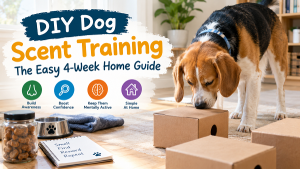
DIY Dog Scent Training: Easy 4-Week Home Guide
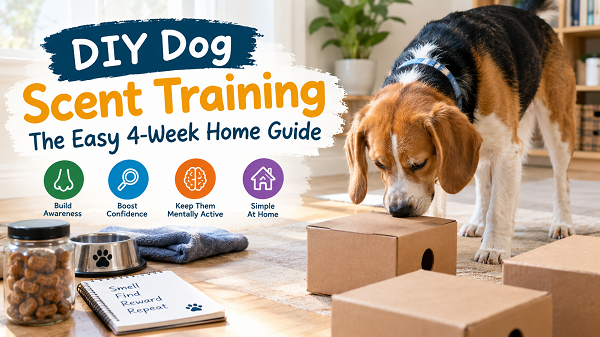
What is DIY dog scent training? It’s teaching your dog to find a hidden smell using simple items from home, like cardboard boxes, cups, towels and treats. Start with food, move to one target odor (like birch), add the “Find it!” cue, then make the hides harder. Most dogs learn the basics in about 4 weeks with 5-10 minute sessions, and it needs no special talent, breed or expensive gear.
Table of Contents
- Why Scent Training Works So Well
- What You Need for DIY Dog Scent Training
- Before You Start: Safety and Setup Rules
- The 4-Week DIY Dog Scent Training Plan
- How to Teach Your Dog to Show You the Find
- Moving From Treats to a Target Odor
- How to Make Searches Harder (Without Breaking Your Dog’s Confidence)
- Troubleshooting: 9 Common Problems and Fixes
- Scent Training for Special Dogs
- Your Training Log: How to Track Progress
- Where Scent Training Can Lead
- FAQs
- Conclusion
Introduction: Your Dog Is Already an Expert. You Just Need to Speak Their Language
Ever watched your dog freeze on a walk, nose glued to one spot, and wondered what on earth they’re reading? That’s their newspaper. And most of us rush them past it.
Here’s the problem. Many owners try to tire out their dogs with more walking, more fetch, more running. But a dog with a busy body and a bored brain still shreds the couch, barks at nothing and paces at 9 p.m. Meanwhile, the most natural job your dog has ever had sits unused: using that nose.
In this guide, I’ll show you exactly how to do DIY dog scent training at home. You’ll learn what to buy (hint: almost nothing), a clear 4-week plan, how to teach a “find it” cue, how to switch from treats to a target odor, and how to fix the problems nobody else warns you about. I’ve taught this to everything from high-drive working dogs to couch-loving seniors, and the steps barely change. Only the speed does.
Why Scent Training Works So Well
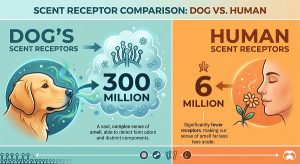
Let’s start with the numbers, because they explain everything. Dogs have up to 300 million scent receptors in their noses. We have about 6 million. The part of a dog’s brain that handles smell is also roughly 40 times bigger than ours in proportion. That’s why professional detection teams can find drugs, explosives, missing people and even certain diseases. Some dogs can pick up odors at parts-per-trillion levels.
It Calms Dogs Down
Sniffing isn’t just fun. It changes how your dog feels. In a study called “Let Me Sniff!” (Duranton and Horowitz, 2019, Applied Animal Behaviour Science), pet dogs did either nose work or heelwork every day for two weeks. The nose work group became more optimistic in a follow-up test, while the heelwork group didn’t change. Same treats, same time, different result. The difference? In nose work, the dog makes the choices.
That matches what I see in the field. A 10-minute search often settles a wound-up dog better than a 30-minute run.
It Builds Confidence
Shy dogs love scent games because there’s no pressure. You aren’t asking for a perfect sit or a tight heel. You’re just saying, “Go be a dog.” Every find is a win, and wins stack up fast.
It’s Easy on the Body
No jumping, no twisting, no pounding on joints. That makes scent work a smart choice for puppies (under guidance), seniors, injured dogs and giant breeds. If you want to see how mental work fits into a full routine, my guide on how often to exercise a working dog shows how to balance body and brain.
What You Need for DIY Dog Scent Training
You can start today with stuff you already own.
The Free Starter Kit
- 6-10 cardboard boxes or shoe boxes (same size works best)
- Paper cups or small plastic containers
- An old towel or two
- A muffin tin and tennis balls (a cheap DIY food puzzle)
- Small, smelly, soft treats (cheese cubes, boiled chicken, freeze-dried liver)
- A treat pouch or small bowl
- A notebook or phone for your training log
The Upgrade Kit (For Odor Work)
When your dog is ready for a true target odor, you’ll add:
- Metal tins with holes in the lid (like a small mint tin or a tea tin), so the odor can escape but the dog can’t touch the source
- Cotton swabs or cotton balls to hold the odor
- Disposable gloves and tweezers, so your own scent doesn’t mix with the training scent
- Glass jars with lids to store scented swabs, so they don’t contaminate the room
- Birch, anise or clove oil (the same odors used in sport trials)
Why Birch, Anise and Clove?
In AKC Scent Work, the Odor Search Division uses four odors: birch, anise, clove and cypress. Novice searches use birch only. Advanced adds anise, Excellent adds clove, and Master adds cypress. The National Association of Canine Scent Work (NACSW) uses birch, anise and clove. If you ever want to compete, starting with birch now saves you work later. If you don’t care about trials, any safe, steady scent works for DIY training.
Before You Start: Safety and Setup Rules
This is the section most guides skip, and it’s the one that keeps your dog safe.
Essential Oil Safety
Essential oils are strong. Birch oil contains methyl salicylate, a relative of aspirin, so it can be harmful if a dog licks or swallows it. Follow these rules:
- Never put oil on your dog or on anything your dog will chew.
- Put one or two drops on a cotton swab, then seal it inside a tin with holes in the lid so your dog can’t reach the swab.
- Store oils and swabs in sealed jars, out of reach of dogs, kids and cats.
- Don’t use oil diffusers around your training area. Cats and birds are especially sensitive.
- Check with your vet before starting if your dog has breathing problems, seizures or a history of eating non-food items.
Treat-based searches (Weeks 1-2) carry none of these risks. That’s one reason I always start with food.
Pick the Right Place and Time
- Choose a quiet room with little foot traffic.
- Train before meals, when your dog is hungry but not frantic.
- Keep sessions short: 5-10 minutes to start, with 2-3 sessions a day at most.
- Stop while your dog is still keen. Always.
Check Your Dog’s Health
If your dog has a blocked nose, heavy discharge, or sniffs less than normal, see your vet first. A dog with a stuffy nose can’t do this work, and it can be a sign of illness.
The 4-Week DIY Dog Scent Training Plan
Here’s the plan I use. Think of it as a ladder. Don’t climb to the next rung until your dog finds the last one fast and happy.
Week 1: The Box Game (Build the Love of Searching)
Goal: Your dog learns that sniffing boxes pays.
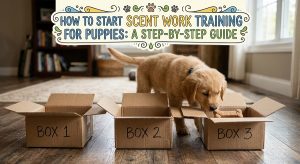
- Line up 3 open boxes on the floor, about a foot apart.
- Drop a treat into one box while your dog watches.
- Say “Find it!” in a happy voice and let your dog go.
- When your dog nose-checks the right box, say “Yes!” and add a second treat right there.
- Repeat 5-8 times, then end the session.
Level up within the week:
- Day 3-4: Add boxes (up to 6), and hide the treat before your dog comes into the room.
- Day 5-7: Close the box flaps halfway, then fully (with the treat inside).
Pass mark: Your dog runs to the boxes, checks them all and finds the treat in under 10 seconds, 8 out of 10 times.
Week 2: The Room Search (Hide Treats Around the House)
Goal: Your dog searches an area, not just a row of boxes.
- Start with one easy hide in plain sight (on the floor, by a chair leg).
- Say “Find it!” and stay still. Don’t point, lead or hover.
- Add one new hide location every two sessions: under a towel, behind a box, on a low shelf.
- Mix in an empty box now and then so your dog learns to move on.
Handler tip: I tell new students to pretend they’re a statue. Dogs read our body language faster than our words. If you lean toward the hide, your dog will follow you instead of the smell, and they won’t learn to trust their nose.
Pass mark: Your dog finds 3 hidden treats in a room in under 60 seconds without any help from you.
Week 3: The Target Odor (Introduce Birch or Another Scent)
Goal: Your dog learns that one special smell means treats.
This step is called odor imprinting in the detection world. Details are in the next section, but here’s the quick version:
- Put a scented swab in a tin with holes in the lid.
- Hold the tin low. When your dog sniffs it, say “Yes!” and feed a treat from your hand right at the tin.
- Repeat 10-15 times over a couple of sessions until your dog stares at the tin and waits for the treat.
- Place the tin in one box (with other empty boxes) and give the “Find it!” cue.
Pass mark: Your dog picks the scented box out of 4-6 boxes in under 15 seconds, 8 times out of 10.
Week 4: Build Searches (Rooms, Containers and Outdoors)
Goal: Take the skill to new places.
- Hide the scented tin in a room instead of a box.
- Use different surfaces (carpet, tile, grass).
- Search outdoors in a quiet garden, then a park.
- Mix in multiple hides, but only one odor.
By the end of Week 4, most dogs I work with can find a hidden odor in a small room within a minute or two. Some do it in Week 3, and some take 6 weeks. Both are normal.
How to Teach Your Dog to Show You the Find
Finding the scent is half the job. The other half is telling you about it. Detection dogs do this with a clear final response, known as an alert or indication.
Pick a Final Response
In AKC Scent Work, dogs may paw, bark, point, sit, lie down or use any behavior to show where the odor is. For DIY training, pick whatever comes naturally:
- Freeze and stare at the source (easiest for most dogs)
- Nose touch to the container
- Sit or down next to the source
How to Shape It
- Hold off on the treat for 1-2 seconds when your dog finds the scent.
- Wait for the behavior you want. Don’t ask. Let your dog offer it.
- The second it happens, say “Yes!” and deliver the treat at the source, not from your pocket.
Delivering the reward at the hide is the secret. It teaches your dog that the smell itself is where the money is.
Working-line breeds like Malinois and German Shepherds pick this up quickly because they’re bred for drive. If you want a deeper look at how drive and obedience fit together, read my article on dog obedience vs. instinct.
Moving From Treats to a Target Odor
This step confuses people more than any other. Here’s how pros do it.
Step 1: Pair the Odor With the Treat
Open the tin so your dog can sniff it, and feed a treat the moment their nose touches it. Do this 10-15 times. Your dog is learning one simple fact: this smell = food.
Step 2: Keep Your Hands Clean
Use tweezers or gloves to handle the swab. If your scent is all over it, your dog may be searching for you, not the birch.
Step 3: Always Keep a Blank
A blank is a tin or box with no odor. Add one to most searches. It teaches your dog to say “no” to empty containers and keeps them honest.
Step 4: Fade the Food Slowly
The treat should always come, but not always from you. Once your dog is solid, you can place the treat near (not in) the hide, or reward from a distance. Keep paying well for the harder finds.
Step 5: Rotate Your Odor Storage
Odors leak. Keep scented swabs in a sealed glass jar, and use fresh swabs every week or two. Wash your hands after handling. Never store training swabs in the same jar as your blanks.
How to Make Searches Harder (Without Breaking Your Dog’s Confidence)
The rule is simple: change only one thing at a time.
The Six Ways to Add Difficulty
| Change | Example |
|---|---|
| Height | Floor, then chair seat, then low shelf |
| Distance | 5 feet, 10 feet, across the room |
| Hiding place | Open, partly hidden, fully hidden |
| Area size | Box row, bathroom, living room, garden |
| Distractions | Quiet room, TV on, other pets nearby |
| Number of hides | One hide, two hides, three hides |
If your dog struggles, go back one step. Not three. One.
Learn the Basic Scent Rules
You don’t need a science degree, but a few facts help you hide smarter:
- Scent travels with air. A fan, open window or AC vent can push odor across a room. If your dog loses it, check the airflow.
- Scent pools. Odor collects in corners, under furniture and along walls.
- Scent rises and falls. Warm air lifts odor. Cool air keeps it low.
- Heat and wind change everything outside. Hot sun bakes odor off, and strong wind scatters it.
When I run field training, I check wind direction before every hide. It sounds small, but it’s often why a good dog “fails” a search.
Add Search Patterns
Once your dog is confident, walk a loose pattern around the room. Let your dog lead and work the edges and corners. Don’t drag them away from a scent pool just because you think the hide is somewhere else. Trust the nose.
Troubleshooting: 9 Common Problems and Fixes
This is where most DIY guides stop, and where most owners get stuck. Here’s what I’d tell you if we were standing in your living room.
1. My Dog Isn’t Interested
Your treat is probably too boring. Switch to something smellier and softer, like cheese or chicken. Also check that your dog isn’t too full or too excited.
2. My Dog Gives Up Too Quickly
The search is too hard. Go back to an easier hide and pay big. Confidence first, difficulty second.
3. My Dog Checks Me Instead of Searching
You’re giving cues without realizing it. Stand still, look away from the hide, and avoid pointing or whispering hints.
4. My Dog Gets Frantic
Some dogs hit their “ON” switch too hard. Slow things down: shorter sessions, calm voice, and feed treats from a bowl on the floor to bring arousal down. Do a few easy finds before you stop.
5. My Dog Eats the Treat Hide Before I Say “Yes”
Use a container with holes (a tin or cup with a lid) so the dog can smell but not grab. Or put the treat inside a closed box.
6. My Dog Marks or Pees During Searches
Adult intact males sometimes do this in new places. Take a potty break first, use a short leash if needed, and work in a fresh area only after your dog has relieved himself.
7. My Dog Finds Everything Except the Odor
Your dog may be finding leftover food crumbs. Wipe boxes down, use fresh containers, and rotate your search area.
8. My Dog Alerts on Everything
Add more blanks, and reward only true finds. If the dog alerts at an empty box, calmly say nothing, walk away, and reset.
9. My Dog Used to Love It and Now Quits
Check for stale swabs, a stuffy nose, a hard hide or too many sessions in a row. Take a week off, go back to treat boxes, then rebuild.
Scent Training for Special Dogs
Every dog can do this. Here’s how to adapt.
Puppies
Start as early as you want with treat-based games. They’re safe, short and fun. Hold off on essential-oil target odors until your vet is happy and your puppy no longer chews everything. (Note: AKC trials require dogs to be at least 6 months old, but home play can start much earlier.)
Senior Dogs
Scent work is a gift for older dogs. Use low hides, skip the jumping, and keep sessions short. Dogs with weaker eyesight or hearing often become more confident when they use their nose.
Fearful or Reactive Dogs
Stay in a quiet room with zero pressure. Let your dog choose when to start. Use a long line, a slow pace and extra-soft treats. Many reactive dogs relax during scent work because they stay busy and focused.
Flat-Faced Breeds
Pugs, Bulldogs and Frenchies can absolutely play, but they tire fast and overheat easily. Keep sessions very short, work indoors in cool weather, and let them rest between searches.
High-Drive Working Breeds
Malinois, Shepherds and Border Collies can race through the steps and then get frustrated. Keep your searches tricky, your rewards big, and your sessions short. They’ll learn faster than you expect.
Your Training Log: How to Track Progress
Pros keep logs. You should too. It takes a minute and shows you patterns you’d miss.
After each session, write down:
- Date and time
- Location and weather (for outdoor work)
- Odor or treat used
- Number of hides
- Time to find
- Mistakes or distractions
- Your dog’s mood (keen, slow, frantic, relaxed)
After two weeks, look for trends. You’ll often find your dog is sharper in the morning, or struggles near the air vent, or loves the garden but hates the carpet.
Where Scent Training Can Lead
DIY games are enough for most pet dogs. But if your dog loves it, you’ve got options.
Scent Work Sports
- AKC Scent Work (open to purebreds and mixed breeds, minimum age 6 months)
- NACSW K9 Nose Work trials
- Local scent work clubs and classes, which are worth joining if you want feedback on timing and handler movement
Practical Jobs
Trained noses can help find:
- Lost keys or phones (yes, really)
- Missing pets
- Wildlife conservation targets, like endangered species surveys
- Detection work for drugs, explosives, currency, bed bugs and medical conditions, though those need professional training
Keep Building Skills
Scent work pairs well with basic tricks and focus training. If you want fun add-ons, check out 10 K9-approved tricks to teach your dog. And if you want a deeper understanding of how to read, motivate and communicate with your dog, my e-book Beyond the Bark walks you through the handler mindset step by step.
FAQs
1. How long does it take to scent train a dog?
Most dogs learn the basic treat-search game in 1-2 weeks and can find a target odor in about 4 weeks with 5-10 minute sessions. Some dogs need 6-8 weeks, especially if they’re shy or easily distracted. Speed matters less than confidence.
2. Can any dog learn scent work?
Yes. Every healthy dog has enough scent receptors to learn. Puppies, seniors, small breeds and fearful dogs can all enjoy it. Dogs with breathing or nasal problems should see a vet first.
3. What can I use for DIY dog scent training?
Start with cardboard boxes, cups, towels and smelly treats. When you’re ready for a target odor, use a cotton swab with one or two drops of birch, anise or clove oil inside a tin with holes in the lid. Keep the oil away from your dog’s mouth and skin.
4. How long should each scent training session be?
Start with 5-10 minutes. Two or three short sessions a day beat one long one. End while your dog is still eager, so they look forward to the next round.
5. Is essential oil safe for dogs in scent training?
It can be, if you use it carefully. Never put oil on your dog or let them lick it. Keep a few drops on a cotton swab in a sealed tin, store everything out of reach, and ask your vet if you’re unsure. If you’d rather skip oils, treat-based searches still give your dog a great workout.
Conclusion: Start Small, Stay Consistent, Let the Nose Lead
So here’s the short version. DIY dog scent training isn’t hard, and it doesn’t need fancy gear. Start with boxes and treats, build to a room search, then introduce one target odor with a clear reward. Keep sessions short, change one thing at a time, and always end on a win.
Your next steps:
- Grab 3 boxes and some treats tonight.
- Play the Week 1 box game for 5 minutes.
- Write down how it went in your training log.
- Follow the 4-week plan at your dog’s pace.
That’s it. A few minutes a day gives you a calmer, more confident dog and a stronger bond.
Want more practical training guides like this one every week? Subscribe to our weekly articles roundup newsletter and get new K9 tips straight to your inbox.

Her work centres on obedience, detection, protection and operational readiness. She favours proven methods built on repetition, consistency and real-world conditioning, so that both dogs and handlers are prepared for high-pressure tasks.
Rofiat represented the Nigerian Army Dog Centre at the Nigerian Army Day Celebration (NADCEL) 2026, where she led demonstrations in obedience, explosive detection, agility and tactical movement. Through articles, training content and documentaries, she shares field-based insight into how structured training, clear communication and trust between handler and dog affect performance and reliability.
She is the author of Beyond the Bark: Inside a Pro Handler's Playbook for Raising the Ideal Dog, a practical guide that helps dog owners and handlers apply professional training principles in everyday situations.
- How to Safely Approach Stray Dogs: 5 Field Rules - November 22, 2026
- Food Aggression Dog Training: Pro K9 Guide - November 21, 2026
- DIY Dog Scent Training: Easy 4-Week Home Guide - November 20, 2026