How to Start Scent Work Training for Puppies
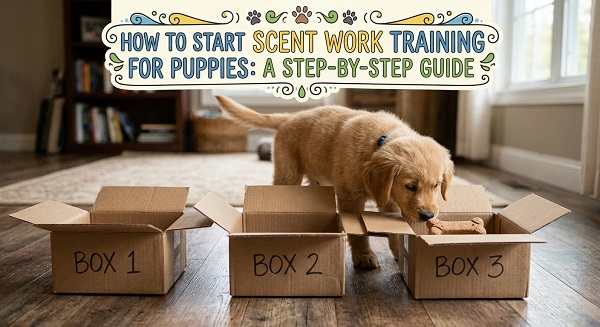
How do you start scent work training for puppies? Start around 8 weeks old with short, 2 to 3 minute food-finding games at home. Drop a smelly treat on the floor, say “Find it,” and let your puppy sniff it out. Then hide treats in boxes, teach a clear signal like a nose touch, and only bring in a target odor when your puppy is older and your vet agrees.
- Best starting age: about 8 weeks for simple games. Formal sports like AKC Scent Work and NACSW tests start at 6 months.
- Session length: 2 to 5 minutes, once or twice a day.
- Cost: almost nothing. Cardboard boxes, a muffin tin and small treats are enough.
- Biggest safety rule: keep sweet birch oil and other essential oils away from young puppies.
- Realistic timeline: most puppies run a confident box search after about 4 weeks of daily practice.
Table of Contents
- What Is Scent Work for Puppies?
- What Age Can You Start Scent Work With a Puppy?
- What You Need Before You Start
- Safety First: Oils, Xylitol, Heat and Vaccines
- How to Start Scent Work Training for Puppies: 7 Steps
- A 4-Week Puppy Scent Work Plan
- 5 Puppy Scent Games to Play at Home
- Common Mistakes and How to Fix Them
- Trainer Notes: What I’ve Learned Working With Detection Dogs
- From Puppy Games to Real Scent Work Sports
- FAQs
- Final Thoughts
Introduction
Your puppy just ripped through the living room for the third time today. You walked him for 20 minutes, played fetch, and he’s still bouncing off the walls. Sound familiar?
Here’s the thing. Young puppies can’t handle long runs or hard exercise because their joints are still growing. But their brains need a workout, and that’s where scent work training for puppies shines. A few minutes of sniffing games often tires a pup out more than a long walk, and it builds confidence at the same time.
The problem is that most guides either stay too basic (“hide a treat and say find it”) or jump straight to competition rules and essential oils that aren’t safe for a young puppy. I want to fix that.
In this guide, you’ll learn:
- Why a puppy’s nose is perfect for this work, and what the science says about starting early
- Exactly when to start, with an age-by-age table
- What to buy (and what to skip) and the safety rules most blogs forget
- A clear 7-step method, a 4-week plan and five easy games
- How to fix the most common problems, and where to go next
What Is Scent Work for Puppies?
Scent work (also called puppy nose work) is a training game where your puppy uses his nose to find a hidden target, then tells you he found it. The target starts as food. Later it can become a specific odor, just like the odors used by real detection dogs.
It’s different from obedience. In obedience, you give the cues and your dog follows. In scent work, the puppy is the expert. You just stand back and let him solve the puzzle. That’s why it’s so good for shy, excitable or easily frustrated pups.
Your Puppy’s Nose in Numbers
Dogs can have up to 300 million olfactory receptors in their noses, compared with about 6 million in people, according to veterinarian Dr. Michael Nappier in a PetMD article. The part of the dog’s brain that processes smell is also roughly 40 times larger than ours. Even a pet puppy from a shelter has this equipment. You don’t need a special breed to begin.
Puppies also use their noses from day one. They sniff their way to their mother’s milk before their eyes open. You’re not teaching a new skill. You’re giving a natural skill a job.
What Does the Science Say About Starting Early?
Researchers at Auburn University studied this with purpose-bred detection dogs. In a 2022 master’s thesis, one group got odor enrichment from 2 to 7 weeks of age. Another group started odor discrimination training at 2 to 6 months. A third group was the control. The team tested all the dogs on thinking tasks at 3, 5 and 11 months.
The results weren’t a magic bullet. The author said larger studies are needed. But the dogs that began odor work at 2 to 6 months showed more reward-driven arousal, which means they got more excited about working for a reward. For a future working dog, that drive matters. For a pet puppy, the takeaway is simple: early, short, positive odor games are a low-risk way to build focus and curiosity.
Here’s some good news if you’re reading this with an older dog too. A 2024 Auburn study found that aging had minimal to no impact on dogs’ olfactory abilities. So the nose doesn’t “expire.” Starting with a puppy just gives you more time to build good habits.
Which Puppies Do Well?
Any puppy can learn this. Breeds with a long history of scent work, like Bloodhounds, Beagles, Labradors, German Shepherds and Belgian Malinois, often pick it up fast. But I’ve seen small mixed-breed pups outwork them because their handler kept things simple and fun. Flat-faced breeds like Pugs and Bulldogs can play too. Just keep sessions short and watch their breathing.
Curious how these games connect to real K9 careers? Read our guide on what a working dog is, plus traits, breeds and K9 careers.
What Age Can You Start Scent Work With a Puppy?
You can start simple scent games at about 8 weeks, as soon as your puppy settles into your home. The table below shows how I usually break it down. These are my handler guidelines, not strict rules, so go slower if your puppy gets tired or frustrated.
| Puppy age | What to do | Session length |
|---|---|---|
| 8 to 12 weeks | Treat finds on the floor, “Find it” cue, indoors only | 2 to 3 minutes |
| 3 to 4 months | Open boxes, muffin tin game, hides in different rooms | 3 to 5 minutes |
| 4 to 6 months | Nose-touch signal, short delays, new locations, tin with food odor | 5 minutes |
| 6 months and up | Ready for formal classes and odor imprinting, with vet approval for any oils | 5 to 10 minutes |
One important note: before your puppy finishes his vaccines, stick to your home and clean, private areas. Ask your vet when it’s safe to practice in parks or shared spaces.
What You Need Before You Start
The best part of puppy nose work is how cheap it is. Here’s my starter kit.
The Free (or Almost Free) Starter Kit
- Pea-sized treats. Soft and smelly works best: plain cooked chicken, dried liver or small pieces of his regular kibble. Use part of his daily food so you don’t overfeed.
- 3 to 6 cardboard boxes of the same size. Shoe boxes are perfect.
- A muffin tin and tennis balls for the muffin tin game.
- A small metal tin with air holes. You’ll use this later for odor games. The holes let smell out but keep puppy teeth off the source.
- A non-slip floor or mat. Puppies slip on tile and lose confidence fast.
- A quiet room with the TV off and other pets out.
You don’t need a fancy kit. Some online posts push scent kits and essential oils on day one. In my experience, that’s the wrong order. Build the searching habit with food first. Add odors later.
Check Your Puppy’s Foundations
Scent work is easier when your puppy already knows his routine. A pup who is fed on a schedule, gets enough rest and can settle in a crate learns faster. If you’re still working on those, start with our crate training guide for puppies. My e-book, Beyond the Bark, also covers puppy foundations like routines and potty training, so your training sessions don’t get derailed by accidents.
Safety First: Oils, Xylitol, Heat and Vaccines
Most top-ranking pages on this topic skip safety or mention it in one line. That’s a problem, because a puppy will put anything in his mouth.
Why Essential Oils Need Extra Care
AKC Scent Work uses the essential oils of birch, anise, clove and cypress as target odors. Many blogs copy this and tell new owners to dip a cotton swab in oil. But for puppies, this needs caution.
Toxicology researchers at Michigan State University confirmed that birch oil contains a highly toxic concentration of methyl salicylate. They warned that dogs who find a bottle of undiluted oil may lick it or absorb it through the skin. The AKC also notes that some oils are unsafe for dogs if swallowed or put on the skin at full strength, and that puppies and small dogs are at higher risk.
My rule at ARFS K9 Team is simple:
- No essential oils for puppies under 6 months unless your vet agrees.
- Keep every bottle locked away, not just out of sight.
- Never put oil on your puppy, his bedding or his toys.
- Use a sealed tin with holes so the puppy can’t chew or lick the source.
- If your puppy swallows or licks oil, call your vet or a pet poison hotline right away.
The Xylitol Trap Nobody Talks About
The Michigan State team raised another point. Birch scent is often used in sugar-free chewing gum, and that gum can contain xylitol, which is toxic to dogs. A puppy trained to love the smell of birch might go hunting for gum in a handbag. Another reason to keep odor training for later, and to keep gum out of reach.
Heat, Rest and Vaccines
- Heat: Practice indoors or in shade, in the cool part of the day. Dogs pant harder when they sniff, so give water after each session.
- Rest: Sniffing is mentally tiring. Let your puppy nap after a session. A calm crate rest works well.
- Vaccines: Ask your vet before taking your puppy to public places.
- Choking hazards: Use treats and containers bigger than your puppy’s mouth, and supervise every search.
How to Start Scent Work Training for Puppies: 7 Steps
Here’s the method I use. Move to the next step only when your puppy finds the treat quickly and happily about 8 times out of 10.
Step 1: Set the Stage
Pick a quiet room. Train before a meal, when your puppy is a little hungry. Have 10 to 15 tiny treats ready in a pouch. Keep sessions to 2 or 3 minutes at first. End while your puppy still wants more.
Step 2: Teach “Find It” With Floor Treats
Show your puppy a treat. Toss it about one meter (3 feet) away while he watches. As his nose goes down, say “Find it” in a happy voice. When he eats the treat, praise him. Repeat 5 times.
Next, toss the treat where he can’t see it land, such as behind your leg. Let him use his nose to hunt. This is the moment you’ll see the lightbulb turn on.
Step 3: Add Boxes and Reward at the Source
Set out three open boxes. Put a treat in one box only. Say “Find it.” When he sniffs the right box, drop a second treat into that box while he’s still sniffing.
Here’s the key trick: always reward at the source, not from your hand. This teaches your puppy that the smell itself pays. Dogs who learn this are less likely to look at you for help later. They look at the source.
Step 4: Make the Hide a Little Harder
Now hide treats in new spots: behind a table leg, in a corner, under the edge of a towel. Keep every hide easy at first. If your puppy struggles for more than 30 seconds, make it easier next time.
Stay still and quiet. Don’t point, and don’t hover. If you steer your puppy, he’ll learn to watch you instead of using his nose.
Step 5: Teach a Clear Signal
A real detection dog has a way to say “I found it.” For a puppy, keep it simple. Ask for a nose touch or a one-second freeze at the source before you reward. Start with half a second, then build slowly. Don’t force a sit or down before 4 to 5 months. Young puppies get frustrated when you ask too much.
Step 6: Introduce a Target Odor (Safely)
Puppies are old enough for this step at about 4 to 6 months, and you can keep it food-based. Put a small piece of dried liver or a smelly treat inside the tin with holes. Place the tin in one box. Reward your puppy at the tin every time he finds it. Your puppy learns that this odor means a payday.
This is called odor imprinting. Do no more than 10 repetitions per session. If you plan to compete, you can switch to a competition odor after 6 months with guidance from a trainer and your vet.
Step 7: Add New Places and Distractions
Move to a new room, a shady garden spot or a different surface. Raise a hide on a low step. Add a second container. A new place can make a puppy forget everything for a minute. That’s normal. Go back one step, win easily, then build up again.
When your puppy is solid, you can also try the focus skills in our guide to 10 K9-approved tricks to teach your dog. Focus and scent work make a great team.
A 4-Week Puppy Scent Work Plan
Want a simple schedule? Use this plan. Do one or two short sessions each day, and skip a day if your puppy is tired or unwell.
| Week | Focus | What success looks like |
|---|---|---|
| Week 1 | Floor finds and the “Find it” cue (Steps 1 and 2) | Puppy drops his nose the moment he hears “Find it” |
| Week 2 | Boxes and reward at the source (Step 3) | Puppy checks each box and stays at the right one |
| Week 3 | Harder hides and nose-touch signal (Steps 4 and 5) | Puppy searches for 20 to 30 seconds without help |
| Week 4 | Odor tin and a new location (Steps 6 and 7) | Puppy finds the tin in a new room with confidence |
Every puppy moves at his own speed. A bolder pup may finish this in two weeks. A shy pup may take six. Both are fine.
5 Puppy Scent Games to Play at Home
Once your puppy knows “Find it,” these games keep things fresh.
- Muffin tin shuffle. Put a treat in a few cups of a muffin tin and cover each cup with a tennis ball. Your puppy sniffs and nudges the balls to find the food.
- Towel burrito. Roll a treat inside a loosely folded towel. Your puppy learns to dig and problem-solve.
- Hide and seek with a person. Have a family member hide while you hold your puppy. Release him and say “Find them!” This game builds a strong bond, and it mirrors the Handler Discrimination Division in AKC Scent Work, where dogs search for their handler’s scent.
- Kibble trail. Drop kibble in a short line across the floor so he follows it with his nose.
- Scatter feed. Sprinkle his meal across the grass or a snuffle mat instead of using a bowl. It’s easy, free and a great way to burn mental energy.
Common Mistakes and How to Fix Them
| Problem | Why it happens | Quick fix |
|---|---|---|
| Puppy ignores the treat | The treat isn’t smelly enough, or he’s full | Use a stronger treat and train before meals |
| Puppy looks at you instead of searching | You helped or pointed in earlier rounds | Stay still and reward at the source |
| Puppy gets bored fast | Sessions are too long or too easy | Cut sessions to 2 or 3 minutes and mix up the hides |
| Puppy quits in a new room | The new place is too distracting | Go back one step and make the hide very easy |
| Puppy chews the box or tin | He can reach the source | Use a tin with small holes and supervise closely |
| Puppy gets frantic and bites at the treat pouch | Too much excitement | Slow down, use calm praise and a settle break |
One more thing I see a lot: owners rush. Your puppy’s nose is already good. Your job isn’t to make it better. Your job is to make searching feel like the best game in the world.
Trainer Notes: What I’ve Learned Working With Detection Dogs
At ARFS K9 Team, we work with working dogs every day. I’ve also handled Military Working Dogs in public demonstrations, including an explosive detection demo at the Nigerian Army Day Celebration (NADCEL) in 2026. That work taught me a few things that apply to puppies too:
- Detection is a game first. Professional detection dogs search because the search pays off. If the game isn’t fun, nothing else works.
- Handlers matter as much as noses. A calm handler who reads body language gets more from the dog than a nervous handler with a “better” dog.
- Short and successful beats long and hard. Working dog handlers end sessions on a win. You should too.
- Safety is part of training. In real detection work, handlers store training odors in secured containers. At home, treat any odor source the same way.
I’m a dog trainer, not a vet. If you’re unsure about oils, treats or your puppy’s health, check with your veterinarian first.
From Puppy Games to Real Scent Work Sports
When your puppy grows up, you can take it further. Both major scent work groups require dogs to be at least 6 months old.
- AKC Scent Work: Open to all dogs, purebred and mixed. Dogs search for birch, anise, clove and cypress. Novice searches use birch only, and higher levels add the other odors.
- NACSW (K9 Nose Work): Uses birch, anise and clove. Dogs must pass an Odor Recognition Test, and the minimum age is 6 months.
- Local clubs and classes: If you like a class setting, look for a local scent work or nose work club. A good instructor can guide odor imprinting safely.
You can also stay casual. Plenty of owners play puppy nose work for years with no trial in sight, and their dogs love it.
FAQs
What age can I start scent work with a puppy?
You can start simple food-finding games at about 8 weeks old. Keep sessions to 2 or 3 minutes. Wait until 6 months before formal scent work classes or competition odors.
How long should puppy scent work sessions be?
Two to five minutes, once or twice a day, is plenty. Puppies tire mentally before they tire physically. End the session while your puppy is still eager.
Do I need essential oils to start scent work?
No. Start with food. Essential oils like birch contain compounds that can be toxic to dogs, so skip them for young puppies unless your vet says it’s fine. Add a target odor later, in a sealed tin with holes.
Can any breed do scent work?
Yes. Every dog has a strong nose. Scent hounds and working breeds often learn quickly, but mixed breeds and small dogs can do very well. For flat-faced breeds, keep sessions short and watch for heavy breathing.
Will scent work replace my puppy’s walks?
No. Puppies still need gentle exercise, socialization and rest. Scent work adds mental exercise. Think of it as a partner to walks, not a replacement.
Final Thoughts: Start Small, Stay Playful
Scent work training for puppies doesn’t need special gear or a pro trainer. It needs a few tasty treats, a quiet room and a few minutes a day. Here’s the short version of what to do next:
- Tonight, drop a treat on the floor, say “Find it,” and watch your puppy’s nose go to work.
- This week, add boxes and reward at the source.
- Over the next month, build up to harder hides, a nose-touch signal and one new location.
- Keep essential oils out of the picture until your puppy is older and your vet agrees.
- End every session while your puppy still wants more.
Want more tips like this? Subscribe to our weekly roundup newsletter at arfsk9team.com.ng/newsletter and get fresh K9 training articles in your inbox.
Sources
- AKC Scent Work eligibility, odors and divisions: akc.org/sports/akc-scent-work
- NACSW Odor Recognition Test minimum age and odors: nacsw.net
- Smith, J. (2022). Early Olfactory Stimulation in Purpose-Bred Detection Dogs. Auburn University: etd.auburn.edu
- Montgomery, L. (2024). Evaluating Olfactory Decline in Aging Dogs. Auburn University: etd.auburn.edu
- Michigan State University toxicology alert on scent training oils (via dvm360): dvm360.com
- AKC, Are Essential Oils Safe for Dogs?: akc.org
- PetMD, 8 Dog Nose Facts: petmd.com

Her work centres on obedience, detection, protection and operational readiness. She favours proven methods built on repetition, consistency and real-world conditioning, so that both dogs and handlers are prepared for high-pressure tasks.
Rofiat represented the Nigerian Army Dog Centre at the Nigerian Army Day Celebration (NADCEL) 2026, where she led demonstrations in obedience, explosive detection, agility and tactical movement. Through articles, training content and documentaries, she shares field-based insight into how structured training, clear communication and trust between handler and dog affect performance and reliability.
She is the author of Beyond the Bark: Inside a Pro Handler's Playbook for Raising the Ideal Dog, a practical guide that helps dog owners and handlers apply professional training principles in everyday situations.
- Food Aggression Dog Training: Pro K9 Guide - November 21, 2026
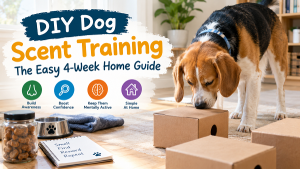
- DIY Dog Scent Training: Easy 4-Week Home Guide - November 20, 2026
- Buckeye Puppies Review: 5 Red Flags to Check - November 19, 2026