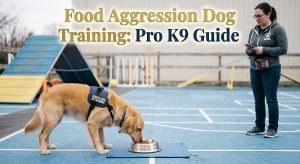
Food Aggression Dog Training: Pro K9 Guide
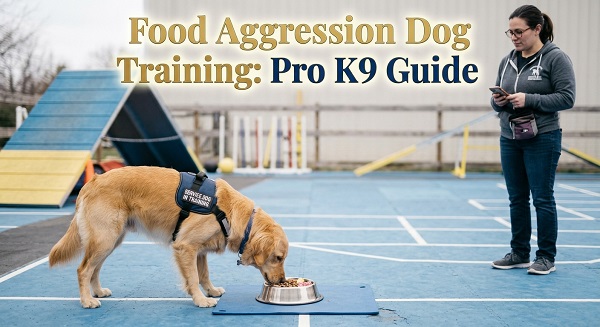
Food aggression dog training works by teaching your dog that people near the bowl predict something better, not something lost. Start with a vet check to rule out pain, set up safe mealtimes, then use approach-and-drop and trade-up exercises at a distance where your dog stays relaxed. Most mild cases show real progress in four to eight weeks. Dogs that bite, guard around children, or escalate fast need a qualified behavior professional, not a DIY plan.
Table of Contents
- What Food Aggression Really Looks Like
- Why Dogs Guard Their Food: What the Research Says
- Safety First: Do This Before Any Training
- The Pro K9 Food Aggression Training Plan
- Special Situations: Multi-Dog Homes, Puppies, Rescues and Kids
- 9 Mistakes That Make Food Aggression Worse
- When to Call a Professional
- What 14+ Years Around Working Dogs Taught Me About Food
- FAQs
- Final Thoughts
Introduction: When Dinner Turns Dangerous
You set the bowl down. Your dog freezes, locks eyes on you, and a low growl rumbles out. Your stomach drops, because you know what could happen next.
If that sounds familiar, you’re not alone, and you’re not raising a “bad” dog. Food aggression is one of the most common behavior problems handlers and owners face. A 2019 review of 1,016 shelter dogs found about 15% showed resource guarding, and most of those cases were mild to moderate. The problem? Plenty of homes handle it badly. They grab the bowl, scold the growl, or stand over the dog “to show who’s boss.” That usually makes things worse.
In this guide, I’ll walk you through food aggression dog training the way we’d approach it with a working dog: safety first, clear criteria, small steps, and no guesswork. You’ll learn:
- How to read the warning signs and rate a bite with the Dunbar scale
- What research says causes dog food aggression (and what doesn’t)
- A phase-by-phase plan with timelines you can follow at home
- How to handle multi-dog homes, puppies, rescues, and kids
- The red flags that tell you it’s time to call a professional
Quick note before we start: I’m a trainer, not your vet. If your dog has already bitten someone, jump to “When to Call a Professional” first.
What Food Aggression Really Looks Like
Food aggression is when a dog uses warning behaviors, like freezing, growling, snapping, or biting, to keep people or other animals away from food. Trainers often call the bigger picture resource guarding, because many dogs guard more than food. They guard toys, beds, couches, even favorite people. Food aggression is the food-specific version. Some dogs only guard bones and chews. Others guard a plain bowl of kibble. Knowing which one you’re dealing with changes the whole plan.
The Warning Ladder: Read It Early
Dogs rarely go from relaxed to biting in one second. They climb a ladder, and every rung is a message. Miss the early rungs and the bite feels like it came from nowhere.
| Level | What you see | What it means |
|---|---|---|
| 1. Subtle | Eating faster, body curled over the bowl, freezing mid-chew, side-eye showing the whites of the eyes | “I’m worried you’ll take this.” |
| 2. Clear warning | Stiff body, hard stare, lip lift, low growl | “Back off. I mean it.” |
| 3. Snap or lunge | Air snap, lunge toward you, snarl with teeth showing | Earlier warnings were ignored, so the volume goes up |
| 4. Bite | Teeth contact skin, from a pinch to deep punctures | The dog learned that warnings don’t work |
Here’s the part many owners miss: a growl is information, not disobedience. Punish it and you may teach your dog to skip straight to the bite. Research cited in an ASPCA study also shows that growling doesn’t reliably predict biting. In one veterinary caseload study of 3,226 dogs, 41% showed aggressive vocal behavior toward people, yet only 15% of those dogs ever bit a person. That’s not permission to relax, though. A dog with a bite history sits in a very different risk category.
How Serious Is It? Use the Dunbar Bite Scale
Professionals use Dr. Ian Dunbar’s bite scale because “he bit me” can mean a bruise or a hospital trip. Here’s the short version:
- Level 1: Growling, lunging, or snapping with no skin contact
- Level 2: Teeth touch skin but don’t puncture it
- Level 3: One to four shallow punctures from a single bite
- Level 4: Deep punctures, usually with tearing or bruising
- Level 5–6: Multiple deep bites in one attack, or a fatal one
My rule is simple. Levels 1 and 2 can often be worked at home by a careful owner with a good plan. Level 3 and up means a qualified professional needs to be in the room. No exceptions.
Why Dogs Guard Their Food: What the Research Says
Forget alpha and “pack leader” explanations. They’re outdated, and they push owners toward confrontation. The evidence points to a mix of genetics, learning, and the value of what’s in the bowl.
Genetics and Temperament
In a 2018 survey of 2,207 dog owners, Jacobs and her colleagues found that intact males and dogs living in multi-dog homes were more likely to guard resources. Jacobs also notes that impulsivity and generalized fear, two traits linked to guarding, are mostly genetic. Translation: some puppies are simply born more worried about losing things.
Guarding is instinct. Calm behavior around food is trained. If you want the bigger picture of how drive and control fit together, read our dog obedience vs. instinct guide.
Learning History
A dog that grew up fighting for food in a big litter, lived in a crowded shelter, or had people constantly tease or snatch its bowl can learn that humans nearby mean loss. Classic research by Scott and Fuller found that litters of puppies fed from an always-available supply rarely guarded. When food is plentiful, aggression drops. When it’s scarce, aggression climbs.
The Value of the Item
Smell matters. Strong-smelling, high-value items get guarded harder. In the ASPCA’s post-adoption follow-up calls, most guarding involved a rawhide, a plastic bone, or a tennis ball, not the food bowl. That’s useful: guarding a chew and guarding a bowl are two separate problems with two separate fixes.
Pain
Pain lowers a dog’s tolerance for everything. Dental disease, arthritis, and thyroid problems can all make a dog defensive around food. One veterinary behaviorist described a dog who started guarding food from his housemates every time his ear infection flared up. If your dog’s guarding started suddenly, book a vet visit before you start training.
How Common Is Food Aggression in Dogs?
More common than most people think, and often milder than people fear:
- 15% of 1,016 shelter dogs showed resource guarding in a 2019 study, and most cases were mild to moderate. Guarding was more common in adult and senior dogs than juveniles, and in small and large dogs than medium ones.
- 14% on average (range 7% to 30%) in an ASPCA survey of 77 shelters. Only 34% of those shelters tried to modify the behavior, and 51% made no attempt to place a food guarder for adoption.
- 5% return rate for 96 food-bowl guarders adopted under a simple management plan, compared with 9% for other adult dogs at that shelter. Only one of those dogs guarded the bowl at home in the first three weeks, and none did by month three.
That last study comes with honest caveats. Many adopters didn’t follow the plan perfectly, so the authors couldn’t say exactly what worked. They suspect less stress, more enrichment, and less competition at home all helped. The takeaway for you? Calm management and no bowl fights work better than most people expect.
Safety First: Do This Before Any Training
Step 1: Rule Out Medical Causes
Schedule a vet exam. Tell the vet exactly when the guarding happens. Ask about teeth, joints, digestion, and thyroid, and for senior dogs, vision, hearing, and cognitive changes. Sudden guarding in a dog with no history deserves a visit soon, not someday.
Step 2: Check the Red Flags
Call a professional first if any of these is true:
- Your dog has bitten with punctures (Level 3 or higher), or has bitten more than once
- The guarding goes beyond the bowl to toys, furniture, or you
- Your dog chases your hand away from the bowl, bites repeatedly, steps into the bowl, or moves it with his mouth. The ASPCA kept dogs like this out of its home program for safety reasons, and I treat the pattern as higher risk too
- A child, an elderly person, or someone with limited mobility lives in or visits the home
- You feel afraid to walk past the bowl
- Your dogs fight over food
Step 3: Build Your Management System
Management isn’t a cop-out. It keeps everyone safe while training does its slow work.
- Feed in a quiet, low-traffic spot, ideally behind a closed door or baby gate. A crate works well if your dog loves it. Our guide to crate training a puppy shows how to build that comfort.
- Never feed dogs near each other.
- Skip the “bowl test.” Don’t reach in to see if he’ll let you.
- Pick up bowls once your dog walks away on his own, so there’s no leftover prize to defend.
- Hold back bones, rawhides, and other high-value chews until training is further along.
- Keep children away from any dog that’s eating. An Australian (NSW) government factsheet notes that children aged 0 to 4 face the highest risk and most attacks happen in familiar places like home.
The Pro K9 Food Aggression Training Plan
Working-dog trainers don’t fix problems by arguing with the dog. We change what the dog expects. Three rules drive everything below:
- Work under threshold. Train at the distance where your dog stays relaxed. If he stiffens, you’re too close.
- Pay better than the prize. What you offer must beat what he’s guarding.
- Never turn it into a contest. You’re not trying to win the bowl. You’re building trust.
What you’ll need: high-value treats (cooked chicken, cheese, or hot dog slices), your dog’s normal meals split into portions, a notebook, and optionally a puzzle feeder.
Phase 0 (Week 0–1): Reset Mealtimes
- Feed at the same times in the same quiet spot.
- Keep food prep calm. The ASPCA’s own protocol says food time should never become an event.
- If your dog is relaxed about it, ask for a sit before lowering the bowl. If he stiffens when you lean in, skip that step. Put the bowl down while he waits behind a gate, then let him in.
- Feed half the daily ration from a puzzle feeder or snuffle mat. It gives him something to do besides worry.
- Ask your vet about splitting the day’s food into smaller, more frequent meals. A hungry, anxious dog guards harder.
- Free feeding helped some guarders in shelter settings, but it doesn’t suit multi-dog homes or dogs who tend to gain weight.
Phase 1 (Week 1–2): Approach and Drop
This is the core exercise. It flips what your approach means.
- Put a normal meal in the bowl and let your dog start eating.
- Stand at your “easy distance,” where he notices you but keeps eating with a loose body. For many dogs that’s 8 to 10 feet (about 3 meters). For some it’s across the room.
- Walk toward him on a gentle curve, no staring. Toss a bit of high-value food into the bowl from standing height, then walk away. Don’t stop, don’t talk, don’t touch.
- Repeat 5 to 10 times per session, once or twice a day.
- Close the gap by one step only after you see the “happy look-up”: he lifts his head to look at you with soft eyes and a loose body, because your approach now predicts food.
Pro tip: If he stops eating or freezes, step back two paces next time. Slow is fast here.
Phase 2 (Week 2–4): Teach the Trade
Start with objects, not the food bowl.
- Give your dog a boring toy he only mildly likes.
- After a moment, show a treat from your pocket, say “trade,” and let him nibble the treat while you pick up the toy.
- Give the toy back. A trade should never feel like theft.
- Build a ladder from low-value items (a dry toy) up to high-value ones (a favorite chew). Work one new item per day.
- Add “out” (drop it) and “leave it” cues. We teach both in our guide to the 10 essential protection dog commands, and they transfer straight to food guarding.
The golden rule: the trade must always be better than what’s in his mouth. If it isn’t, you’re just a thief with treats.
Phase 3 (Week 3–6): Add the Hand (Mild Guarders Only)
If your dog’s guarding has stayed at Level 1 or 2, you can build on the foundation:
- Hand-feed part of meals, a few kibbles at a time. Your hand becomes the source of food. Work with one dog at a time.
- Add food, don’t take it. While he eats, approach and add something better to the bowl.
- Bowl swap, much later. After at least two weeks of relaxed responses, pick up the bowl, add something better, and give it straight back.
Skip this phase if your dog has ever bitten at Level 3 or higher, or if he tenses when your hand moves. Get a professional to guide you instead.
Phase 4 (Week 5–8+): Generalize and Maintain
- Repeat the steps with different adults in the house (you present, same rules), different rooms, different bowls, and different foods.
- Keep practicing two or three times a week for months.
- Expect setbacks after big changes. In the ASPCA follow-up, all six homes where guarding showed up reported a major life change, like moving or a new routine. If life shakes things up, drop back to Phase 1 for a week or two.
Your Progress Traffic Light
| Signal | What you see | What you do |
|---|---|---|
| Green | Soft eyes, loose body, happy look-up | Close the gap one step or raise the difficulty |
| Yellow | Slower chewing, small freeze, stiff body, sideways glance | Hold here, repeat at the same level, or step back |
| Red | Growl, lip lift, hard stare, snap | Calmly end the session, return to the last easy distance, never scold. If red shows up at easy distances, call a pro |
Typical Timeline
| Weeks | Focus | Goal |
|---|---|---|
| 0–1 | Vet check and management | Calm meals, zero incidents |
| 1–2 | Approach and drop | Happy look-up at your easy distance |
| 2–4 | Teaching the trade | Dog swaps low-value items willingly |
| 3–6 | Hands and closer approach | Relaxed with you beside the bowl |
| 5–8+ | Generalize and maintain | Works with other adults and places |
These timelines come from my own work with mild cases. Nobody can honestly promise a date. Let the dog set the pace.
Special Situations: Multi-Dog Homes, Puppies, Rescues and Kids
Multi-Dog Homes
Fights over food cause some of the worst injuries I see. Feed every dog behind a closed door or in a separate crate. Pick up bowls after meals. Keep chews apart. Train each dog alone, because the exercises above get risky with an audience. Remember the survey data: multi-dog homes raise the odds of guarding. Don’t let dogs “work it out” over food.
Puppies: Prevention Is Easy
A puppy that stiffens over his bowl at ten weeks is telling you something. Act early:
- Hand-feed some meals and drop extra food into the bowl while he eats.
- Occasionally lift the bowl, trade for something better, and give it back right away.
- Keep it gentle and short. A puppy who gets harassed while eating learns to guard.
- If a puppy growls or snaps, ask a professional early. It’s far easier to fix at four months than at four years.
Newly Adopted and Rescue Dogs
Treat every new dog like a possible guarder for the first three weeks, even if he’s been perfect. Stress, new smells, and a new home all change how dogs think about resources. In the ASPCA study, guarding mostly appeared in the first three weeks, and mostly around high-value chews. Give those in a crate or behind a closed door, not in the middle of the family room.
Homes with Children
- Use baby gates or closed doors during every meal and chew session.
- Never let kids feed the dog, take things away, or “help” with training.
- Teach children the simple rule: a dog that’s eating is off limits.
- If your dog guards around kids at all, call a professional before another meal.
Guarding Chews, Bones, and Treats
Bowl guarding and chew guarding aren’t the same. Often the easiest fix is not handing out the item that causes trouble. If you do want to give a chew, give it alone, then use the trade ladder from Phase 2.
9 Mistakes That Make Food Aggression Worse
Some guides tell you to stand over your dog and ignore the growl, or yank him off the bowl with a leash. Please don’t. Here are the mistakes I see most:
- Punishing the growl. You remove the warning and keep the problem.
- Taking the bowl to prove a point. Repeated bowl grabs teach him that humans near food mean loss. All six dogs that guarded in the ASPCA follow-up lived with adopters who tried to pick up the bowl mid-meal. That’s not proof, but it matches what trainers see.
- Alpha rolls and “dominance” corrections. They add fear and conflict.
- Rushing the distance. If you go closer too fast, you teach him that warnings work.
- Using low-value rewards. Dry kibble doesn’t beat a steak bone.
- Letting kids help. Never.
- Training only when there’s a problem. Practice a little each day, not only after a scary moment.
- Ignoring stress and life changes. Moves, new babies, and new pets bring guarding back.
- Skipping the vet. Pain hides behind behavior problems all the time.
When to Call a Professional
Call a pro if you see any red flag from the safety section, if your dog doesn’t improve after four to six weeks, or if you just don’t feel safe. That isn’t failure. It’s smart handling.
Who to look for:
- A veterinary behaviorist (DACVB in the US), who can also treat medical causes and prescribe medication
- A certified applied animal behaviorist (CAAB) or certified behavior consultant (such as CDBC or CBCC-KA)
- A trainer with proven experience in resource guarding who uses reward-based methods. In the UK, ask your vet about a referral to a behaviorist registered with the APBC
Ask these questions:
- What methods do you use, and do you avoid shock, prong collars, and alpha-style corrections?
- How many resource guarding cases have you handled?
- Will I get a written plan and follow-up support?
- Can you teach us safety tools like muzzle training for severe cases?
Walk away if they promise a “100% cure in three days.” Real behavior change takes weeks, and honest pros say so.
Want to go deeper? Jean Donaldson’s book Mine! A Practical Guide to Resource Guarding in Dogs (winner of the 2002 DWAA Maxwell Award) covers safety tools, desensitization, and sample item hierarchies in detail.
What 14+ Years Around Working Dogs Taught Me About Food
Working-dog programs treat food as a tool, not a free gift. Here’s what carries over to your living room:
- The handler controls resources. Working dogs earn rewards and follow clear mealtime routines, which means less competition and less worry.
- We never “test” a dog’s bowl. We ask the dog to move, then we add value. That’s it.
- We keep data. Write down the date, the item, the distance, and your dog’s reaction. Five lines per session shows you progress your memory will miss.
- We train “out” with decoy items every week. A dog who trades a ball for a treat will often trade a bone too.
- We pick safety over pride. If a dog bites hard, we call in specialists and use safety gear while we work.
Here’s a pattern I see again and again. An owner calls about a young adult dog that growls whenever the family walks past at dinner. They’ve been checking the bowl daily “to make sure he’s okay with it.” Once they stop the tests and switch to approach-and-drop, the growling usually fades first, then the stiff body language follows. The dog never needed a stronger hand. He needed a clearer deal.
One honest limit: some dogs will always lean toward guarding. For them, success means a safe, predictable, relaxed routine for life, not a magic cure.
Disclaimer: This article is educational and doesn’t replace advice from your vet or a qualified behavior professional.
FAQs
1. Can food aggression in dogs be cured?
Many dogs improve a lot, especially mild cases. The ASPCA study showed that most food guarders adopted with a simple plan weren’t guarding the bowl at home within three months. But “cured” is a big word. Think of it as managed and trained, with maintenance practice for life.
2. Should I take food away to show my dog I’m the boss?
No. Repeated bowl grabs teach your dog that people near food mean loss, which is exactly what he fears. Use approach-and-drop and trade-up instead.
3. Why does my dog growl when eating but stay friendly the rest of the time?
Because the worry is tied to food, not to you. Many dogs are relaxed and loving until something valuable is on the line. The growl is a request for space, so respect it, then start the training plan from a safe distance.
4. How long does food aggression dog training take?
Mild cases often show change in two to four weeks and solid habits in six to eight. Severe cases take longer and need professional support. Setbacks after stress are normal, so expect to practice for months.
5. Are some breeds more food aggressive?
The research points to size and circumstances more than breed. The 2019 shelter study found guarding more common in small and large dogs than medium ones, and the 2018 owner survey linked it to intact males and multi-dog homes. Any breed can guard, so watch your individual dog.
Final Thoughts: Calm Dogs Are Built, Not Bossed
Food aggression feels scary, but it’s one of the most workable behavior problems when you stay patient and safe. Rule out pain. Manage mealtimes. Work at your dog’s pace. Pay better than the prize. And call a professional the moment bites, kids, or fear enter the picture.
Here’s your action plan:
- This week: book the vet check and set up a separate, quiet feeding spot.
- Tonight: stop all bowl tests and start a simple training log.
- Tomorrow: begin Phase 1, approach and drop, at your dog’s easy distance.
If you want more of my handler-level training approach in one place, grab my e-book Beyond the Bark: Inside a Pro Handler’s Playbook for Raising the Ideal Dog. And if you’d like practical K9 training tips delivered every week, subscribe to our weekly articles roundup newsletter.
Sources and Further Reading
- McGuire, B. (2019). Characteristics and Adoption Success of Shelter Dogs Assessed as Resource Guarders.
- Mohan-Gibbons, H., Weiss, E., & Slater, M. (2012). Preliminary Investigation of Food Guarding Behavior in Shelter Dogs in the United States. Animals, 2(3), 331–346.
- Jacobs and colleagues (2018). Owner survey of 2,207 dogs on factors linked to resource guarding.
- NSW Government. Preventing Dog Attacks factsheet.
- Donaldson, J. Mine! A Practical Guide to Resource Guarding in Dogs. Dogwise.
- dvm360. Bad behavior? Pet may be pain.

Her work centres on obedience, detection, protection and operational readiness. She favours proven methods built on repetition, consistency and real-world conditioning, so that both dogs and handlers are prepared for high-pressure tasks.
Rofiat represented the Nigerian Army Dog Centre at the Nigerian Army Day Celebration (NADCEL) 2026, where she led demonstrations in obedience, explosive detection, agility and tactical movement. Through articles, training content and documentaries, she shares field-based insight into how structured training, clear communication and trust between handler and dog affect performance and reliability.
She is the author of Beyond the Bark: Inside a Pro Handler's Playbook for Raising the Ideal Dog, a practical guide that helps dog owners and handlers apply professional training principles in everyday situations.
- Food Aggression Dog Training: Pro K9 Guide - November 21, 2026
- DIY Dog Scent Training: Easy 4-Week Home Guide - November 20, 2026
- Buckeye Puppies Review: 5 Red Flags to Check - November 19, 2026