Buckeye Puppies Review: 5 Red Flags to Check
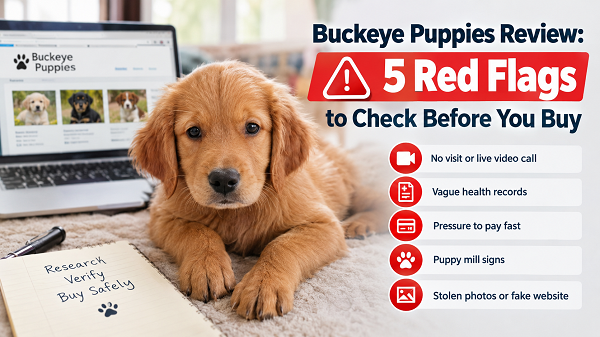
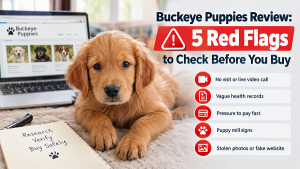
Is Buckeye Puppies legit? Buckeye Puppies is a real Ohio-based classifieds website. Its representatives say the site advertises puppies for breeders and does not raise, sell, or house any puppies itself. That means the site isn’t the risk. The individual seller is. The 5 red flags to check are:
- The seller won’t let you visit or do a live video call.
- Health records are vague, or the dates don’t add up.
- You’re pushed to pay a deposit fast, or by an unusual method.
- The seller shows puppy mill signs, like many breeds and non-stop litters.
- The photos are stolen, or the website is a lookalike of the real one.
Table of Contents
- Introduction
- What Is Buckeye Puppies, Really?
- What Buyers Say: A Reality Check on Buckeye Puppies Reviews
- The 5 Red Flags to Check
- The Safe-Buying Checklist (Step by Step)
- Why This Matters for Training
- What to Do If Things Go Wrong
- FAQs
- Final Thoughts
Introduction
You found a cute puppy on Buckeye Puppies. The photos are adorable, the price feels fair, and your kids are already picking names. Then you Google “Buckeye Puppies reviews” and see a mess: angry complaints, a few happy buyers, and scam warnings that mention similar names.
So what’s the truth?
I train working dogs, and I’ve seen what happens when a puppy starts life in a bad place. Poor early care shows up later as fear, anxiety, bad health and behavior problems that take months to fix. Buying the right puppy matters as much as training it well.
In this guide, you’ll learn what Buckeye Puppies actually is, what real buyers report, the 5 red flags to check before you pay anyone a cent, and what to do if something goes wrong. This is a global guide. The scam tactics are the same whether you’re in the US, UK, Canada or Europe.
What Is Buckeye Puppies, Really?
It’s a Classifieds Site, Not a Breeder
Most people get this wrong. Buckeye Puppies works like an online noticeboard. Breeders pay to list their puppies, and buyers contact them directly. The site says buyers pay nothing to use it, and that any deposit you send goes straight to the seller, not to the website.
So when someone writes “I bought a sick puppy from Buckeye Puppies,” they usually mean they bought from a seller listed there. That difference matters. It tells you where to put your effort: vetting the seller, not the website.
How the Platform Works
You browse listings, then message or call the seller. The site doesn’t inspect kennels, check health records, or handle payment. Sellers handle all of that themselves, outside the site. Think of it like a car listing site. The site shows you the car, but it doesn’t certify the engine.
Beware of Lookalike Websites
Here’s a trap that catches careful buyers. The real site is buckeyepuppies.com. But scam trackers have flagged lookalike sites with “Buckeye” in the name. Petscams.com lists doxiebuckeye.com, which uses a Gmail address as its contact, as a scam site. It also lists buckeyedachshund.com, another Gmail-based site.
If a “Buckeye” website has one breed, a contact form, a free email address and no way to visit, walk away. That’s not the classifieds site. That’s a fake wearing its name.
What Buyers Say: A Reality Check on Buckeye Puppies Reviews
I’ll be straight with you. The reviews are mixed, and the review sites aren’t perfectly reliable either.
The Numbers at a Glance
| Source | What it shows |
|---|---|
| ComplaintsBoard | A 1.0 out of 5 reputation rating based on 15 complaints and no reviews |
| Trustpilot (Belgium page) | A 3.5 TrustScore from only 3 reviews |
| SmartCustomer | Several complaints, each answered by a site rep |
Those are small samples. Fifteen complaints can’t tell you how a site performs across millions of visits, but they do show patterns worth knowing.
The Patterns in the Complaints
One verified ComplaintsBoard complaint stuck with me. A buyer took their puppy to the vet the day after pickup and found ear infections, roundworms and giardia, then spent about $640 on visits, tests and medicine. The health paper said a vet had checked the puppy two days before pickup. The seller reportedly ignored the receipts afterward.
Other complaints use the words “puppy mill.” One reviewer claims many listings come from large breeding operations where adult dogs live in cages and breed repeatedly. These are buyer allegations, not proven facts about any named seller. Still, they match what animal welfare groups report about Ohio, which we’ll cover below.
How to Read These Reviews Wisely
- Look for patterns, not single stories. One angry review is noise. The same complaint ten times is a signal.
- Remember the seller is different from the site. A bad seller doesn’t make every listing bad.
- Don’t trust glowing reviews blindly. Scam sites fake reviews. Petscams.com notes that scammers often copy the same review text across several fake sites, so paste a review into Google and see if it appears elsewhere.
The 5 Red Flags to Check
Red Flag 1: The Seller Won’t Let You Visit or Do a Live Video Call
This is the biggest one. A real breeder with a real puppy can show you the puppy, the mother and the place where they live. Scammers can’t.
The BBB says scammers can’t produce a live video of a pet they don’t have. So ask for a live video call and request something specific: “Please hold the puppy next to today’s newspaper,” or “Show me the mother.” A recorded clip proves nothing.
Here’s my rule: no visit and no live video means no deal. Animal welfare researchers give the same advice, and say to avoid any breeder you can’t visit in person.
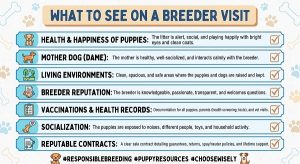
If you visit, watch for these things:
- Are the mother dogs around, healthy and friendly?
- Is the area clean, with space to move?
- Does the seller let you see where the puppies sleep, or does the exchange happen in a parking lot?
Red Flag 2: Vague Health Records or Dates That Don’t Add Up
Remember that $640 vet-bill story? The warning sign was sitting in the paperwork. The vet check was dated two days before pickup, yet the puppy had parasites a vet would almost certainly have caught.
Here’s what a healthy paper trail looks like for a puppy leaving at 8 weeks or older:
- A written vaccination record. Puppies usually get first shots around 6 to 8 weeks, with boosters every few weeks until about 16 weeks.
- Deworming dates with product names.
- A vet’s name and phone number you can actually call.
- Written health guarantee terms.
Call the vet. It takes five minutes. If the seller won’t give a vet name, treat that as your answer. And book your own vet visit within the first few days, no matter what the paperwork says.
Red Flag 3: Pressure to Pay Fast, or in Strange Ways
Scammers love urgency. “Another buyer is coming today, so send a deposit now.” Sound familiar?
Watch for:
- Deposits requested before you’ve seen the puppy
- Payment only by gift card, cash app, wire transfer or crypto
- Surprise “shipping,” “insurance” or “special crate” fees after you’ve paid
- Sellers who refuse a written receipt
Money lost this way rarely comes back. One Ohio teenager sent a $150 deposit by Cash App for a Dachshund listed at $300, then the seller stopped answering and the number went dead. Look at the pattern: low price, small deposit, ghosting.
The BBB adds a nasty twist. These scams work because they come back for more money several times, and average losses reached $850 in 2022, up 60 percent since 2017. A first small fee is often just the start.
Better habits: pay by credit card when possible, because card protections give you a way to dispute charges. Pay the balance only when you hold the puppy. Always get a receipt with names, date and puppy details.
Red Flag 4: Puppy Mill Signs (Too Many Breeds, Too Many Litters)
Puppy mills are why this topic matters so much in Ohio. In the 2025 Horrible Hundred report, Ohio ranked second in the country with 16 problem breeders, spread across Tuscarawas, Coshocton, Richland, Holmes, Wayne and Muskingum counties. In 2026, eight Ohio breeders made the list.
The Horrible Hundred isn’t a list of every puppy mill. The group describes it as a list of problem breeders to avoid, and says it shows recurring problems, not a full inventory.
A license doesn’t guarantee good care either. The group warns that a USDA-licensed facility can still be a problem. You can check an Ohio breeder against the Ohio Department of Agriculture’s searchable list of high-volume dog breeders, and search the seller’s name alongside “Horrible Hundred.”
Spot these signs in a listing or on a visit:
- Five or more breeds for sale at one address
- Puppies “always available” in every size and color
- Mothers you can’t see, or who look thin, scared or matted
- Puppies sold before 8 weeks
- The seller asks very few questions about you
A good breeder interviews you. They want to know your home, your schedule and your plans. If a seller only asks “Cash or deposit?”, you’ve found a business, not a breeder.
Red Flag 5: Stolen Photos or a Fake Website
Reverse image search is free, and it catches a shocking number of scams. Right-click the puppy photo, choose “Search image with Google,” and see where else it appears. One reviewer on SmartCustomer even claimed a seller’s puppy pictures were taken from real people’s social media accounts. That’s an allegation, but it shows what to check.
Also check the website itself:
- When was the domain registered? A brand-new domain selling “years of experience” is suspicious.
- Does it use a free Gmail or Yahoo address?
- Is there a real street address you can find on a map?
- Do the same reviews appear on several other sites?
The BBB in Texas logged more than 35 puppy scam complaints and over $31,000 in losses between December 2025 and February 2026. Yorkshire Terriers, Dachshunds and French Bulldogs make up nearly a third of puppy scams, because scammers know those breeds sell fast. So if a listing for one of those breeds looks too good, slow down.
The Safe-Buying Checklist (Step by Step)
Use this order every time. Don’t skip steps because the puppy is cute. That’s exactly what sellers count on.
- Search the seller’s name, phone number and email. Add words like “complaint,” “scam” and “review.”
- Check the BBB and the state agriculture or licensing record. In Ohio, that’s the Department of Agriculture’s breeder list. Elsewhere, check your own country’s equivalent.
- Run a reverse image search on every photo.
- Request a live video call with the puppy and the mother.
- Visit in person. Look at the living area, the mother and the other dogs.
- Ask for vet records, and call the vet.
- Ask about health testing for the parents. For larger breeds, that usually means hip and elbow checks.
- Get a written contract that covers health guarantees, return terms and what happens if the puppy is sick.
- Pay safely. Use a card or another traceable method, and never pay in full before pickup.
- See your own vet within 72 hours of bringing the puppy home.
Outside the US, look for the same protections locally. In the UK, for example, the Kennel Club’s Assured Breeder Scheme and the Puppy Contract are useful starting points. In Canada, the Canadian Anti-Fraud Centre tracks pet scams. It logged 247 pet scam reports in 2022 alone.
If you don’t need a specific breed, consider a shelter or rescue. The BBB notes that adopting locally lets you know exactly where your pet comes from.
Why This Matters for Training
Here’s the angle most review sites miss. Where your puppy comes from shapes how easily it trains.
Puppies raised in crowded, noisy or isolated conditions often miss key socialization in the first 8 to 12 weeks. I’ve seen them show up with fear of new people, trouble settling alone, and house-training that just won’t stick. That’s not “a bad dog.” It’s a puppy who didn’t get a fair start.
The good news is that you can help. Start with structure on day one:
- How to Potty Train a Puppy in 7 Days: Expert Schedule gives you a day-by-day plan.
- How to Crate Train a Puppy: K9 Trainer Tips for Faster Results helps a nervous pup feel safe.
- Essential Dog Grooming Tips for a Healthy Puppy covers weekly checks that catch ear infections and skin problems early.
If you want a deeper plan for the first months, my e-book Beyond the Bark walks new owners through building good habits from the start.
What to Do If Things Go Wrong
If You Lost Money to a Fake Seller
- Contact your bank or card company right away.
- Report it to the FTC at reportfraud.ftc.gov (US), and to the BBB Scam Tracker.
- Report it to Petscams.com, which tracks complaints and works to get fraudulent websites taken down.
- In Canada, report to the Canadian Anti-Fraud Centre. In the UK, use Action Fraud.
If Your Puppy Arrived Sick
- See a vet immediately and keep every record and receipt.
- Send the seller your vet report in writing, and keep copies of every message.
- Ohio Animal Advocates recommends filing a complaint with the Ohio Department of Agriculture and contacting local animal control.
- Check whether your state or country has a “puppy lemon law.” Many do, and rules vary.
You’re not stuck, and you’re not foolish. These sellers are good at what they do.
FAQs
1. Is Buckeye Puppies a scam?
No. It’s a real classifieds site, and the company says it doesn’t raise or sell puppies. But it doesn’t vet sellers for you, so scams and poor breeders can still appear in listings. Treat every seller as unproven until you’ve checked them yourself.
2. Does Buckeye Puppies ship puppies?
Based on the site’s own guidance, it doesn’t arrange delivery. Any seller who insists you pay for shipping without meeting you is a major red flag, and it matches the scam pattern the BBB describes.
3. Can I trust Buckeye Puppies reviews?
Use them as clues, not proof. The review samples are small, and fake reviews exist across the internet. Look for repeated complaints about the same issue, like parasites, missing records or refund refusals.
4. How do I tell a good breeder from a puppy mill seller?
A good breeder lets you visit, shows you the mother, asks you many questions, gives written health records and offers a contract. A mill-style seller sells many breeds, avoids visits and focuses on getting paid fast.
5. What should I do first after bringing a puppy home?
Book a vet visit within 72 hours, keep the puppy away from public areas until vaccinations are complete, and begin gentle house-training and crate routines straight away.
Final Thoughts
So, is Buckeye Puppies legit? The site is real, but it’s a listing board, and your protection comes from checking the seller yourself. Remember the five flags: no visit or live video, shaky health records, payment pressure, puppy mill signs, and stolen photos or lookalike websites.
Here’s what to do today:
- Pick the puppy you like, then research the seller before you message them again.
- Insist on a visit or live video.
- Call the vet listed on the records.
- Pay safely, and only after you hold the puppy.
A few extra days of checking can save you hundreds of dollars and a lot of heartache.
Want weekly tips on training, health and smart puppy buying? Subscribe to our weekly articles roundup newsletter.
Sources used: Humane World for Animals (Horrible Hundred), NBC4 Columbus, Spectrum News, Hoodline, BBB (national and Heart of Texas reports), News5 Cleveland, ComplaintsBoard, Trustpilot, SmartCustomer, Petscams.com, Canadian Anti-Fraud Centre figures via local news.

Her work centres on obedience, detection, protection and operational readiness. She favours proven methods built on repetition, consistency and real-world conditioning, so that both dogs and handlers are prepared for high-pressure tasks.
Rofiat represented the Nigerian Army Dog Centre at the Nigerian Army Day Celebration (NADCEL) 2026, where she led demonstrations in obedience, explosive detection, agility and tactical movement. Through articles, training content and documentaries, she shares field-based insight into how structured training, clear communication and trust between handler and dog affect performance and reliability.
She is the author of Beyond the Bark: Inside a Pro Handler's Playbook for Raising the Ideal Dog, a practical guide that helps dog owners and handlers apply professional training principles in everyday situations.
- Food Aggression Dog Training: Pro K9 Guide - November 21, 2026
- DIY Dog Scent Training: Easy 4-Week Home Guide - November 20, 2026
- Buckeye Puppies Review: 5 Red Flags to Check - November 19, 2026