Essential Dog Grooming Tips for a Healthy Puppy
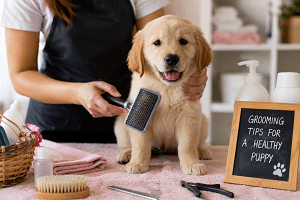
Essential dog grooming tips for a healthy puppy come down to five habits: brush on a regular schedule, bathe only when needed with puppy-safe shampoo, trim nails every few weeks, check ears and eyes weekly, and brush teeth daily. Start handling your puppy’s paws, ears and mouth from day one, in short, treat-filled sessions. Take your puppy to a professional groomer for a first visit at around 12 to 14 weeks, once vaccines are up to date. Match the routine to your puppy’s coat, and check the whole body during every session so you catch skin problems, parasites and lumps early.
Table of Contents
- Introduction
- Why Puppy Grooming Matters (More Than You Think)
- When to Start Grooming a Puppy (Age-by-Age Timeline)
- Essential Puppy Grooming Tools
- The 5-Minute Handling Drill (Do This First)
- How to Brush a Puppy (By Coat Type)
- How to Bathe a Puppy: First Bath and Step-by-Step
- Nail Care for Puppies
- Ear and Eye Care
- Puppy Dental Care
- The Weekly Head-to-Tail Health Check
- A Simple Puppy Grooming Schedule
- Grooming in Different Climates and Seasons
- Professional Groomers: When, How Much and How to Choose
- 7 Grooming Mistakes to Avoid
- FAQs
- Conclusion
Introduction
Your puppy needs more than food, vaccines and walks. Grooming is part of preventive healthcare, and most new owners don’t realize that until a problem shows up: a painful mat, an ear infection, nails that make the puppy slip on tiles, or an adult dog who fights every nail trim.
Here’s the good news. Puppy grooming isn’t hard, and it doesn’t need expensive gear. It needs the right order of steps and a calm, steady routine.
In this guide, you’ll learn when to start grooming, how often to brush, bathe and trim, how to handle the first bath, how to deal with the puppy-to-adult coat change, and how to build a weekly schedule you’ll actually follow. I’ll also share what we teach on the training field about getting dogs comfortable with handling, because that skill matters for every dog, not just working dogs.
Why Trust This Guide?
I’m writing this the way I’d explain it to a new handler. I’m Cpl. Rofiat Muritala, a Nigerian Army military working dog instructor and handler with more than 14 years of experience at the Nigerian Army Dog Centre. Working dogs get examined, handled and checked constantly, so we treat tolerance for touch as a core skill, not a bonus. I’ve also raised my own puppy, a German Shepherd mix named Bruno, and I made plenty of grooming mistakes with him. I’ll share those so you can skip them.
I’ve backed the key facts with veterinary sources like PetMD, the American Veterinary Medical Association (AVMA) and the American Kennel Club (AKC). They’re listed at the end. This guide is general education, so always ask your own vet about anything that worries you.
Why Puppy Grooming Matters (More Than You Think)
Puppies explore with their whole bodies. They roll in grass, crawl under furniture and splash through puddles. That means dirt, loose hair, moisture and parasites all end up in the coat.
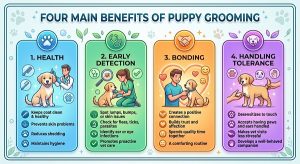
Regular grooming does three big jobs:
- It protects health. Brushing prevents mats, which can cause skin infections and even cut off circulation, according to PetMD. Trimmed nails prevent painful splitting. Clean ears lower infection risk in floppy-eared puppies.
- It lets you find problems early. Every grooming session is a mini health exam. You’ll spot fleas, ticks, lumps, scabs and sore spots long before they become emergencies.
- It builds a handling-friendly dog. This is the benefit people overlook. A puppy who learns to relax while you touch its paws, ears and mouth will be far easier to manage at the vet, at the groomer and at home.
Dental care shows why early habits count. The AVMA says periodontal disease affects nearly 80% of dogs by age three. Yet a study cited by the AVMA found only about 2% of dog owners brush daily. The same AVMA release cites a 2013 insurance analysis showing preventive dental care costs roughly one-third as much as treating preventable dental disease. Small daily habits save money and pain.
The behavior side matters just as much. I once helped a friend whose adult dog panicked whenever nail clippers appeared. Nobody had ever introduced nail trimming when the dog was a puppy. A five-minute job turned into a monthly wrestling match. That’s the cost of waiting.
When to Start Grooming a Puppy (Age-by-Age Timeline)
You can start gentle grooming the day you bring your puppy home, using soft brushing and touching the paws, ears and mouth. A full bath usually waits until at least 8 weeks, and many vets prefer you wait until after the first vaccines, so ask yours. The first professional groomer visit works best at about 12 to 14 weeks, once vaccines are up to date, according to PetMD.
Timing matters because puppies learn fastest when they’re young. PetMD notes that a puppy’s ability to form positive associations with new experiences drops sharply after about four months of age. So you don’t want to wait until the “perfect” moment. Start small now.
| Age | What to do |
|---|---|
| 8 to 10 weeks | Soft brushing, paw/ear/mouth touching, finger “tooth” practice. Spot-clean with a damp cloth. Ask your vet when a full bath is safe. |
| 10 to 14 weeks | First tiny nail trims (tips only). First full bath if your vet agrees. Book a first groomer visit at 12 to 14 weeks if vaccines are up to date. |
| 3 to 4 months | Add toothbrush practice. Repeat short groomer visits if you use one. Keep every session positive. |
| 4 to 6 months | Puppy coat starts changing to adult coat. Brush more often. Baby teeth are being replaced. |
| 6 to 12 months | Settle into an adult routine. Watch the coat closely in slow-maturing breeds. |
Treat this as a guide, not a rule. Every puppy matures at a different pace.
Essential Puppy Grooming Tools
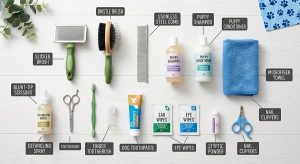
You don’t need a huge kit. Start with these basics and add more later.
| Tool | What it does | What to watch for |
|---|---|---|
| Soft slicker brush | Detangles long, curly and double coats | Use light pressure on puppy skin |
| Rubber grooming mitt or bristle brush | Lifts loose hair on short coats | Great first tool for nervous puppies |
| Metal comb | Checks for hidden tangles behind ears and under legs | Use after brushing, not instead of it |
| Puppy shampoo | Cleans without stripping skin oils | Never use human shampoo |
| Nail clippers or grinder | Shortens nails safely | Choose a size that fits small nails |
| Styptic powder | Stops bleeding if you clip the quick | Keep it open and ready before you start |
| Vet-approved ear cleaner | Clears wax and debris | Skip alcohol-based products |
| Dog toothbrush or finger brush + dog toothpaste | Daily plaque control | Use fluoride-free dog toothpaste |
| Non-slip mat and towels | Keeps your puppy steady and warm | A slippery tub causes panic fast |
| High-value treats | Makes grooming rewarding | Soft, tiny pieces work best |
A quick word about quality: cheap brushes with sharp metal pins scrape the skin. Your puppy will remember that feeling. Spend a little more on a gentle brush.
The 5-Minute Handling Drill (Do This First)
Before you pick up a brush, teach your puppy to enjoy being touched. This is the same idea we use with working dogs: you can’t examine, treat or groom a dog that won’t stand still for handling.
PetMD recommends short sessions, several times a day, with lots of praise and tasty treats. Here’s how I’d run it:
- Pick a calm moment. After a walk or play session works well. A tired puppy cooperates better.
- Touch, then treat. Touch one paw for one second. Give a treat. Repeat.
- Work your way around. Over several days, add ears, mouth, belly, tail and each leg.
- Increase time slowly. Go from one second to three, then five.
- Add the tools. Let your puppy sniff the brush or clippers. Touch the tool to the body. Treat. Repeat.
- Stop before your puppy gets tired of it. Two good minutes beat ten bad ones.
If your puppy pulls away, you moved too fast. Back up a step. Never hold a frightened puppy down, because forced handling teaches fear. That’s the same reason good trainers rely on calm structure over intimidation.
How to Brush a Puppy (By Coat Type)
Brushing is the most important grooming habit. It spreads skin oils, removes dead hair and finds problems early.
Brush with the lay of the hair. Use light strokes. Hold the skin steady with your free hand so you don’t tug.
| Coat type | Examples | Best tools | How often |
|---|---|---|---|
| Short | Beagle, Boxer, Doberman | Rubber mitt, soft bristle brush | Once a week |
| Double | German Shepherd, Husky, Golden Retriever | Soft slicker, undercoat rake (later) | 2 to 3 times a week |
| Curly/wavy | Poodle, Doodle, Portuguese Water Dog | Slicker + metal comb | Daily or every other day |
| Long/silky | Shih Tzu, Maltese, Yorkie | Slicker + metal comb | Daily |
| Wire | Terriers | Slicker or stripping comb | 1 to 2 times a week |
Always brush down to the skin, not just the top layer. Hidden tangles form behind the ears, under the armpits, at the base of the tail and around the collar.
The Puppy-to-Adult Coat Change
This is the part most guides skip, and it’s where mats sneak up on owners.
Puppies usually start losing their puppy coat at around 4 to 6 months, according to PitPat. The AKC notes that the adult coat is usually thicker and stiffer, and that some breeds, like the Pomeranian, can take up to two years to fully grow it in. Color can change too.
During this phase, loose puppy fur can tangle into the new coat, especially in long and curly breeds. So brush more often than usual, use a soft brush early on, and don’t panic about heavy shedding. If you see bald patches, redness or constant scratching, that’s not normal. See your vet.
Also, don’t shave a double-coated puppy to “help in the heat.” The AKC advises against shaving double coats unless there’s a medical reason, because the coat helps regulate temperature.
How to Bathe a Puppy: First Bath and Step-by-Step
Most puppies don’t need many baths. You can usually give a first full bath at 8 weeks or older, but check with your vet about timing around vaccines. After that, bathe about once every 4 to 6 weeks, or when your puppy is dirty or smelly. Too many baths strip natural oils and dry out the skin.
Before 8 weeks, or if your vet says to wait, spot-clean with a damp cloth. Young puppies chill quickly because they don’t regulate body heat well yet.
I learned the “too much bathing” lesson with Bruno. During the rains he came home muddy again and again, and I washed him each time. His skin dried out, flaked and itched. My vet’s advice was simple: rinse the mud off the legs and belly, and save full shampoo baths for when he really needed one. Another time, Bruno rolled in mud mixed with engine oil. That emergency bath taught me to keep puppy shampoo and towels ready before I needed them.
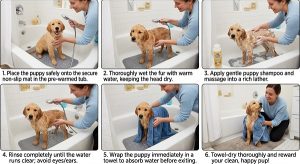
Step-by-Step Puppy Bath
- Gather everything first. You need shampoo, towels, a cup or gentle sprayer, a brush and treats. Never leave a wet puppy to fetch something.
- Brush first. Water tightens knots. Remove loose hair and tangles before the bath.
- Set up a non-slip surface. A rubber mat in the tub or sink makes your puppy feel secure.
- Use lukewarm water. Test it on your inner wrist. It should feel comfortable, not hot.
- Wet from the legs up. Start at the body and work toward the neck. Avoid pouring water over the head.
- Apply a small amount of puppy shampoo. Massage into the neck, back, chest, belly, legs and tail. Keep it out of the eyes and ears.
- Rinse thoroughly. Leftover shampoo is one of the top causes of itching. Rinse longer than you think you need to.
- Wipe the face with a damp cloth. Skip shampoo around the eyes and nose.
- Towel dry gently. Pat and squeeze rather than rub hard.
- Keep your puppy warm. Stay in a warm room until fully dry. Introduce a dryer slowly on a low, cool setting, because many puppies fear the noise.
- Reward calm behavior. Praise and treat at the end so bath time ends on a good note.
A tip from PitPat: for some puppies, running the bath before you bring the puppy in reduces the shock of noise and spray.
Safety rule: never leave a puppy alone in water or on a raised table, not even for a few seconds.
Nail Care for Puppies
Puppy nails are needle-sharp, and long nails cause real problems. They can change how your puppy stands and walks, strain joints, split or snap, and in extreme cases curl into the paw pad, as PetMD points out.
Inside each nail is the quick, a bundle of blood vessels and nerves. Cut it and your puppy feels pain and the nail bleeds.
How Often?
Trim about every 2 to 4 weeks, or whenever you hear clicking on hard floors. Many puppies do best with tiny, frequent trims.
I once got busy and let Bruno’s nails go too long. He started sliding on our smooth tiles and walked awkwardly. After a trim, his normal stride came back within hours. That’s how much nail length affects movement.
Safe Trimming Steps
- Handle the paws daily so trimming isn’t a surprise.
- Hold one paw and press gently on a toe to extend the nail.
- Clip only the tip. On light nails, stay away from the pink area. On dark nails, trim tiny slices and stop when you see a small dark dot appear in the center of the cut surface.
- Treat after each nail, not just at the end.
- Don’t forget the dewclaws, the higher nails on the inside of the leg. They don’t touch the ground, so they never wear down and can curl.
- Keep styptic powder open and nearby. If you clip the quick, press it on the nail. Stay calm. Your puppy copies your mood.
Clippers or Grinder?
Grinders give you smoother edges and more control, and they work well for nervous dogs, but the vibration and noise take time to get used to. Clippers are quick and quiet. Choose what your puppy tolerates, and introduce either slowly.
Ear and Eye Care
Ears
Check ears weekly. A healthy ear looks pale pink, smells clean and has little wax. Floppy-eared puppies trap moisture and often need more attention.
Warning signs:
- Bad smell
- Redness or swelling
- Brown or yellow discharge
- Constant scratching or head shaking
How to clean:
- Squeeze a vet-approved ear cleaner into the ear.
- Massage the base of the ear for 20 to 30 seconds.
- Let your puppy shake its head.
- Wipe away debris from the outer part with a cotton ball or pad.
Don’t push cotton swabs into the canal. PetMD warns that swabs can rupture an eardrum. I made a related mistake with Bruno: I cleaned too deep and too hard, pushed debris further in, and he started shaking his head constantly. We ended up at the clinic. Gentle and shallow is the rule.
If your puppy swims or gets a bath, dry the ears well afterward. Trapped moisture lets bacteria and yeast grow.
Eyes
Wipe the corners with a clean, damp cloth or cotton pad, using a fresh one for each eye. Petplan advises seeing a vet if the eyes look sticky or sore. Squinting, heavy discharge, redness or pawing at the eye also need a vet visit.
Puppy Dental Care
Dental care is the most neglected part of grooming. Remember that AVMA figure: nearly 80% of dogs show periodontal disease by age three. You can cut that risk by starting early.
Puppies lose their baby teeth and grow adult teeth by about six months, so a little gum bleeding or fussiness is common. Start brushing anyway. You’re training the habit while the new teeth come in.
How to Start
- Day 1 to 3: Let your puppy lick a dab of dog toothpaste (chicken or peanut flavor works well).
- Day 4 to 7: Rub a finger gently along the gums.
- Week 2: Use a finger brush or soft puppy toothbrush. Brush the outside surfaces in small circles.
- Build up: Aim for 30 seconds at first, working toward a couple of minutes.
PetMD notes that many veterinary dentists recommend daily brushing, and about five minutes a day keeps teeth in good shape. Use only dog toothpaste. Human toothpaste isn’t made to be swallowed, and some brands contain xylitol, which is toxic to dogs. PetMD also recommends fluoride-free dog toothpaste.
Dental chews and safe chew toys can help, but they don’t replace brushing. Avoid very hard bones and antlers. A good rule: if you can’t press a fingernail into it, it may be hard enough to crack a tooth.
The Weekly Head-to-Tail Health Check
Make this part of your grooming routine every week. It takes about two minutes, and it’s the same habit we use to check working dogs before and after duty.
Go in this order:
- Eyes: clear, bright, no discharge
- Ears: clean, no odor or redness
- Mouth: pink gums, no bad breath, no loose teeth
- Skin and coat: flakes, scabs, red patches, bald spots, bumps
- Parasites: fleas, flea dirt (tiny black specks), ticks, especially between toes, in the armpits and inside the ears
- Paws: cracked pads, thorns, cuts, overgrown nails
- Belly and groin: rashes, swelling, redness
- Tail and rear end: matting, soiling, signs of scooting or licking
Common puppy skin problems include fleas, allergies, hot spots (moist, painful inflamed patches) and mange. When I was grooming Bruno one day, I noticed a small bare patch on his neck. It turned out to be the start of a fungal skin problem. Because I caught it early, treatment was quick and cheap. A missed brushing session could have let it spread.
If you find ticks, remove them properly and talk to your vet about prevention. Our K9 tick care guide explains what to know before choosing a product.
Anal glands usually empty on their own when your puppy poops, according to PetMD, so most puppies don’t need routine expression. If your puppy scoots or licks the area a lot, call your vet.
A Simple Puppy Grooming Schedule
Print this and stick it on the fridge.
| Task | Short coat | Medium/double coat | Long or curly coat |
|---|---|---|---|
| Brushing | Weekly | 2 to 3x per week | Daily |
| Bath | Every 4 to 6 weeks, or when dirty | Every 4 to 6 weeks | Every 3 to 6 weeks, per groomer advice |
| Nail check/trim | Every 2 to 4 weeks | Every 2 to 4 weeks | Every 2 to 4 weeks |
| Ear check | Weekly | Weekly | Weekly (more often if floppy ears) |
| Eye wipe | As needed | As needed | Daily to weekly |
| Teeth brushing | Daily (minimum 3x per week) | Same | Same |
| Head-to-tail check | Weekly | Weekly | Weekly |
| Handling drill | Daily, 2 to 5 minutes | Same | Same |
Don’t try to do everything in one session. Spread tasks across the week. A puppy who gets overwhelmed learns to hate grooming.
Grooming in Different Climates and Seasons
Where you live changes your routine.
Hot and humid climates
- Ticks and fleas thrive, so run your hands over your puppy after every outdoor trip.
- Dry the coat fully after baths and swimming to prevent skin infections.
- Don’t shave double coats. Brush out loose undercoat instead, and give shade and water. For active or working puppies, check out our guide to dog cooling vests before outdoor sessions begin.
Rainy or muddy seasons
- Rinse and towel off mud rather than shampooing every time.
- Dry between the toes and under the belly. Damp skin is where hot spots and fungus start.
- Keep grooming wipes by the door.
Cold or dry weather (including dusty, dry seasons like Harmattan)
- Expect flakier skin and more shedding.
- Bathe less often, and use a moisturizing puppy shampoo like oatmeal.
- Ask your vet whether an omega-3 supplement makes sense. Don’t start one without advice.
Professional Groomers: When, How Much and How to Choose
You can do most puppy grooming at home. A groomer is still worth it for socialization, breed-specific cuts, severe matting and tricky nail trims.
Some key facts from PetMD:
- Book a first visit by about 12 to 14 weeks, once vaccines are current.
- Long-haired and curly breeds like Maltese, Poodles and Doodles may need a groomer even earlier to prevent matting.
- Under six months, visits every two to three weeks can help build positive routines.
- A full-service groom commonly costs between $40 and $75 in the US. Prices vary widely by country, city and breed.
- A bath alone takes 30 to 40 minutes. A full appointment can take three to four hours.
For the first visit, ask for the basics only: a bath, a gentle dry, a brush and maybe a nail trim. Skip the full haircut. The salon is full of new sights and sounds, and you want the first experience to be easy.
How to choose a groomer:
- Visit before booking. The space should be clean and organized.
- Ask where dogs wait between steps.
- Look for groomers who ask about vaccination records.
- Ask how they handle nervous puppies. Good ones go slowly.
- If your puppy had a rough visit, tell the groomer next time and practice handling at home.
For your next step, keep arrival and pick-up calm. Long goodbyes and over-excited greetings make puppies more anxious.
If you’re still deciding on a breed, our guide to low-maintenance dog breeds helps you match coat care to your lifestyle.
7 Grooming Mistakes to Avoid
- Using human shampoo or toothpaste. Dog skin and mouths need dog products.
- Bathing too often. It dries skin and dulls the coat.
- Skipping the brush before a bath. Water makes mats tighter.
- Ignoring small tangles. Tiny knots become painful mats fast.
- Forcing a scared puppy. Fear sticks. Slow down instead.
- Cutting with scissors at home. PetMD warns that scissor grooming can be very dangerous unless you’re a professional. A wriggling puppy and sharp points don’t mix.
- Trying everything in one session. Overwhelmed puppies shut down.
Want to Raise a Calm, Confident Dog From Day One?
Grooming is one piece of the puzzle. Handling, structure, confidence and communication shape the adult dog you’ll live with.
My ebook, Beyond the Bark: Inside a Pro Handler’s Playbook for Raising the Ideal Dog, walks through the routines professional handlers use, from early handling and discipline to confidence-building, so you can raise a stable, reliable dog from puppyhood.
Get a new guide every week. Join our weekly articles roundup at arfsk9team.com.ng/newsletter for training tips, health advice and handler insights straight to your inbox.
Frequently Asked Questions
1. How often should I groom my puppy?
It depends on the coat. Short coats need brushing about once a week, double coats two to three times a week, and long or curly coats daily. Bathe about every 4 to 6 weeks unless your puppy gets really dirty. Check nails every 2 to 4 weeks and brush teeth daily.
2. At what age can I give my puppy a first bath?
Most puppies can have a full bath at 8 weeks or older. Ask your vet about timing around vaccines. Before that, spot-clean with a damp cloth and keep your puppy warm, since young puppies chill quickly.
3. Can I use human shampoo on a puppy?
No. Human shampoo isn’t formulated for dog skin, which can lead to dryness, itching and irritation. PetMD says to use shampoo made for dogs. Look for a mild, puppy-specific or oatmeal formula.
4. How do I get a puppy who hates grooming to relax?
Go back to basics with short, treat-filled handling sessions. Let your puppy sniff each tool, touch it to the body, then treat. Groom after exercise, when your puppy is tired, and keep sessions to a few minutes. If fear doesn’t improve, ask your vet or a trainer for help.
5. Do puppies need professional grooming?
Not always, but a first visit around 12 to 14 weeks helps with socialization, even for short-haired breeds. Long-haired, curly and double-coated breeds benefit most. Keep up brushing, ear checks and teeth care at home between visits.
Conclusion: Make Grooming Your Puppy’s Favorite Routine
Grooming isn’t just about looking tidy. It’s preventive care, a handling lesson and a trust-building habit rolled into one.
Here’s what to remember:
- Start now. Begin with gentle handling from the first day, and add tools slowly.
- Match the routine to the coat. Brush more often in long, curly and double coats, especially during the puppy-to-adult coat change.
- Bathe less than you think. Every 4 to 6 weeks is plenty for most puppies.
- Never skip nails, ears and teeth. They’re small jobs that prevent big problems.
- Check the whole body weekly. It’s the cheapest health screening you’ll ever do.
- Keep it positive. Short sessions, treats and a calm voice beat any fancy tool.
If I could give you one rule, it would be this: consistency beats perfection. Five calm minutes most days will do more for your puppy than one long, stressful session each month.
Pick one task from this guide and do it today. Then pick the next one tomorrow.
Sources
- PetMD, “Puppy Grooming Guide: How and When To Groom a Puppy” (Jamie Lovejoy, DVM; updated Feb 2025)
- AVMA, “Doggie breath could be a sign of serious disease”
- AKC, “How to Groom a Double-Coated Dog” and “Why Puppies Shed”
- Petplan UK, “Puppy Grooming”
- PitPat, “Grooming Your Puppy”
- Royal Canin, “Grooming and Hygiene Tips for Your New Puppy”

Her work centres on obedience, detection, protection and operational readiness. She favours proven methods built on repetition, consistency and real-world conditioning, so that both dogs and handlers are prepared for high-pressure tasks.
Rofiat represented the Nigerian Army Dog Centre at the Nigerian Army Day Celebration (NADCEL) 2026, where she led demonstrations in obedience, explosive detection, agility and tactical movement. Through articles, training content and documentaries, she shares field-based insight into how structured training, clear communication and trust between handler and dog affect performance and reliability.
She is the author of Beyond the Bark: Inside a Pro Handler's Playbook for Raising the Ideal Dog, a practical guide that helps dog owners and handlers apply professional training principles in everyday situations.
- Dog Hotel Prep: 7 Must-Haves Before Boarding - October 21, 2026
- How to Enter the COBA National Dog Championship - October 20, 2026
- K9 Advantix Dosage Chart & Safety Guide for Dogs - October 19, 2026