Westminster Dog Show 2026: Winners & Full Results
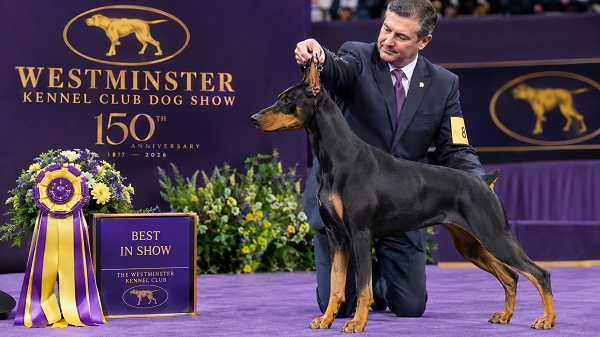
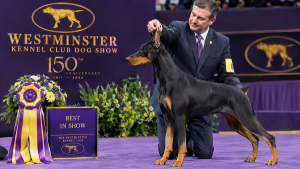
Penny, a 4-year-old Doberman Pinscher handled by Andy Linton, won Best in Show at the 150th Westminster Kennel Club Dog Show on February 3, 2026, at Madison Square Garden. She beat out nearly 2,500 dogs and seven other Group winners, becoming only the fifth Doberman in history to take the title and the first since 1989. Cota, a Chesapeake Bay Retriever, earned Reserve Best in Show.
If you’ve ever watched Westminster and wondered how a dog actually earns that green-and-purple ribbon, or you just want the full rundown of who won what this year, you’re in the right place. I’ve broken down every group, every notable stat, and a few things about the judging process that most recap articles skip entirely.
Table of Contents
- Westminster 2026 At a Glance
- Best in Show 2026: Penny the Doberman Pinscher
- Reserve Best in Show: Cota the Chesapeake Bay Retriever
- Full 2026 Group Results (All 7 Groups)
- Masters Agility Championship 2026 Results
- Best Junior Handler 2026
- Westminster By The Numbers: 150 Years of History
- How Westminster Judging Actually Works
- What Everyday Dog Owners Can Learn From Westminster Winners
- When Is the Next Westminster Dog Show?
- FAQs
- Final Thoughts
Introduction
Every February, dog people all over the world stop what they’re doing and tune in to Madison Square Garden. It doesn’t matter if you own a scruffy backyard mutt or a champion bloodline Malinois, Westminster has a way of pulling everyone in. It’s the second-oldest continuously held sporting event in the United States, beaten only by the Kentucky Derby, and 2026 marked its 150th anniversary.
If you searched for “Westminster Dog Show 2026 winners,” you’ve probably already scrolled through a handful of recap articles that mention Best in Show and then… stop. No group placements. No agility results. No context on why the judge picked the dog he picked, or what any of it actually means if you’re not already a conformation insider.
I’m going to fix that. Below you’ll find the complete results from every group, the Masters Agility Championship, Junior Showmanship, and a breakdown, from a working-dog trainer’s perspective, of what these wins actually tell us about structure, temperament, and training. By the end, you’ll know exactly what happened at the 150th Westminster Kennel Club Dog Show and why it mattered.
1. Westminster 2026 At a Glance
| Detail | Information |
|---|---|
| Official name | 150th Annual Westminster Kennel Club Dog Show |
| Dates | January 31 – February 3, 2026 |
| Venues | Jacob K. Javits Convention Center (agility, flyball) & Madison Square Garden (breed judging, groups, Best in Show) |
| City | New York City, USA |
| Total entries | Nearly 2,500 dogs |
| Best in Show winner | Penny, Doberman Pinscher |
| Reserve Best in Show | Cota, Chesapeake Bay Retriever |
| Best in Show judge | Mr. David Fitzpatrick (East Berlin, PA) |
| First held | 1877 |
Westminster isn’t a single event, it’s a full week. The competition kicks off with the Masters Agility Championship and the Flyball Tournament at the Javits Center, followed by two days of breed and group judging at Madison Square Garden that build toward the Tuesday-night Best in Show finale.
2. Best in Show 2026: Penny the Doberman Pinscher
The biggest story of the night belonged to Penny, officially registered as GCHP CH Connquest Best Of Both Worlds. The 4-year-old female Doberman Pinscher, handled by Andy Linton, won the Working Group before going on to claim Best in Show under judge David Fitzpatrick.
A few things make this win genuinely historic, not just a nice headline:
- It’s the first Doberman Best in Show win since 1989, a 37-year gap.
- Penny is only the fifth Doberman Pinscher to win Best in Show at Westminster in the event’s 150-year history.
- She’s the 42nd female dog to ever take the title.
- Coincidentally, handler Andy Linton was also behind the breed’s 1989 win, giving this victory a full-circle, multi-generational feel.
- It’s the second year running that a Working Group dog has taken Best in Show, Monty the Giant Schnauzer won it in 2025.
After the win, Linton told reporters, “You can’t attribute it to one thing, but she is as great a Doberman as I’ve seen.” Fitzpatrick reportedly called the 2026 finalist lineup one of the strongest he’s judged in his career.
Why the judge picked her: In conformation judging, Best in Show isn’t about which dog is “cutest”, it comes down to which dog most closely matches its breed’s official standard on the night, combined with condition, movement, and ring presence. Dobermans are judged on a square, compact frame, a confident and alert temperament, and a smooth, driving gait. Handlers who’ve shown working breeds for decades often say a dog’s Best in Show run comes down to a single word: presence. Penny reportedly had it in spades, steady under the lights, with the kind of controlled energy judges look for in a protection and working breed.
3. Reserve Best in Show: Cota the Chesapeake Bay Retriever
Runner-up honors, officially called Reserve Best in Show, went to Cota, a Chesapeake Bay Retriever who won the Sporting Group earlier in the evening. Reserve Best in Show matters more than most casual viewers realize, if the Best in Show winner is later disqualified for any reason, the Reserve dog inherits the title. It’s also widely regarded within the sport as a legitimate mark of excellence in its own right, not a consolation prize.
4. Full 2026 Group Results (All 7 Groups)
Here’s the complete rundown of every Group winner from the 150th Westminster Kennel Club Dog Show, in the order they were judged:
| Group | Winner | Breed |
|---|---|---|
| Working | Penny | Doberman Pinscher |
| Sporting | Cota | Chesapeake Bay Retriever |
| Herding | Graham | Old English Sheepdog |
| Hound | Zaida | Afghan Hound |
| Non-Sporting | JJ (“Jingle Juice”) | Lhasa Apso |
| Terrier | Wager | Smooth Fox Terrier |
| Toy | Cookie | Maltese |
Working Group — Full Placements
The Working Group is typically the largest and most competitive at Westminster, and 2026 was no exception:
- Penny — Doberman Pinscher
- Bodacious — Saint Bernard
- Sonny — Portuguese Water Dog
- Maverick — Samoyed
If you’re into protection breeds and working dogs specifically (which, if you’re reading this on a K9-focused blog, you probably are), it’s worth noting how stacked this group was. Saint Bernards, Portuguese Water Dogs, and Samoyeds are all bred for demanding physical jobs, search and rescue, water retrieval, sled pulling and it shows in their structure and drive. If you want to understand what actually separates a “working” temperament from a companion one, our guide on obedience vs. instinct and the two types of dog intelligence every handler should understand breaks it down in plain language.
Non-Sporting Group — Full Placements
- JJ (“Jingle Juice”) — Lhasa Apso
- Elle — Schipperke
- Joy — Shar-Pei
- Calaco — Xoloitzcuintli
For the Sporting, Herding, Hound, Terrier, and Toy Groups, full first-through-fourth placements are published on westminsterkennelclub.org; the winners listed above are confirmed by AKC and event coverage.
5. Masters Agility Championship 2026 Results
Before breed judging even starts, Westminster kicks off its week with the 13th Annual Masters Agility Championship, presented by Purina Pro Plan, held at the Jacob K. Javits Convention Center on January 31.
Masters Agility Champion: Prove-It, a 3-year-old male Border Collie (officially MACH2 Darkside’s It Wasn’t Me MXS MJS BCAT DJ), handled by owner-handler Amber McCune of Bedford, NH. Prove-It posted the fastest clean round of the night at 29.81 seconds, beating a field of 300 total agility competitors narrowed down to 50 finalists.
Highest Scoring All-American Dog (mixed breed): Iron Man, a 5-year-old (MACH Its High Flying Marvel MXB MJB MXF), owned by Carol Boggess and handled by Merritt Speagle, posted a clean 29.60-second round among 28 entrants.
Height division winners:
- 8-inch division: Gabby, a Papillon, handled by Andrea Samuels, 33.42 seconds
- 12-inch division: Nimble, an All-American Dog, handled by Cynthia Horner, 29.19 seconds
One detail most recap articles skip: Westminster donates $5,000 in the Masters Agility Champion’s name to the AKC training club of their choice, or the AKC Humane Fund, plus a further $1,000 donation in the names of the Top All-American Dog and each height-division winner. It’s a nice reminder that agility competitors are often ordinary pet owners who put in years of weekend training, not just professional handlers.
If watching the agility finals gets you itching to try it with your own dog, you don’t need a competition-level setup to start. We’ve put together a practical breakdown of 5 easy dog agility exercises you can start today with nothing more than basic equipment.
6. Best Junior Handler 2026
Junior Showmanship is judged entirely on the handler’s skill, not the dog’s conformation, and it’s been part of Westminster since 1934, making 2026 its 92nd year running alongside the main show.
Best Junior Handler 2026: Hadrian Towell, showing his 8-year-old Manchester Terrier “Simon” (GCHG CH Passport Sunkissed It’s A Yes From Me Bonchien), under judge Michael Faulkner. Towell beat a field of 99 entrants narrowed down to eight finalists across two days of preliminary judging.
As the winner, Towell received a $10,000 scholarship award; the remaining finalists received scholarships ranging from $500 to $5,000, all earmarked for post-secondary education. It’s one of the more overlooked parts of Westminster, but it’s arguably where the sport’s future handlers, breeders, and judges get their start.
7. Westminster By The Numbers: 150 Years of History
A few stats that put the 2026 show into perspective:
- 150 years — Westminster’s official age in 2026, making it the second-longest continuously run sporting event in the U.S., after the Kentucky Derby.
- 1877 — the year of the very first Westminster Kennel Club Dog Show.
- ~2,500 dogs competed at the 2026 show, spanning around 200 recognized breeds and varieties.
- 5 — the number of Best in Show wins by Doberman Pinschers in Westminster’s entire history (as of 2026).
- 42 — the number of female dogs to ever win Best in Show.
- 2 — consecutive years (2025 and 2026) that a Working Group dog has taken the top title.
- 13 — the number of years the Masters Agility Championship has run at Westminster.
- 92 — the number of years Junior Showmanship has been part of the event.
For context on why this history matters: the AKC estimates roughly 195 breeds and varieties are currently recognized for conformation showing in the U.S., and Westminster remains one of the very few “benched” all-breed shows most spectators can watch live and in person, rather than only through club-level circuits.
8. How Westminster Judging Actually Works
This is the part most articles skip entirely, and it’s honestly the most useful thing to understand if you want Westminster to make sense beyond “cute dog wins trophy.”
Here’s the simplified version of how a dog gets from its home to the Best in Show ring:
- Breed judging. Every dog is first judged against its own breed’s official written standard, not against other breeds. A judge is checking how closely that individual dog matches the ideal structure, coat, movement, and temperament described for its breed.
- Best of Breed. One dog per breed wins Best of Breed and advances.
- Group judging. Best of Breed winners are split into seven groups (Sporting, Hound, Working, Terrier, Toy, Non-Sporting, Herding) based on original function. Each group is judged as a whole, and one dog per group advances.
- Best in Show. The seven group winners face a single judge who compares dogs across completely different breed standards, essentially deciding which dog, on that specific night, best represents its own breed’s ideal.
This last step is why Best in Show judging is considered one of the hardest assignments in the sport. The judge isn’t comparing a Doberman to another Doberman, they’re comparing a Doberman’s “correctness” against a Maltese’s, an Afghan Hound’s, and a Lhasa Apso’s, all at once. Experienced judges often say it comes down to whichever dog shows the fewest faults relative to its own breed standard, combined with confidence and presentation on the day.
Presentation matters more than most pet owners assume, too. A nervous, shut-down dog, no matter how physically correct, will lose to a confident dog with minor structural flaws almost every time. That’s a lesson that applies well beyond the show ring, and it’s one reason temperament and confidence-building are just as important as physical conditioning if you’re raising or training any working or show-quality dog.
9. What Everyday Dog Owners Can Learn From Westminster Winners
I’ve spent years working with protection and security dogs, and every time Westminster rolls around, I get the same question from clients: “My dog will never be a show dog, why should I care about any of this?”
Here’s the honest answer: you don’t need a champion pedigree to apply what makes these dogs successful. A few things every Westminster finalist has in common, regardless of breed:
- Rock-solid socialization. These dogs have been exposed to crowds, noise, strange dogs, and unfamiliar handlers since puppyhood. That’s not luck, it’s deliberate, early, repeated exposure.
- Structured handling from day one. Show dogs are taught to accept being touched, examined, and posed by strangers (judges) without flinching. That same foundation makes vet visits, grooming, and boarding far less stressful for any dog.
- Consistent, low-drama corrections. Top handlers rarely raise their voice in the ring. Calm, clear, consistent communication is what actually builds trust and reliability, whether you’re prepping for Westminster or just trying to stop your dog from pulling on walks.
- Purposeful daily structure. Working and sporting breeds especially need a job, even if that “job” is just a structured daily routine of training, exercise, and mental stimulation.
If you’re raising a working breed, Doberman, Malinois, German Shepherd, or otherwise and want a deeper, structured framework for building that same kind of calm confidence and control at home, our e-book Beyond the Bark walks through the exact principles professional handlers use, adapted for everyday owners. It’s not a substitute for hands-on training, but it’s a solid starting point if you’re serious about raising a dog with real structure.
It’s also worth pointing out that several Working Group breeds seen at Westminster, Dobermans, Samoyeds, Portuguese Water Dogs, have working origins in protection, herding, or search-and-rescue roles. If that side of working dogs interests you more than the show ring, our guide on how search and rescue dogs actually work is a good next read.
10. When Is the Next Westminster Dog Show?
Westminster is traditionally held in early-to-mid February in New York City, at Madison Square Garden and the Jacob K. Javits Convention Center, with the Masters Agility Championship kicking off the week beforehand. Exact 2027 dates are announced closer to the event on westminsterkennelclub.org, and the Best in Show finals are typically broadcast live on FOX and streamed via FOX Sports and NBC/Peacock platforms in the U.S., with international broadcast partners covering the event for viewers in the UK, Europe, and elsewhere.
FAQs
1. Who won Best in Show at the 2026 Westminster Dog Show?
Penny, a 4-year-old Doberman Pinscher handled by Andy Linton, won Best in Show at the 150th Westminster Kennel Club Dog Show on February 3, 2026, at Madison Square Garden.
2. How many dogs competed in Westminster 2026?
Nearly 2,500 dogs competed across roughly 200 breeds and varieties at the 150th Westminster Kennel Club Dog Show.
3. What breed won the Working Group at Westminster 2026?
The Doberman Pinscher, represented by Penny, won the Working Group before going on to win Best in Show overall.
4. Who won the Masters Agility Championship at Westminster 2026?
Prove-It, a Border Collie handled by Amber McCune, won the 13th Annual Masters Agility Championship with a clean run of 29.81 seconds.
5. How is the Best in Show winner chosen at Westminster?
A single judge compares the seven Group winners against their own individual breed standards, rather than against each other directly, and selects whichever dog is judged closest to its breed’s ideal on the night, combined with condition, movement, and ring presentation.
Final Thoughts
The 150th Westminster Kennel Club Dog Show delivered exactly the kind of storyline the sport loves: a Working Group breed making history, a 37-year gap finally closed, and a lineup that even veteran judges called one for the record books. Penny’s win is a reminder that structure, temperament, and presence still matter more than trends, something that holds true whether you’re prepping for Madison Square Garden or just trying to raise a well-mannered dog at home.
If you found this breakdown useful, you’ll probably enjoy our other deep dives into working dog training, agility, and breed-specific guidance. Subscribe to our free weekly newsletter at for a roundup of new articles like this one, straight to your inbox, no spam, just practical K9 knowledge.

Her work centres on obedience, detection, protection and operational readiness. She favours proven methods built on repetition, consistency and real-world conditioning, so that both dogs and handlers are prepared for high-pressure tasks.
Rofiat represented the Nigerian Army Dog Centre at the Nigerian Army Day Celebration (NADCEL) 2026, where she led demonstrations in obedience, explosive detection, agility and tactical movement. Through articles, training content and documentaries, she shares field-based insight into how structured training, clear communication and trust between handler and dog affect performance and reliability.
She is the author of Beyond the Bark: Inside a Pro Handler's Playbook for Raising the Ideal Dog, a practical guide that helps dog owners and handlers apply professional training principles in everyday situations.
- K9 Advantix Dosage Chart & Safety Guide for Dogs - October 19, 2026
- How to Set Up & Use Bousnic Dog Training Collar - October 18, 2026
- Westminster Dog Show 2026: Winners & Full Results - October 17, 2026