Home Safety Dog Training Tips: 12 Expert Steps That Work
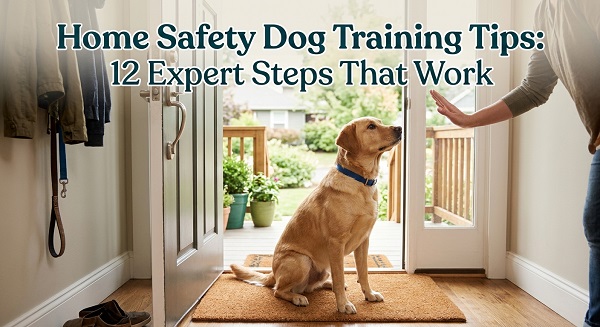
To train a dog for home safety, teach six core skills: Leave It, Drop It (Out), Place (settle on a mat), Wait at doors, a solid Recall (Come), and a calm alert-then-quiet routine for visitors. Practice each skill in short 5–10 minute sessions, reward with treats, and build up from quiet rooms to real-life distractions. Pair the training with a dog-proofed home, supervised time with children, and a basic first-aid plan, and you’ll prevent most accidents before they happen.
Table of Contents
- Why Home Safety Training Matters More Than You Think
- Home Safety Starts With Two Jobs: Protect Your Dog and Protect Your Household
- The 6 Core Commands That Prevent Most Home Accidents
- Door and Gate Training: Your First Line of Defense
- How to Train Your Dog to Alert You (Without Becoming Reactive)
- Dog-Proof Your Home Like a Handler Does
- Kids and Dogs: Training Rules That Actually Work
- Train for Emergencies Before They Happen
- A Realistic Training Timeline
- Common Mistakes That Make Homes Less Safe
- Why You Can Trust These Tips (Trainer Note)
- Frequently Asked Questions
- Final Thoughts: Start Small, Stay Consistent
Introduction: The Danger Usually Lives Inside the House
Here’s something most owners don’t expect. The biggest risks to your dog and your family usually aren’t out on the street. They’re in your kitchen, your living room, and your front doorway.
The ASPCA Poison Control team handled calls about more than 376,000 substances pets were exposed to in 2025. Many of them were ordinary things sitting in homes: pain relievers, vitamins, chocolate, and sugar-free gum. On the people side, a pediatric study of dog-related injuries in children found that about 59% happened at home and 81.5% involved a dog the child already knew. Another review of 321 facial dog bites at Massachusetts General Hospital found that 88% came from known dogs.
So the problem is clear. Most households focus on gear and gadgets, but they skip the training that actually prevents accidents.
In this guide, you’ll learn practical home safety dog training tips I use as a K9 handler, written for regular families as much as for professionals. You’ll get the exact commands to teach, how to set up your doors and rooms, how to keep kids and dogs safe together, how long training really takes, and what to do in an emergency. Let’s get into it.
Why Home Safety Training Matters More Than You Think
A dog that knows basic safety skills is easier to protect. It’s that simple.
Think about a typical bad moment at home. A pill drops on the floor. A door swings open. A toddler runs at the dog with a toy. In each case, the outcome depends on what your dog does in the next two seconds. If your dog has a reliable “Leave It,” “Wait,” or “Place,” you win those two seconds. If not, you’re hoping for luck.
Trainers across the world agree on this. A TV interview with Top Gun Dog Training in Alabama made the same point: basic obedience, impulse control and a comfortable crate keep a dog from getting into trouble and keep others safe if something triggers the dog. Another safety guide from a GPS tracker company says a few minutes of basic obedience each day makes a real difference. I’d agree, and I’d add that the quality of those minutes matters more than the quantity.
Quick takeaway: Training doesn’t replace a safe home, and a safe home doesn’t replace training. You need both.
Home Safety Starts With Two Jobs: Protect Your Dog and Protect Your Household
When people search for home safety dog training, they usually mean one of two things:
- Keeping the dog safe at home: poisons, cords, falls, pools, escapes and heat.
- Using the dog to help keep the home safe: alerting to visitors, calm door behavior, and good manners with guests and children.
Most guides cover only one of these. In real homes, they overlap. A dog that bolts out the front door is unsafe and makes your home less secure. A dog that eats a stranger’s dropped snack is in danger and may be a risk to others. So we’ll cover both.
One honest note before we go further. A family dog doesn’t need “guard dog” or bite training to make your home safer. In fact, I’d tell most owners to avoid it. Bite work belongs with professional programs, because a poorly trained protective dog is a liability. What you want is a dog that notices, tells you, and then listens when you say “enough.” I explain that more in our guide on 10 essential protection dog commands every owner should master.
The 6 Core Commands That Prevent Most Home Accidents
If you only teach six things, teach these. Keep sessions to 5–10 minutes, once or twice a day, and use small, tasty rewards.
1. Leave It
This is your best poison-prevention tool. It tells your dog to ignore something and look at you instead.
How to teach it:
- Hold a boring treat in your closed fist. Let your dog sniff and lick it.
- The moment your dog backs off or looks away, say “Yes!” and give a different, better treat from your other hand.
- Repeat until your dog pulls away from your fist right away.
- Next, put the treat on the floor under your hand. Reward every time your dog ignores it.
- Finally, drop the item from a small height, ready to cover it if needed.
Practice “Leave It” with things your dog actually wants, like a dropped sock or a safe chew. Never test it first with real medicine.
2. Drop It (Out)
Every dog will pick up something dangerous one day. “Drop It” is how you get it back without a chase.
- Offer a toy your dog likes. Let your dog hold it.
- Show a treat near the nose and say “Drop it.”
- When the toy falls, say “Yes!” and give the treat.
- Give the toy back sometimes, so your dog learns that giving things up isn’t a loss.
That last point is a handler’s trick. If “Drop It” always means you take the item away, dogs learn to guard it. If it often means “trade, then play again,” they’ll hand things over happily.
3. Place (Settle on a Mat)
“Place” sends your dog to a mat or bed and keeps them there until released. It’s the most useful skill for homes with visitors, kids, cooking and deliveries.
- Put a mat on the floor. Reward your dog for stepping on it.
- Add the word “Place” as your dog steps on.
- Reward for staying on the mat. Start with two seconds, then five, then fifteen.
- Add distance, then add distractions like a knock at the door.
A good “Place” can calm a chaotic household in under a minute.
4. Wait (Door and Gate Manners)
“Wait” is different from “Stay.” It means “pause until I release you.” We’ll go deeper on it in the door-training section below.
5. Recall (Come)
A reliable recall is a lifesaver if a door or gate opens by mistake. Train it indoors first, then in the yard, and only trust it off-leash in a secure area.
- Use a happy voice and a special reward, like chicken or cheese, that your dog only gets for coming.
- Never call your dog for something unpleasant, like a bath or nail trim.
- Practice in short bursts, a few times a day.
6. Watch Me
This simple eye-contact cue pulls your dog’s attention away from a trigger, like a squirrel, a guest or a dropped plate. It buys you time to react.
You’ll find more on building these foundations in our post on how to crate train a puppy with K9 trainer tips, since a calm crate routine supports almost every safety command.
Door and Gate Training: Your First Line of Defense
Doors are the number-one escape route. A dog that bolts into traffic, a dog that jumps on a delivery person, and a dog that charges a visitor all share one problem: no door manners.
Teach the “Threshold Wait”
- Put your dog on a leash and walk to the door.
- Ask for a sit. Put your hand on the handle.
- If your dog stands up, take your hand away and wait. When your dog sits, try again.
- Open the door an inch. If your dog stays, reward. If your dog moves, close it.
- Slowly open it wider. Release with a word like “Okay!” so your dog knows when to move.
It can take several days of practice for dogs to stay put when a door fully opens. That’s normal. Go slowly.
Set Up Visitor Rules
Here’s a simple routine we teach clients:
- Dog goes to “Place” before the door opens.
- Guests ignore the dog at first (no excited greetings).
- Once the dog is calm, a guest offers a treat on the floor, not from over the dog’s head.
- Dog gets released only when everyone’s settled.
If your dog is nervous, use a baby gate or put the dog in another room with a chew. A calm dog behind a gate is far safer than an anxious dog in the middle of the party.
Don’t Forget the Yard and Fence
Check your fence monthly for gaps, loose boards and digging spots. Don’t leave your dog outside alone for long periods. Trainer Dale Buchanan of Top Gun Dog Training tells clients never to leave dogs unsupervised outside, since you can’t know what may enter the yard or how the dog could get out.
How to Train Your Dog to Alert You (Without Becoming Reactive)
Many people want a dog that warns them when someone’s at the door. That’s a fair goal, and it’s different from teaching aggression.
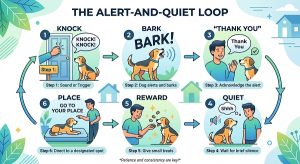
Quick answer: To teach an alert behavior, reward your dog for one or two barks when they hear a knock or doorbell, then say “Thank you, quiet” and reward silence. Don’t encourage nonstop barking or lunging, because that creates a reactive dog, not a safe one.
Step-by-Step Alert and Quiet Training
- Have a helper knock or ring the bell.
- When your dog barks once or twice, say “Good alert!” and give a treat.
- Walk calmly to the door and say “Thank you, quiet.”
- When your dog stops barking, reward immediately.
- Gradually require more seconds of quiet before rewards.
- Send your dog to “Place” while you answer the door.
This works because your dog learns a job (notice and tell), then a second job (stop and wait for you). That second job is what separates a trained alert dog from a nuisance barker.
What About Breed?
Temperament, history and training matter more than breed alone. Some breeds, like German Shepherds, Belgian Malinois and Rottweilers, have strong watchful instincts. Others, like Labradors, will greet a burglar with a wagging tail. Neither is “better.” You simply train based on the dog you have. Our article on obedience versus instinct in working dogs explains why control matters more than drive.
Dog-Proof Your Home Like a Handler Does
Training is half the job. The other half is changing the environment so your dog can’t fail. Handlers call this “management.” Walk through every room at dog height and look for trouble.
Kitchen and Dining Area
- Keep chocolate, grapes, raisins, onions, garlic and anything with xylitol out of reach. ASPCA reported that food and drink made up about 16.4% of 2025 exposure calls, and chocolate alone made up about 13.6%.
- Close lids on bins. Use a latch if your dog is a bin raider.
- Train “Off” and reward all four paws on the floor. Counter surfing is a habit, and habits grow fast.
Medicine Cabinet and Bathroom
Over-the-counter drugs, vitamins and supplements were the No. 1 category in ASPCA’s 2025 data, at 16.9% of exposures. Don’t keep pills in handbags on the floor. Don’t leave pill organizers on low tables. Skin creams and face masks matter too; ASPCA noted that new skin care products popular on social media contributed to the rise.
Living Room and Bedrooms
- Tape or cover loose electrical cords. Spray cord covers with a bitter deterrent for chewers.
- Keep small items like socks, hair ties and batteries off the floor.
- Check houseplants against the ASPCA’s list of toxic plants. Plants and fungi accounted for 7.5% of 2025 exposures.
Windows, Balconies and Stairs
Install secure screens or safety barriers on balconies and open windows. Use gates for puppies and senior dogs near stairs. Small dogs and curious breeds can slip through gaps you’d never expect.
Pools and Water
Many dogs can swim, but not all can climb out. Teach your dog where the exit steps are. Show them the steps from inside the water, calmly, a few times. A pool fence or cover is still the best protection.
Heat and Cars
Never leave a dog in a parked car, even for a few minutes. Provide shade and fresh water at home, especially in hot climates.
Make a Safe Space for Your Dog
A safe place isn’t only about hazards. Your dog also needs a quiet retreat from noise and busy children. A crate with the door open, a bed in a calm room, or a covered pen works well. Train your dog to love it with treats and chews, and never use it as punishment.
Kids and Dogs: Training Rules That Actually Work
This is the section most competing guides skip, and it matters most. Most children bitten by dogs are bitten by a dog they know, often in their own home. Dog bites to young children also land more often on the face and neck. Experts agree that bites aren’t a breed problem alone; they’re usually about fear, stress or surprise.
Rules for the Adults
- Never leave a baby or young child alone with any dog. Not even the sweetest one.
- Give your dog a retreat area children can’t enter.
- Don’t let kids hug, climb on, or chase the dog.
- Don’t punish growling. A growl is a warning. If you punish it, you may teach your dog to skip the warning and go straight to a bite.
- Learn the early signs of stress: lip licking, yawning, turning the head away, showing the whites of the eyes, stiffening, or a tucked tail.
Rules for the Kids
The UK Kennel Club teaches children two simple ideas. If a dog jumps up and scares you, “become a tree”: stand still, arms folded, and look away. If a dog knocks you over, “become a stone”: curl up and stay still until the dog leaves. Then tell an adult. Kids can also learn to ask the owner before petting, offer a closed hand for a sniff, and never bother a dog that’s eating, sleeping or caring for puppies.
Train the Dog for Kids
- Practice “Place” while children play nearby.
- Reward your dog for calm behavior around kid noises, like running and squealing.
- Teach “Gentle” for taking treats from small hands.
- Trade, don’t take, when your dog has a toy. This prevents resource guarding.
If your dog shows stiffening, freezing or snapping around food or toys, call a qualified trainer or behaviorist right away. Don’t wait.
Train for Emergencies Before They Happen
Safe homes also prepare for the worst day. Most guides mention a first-aid kit and stop there. A handler goes further.
Build a Dog First-Aid Kit
Include gauze, self-adhesive bandage, saline, tweezers, a digital thermometer, a spare leash, your vet’s number and a copy of your dog’s vaccination record. Keep it somewhere you can reach fast.
Save the Poison Numbers
If you think your dog ate something toxic, call your vet or a poison line immediately. In the US, ASPCA Poison Control’s 24-hour hotline is (888) 426-4435. In other countries, search for your local animal poison line now and save it in your phone. Don’t make your dog vomit unless a vet tells you to.
Muzzle and Handling Training
An injured dog in pain can bite, even gently loved ones. Handlers condition working dogs to accept a basket muzzle and to be touched on paws, ears and mouth. You can do this too.
- Put treats inside the muzzle and let your dog eat from it.
- Add a second of fastening, then release and reward.
- Slowly build the time the muzzle stays on.
- Practice gentle handling of paws and ears daily.
This takes patience, but it can make a vet trip or an emergency far safer.
Practice an Evacuation Drill
Keep a leash, collar with ID tag, and a photo of your dog near the exit. Teach your dog to come to a whistle or recall cue from any room. Microchip your dog and keep your registration details updated.
A Realistic Training Timeline
People always ask, “How long will this take?” There’s no exact answer, since age, breed, history and consistency all matter. These are typical ranges I see when owners practice daily.
| Skill | Typical time to reliable at home | Notes |
|---|---|---|
| Leave It | 2–4 weeks | Add real-life distractions slowly |
| Drop It | 1–3 weeks | Reward and often return the item |
| Place | 2–4 weeks | Build duration before distractions |
| Door Wait | 1–3 weeks | Practice on leash at first |
| Recall indoors | 2–4 weeks | Outdoors takes longer |
| Alert and Quiet | 3–6 weeks | Needs a helper and patience |
| Muzzle comfort | 2–4 weeks | Go in tiny steps |
These are guidelines, not guarantees. A young puppy may learn faster in short sessions. An adult rescue dog may need more time to build trust. Keep sessions short and end on a win.
If you’re starting with a new puppy, our ebook Beyond the Bark is a handy companion for building good habits from day one.
Common Mistakes That Make Homes Less Safe
I’ve seen these over and over:
- Skipping supervision. Training doesn’t replace watching your dog and kids.
- Using punishment. Aversive methods can raise fear and stress, which can raise bite risk.
- Practicing only when it’s easy. Dogs need training near real distractions, like doorbells and kitchen noise.
- Testing “Leave It” with real danger. Practice with safe items first.
- Teaching guard behavior at home. This is a job for professionals only.
- Ignoring body language. Dogs speak before they bite. Learn to listen.
- Inconsistent rules. If one person allows couch time and another doesn’t, your dog won’t know the rules.
Why You Can Trust These Tips (Trainer Note)
I’m a working dog handler, and I’ve spent years training dogs for obedience, detection and security work. That includes taking part in a public Military Working Dog demonstration at the Nigerian Army Day Celebration (NADCEL) 2026. In that world, a dog’s safety skills aren’t optional extras. They’re what let a dog work calmly around crowds, doors, noise and strangers.
The core ideas here come from the same foundations: clear commands, impulse control, reward-based training and careful management of the environment. The numbers I cite come from respected sources, including ASPCA Poison Control, the CDC and AVMA estimates, Harvard Health, a pediatric injury study on dog bites in children, and The Kennel Club in the UK.
Important note: This article is general education, not veterinary or behavior treatment. If your dog is aggressive, extremely fearful, or has bitten someone, work with a qualified trainer or veterinary behaviorist in person.
Frequently Asked Questions
1. What are the most important home safety commands for dogs?
The most important commands are Leave It, Drop It, Place, Wait at doors, Recall (Come) and Watch Me. Together they stop dogs from eating dangerous items, bolting out of doors, and rushing at visitors. Practice each one for 5–10 minutes daily.
2. Can I train my dog to protect my home without professional guard dog training?
Yes, but only in a limited way. You can teach your dog to alert you to visitors and then settle on cue. Full protection work or bite training should only be done with a professional, because mistakes can be dangerous for your family and your community.
3. How long does it take to train a dog for home safety?
Most dogs learn basic safety commands in two to six weeks if you practice daily, though reliability around big distractions takes longer. Puppies, rescue dogs and adult dogs with bad habits all move at different speeds. Consistency matters more than session length.
4. How do I keep my dog and child safe together?
Never leave young children alone with a dog, give the dog a safe retreat, teach kids gentle rules, and learn your dog’s stress signals. Practice “Place” and “Drop It” with the whole family. If your dog growls, stiffens or guards food or toys, get help from a qualified trainer.
5. What should I do if my dog eats something toxic?
Call your vet or a poison hotline right away and have the product name, amount and your dog’s weight ready. In the US, ASPCA Poison Control’s number is (888) 426-4435. Don’t induce vomiting unless a professional tells you to.
Final Thoughts: Start Small, Stay Consistent
Home safety for dogs isn’t about one big fix. It’s a mix of smart training, a dog-proofed space, and clear family rules.
Here’s your action plan for this week:
- Walk through your home at dog height and remove obvious hazards.
- Start “Leave It” and “Place” today, five minutes at a time.
- Practice the threshold “Wait” at your front door daily.
- Set clear rules for kids and visitors, and give your dog a safe retreat.
- Build a first-aid kit and save your vet and poison hotline numbers.
Do those five things and you’ll cut your risk of accidents dramatically. You don’t need fancy gear. You need patience, consistency and a bit of daily practice.
Want more practical K9 training tips like these? Subscribe to our weekly articles roundup newsletter at https://arfsk9team.com.ng/newsletter/ and get fresh handler-tested advice in your inbox every week.

Her work centres on obedience, detection, protection and operational readiness. She favours proven methods built on repetition, consistency and real-world conditioning, so that both dogs and handlers are prepared for high-pressure tasks.
Rofiat represented the Nigerian Army Dog Centre at the Nigerian Army Day Celebration (NADCEL) 2026, where she led demonstrations in obedience, explosive detection, agility and tactical movement. Through articles, training content and documentaries, she shares field-based insight into how structured training, clear communication and trust between handler and dog affect performance and reliability.
She is the author of Beyond the Bark: Inside a Pro Handler's Playbook for Raising the Ideal Dog, a practical guide that helps dog owners and handlers apply professional training principles in everyday situations.
- Food Aggression Dog Training: Pro K9 Guide - November 21, 2026
- DIY Dog Scent Training: Easy 4-Week Home Guide - November 20, 2026
- Buckeye Puppies Review: 5 Red Flags to Check - November 19, 2026