Dog Hotel vs. House Sitter: Which Is Best for Your Dog?
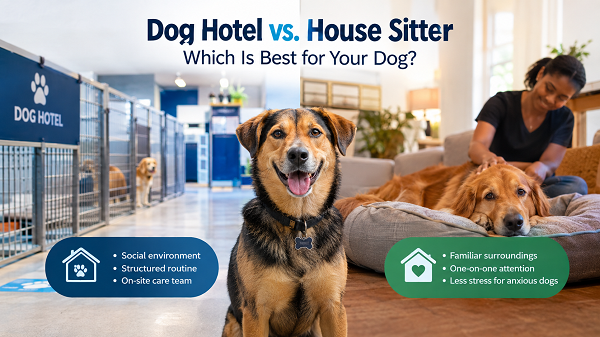
There’s no single “better” option, a dog hotel (boarding facility) usually suits social, active dogs who enjoy company and structure, while a house sitter (in-home pet sitting) tends to work better for anxious, senior, or medically fragile dogs who do best in a familiar environment. The right choice comes down to your dog’s temperament, health needs, and how long you’ll be away, not which service sounds fancier.
Table of Contents
- What’s the Real Difference Between a Dog Hotel and a House Sitter?
- Quick Comparison: Dog Hotel vs. House Sitter
- Cost Breakdown: What You’ll Actually Pay
- Which Option Fits Your Dog’s Personality
- Safety, Licensing, and Insurance Checks
- Health Risks You Shouldn’t Ignore
- Real Case Studies from the Field
- Trainer’s Decision Checklist
- How to Prepare Your Dog Either Way
- Trainer Note
- Frequently Asked Questions
- Conclusion
Introduction
If you’ve ever stood in your kitchen with a suitcase half-packed, phone in hand, trying to decide whether to drop your dog off at a fancy “pet hotel” or hire someone to crash on your couch for a week, you already know this decision isn’t as simple as Google makes it look. I’ve handled working dogs and family pets for years, and I still get asked this question more than almost anything else.
So here’s the thing: both options can be excellent. Both can also go badly wrong if you pick them for the wrong dog. This guide breaks down the real costs, the real risks, and the real signs that tell you which one your specific dog needs, not generic advice that ignores the fact that your Labrador and your neighbor’s rescue Chihuahua have completely different needs.
What’s the Real Difference Between a Dog Hotel and a House Sitter?
People throw these terms around loosely, so let’s clear it up first.
What Counts as a “Dog Hotel”
A dog hotel is just a modern name for an upgraded boarding kennel. Instead of concrete runs and chain-link fencing, you’re paying for suites with webcams, “pupcorn” treats, swimming pools, and sometimes even massage therapy. Underneath the branding, it’s still dog boarding: your dog stays at a facility, sleeps there overnight, and is cared for by staff who are also looking after other dogs at the same time.
According to Wikipedia’s overview of the industry, dog boarding is overnight care for dogs in a setting outside the owner’s home, offered through kennels, professional boarding facilities, dog hotels, dog resorts, or private dog sitters’ homes. The “hotel” branding usually just signals a higher price point and nicer furniture, the underlying model (multiple dogs, staff rotation, a facility) is the same.
What a House Sitter Actually Does
A house sitter (also called an in-home pet sitter) comes to your house or, in some arrangements, your dog goes to theirs and provides one-on-one care in a familiar environment. Officially, pet sitting is a more personal and individualized arrangement for care compared to boarding or kenneling, and specialized training is usually not required. Pet Sitters International, the industry’s main professional body in the US, defines it simply as “the act of caring for a pet in its own home while the owner is away.”
The key distinction most articles skip: a sitter who cares for your dog at their own house is technically boarding, not sitting, and in many US counties that setup legally requires a kennel license. If a “pet sitter” is keeping multiple dogs from different families under one roof, ask whether they’re licensed the same way a boarding kennel would be, this is exactly the kind of grey area that trips up first-time pet owners.
Quick Comparison: Dog Hotel vs. House Sitter
| Factor | Dog Hotel (Boarding) | House Sitter |
|---|---|---|
| Location | Facility, away from home | Your home (usually) |
| Attention | Shared among staff/multiple dogs | One-on-one |
| Socialization | High (group play, other dogs) | Low to none |
| Routine disruption | High (new place, new schedule) | Low (same bed, same yard) |
| Home security | Not applicable | Sitter often deters break-ins, waters plants, collects mail |
| Illness exposure | Higher (shared air, communal play areas) | Lower |
| Best for | Social, high-energy, young dogs | Anxious, senior, medically needy dogs |
| Typical US cost | $35–$85/night | $45–$90/night (overnight in-home) |
Cost Breakdown: What You’ll Actually Pay
Cost is where most articles get vague. Let’s actually put numbers on the table for 2026.
Dog boarding / dog hotel pricing:
- Standard kennel boarding averages around $40 per night, with luxury “hotel” tiers running close to $80 per night, according to industry data compiled by Home Guide, which puts typical prices between $30 and $50 per night, with more luxurious accommodation averaging closer to $80.
- The global pet boarding market is worth approximately $20 billion and is projected to grow to $36 billion by 2031, this isn’t a shrinking niche service, it’s one of the fastest-growing corners of the pet industry.
- There are more than 9,000 boarding kennels across the US and Canada alone, so competition (and price variation) is significant even within one city.
House sitting / pet sitting pricing:
- Drop-in visits run about $20 to $50 per visit, while overnight in-home sitting runs $45 to $90 a night in 2026, with pricing shaped by visit length, medical needs, and location.
- On the lower end, some sources report overnight sitting averaging closer to $80 per night, per data from Thumbtack showing general pet sitting visits average $25 for 30 minutes and $80 for an overnight stay.
- Rover’s own data shows an interesting wrinkle: overnight boarding at a sitter’s home is often cheaper than a traditional kennel, with nightly rates typically ranging from $25 to $45, while booking a sitter to stay overnight at your own house usually costs $40 to $75 or more per night.
The bottom line on cost: for a single dog, the two options land in roughly the same ballpark ($35–$90/night), so cost alone rarely decides this for you. Where it does matter is with multiple dogs, most boarding kennels charge per dog, while many house sitters charge a flat nightly rate regardless of how many pets are in the home. If you’ve got three dogs, a sitter is almost always the cheaper route.
One stat that surprised even me: dog owners in the US spend an average of $228 a year on boarding kennels, nearly triple what cat owners spend on boarding, a clear sign that boarding remains the default choice for most dog households, even though it’s not automatically the best one for every dog.
Which Option Fits Your Dog’s Personality
This is the section most “top 10 tips” articles rush through. It deserves more than a paragraph, because getting this wrong is how dogs come home stressed, sick, or with a new fear of car rides.
The social butterfly. If your dog lights up at the dog park, tolerates crates fine, and has no real medical issues, a boarding facility is often genuinely good for them, not just tolerable. Group play, new smells, and staff attention can make it feel like doggy summer camp rather than an ordeal.
The anxious or shy dog. According to trainer Amanda Dwyer, a certified separation anxiety specialist, pet parents need to weigh the severity and type of anxiety their dog experiences, since assessing stress levels and typical reactions to new people, places, and dogs helps determine the right facility. For dogs who hide under the bed when guests arrive, a sitter working within four familiar walls almost always produces a calmer, less destructive outcome than a kennel full of barking strangers. If you’re not sure whether your dog’s nervousness rises to the level of true separation anxiety or is just garden-variety shyness, it’s worth reading up on when a canine behaviorist is warranted versus a general trainer, our guide on choosing the right dog therapist breaks down exactly that distinction.
The senior dog. Older dogs generally do worse with novelty. Noise, new floors, unfamiliar smells, and the absence of a favorite couch cushion are all bigger deals to a 12-year-old dog with arthritis than to a bouncy 2-year-old. As one boarding comparison put it plainly, older dogs often find the noise of a busy kennel exhausting and usually prefer the quiet of their own living room with a sitter.
The dog on medication or with a medical condition. A sitter who can follow your exact feeding times, medication schedule, and emergency vet contact without competing demands from a dozen other dogs is usually the safer bet. Rover’s own comparison notes it’s usually a better fit for special-needs dogs with specific medical or dietary requirements.
High-drive working and herding breeds. Border Collies, Belgian Malinois, and similar breeds need real mental and physical outlets, not just a walk around a kennel yard. A house sitter who understands structured exercise (not just a leisurely stroll) matters here, we go deeper into what “enough exercise” actually looks like for these breeds in our piece on how often you should exercise a working dog, which is worth reading before you brief any sitter or kennel on your dog’s needs.
The escape artist. If your dog can clear a 6-foot fence, a private backyard with a sitter might actually be less secure than a purpose-built, double-gated kennel. As one boarding facility bluntly put it, for the “Escape Artist” who can jump a fence the moment you turn your back, the secure, double-gated environment of a professional kennel is significantly safer than a home backyard.
Safety, Licensing, and Insurance Checks
Whichever way you lean, don’t skip due diligence. Ask these questions before you hand over your leash or your house keys.
Questions for a dog hotel or boarding kennel:
- Are you licensed with your state, county, or (in the UK) under the Animal Welfare (Licensing of Activities Involving Animals) Regulations 2018?
- What’s your staff-to-dog ratio during play sessions and overnight?
- What vaccinations do you require, and do you verify them?
- What’s your protocol if a dog gets sick or injured overnight?
- Can I tour the facility, including overnight kennel areas, not just the lobby?
Questions for a house or pet sitter:
- Are you bonded and insured? (In the US, membership with Pet Sitters International (PSI) or the former National Association of Professional Pet Sitters generally requires proof of insurance.)
- Do you have pet first-aid or CPR certification?
- Will you be caring for other pets at the same time, in a different location?
- Can you provide references from at least two past clients?
- What’s your plan if my dog needs an emergency vet visit while I’m unreachable?
Membership organizations matter more than most owners realize. PSI reports that 99% of its member pet-sitting businesses are independently owned, 89% of members are women, and 73% have been in business for five or more years, a credential worth checking, since it filters out fly-by-night operators who set up a Facebook page last week.
Health Risks You Shouldn’t Ignore
This is the section most competing articles leave out entirely, and it’s a real gap worth closing.
Boarding facilities, by design, put dogs in shared air spaces and communal play yards. That means a higher exposure risk to:
- Kennel cough (Bordetella) — highly contagious, spreads through shared air and toys, and is the reason reputable kennels require proof of the Bordetella vaccine before intake.
- Canine influenza (H3N2/H3N8) — an airborne virus that spreads fastest in group settings, with outbreaks periodically closing entire boarding chains for weeks.
- Kennel stress-related GI upset — diarrhea and appetite loss from stress and unfamiliar food/water, common enough that most kennels warn owners to expect it.
House sitting largely avoids these risks since your dog isn’t sharing space with unfamiliar animals, but it introduces a different one: a stranger has a key to your home. Reputable sitters carry liability insurance for exactly this reason, though it’s worth noting industry data shows pet sitters are generally not protected from injury to themselves by regular pet sitting liability coverage, which usually only covers injury to other people and pets, so ask about this explicitly if your dog has ever nipped a stranger.
If your dog already struggles with stress-related behavior, pacing, excessive licking, destructive chewing when left alone, it’s worth working through that before your trip, not during it. This is one area where our team’s own field guide, Beyond the Bark, walks through practical desensitization steps you can start weeks ahead of a boarding stay or a sitter’s first visit.
Real Case Studies from the Field
A few examples from real situations I’ve either handled directly or consulted on:
Case 1 — The Malinois who “failed” boarding twice. A client’s Belgian Malinois came home from two separate boarding stints thinner, hoarse from barking, and reactive toward other dogs for weeks afterward. Switching to a house sitter who understood structured exercise and drive-satisfying games (tug, scent work) solved it entirely, the dog wasn’t “bad at boarding,” he was simply over-stimulated and under-exercised in a kennel setting that couldn’t match his working-line energy.
Case 2 — The senior Beagle who thrived at a hotel. Conversely, a 9-year-old Beagle who’d spent her whole life around other dogs did better at a social, activity-heavy dog hotel than with a quiet in-home sitter, because her real anxiety trigger was silence and being the only dog in the house, not novelty itself. This is exactly why “boarding is bad for seniors” as a blanket rule is wrong, it depends on what your specific dog finds stressful.
Case 3 — The multi-dog household. A family with three dogs found that a single house sitter, charging a flat nightly rate, cost roughly 40% less over a 10-day trip than boarding all three dogs individually, while also keeping their pack dynamic and home routine intact, avoiding the well-documented issue where dogs shuffled between the same kennel runs and the family’s living room show very different stress markers on return.
Trainer’s Decision Checklist
Run through this quickly before you book anything:
- Has my dog stayed away from home overnight before, and how did it go?
- Does my dog show signs of true separation anxiety (panting, drooling, destructive escape attempts) or just normal mild fussing?
- Is my dog current on Bordetella, DHPP, and rabies vaccines, and does the facility/sitter actually verify this?
- How many other dogs will be in the same space as mine, and is that a comfort or a stressor for them?
- Do I have more than one pet, making a flat-rate sitter more cost-effective?
- Is my home secure enough for a sitter to stay in it comfortably, and am I comfortable giving someone access?
- What’s the actual cancellation and emergency policy, in writing, not just verbally promised?
If you answer “anxious,” “medical needs,” or “multiple pets” to most of these, lean sitter. If you answer “social,” “healthy,” and “single dog,” a dog hotel is a perfectly good, even enjoyable, option.
How to Prepare Your Dog Either Way
Regardless of which you choose, preparation cuts stress dramatically:
- Do a trial run. Book a single half-day or overnight stay weeks before the real trip, whether that’s a kennel or a sitter, so it’s not your dog’s first experience with the arrangement on the day you also disappear.
- Leave familiar scent items. An unwashed blanket or worn t-shirt genuinely helps dogs settle in unfamiliar spaces.
- Keep routines identical. Same feeding times, same walk schedule, write it down and hand it over, don’t rely on memory or a rushed verbal explanation at drop-off.
- Don’t skip grooming and basic hygiene checks before the trip. A dog with matted fur, overgrown nails, or dirty ears is more prone to discomfort-driven stress in a new environment, our essential grooming guide for dogs covers the basics worth handling before any stay away from home.
- Update ID tags and microchip info. This matters more for boarding, where multiple dogs and multiple handlers increase the (small but real) risk of mix-ups at pickup.
Trainer Note
This guide draws on hands-on experience handling working and family dogs, cross-referenced against data from Pet Sitters International, the American Pet Products Association (APPA), Rover, and Wikipedia’s documented industry overviews. Recommendations reflect real client cases, not generic advice recycled from other blogs, where a claim is backed by outside data, it’s cited directly to its source above so you can verify it yourself.
Frequently Asked Questions
1. Is a dog hotel the same as boarding?
Yes, “dog hotel” is simply a branding term for an upgraded boarding kennel. The underlying service (your dog stays at a facility with other dogs, cared for by rotating staff) is identical to traditional boarding, just with nicer amenities and a higher price tag.
2. Is it cheaper to hire a house sitter or board my dog?
For a single dog, costs are roughly comparable, both typically run $35 to $90 per night. House sitters become noticeably cheaper for households with multiple pets, since most charge a flat rate rather than per-dog.
3. Will my dog think I abandoned them if I choose boarding?
No, dogs don’t reason in terms of abandonment. What actually causes stress is unfamiliarity and disrupted routine, not the type of care itself. A well-prepared trial stay beforehand reduces this far more than choosing one option over the other.
4. Is boarding safe for dogs with separation anxiety?
It can be, but it depends on severity. If your dog has extreme separation anxiety, boarding might actually be the better choice, since there are always people and dogs around, making a dog feel less alone than an empty house with occasional sitter visits. Mild anxiety, on the other hand, usually responds better to a familiar-home sitter.
5. How far in advance should I book a dog hotel or house sitter?
For peak travel seasons (holidays, summer), book 4 to 6 weeks ahead, reputable sitters and kennels fill up fast, and last-minute bookings are how owners end up settling for unvetted, unlicensed options out of desperation.
Conclusion
There’s no universal winner between a dog hotel and a house sitter, the right call depends entirely on your dog sitting in front of you right now, not on which option has better online reviews or a nicer Instagram page. Social, healthy, single dogs generally thrive at a good boarding facility. Anxious, senior, medically-managed, or multi-pet households usually do better with a trusted in-home sitter.
Whatever you choose, do the boring due diligence: check licensing, ask about vaccination requirements, confirm insurance, and run a trial stay before the real trip. That five minutes of homework is the actual difference between a dog who comes home relaxed and one who comes home stressed, sick, or afraid of the car.
Want more real-world K9 care guides like this one delivered straight to your inbox? Subscribe to our weekly newsletter for practical, no-fluff advice from working handlers.

Her work centres on obedience, detection, protection and operational readiness. She favours proven methods built on repetition, consistency and real-world conditioning, so that both dogs and handlers are prepared for high-pressure tasks.
Rofiat represented the Nigerian Army Dog Centre at the Nigerian Army Day Celebration (NADCEL) 2026, where she led demonstrations in obedience, explosive detection, agility and tactical movement. Through articles, training content and documentaries, she shares field-based insight into how structured training, clear communication and trust between handler and dog affect performance and reliability.
She is the author of Beyond the Bark: Inside a Pro Handler's Playbook for Raising the Ideal Dog, a practical guide that helps dog owners and handlers apply professional training principles in everyday situations.
- Food Aggression Dog Training: Pro K9 Guide - November 21, 2026
- DIY Dog Scent Training: Easy 4-Week Home Guide - November 20, 2026
- Buckeye Puppies Review: 5 Red Flags to Check - November 19, 2026