Bernese Mountain Dog Working Drive & Carting History
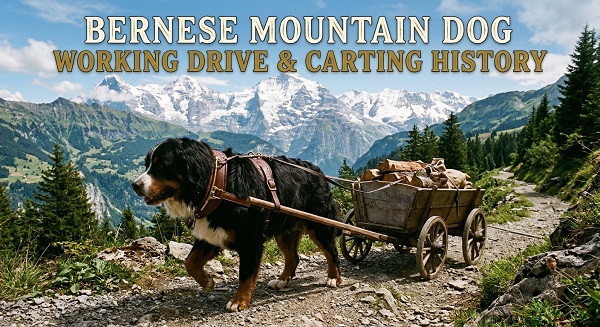
Bernese Mountain Dogs were bred as all-round farm dogs in the Swiss canton of Bern. They pulled milk and cheese carts, guarded homes and drove cattle. Industrial farming later replaced their labor and their numbers dropped, until Swiss enthusiasts rebuilt the breed in the late 1800s. Today that “working drive” shows up as a love of pulling, carrying and having a job. Modern carting (drafting) tests keep that heritage alive. Berners should not pull any weight until their growth plates close, at around 2 years old. Their lifespan is usually quoted as 7 to 10 years, so it pays to plan their work and care around that.
Table of Contents
- Introduction
- Where Did the Bernese Mountain Dog Come From?
- Why Swiss Farmers Hitched Berners to Carts
- Near Extinction and the Comeback
- How Berners Reached America and Built Modern Draft Tests
- What “Working Drive” Really Means in a Bernese Mountain Dog
- Carting Today: Draft Tests and Titles
- How to Start Carting With Your Bernese (Step by Step)
- Bernese Mountain Dog Lifespan
- Is Carting Right for Your Berner?
- Why You Can Trust This Guide (Trainer Notes)
- Frequently Asked Questions
- Final Thoughts
Introduction
Ever watch a Bernese Mountain Dog grab a laundry basket, a log or a rolled-up newspaper and march around like it has a job to do? That’s not a quirk. It’s more than a century of breeding showing up in your living room.
Most people meet the Bernese Mountain Dog as a fluffy, friendly family pet. But the breed is one of the great working dogs of the Alps. Many owners don’t understand that Bernese Mountain Dog working drive is quieter than a Malinois’s. It’s calm, steady and people-focused. If you skip it, you can end up with a bored 100-pound dog. If you honor it, you get a happier, healthier companion.
In this guide, you’ll learn:
- How the Bernese Mountain Dog carting history began and why the breed almost vanished
- What “working drive” really looks like in a Berner
- How modern draft tests and titles work
- When and how to start carting safely
- The honest truth about Bernese Mountain Dog lifespan
This guide is for casual owners and serious handlers alike. If you want the bigger picture of what makes a dog a “working dog,” read our guide on what a working dog really is first.
Where Did the Bernese Mountain Dog Come From?
The Berner comes from the farmland around the city of Bern, Switzerland. To understand its drive, you have to start with the jobs it was bred to do.
The Roman Story
You’ll often hear the Roman story. About 2,000 years ago, Roman soldiers crossing the Alps used big Mastiff-type dogs and black-and-tan dogs with white markings. These dogs guarded camps, moved cattle and pulled supply carts. Over time, crosses between those types are said to have produced today’s Berner.
It’s a great story, and the AKC repeats it. But treat it as the popular account, not a documented pedigree. Nobody kept stud books in Roman times. What we can say for sure is that big, tri-colored farm dogs have worked in the Swiss midlands for a very long time.
The Dürrbächler: The Name That Started It All
The breed’s first name tells you about its job. The FCI breed standard says the dogs were called “Dürrbächler,” after the hamlet and inn of Dürrbach near Riggisberg in the canton of Bern, where these long-haired, tri-colored farm dogs were especially common.
The same standard sums up the original work in one line. The breed was a guard, draught and cattle dog on farms in the canton of Bern. “Draught” is just the British spelling for hauling loads. So carting wasn’t a side hustle. It was one of the three core jobs.
One of Four Sennenhunde
The Berner has three Swiss cousins. The four Sennenhund breeds are the Bernese Mountain Dog, Greater Swiss Mountain Dog, Appenzeller Sennenhund and Entlebucher. “Sennenhund” loosely means “dairy farmer’s dog.” The Berner is the only one of the four with a moderately long, silky coat.
That coat is the clue to the Berner’s niche. It worked the cooler, wetter midlands and valleys around Bern. It wasn’t a high-peak rescue dog or a ranch dog, and that shapes how the breed handles heat today.

Why Swiss Farmers Hitched Berners to Carts
So why a dog and not a donkey or a horse? Money and space.
The Small Farm Problem
As Bern grew into a big dairy region, farmers and basket weavers in small valley farms and Alpine dairies relied on Berners to pull milk carts and wagons stacked with textiles. Many of these families couldn’t afford a horse or didn’t have the land to feed one. A strong dog that ate scraps and slept by the door was a smart choice.
Picture the daily routine:
- A farmer loads a small cart with milk cans or cheese.
- The dog pulls it down the track to the village or dairy.
- The dog guards the load while the farmer does business.
- On the way home, the dog helps move the family’s cattle.
The Body Built for the Job
The Berner’s build explains why it was chosen. According to the AKC standard, males stand about 25 to 27½ inches and weigh 80 to 115 pounds, while females are 23 to 26 inches and 70 to 95 pounds.
That’s a big frame with heavy bone and a deep chest. Add a calm head, and you have an animal that can pull steadily without panicking when a load shifts. Here’s what I look for in any draft dog:
- Steady nerves. A spooked dog with a cart attached is dangerous.
- Willingness to work with a person. Berners watch their handler, which makes training easier.
- Slow, even power. They aren’t sprinters. They’re haulers.
That “calm worker” temperament is exactly what the Swiss breed standard still stresses. The FCI says behavior is one of the most important trademarks of the breed.
Near Extinction and the Comeback
Here’s a part of the story many short articles skip. The Berner nearly disappeared.
Why the Breed Declined
Industrial farming replaced canine labor, the number of Bernese Mountain Dogs fell, and the Saint Bernard eventually became known as the Swiss national breed. When trucks and trains took over the milk run, the dog’s main job vanished. Farm dogs that no longer earn their keep tend to disappear fast.
The Rescue Mission
This is where a few stubborn people changed everything.
In 1892, dog fancier Franz Schertenleib searched for a good example of the breed. When he couldn’t find one, other Berner fans joined the hunt. Later, the famous Swiss geologist and mountain-dog champion Albert Heim backed the breed. Professor Heim championed it and helped link it to the wider family of Swiss mountain dogs.
Breed Timeline: 1892 to 1910
| Year | What happened |
|---|---|
| 1892 | Schertenleib begins searching for good breed examples |
| 1902, 1904 | Dürrbächler dogs shown at Swiss dog shows |
| 1907 | Breeders around Burgdorf found the Schweizerischer Dürrbach-Klub |
| 1910 | 107 dogs appear at a Burgdorf show |
The 1907 dates, the three early shows and the 107 dogs at Burgdorf in 1910 all come straight from the FCI breed standard. That 1910 number matters. In just a few years, the breed went from “hard to find” to more than a hundred dogs in one ring.
How Berners Reached America and Built Modern Draft Tests
The American Chapter
A Kansas farmer, Isaac Schliess, is believed to have imported the first Bernese Mountain Dogs to the US in 1926. In 1936, Glen Shadow of Louisiana imported a pair called Felix and Fridy. One story from that pair sticks with me. A few years later, a 350-pound buck attacked Shadow, and Felix and Frances (a daughter of Fridy) pulled the deer off him and chased it away. That’s the “guard” side of the old farm dog.
The AKC recognized the breed in 1937, and in 1968 the Bernese Mountain Dog Club of America (BMDCA) was formed.
The Program That Saved the Skill
Here’s the key moment for carting. The BMDCA set up a drafting and carting program to maintain and test the breed’s historic working ability as a carting dog.
Think about what that means. The job was gone from most farms, so the breed club invented a test to keep the skill alive. Without it, many lines would likely have lost the instinct over time.
The BMDCA also tied the sport to its top awards. The BMDCA Versatility Award, created in 1995, requires a draft title along with a championship and one other working title.
What “Working Drive” Really Means in a Bernese Mountain Dog
Let’s clear up a big misunderstanding.
Berner Drive vs. Malinois Drive
When people hear “working drive,” they picture a Belgian Malinois bouncing off the walls. A Berner isn’t that. Its drive looks like this:
- A strong desire to be useful. It carries things, follows you from room to room and “helps.”
- Pulling comes naturally. BMDCA draft chair Julie Bacon says her Berners love pulling a cart above all else, probably because it comes easiest to them.
- Low-to-medium energy, but good stamina. The AKC notes Berners don’t need as much exercise as a Greater Swiss or a Saint Bernard.
- Biddable attitude. Bacon calls the breed incredibly biddable and up for trying new things, especially when treats are involved.
So the Berner’s drive is a cooperative drive. It wants to work with you. Compare that to a police K9’s drive, which is high-intensity prey and defense energy that needs expert control.
If you want to dig into how drive and obedience fit together, read our piece on balancing instinct and obedience. The same logic applies here. A drivey dog without clear rules gets pushy, even a gentle giant.
Signs Your Berner Has Strong Working Drive
Look for these at home:
- Picks up and carries objects (shoes, tools, sticks) without being asked
- Leans into the leash and pulls steadily on walks
- Follows you everywhere and seems restless when you work and it can’t help
- Gets visibly happier when given a task
- Pulls a sled, wagon, boat or kid’s wagon with no training
What Happens When You Ignore It
I’ve seen this pattern with many working breeds. A dog bred for a job but given none usually invents one. In a Berner, that can mean:
- Leash pulling that gets worse with age
- Nipping or “herding” family members
- Digging and chewing from boredom
- Weight gain, which is especially bad for a big, joint-prone breed
The fix isn’t hours of high-intensity exercise. It’s purpose. Ten minutes of cart work or a “carry the groceries” game can beat a long, aimless walk.
Carting Today: Draft Tests and Titles
What a Draft Test Looks Like
Draft tests copy the old farm run in a controlled way. In drafting and carting tests, dogs must pull a load for a half-mile and finish within 12 to 15 minutes. The average cart weighs about 20 pounds.
Along the way, the dog has to show calm, control and teamwork. That’s why it’s a great sport for family dogs, not only show dogs.
BMDCA Draft Titles
The BMDCA recognizes these draft titles: NDD (Novice Draft Dog), DD (Draft Dog), ANDD (Advanced Novice Draft Dog), MDD (Master Draft Dog), BNDD (Brace Novice Draft Dog), BDD (Brace Draft Dog), ABNDD (Advanced Brace Novice Draft Dog) and MBDD (Master Brace Draft Dog).
“Brace” means two dogs working side by side. One brace class is for a pair on leash, and another is for a pair off leash. Two Berners moving a cart in step is a beautiful sight.
Other kennel clubs run their own versions. Canada’s CKC, for example, has Draft Dog tests with Excellent, Advanced and Master levels. Check your local club for rules, since they change.
The Equipment
The buckle harness is the traditional style seen in old photos of Berners carting in Switzerland. Whatever style you choose, fit matters more than looks. A badly fitted harness can rub, restrict the shoulders and make a dog hate the sport. Our guide on what handlers check when choosing a harness shows how to check fit, strap strength and hardware.
How to Start Carting With Your Bernese (Step by Step)
Most competitor articles say “train your dog to pull a cart” and stop. Here’s a real timeline you can follow.
The Golden Rule: Wait for Mature Joints
This is the most important safety point in the whole article. Pulling a cart is dangerous for Berners until their growth plates close, at around age 2. You can introduce the harness at about 6 months and use training wheels to move slowly, but no weight should go in the cart until age 2.
Another source agrees. There’s no age limit on carting, but a vet check comes first, and in large breeds like the Berner full development can mean waiting until 2 years old.
A Realistic Training Timeline
| Age | Focus | Cart weight |
|---|---|---|
| 8 weeks to 6 months | Basic obedience, leash manners, confidence with new sounds and surfaces | None |
| 6 to 12 months | Wear the harness, walk beside the empty cart or training wheels | None |
| 12 to 24 months | Calm steady walking, “whoa” (stop), turns, loading and unloading | None |
| After 2 years (with vet OK) | Add light weight slowly, build distance | Gradual |
These are guideline stages based on AKC advice and standard handler practice. Every dog matures differently, so let your vet confirm.
Six Steps to a Calm Cart Dog
- Build the basics first. Carting is easier to teach if your dog already knows commands like sit, stand and stay. If you need a simple foundation plan, my e-book Beyond the Bark walks you through step-by-step basic training.
- Make the harness a happy thing. Pair it with treats. Put it on for a minute, then take it off.
- Introduce the cart shafts or wheels while the cart is empty. Reward calm curiosity.
- Teach “walk on” and “whoa.” The stop cue is the one that keeps everyone safe.
- Practice turns and loading in a quiet, flat area before heading to trails.
- Add weight only when mature, in small steps, and watch for soreness or reluctance.
Safety Checks Before Every Session
- Surface is flat and not too hot (a Berner’s thick coat overheats easily)
- Harness fits with no rubbing
- Cart is balanced and stable
- Dog is sound, with no limping or stiffness
- Water and shade are available
- Sessions are short and end on a win
Bernese Mountain Dog Lifespan
You can’t write honestly about this breed’s working life without talking about how short it can be.
How Long Do Bernese Mountain Dogs Live?
The commonly cited Bernese Mountain Dog lifespan is seven to ten years. One caution: “average lifespan” gets used loosely online, and sources sometimes mix up averages, medians and broad breed descriptions. The same source reports one study median of 8.4 years. Numbers differ between studies, countries and bloodlines, so treat any single figure as a range, not a promise.
Why Is the Berner’s Lifespan Shorter Than Many Breeds?
The main reason is cancer. Cancer is the leading cause of death in the breed, and some sources say nearly half of Berners will develop it at some point. Histiocytic sarcoma is the most common type.
A large research study gives us harder numbers. Researchers looked at 365 Bernese Mountain Dogs with histiocytic sarcoma (HS). The mean age at diagnosis was 6.6 years, with a range from 0.6 to 12.2 years.
In plain English, HS often hits in the middle years, when a Berner should be in its prime. That’s why many owners (and I include myself in the advice I give) plan for the working years to happen earlier rather than later.
Joints are the second big issue. Large, heavy dogs are prone to hip and elbow problems, which is one more reason to protect growing joints and keep your dog lean.
Does Carting Shorten or Extend a Berner’s Life?
Honest answer: I haven’t found a study that proves either. What we can say:
- Cancer risk is heavily genetic. Exercise alone can’t remove it.
- Healthy weight and fit joints help quality of life. Moderate, purposeful exercise supports both.
- Overloading or starting too early can injure joints. That’s the real risk.
So carting won’t “use up” your dog, but doing it wrong can hurt.
What Owners Can Do
- Ask breeders for health testing and family history. The BMDCA describes histiocytic sarcoma risk testing as information for breeding decisions. A risk result isn’t a diagnosis, and a good result can’t guarantee a dog will never get cancer.
- Keep your Berner lean. Extra weight stresses joints.
- Get regular vet checks, and go more often once your dog hits 5 or 6.
- Don’t ignore small changes. Stiffness, limping, lumps, low energy or appetite loss need a vet visit. Some cancers can first show up as joint pain.
- Enjoy the work now. Light carting in the prime years is a gift to both of you.

Is Carting Right for Your Berner?
Pros
- Gives a working-bred dog a real job
- Builds focus, trust and calm leadership
- Low-impact compared to high-jump sports like agility
- Fun for families, parades and local events
- Keeps you connected to the breed’s history
Cons
- Needs patience, because you must wait for physical maturity
- Needs proper gear and space
- Not safe in heat, and the Berner’s thick coat makes it prone to overheating
- Some dogs simply aren’t keen, and that’s okay
When to Skip It
Skip carting (and talk to your vet) if your dog has joint disease, is overweight, is under 2 years old or is in the senior years with mobility trouble. Try scent games, easy hikes with a light backpack or simple “carry” tricks instead.
Why You Can Trust This Guide (Trainer Notes)
Here’s how this article was built, so you can judge it yourself:
- Handler’s perspective. ARFS K9 Team is a team of professional dog trainers, and we work with and demonstrate working dogs, including military working dogs in public events. Our view of “drive” comes from handling and training, not from guessing.
- Sources used. Breed history comes from the FCI breed standard (the international authority), the AKC and BMDCA material. Health numbers come from a peer-reviewed study in the journal Veterinary Sciences and from veterinary-reviewed sources.
- What we’re honest about. We flag stories (like the Roman origin) that are popular but unproven, and we say when we found no evidence.
- Not a vet. This guide is for education. Your veterinarian should clear your dog for carting.
Frequently Asked Questions
1. What were Bernese Mountain Dogs originally bred to do?
They were farm dogs in the canton of Bern, Switzerland. They guarded homes, drove cattle and pulled carts of milk, cheese and other goods. The FCI describes the original role as guard, draught and cattle dog.
2. At what age can a Bernese Mountain Dog start pulling a cart?
You can introduce the harness at around 6 months and use training wheels with no weight. Don’t add weight until around age 2, when the growth plates have closed. Always get a vet check first.
3. How much weight can a Bernese Mountain Dog pull?
It depends on the dog’s age, fitness, cart and surface. Draft tests use carts that average about 20 pounds, over a half-mile course. Don’t chase big numbers you see online. Build load gradually and stop at the first sign of strain.
4. How long do Bernese Mountain Dogs live?
The usual range quoted is 7 to 10 years. Cancer, especially histiocytic sarcoma, is a major reason many live shorter lives than other big breeds. Health-tested, well-bred dogs kept lean may have a better chance, but there are no guarantees.
5. Do all Bernese Mountain Dogs enjoy carting?
Most take to it well because pulling is part of their heritage, but not all. Some dogs are shy, sore or just uninterested. Go slow, keep it positive and let your dog tell you if it’s not for them.
Final Thoughts
The Bernese Mountain Dog is a farm worker in a family dog’s coat. It spent generations pulling carts, guarding farms and driving cattle around Bern. When machines took over, the breed nearly disappeared, but a handful of Swiss breeders and later the BMDCA’s draft program kept the skill alive.
Here’s what to take away:
- Respect the drive. It’s a calm, cooperative drive, but it still needs a job.
- Protect the joints. Harness at around 6 months, no weight until about 2 years, and always with a vet’s OK.
- Plan for a shorter lifespan. With a 7 to 10 year range and a high cancer risk, make the prime years count.
- Start small. A 10-minute training session, a backpack walk or an empty-cart introduction is enough.
If your Berner is under 2, start with obedience and harness comfort this week. If your dog is mature and sound, call your vet and a local BMDCA-affiliated or draft club to find a test near you.
Want more practical working-dog guides like this every week? Subscribe to our weekly articles roundup newsletter and get new K9 training tips straight to your inbox.

Her work centres on obedience, detection, protection and operational readiness. She favours proven methods built on repetition, consistency and real-world conditioning, so that both dogs and handlers are prepared for high-pressure tasks.
Rofiat represented the Nigerian Army Dog Centre at the Nigerian Army Day Celebration (NADCEL) 2026, where she led demonstrations in obedience, explosive detection, agility and tactical movement. Through articles, training content and documentaries, she shares field-based insight into how structured training, clear communication and trust between handler and dog affect performance and reliability.
She is the author of Beyond the Bark: Inside a Pro Handler's Playbook for Raising the Ideal Dog, a practical guide that helps dog owners and handlers apply professional training principles in everyday situations.
- Food Aggression Dog Training: Pro K9 Guide - November 21, 2026
- DIY Dog Scent Training: Easy 4-Week Home Guide - November 20, 2026
- Buckeye Puppies Review: 5 Red Flags to Check - November 19, 2026