Top 7 Guard Protection Dogs for Family Safety
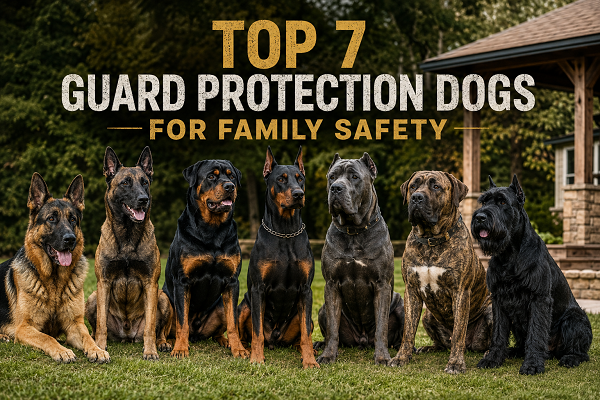
The best guard protection dogs for family safety are the German Shepherd, Belgian Malinois, Rottweiler, Doberman Pinscher, Cane Corso, Boerboel, and Giant Schnauzer. Each of these breeds combines natural protective instinct with high trainability, but the “best” one for your household depends on your experience level, living space, and how much time you can commit to structured training.
Table of Contents
- Introduction
- What Actually Makes a Dog a Good Family Protector
- 1. German Shepherd
- 2. Belgian Malinois
- 3. Rottweiler
- 4. Doberman Pinscher
- 5. Cane Corso
- 6. Boerboel
- 7. Giant Schnauzer
- Cost of Owning and Training a Protection Dog
- Insurance and Legal Considerations
- Trainer Note
- FAQs
- Conclusion
Introduction
Here’s the problem most families run into: they want a dog that’ll protect the house, but they pick based on looks, breed reputation, or something a neighbor told them at the dog park. Six months later, they’ve got a 90-pound dog they can’t control, a homeowner’s insurance policy that just excluded them, or worse, a dog that’s all bark and no real judgment when it actually matters.
A genuine family protection dog isn’t a weapon. It’s a working partner with the temperament to tell the difference between the mail carrier and an actual threat, and the training to act appropriately either way. That distinction is everything, and it’s what separates a well-bred, well-trained guardian from a dog that’s just big and intimidating.
In this guide, I’m going to walk you through the seven breeds that consistently show up, again and again, in professional protection-dog placement programs across the US, UK, and Europe. You’ll get real numbers on training timelines, costs, bite force, and the insurance and liability side nobody talks about enough. Whether you’re a first-time dog owner or a former handler looking for your next partner, you’ll walk away knowing which breed actually fits your life.
What Actually Makes a Dog a Good Family Protector
Before we get into the list, let’s clear something up: a “protective” dog and a “protection dog” are not the same thing.
- A protective dog has natural instincts, alertness, territorial awareness, a deep bond with the family, but hasn’t gone through structured protection training.
- A protection dog has been through formal obedience and controlled bite-work training, meaning it only engages on command or in a genuine, unambiguous threat scenario.
Most families don’t actually need (or want) a fully trained protection dog with bite-work credentials. What they need is a breed with the right temperament, raised and socialized properly, that naturally deters intruders and alerts the household. Keep that distinction in mind as you read through the list below, because it changes what “training” really means for each breed.
Every breed on this list shares four traits:
- Territorial instinct – an inherited wariness of unfamiliar people or animals entering the home
- High trainability – responsive to structured obedience work, not just food-motivated tricks
- Strong family bond – loyalty that translates into a calm, controlled response rather than panic or random aggression
- Physical capability – size, strength, or speed sufficient to actually deter or intervene if needed
1. German Shepherd
If you’ve ever walked into a police station, an airport security checkpoint, or a military K9 unit anywhere in the world, you’ve seen a German Shepherd. It’s the breed protection work is measured against.
German Shepherds were developed in Germany in the late 1800s by Captain Max von Stephanitz, originally for herding, but their intelligence and trainability quickly pushed them into police and military service. Today they remain one of the most popular breeds in the US, UK, and across Europe, and they’re the backbone of programs like the FBI K9 unit and countless municipal police forces.
Why they work as family protectors:
- Exceptionally trainable, they rank among the top 3 smartest breeds by working/obedience intelligence in canine researcher Dr. Stanley Coren’s landmark studies
- Strong bond with children when raised in the home from puppyhood
- Naturally alert without being reactive, once properly socialized
Training timeline: Basic obedience by 4-6 months, structured protection or advanced obedience work typically starts around 12-18 months once the dog’s temperament and nerve strength are fully assessed.
The trade-off: Working-line German Shepherds need serious daily engagement, 60-90 minutes of structured exercise and mental stimulation isn’t unusual, or they’ll find their own (usually destructive) outlet.
2. Belgian Malinois
The Malinois has had a moment in pop culture over the last decade, largely thanks to high-profile military and Secret Service use, but that popularity has also caused real problems. This is not a beginner’s dog.
Belgian Malinois are faster, more intense, and higher-drive than German Shepherds, which is exactly why elite military units favor them for tasks requiring speed and relentless focus. The breed was one of four Belgian Shepherd varieties standardized in the 1890s, originally a herding dog from the city of Malines.
Why they work as family protectors:
- Extremely fast reaction time and physical agility
- Fiercely loyal and highly bonded to their handler or family unit
- Lower grooming needs than the GSD thanks to a short coat
Training timeline: These dogs need structured mental work starting as young as 8 weeks. Without it, that intensity turns into anxiety or destructive behavior fast. Most reputable trainers won’t recommend a Malinois for a first-time dog owner.
The trade-off: Malinois were bred for handler-driven work, not independent decision-making. An under-exercised, under-trained Malinois in a suburban home is a recipe for a very stressed dog and a very frustrated family.
3. Rottweiler
Rottweilers get a reputation problem they honestly don’t deserve. Bred originally in the German town of Rottweil to drive cattle to market and later pull carts for butchers, this breed has centuries of working history built around calm confidence, not aggression.
Why they work as family protectors:
- The American Kennel Club (AKC) rates Rottweilers 5 out of 5 for trainability and 5 out of 5 for affection with family
- Naturally low-key indoors, they’re not a breed that barks at every passing car
- Steady, deliberate temperament, they observe before they react
Training timeline: Socialization is non-negotiable and should start at 7-8 weeks. Rottweilers mature slowly, both physically and mentally, often not reaching full emotional maturity until 2-3 years old, so early structure matters more than early “protection work.”
The trade-off: Rottweilers are one of the breeds most frequently named on homeowner’s insurance breed-restriction lists in the US, right alongside pit bull-type dogs, Dobermans, and Akitas. Check your policy before you commit.
4. Doberman Pinscher
The Doberman was purpose-built for personal protection. A German tax collector named Louis Dobermann developed the breed in the 1890s specifically because he wanted a loyal, intimidating companion for his rounds. That origin story tells you everything about why this breed still excels here.
Why they work as family protectors:
- Athletic and fast, Dobermans can close distance on a threat quicker than most guard breeds
- Highly responsive to training, corrections and rewards both register clearly and reliably
- Sleek build means lower shedding and easier upkeep than many large guard breeds
Training timeline: Basic obedience 8-16 weeks, most trainers see reliable temperament stability and readiness for advanced work by 18-24 months.
The trade-off: Modern Dobermans (post-1970s breeding shift) are actually far more affectionate and less aggressive than their old “junkyard dog” reputation suggests, but that same sensitivity means harsh training methods backfire badly. This is a breed that needs a confident, consistent handler, not a heavy-handed one.
5. Cane Corso
If you want size and presence without going full mastiff-giant, the Cane Corso hits a sweet spot. Descended from Roman war dogs and later used across the Italian countryside to guard farms and hunt large game, the Corso nearly went extinct in the mid-1900s before a small group of Italian breeders revived the line in the 1970s and 80s.
Why they work as family protectors:
- Naturally territorial and highly protective of family and property
- Athletic and muscular, closer to a linebacker’s build than a tank’s, giving it real speed alongside strength
- Deeply loyal once bonded, they form close attachments to their household
Training timeline: Early socialization from 8 weeks is essential given their size trajectory. Structured obedience should begin by 4-5 months before the dog’s size makes handling difficult, some Corsos reach 90-110 pounds by their first birthday.
The trade-off: A poorly socialized Cane Corso is a genuine liability given its size and bite force. This is one of the most-cited breeds in dangerous-dog legislation across parts of Europe, so check local breed-specific laws before bringing one home.
6. Boerboel
Now here’s a breed a lot of American and European families still haven’t heard of, but should. The Boerboel was developed by Dutch and French Huguenot settlers (the “Boers”) at South Africa’s Cape of Good Hope starting in the 1600s. These dogs had one job: keep the farm and family safe from lions, leopards, hyenas, and armed intruders. There was no room for a soft temperament in that environment.
Why they work as family protectors:
- Massive size and raw strength, males can outweigh a Cane Corso by 50-90 pounds
- Historically bred for independent decision-making on isolated farms, meaning they don’t need constant handler direction to assess a threat
- Generally excellent, patient temperament with children when properly raised
Training timeline: Given their sheer size (some males exceed 150-200 pounds), obedience training needs to start at 8-10 weeks, before the dog physically outmatches the handler’s ability to correct unwanted behavior.
The trade-off: Because Boerboels were bred for independent judgment rather than constant handler cues, they need an owner who can establish calm, consistent leadership early. We actually broke down exactly how a Boerboel compares to a Cane Corso in bite force, muscle mass, and real-world performance in a full Boerboel vs Cane Corso strength breakdown if you’re torn between the two.
7. Giant Schnauzer
This is the breed people underestimate the most, and that’s exactly the point. With a beard, bushy eyebrows, and a coat often mistaken for a Labradoodle’s, the Giant Schnauzer doesn’t look like a guard dog. That’s precisely why protection-dog trainers love it.
Bred in Bavaria to guard cattle, breweries, and stockyards, the Giant Schnauzer carries real guarding instinct wrapped in a deceptively approachable package. It’s an AKC-recognized breed under the Working Group since 1930, and in 2025 a Giant Schnauzer took Best in Show at Westminster, a result that pushed the breed up five spots in AKC’s popularity rankings, from No. 57 to No. 52 out of roughly 200 recognized breeds.
Why they work as family protectors:
- Naturally suspicious of strangers without extensive training, an instinct baked in from centuries of guarding isolated farms and breweries
- Hypoallergenic coat, a real advantage for families managing allergies
- High intelligence means faster training timelines than many guard breeds
Training timeline: Basic obedience by 4-6 months, but because this breed is so mentally sharp, many trainers see advanced-level readiness earlier than with Rottweilers or Boerboels, often by 12-15 months.
The trade-off: Fully trained Giant Schnauzer protection dogs from specialty programs can run as high as $30,000-$37,000, among the priciest of any protection breed, largely because qualified breeding stock and experienced trainers for this breed are genuinely rare. I go into the full cost breakdown, bite-force comparisons, and health considerations in our dedicated Giant Schnauzer protection dog guide.
Cost of Owning and Training a Protection Dog
Let’s talk numbers, because this is where a lot of families get blindsided.
- Puppy from a reputable working-line breeder: $1,500-$4,000 depending on breed and pedigree
- Basic obedience group classes: $150-$400 for a 6-8 week course
- Private obedience training: $75-$150 per session, or $2,500-$5,000 for a board-and-train program
- Fully trained personal protection dog (already imprinted and certified): $25,000-$65,000+ depending on breed, program, and training level
- Annual upkeep (food, vet care, insurance, grooming): $1,500-$3,500 for a large-breed guard dog
If you’re not buying a fully trained adult dog, budget for real time, not just money. Solid foundational obedience realistically takes 6-12 months of consistent, weekly effort, and advanced protection work (if you go that route) adds another 6-18 months on top of that. This isn’t a weekend project.
Insurance and Legal Considerations
This part gets skipped in most “best guard dog” articles, and it shouldn’t.
According to the Insurance Information Institute and State Farm, U.S. homeowners insurers paid out $1.86 billion in dog-related liability claims in 2025, across 28,450 claims, with the average cost per claim landing at $65,450. That average has climbed 97% since 2016.
A few things worth knowing before you commit to a breed:
- Many U.S. insurers maintain breed-restriction lists that specifically name Rottweilers, Dobermans, and sometimes German Shepherds and mastiff-type breeds like the Cane Corso and Boerboel
- Some policies won’t exclude coverage outright but will raise premiums significantly for large guard breeds
- In parts of the UK and EU, breed-specific legislation affects ownership of certain large or mastiff-type dogs, so check your local council or municipal regulations before adopting
- A dog that’s fully trained and behaviorally sound with a clean bite history is far less likely to trigger insurer scrutiny than an untrained or poorly socialized one
Bottom line: call your insurance provider before you bring home a large guard breed, not after.
Trainer Note
This guide draws on placement and training patterns observed across working-dog programs in the US, UK, and South Africa, cross-referenced against AKC breed data, Insurance Information Institute claims reporting, and canine behavioral research from Dr. Stanley Coren’s published intelligence rankings. Breed history, training timelines, and cost figures reflect current 2026 industry standards from professional protection-dog trainers and breed clubs.
For more on how we approach obedience foundations before any protection work begins, see our full breakdown of common dog training mistakes handlers must avoid, and our family and home security resource hub for more on layering a protection dog into your overall home safety plan. Keeping a large working breed healthy through years of physical training also matters, our health and nutrition section covers feeding, joint care, and conditioning specific to guard-breed dogs.
FAQs
1. What is the best guard dog for a family with young children?
German Shepherds and Rottweilers are generally considered the most balanced options for families with kids, thanks to their steady temperaments and long track record in family placements, but early socialization and supervised introductions matter more than breed alone.
2. How long does it take to train a protection dog?
Basic obedience typically takes 3-6 months of consistent work. Full protection or bite-work training, if you pursue it, usually takes an additional 6-18 months depending on the breed and the dog’s temperament.
3. Are guard dogs dangerous to have around children?
Not when properly bred, socialized, and trained. Most serious incidents involve dogs with poor socialization, inadequate training, or owners who mistake aggression for protection. A well-trained guard dog is actually more predictable and controlled than an untrained dog of any breed.
4. Do guard dogs affect my homeowner’s insurance?
Often, yes. Breeds like Rottweilers, Dobermans, and some mastiff-type dogs frequently appear on insurer breed-restriction lists. Always check with your provider before adopting, since this can affect your premium or even your coverage eligibility.
5. What’s the difference between a protective dog and a trained protection dog?
A protective dog has natural territorial and alert instincts without formal bite-work training. A trained protection dog has gone through structured obedience and controlled engagement training, meaning it responds to specific commands rather than acting purely on instinct.
Conclusion
Choosing a guard protection dog for your family isn’t about picking the biggest or most intimidating breed on the list. It’s about matching a dog’s natural instincts and energy level to your household’s lifestyle, experience, and commitment to training. A German Shepherd or Rottweiler suits most first-time guardian-dog owners well. A Belgian Malinois or Cane Corso demands a more experienced handler. And breeds like the Boerboel and Giant Schnauzer offer real protective capability in less conventional packages.
Whichever breed you choose, the actual work starts the day you bring the puppy home: consistent socialization, structured obedience, and a clear understanding of your local insurance and legal landscape. Do that right, and you won’t just have a guard dog. You’ll have a genuine family partner that knows exactly when to stand down and when to stand up.

Her work centres on obedience, detection, protection and operational readiness. She favours proven methods built on repetition, consistency and real-world conditioning, so that both dogs and handlers are prepared for high-pressure tasks.
Rofiat represented the Nigerian Army Dog Centre at the Nigerian Army Day Celebration (NADCEL) 2026, where she led demonstrations in obedience, explosive detection, agility and tactical movement. Through articles, training content and documentaries, she shares field-based insight into how structured training, clear communication and trust between handler and dog affect performance and reliability.
She is the author of Beyond the Bark: Inside a Pro Handler's Playbook for Raising the Ideal Dog, a practical guide that helps dog owners and handlers apply professional training principles in everyday situations.
- Local Dog Breeds: Temperament, Health & Training Guide - October 6, 2026
- How Long Do Military Working Dogs Serve? Full Guide - October 5, 2026
- National Puppy Day 2026: Date, Best Deals & Freebies - October 4, 2026