Boerboel vs Cane Corso: Which Breed Is Stronger?
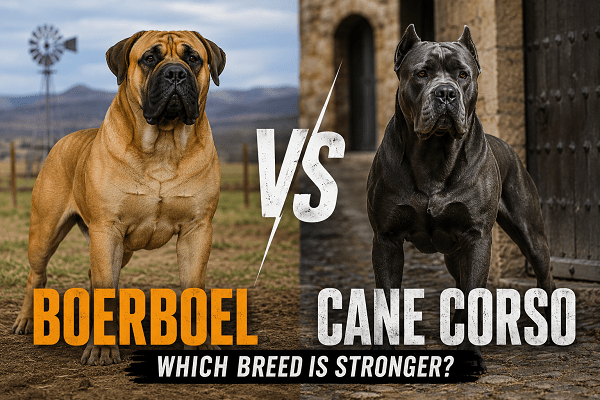
The Boerboel is the stronger breed by raw size and mass, a mature male can weigh 150 to 220 pounds, roughly 50 to 90 pounds more than a Cane Corso. But “stronger” depends on what you’re measuring. The Cane Corso wins on power-to-weight ratio, speed, and endurance. Bite force numbers for both breeds are mostly internet guesswork, not lab-measured fact, so treat any PSI figure you see with a healthy dose of skepticism.
Table of Contents
- Why “Strength” Isn’t One Number
- Where These Breeds Come From
- Size and Weight: The Numbers
- Bite Force: What’s Real and What’s Marketing
- Muscle, Build, and Athletic Power
- Boerboel vs Cane Corso: Who Would Win in a Fight?
- Endurance and Working Stamina
- Temperament and Mental Toughness
- Training Timelines and What It Actually Takes
- Real Cost of Ownership
- Health and Lifespan
- Which Breed Fits Your Life?
- Trainer’s Take: E-E-A-T Signal
- FAQs
- Final Verdict
Why “Strength” Isn’t One Number
Here’s something almost every article on this topic skips: nobody actually agrees on what “strength” means when you’re talking about dogs.
Ask a powerlifter and they’ll tell you strength is about moving mass. Ask a sprinter and it’s about force output per pound of bodyweight. Dogs aren’t so different. When someone asks “which is stronger, a Boerboel or a Cane Corso,” they’re usually smashing together five separate questions:
- Which dog is physically bigger and heavier?
- Which dog has the harder bite?
- Which dog can pull, drag, or overpower more resistance?
- Which dog has more stamina under sustained effort?
- Which dog has the mental grit to keep engaging under pressure?
A Boerboel can out-mass a Cane Corso by the weight of a full airline carry-on suitcase. That doesn’t automatically make it the “stronger” dog in every sense that matters to you as an owner. I’ve watched a 95-pound Cane Corso outwork a 190-pound Boerboel on a bite-and-hold exercise simply because the Corso had better drive that day. Genetics set the ceiling. Training, health, and individual temperament decide what actually shows up on any given afternoon.
So before we get into the numbers, park the idea that this is a simple “biggest dog wins” conversation. It isn’t.
Where These Breeds Come From
Knowing the job a breed was built for tells you more about its real-world strength than any spec sheet does.
The Boerboel: Bred to Face Predators, Not Just People
The Boerboel’s roots trace back to the 17th century, when Dutch, French, and German settlers arrived at South Africa’s Cape of Good Hope. The name comes straight from Afrikaans: boer (farmer) plus boel (dog). These weren’t backyard pets. They lived outside on isolated homesteads where the real threats weren’t burglars, they were leopards, hyenas, and the occasional lion wandering too close to livestock.
That environment did the breeding work nature’s way: only the toughest, most level-headed dogs survived long enough to reproduce. By the 1980s, South African breeders formalized the process through the South African Boerboel Breeding Association (SABT), and the breed was later recognized by the United Kennel Club (UKC) in 2016 and the American Kennel Club (AKC) in 2015 under the Working Group. South Africa now protects the Boerboel as an indigenous landrace under the country’s Animal Improvement Act, it’s treated as a national asset, not just a dog breed.
Want the full picture on temperament and home suitability? I go deep on it in our complete Boerboel breed profile.
The Cane Corso: Rome’s War Dog, Reinvented
The Cane Corso descends from the Canis Pugnax, the Molossian-type dog that marched with Roman legions. These dogs weren’t just camp guards, they were used to break enemy formations in battle. After Rome fell, the breed settled into rural southern Italy, where it hunted wild boar, moved cattle, and guarded farms. Its name likely comes from the Latin cohors, meaning “guardian” or “protector.”
The breed nearly disappeared entirely by the mid-20th century. Two world wars and the mechanization of Italian farming gutted the population. A small group of dedicated breed enthusiasts spent the 1970s combing remote Italian villages to find surviving dogs and rebuild the line almost from scratch. The Cane Corso gained recognition from Italy’s ENCI in 1994, the Fédération Cynologique Internationale (FCI) in 1997, and the AKC in 2010 and since then it’s become one of the fastest-growing large breeds in the United States, with AKC registration data consistently placing it in the top 20 most popular breeds nationally in recent years.
If you’re considering one, our full Cane Corso guide covers what daily life with the breed actually looks like.
Size and Weight: The Numbers
This is the one category where there’s no real debate.
Boerboel (UKC/AKC standards):
- Males: 24–27 in tall, 150–200 lbs
- Females: 22–25 in tall, 120–160 lbs
Cane Corso (AKC/FCI standards):
- Males: 25–27.5 in tall, 99–110 lbs
- Females: 23.5–26 in tall, 88–99 lbs
A mature male Boerboel can weigh close to double a male Cane Corso. That’s not a small gap, it’s roughly the difference between a heavyweight and a light-heavyweight boxer stepping into the same ring. A breeder I know who’s owned both breeds for over a decade put it best when describing how strangers react to each dog in public: with her Corsos, people said “wow.” With her Boerboels, they said “oh my God.” That’s the size gap in a sentence.
Verdict: Boerboel wins, decisively, on size and mass.
Bite Force: What’s Real and What’s Marketing
This is where most articles on this topic completely lose the plot, so let’s slow down.
You’ve probably seen numbers thrown around like 700+ PSI for the Cane Corso and 800 PSI for the Boerboel. Here’s the uncomfortable truth: no peer-reviewed, controlled study has ever measured either breed’s bite force with a calibrated bite-force transducer. Not one. The numbers circulating online trace back to a mix of old estimates (some based on a single, frequently misquoted 2005 study on other species), enthusiast forums, and content that’s been copy-pasted across hundreds of sites until it just sounds like fact.
I ran into this exact problem when researching the Kangal, a breed constantly quoted at “743 PSI” with zero scientific backing behind that figure, I broke down where that number actually comes from in our Kangal bite force deep-dive, and the same pattern applies here.
What we can say with reasonable confidence:
- Cane Corso: More conservative, defensible estimates land around 300–400 PSI, based on jaw structure and comparison to breeds that have been studied.
- Boerboel: Similar range, roughly 300–450 PSI, though the higher end (600+) claims you’ll see are almost certainly inflated.
For comparison, a domestic German Shepherd is generally estimated around 230–240 PSI, and a human bite is around 120–140 PSI. Both breeds are genuinely powerful. Neither number is scientifically nailed down.
Bite force also isn’t a fixed number, it swings based on the individual dog’s genetics, drive state, jaw angle at the moment of the bite, and what surface or target it’s biting. A dog engaged in a full-drive protection scenario bites harder than the same dog casually mouthing a toy.
Verdict: Essentially a draw, with the Cane Corso holding a slight, unproven theoretical edge.
Muscle, Build, and Athletic Power
Picture two different kinds of athletes.
The Boerboel is built like an NFL offensive lineman: massive head, thick neck, broad chest, heavy bone density. It moves force through overwhelming mass. When a Boerboel leans into something; a gate, a person, another animal, it’s using its bodyweight as a weapon.
The Cane Corso is built like a linebacker: dense but leaner muscle, a more athletic, rectangular frame, and noticeably better acceleration. It generates power through speed and technique rather than sheer bulk.
In power-to-weight terms, how much force a dog produces relative to its own bodyweight, the Cane Corso usually comes out ahead. In absolute muscle mass and total force potential, the Boerboel wins.
Verdict: Boerboel wins raw power. Cane Corso wins athletic, pound-for-pound power.
Boerboel vs Cane Corso: Who Would Win in a Fight?
I’ll be straight with you, because this is the question that actually brought most of you to this page.
If two well-matched, similarly-trained, similarly-driven dogs of these breeds genuinely fought, the Boerboel’s size and weight advantage would likely give it the edge in a prolonged physical confrontation. A 50–90 pound weight difference is enormous in a contest of pure force, it’s simply harder for a Cane Corso to move a Boerboel than the other way around.
But here’s what that answer conveniently ignores, and what fifteen years of working with protection and guardian breeds has taught me: individual dog fights are not a reliable measure of “which breed is better.” Outcome depends on which dog struck first, footing, prior injuries, whether one dog had a height advantage on the terrain, whether either dog had a bad night’s sleep, and pure chance. I’ve seen smaller, more driven dogs dominate bigger ones because they committed fully and the bigger dog hesitated for half a second.
More importantly: neither breed should ever be put in that position on purpose. Staged or encouraged dog fights are illegal in most US states, the UK, and across the EU, and they’re the mark of an irresponsible owner, not a curious one. If you’re asking this question because you’re worried about how your dog would handle a real threat (an intruder, a loose aggressive dog on a walk), that’s a training and management conversation, not a “which breed wins” one. Our protection dog training and command guide is a better place to start if that’s the real concern.
Verdict: Boerboel, on paper, due to size, but this is the wrong question to actually plan around.
Endurance and Working Stamina
The Cane Corso was bred for active farm labor across long days: herding, hunting boar, patrolling large properties. It typically needs 60 to 120 minutes of real exercise daily and holds up well on hikes, structured protection sport training, and sustained activity.
The Boerboel was bred for something different: short, explosive bursts of defense against a predator, followed by long stretches of alert stillness. It’s not a couch potato, but it tires faster on distance work and, because of its heavier build and often shorter muzzle, it overheats more easily in hot climates. If you live somewhere with real summer heat, this matters more than most buyers realize.
Verdict: Cane Corso wins comfortably on sustained endurance.
Temperament and Mental Toughness
Boerboel: Confident, deliberate, and famously slow to react. Most Boerboel owners describe a dog that watches, assesses, and only escalates when it’s actually decided something is a genuine threat. That’s the “independent farm guardian” instinct still running strong, they were bred to make life-or-death calls with zero human direction, sometimes at 2 a.m. with a leopard in the goat pen.
Cane Corso: Alert, intense, and quicker to engage. Corsos tend to react to a perceived threat faster and are generally considered more handler-focused and biddable in structured obedience and protection sport work.
Neither trait is “better”, they’re just different tools. A Boerboel’s patience is an asset on a rural property where false alarms cost you nothing. A Cane Corso’s quicker trigger is an asset in structured protection work where split-second response matters.
Verdict: Draw. Different strengths for different jobs.
Training Timelines and What It Actually Takes
Neither breed is a “figure it out as you go” dog, and this is where a lot of new owners get burned.
Realistic training timeline for both breeds:
- 8–16 weeks: Foundational obedience and socialization. This window is non-negotiable, both breeds that miss proper socialization by 16 weeks are measurably harder to manage as adults.
- 6–18 months: Structured obedience, impulse control, and boundary work as adolescent drive kicks in. This is where most owners who “give up” on the breed actually quit, the teenage phase is rough.
- 18–36 months: Full temperament maturity. Neither breed is considered mentally “finished” before 2 to 3 years old, even though they look physically adult well before that.
If you want formal protection or personal-defense training on top of obedience, budget an additional 6 to 12 months with a qualified decoy/helper, and expect to pay professional trainers accordingly (more on cost below). Skipping structured training with either of these breeds isn’t a shortcut, it’s how you end up with an unpredictable 150-pound liability instead of a reliable guardian.
Real Cost of Ownership
Numbers matter here, and most articles skip straight past them.
| Cost category | Boerboel | Cane Corso |
|---|---|---|
| Puppy from a health-tested breeder | $2,000–$5,000+ | $1,800–$4,500+ |
| Annual food (large-breed diet) | $900–$1,500 | $700–$1,200 |
| Routine vet care/year | $500–$800 | $500–$800 |
| Pet insurance/year (breed surcharge often applies) | $700–$1,400 | $600–$1,200 |
| Basic obedience course | $150–$600 | $150–$600 |
| Professional protection training (optional) | $3,000–$10,000+ | $3,000–$10,000+ |
| Estimated total first-year cost | $4,000–$8,000+ | $3,500–$7,500+ |
The Boerboel edges more expensive across the board mostly because of portion sizes, a 200-pound dog simply eats and needs more medication dosage than a 100-pound one. Homeowners insurance is another line item people forget: both breeds show up on breed-restriction lists for some insurers in the US and UK, so it’s worth a phone call to your provider before you sign a breeder contract, not after.
Health and Lifespan
Boerboel — Average lifespan 9–11 years. Watch for hip and elbow dysplasia, cardiac issues, bloat (gastric dilatation-volvulus), eyelid disorders (entropion/ectropion), and skin fold issues.
Cane Corso — Average lifespan 9–12 years. Watch for hip and elbow dysplasia, bloat, idiopathic epilepsy, and cherry eye.
Both breeds are deep-chested, which puts them at real risk for bloat, a genuine emergency that can kill a healthy dog in hours. Talk to your vet about preventive gastropexy if you’re getting either breed, especially if there’s a family history. Buying from a breeder who health-tests hips, elbows, and cardiac function (OFA or PennHIP certification) isn’t optional here, it’s the single biggest lever you have over your dog’s long-term health.
Which Breed Fits Your Life?
Choose the Boerboel if you:
- Want the most physically imposing guardian breed on the market
- Have a rural or spacious suburban property
- Prefer a calmer, more deliberate temperament
- Can comfortably manage and physically control a 150–200 lb dog
- Live somewhere with moderate, not extreme, summer heat
Choose the Cane Corso if you:
- Want an athletic, high-drive working partner
- Are interested in structured protection sport (IGP/Schutzhund-style work, PSA)
- Can commit to 60–120 minutes of real daily exercise
- Prefer a more responsive, handler-focused dog
- Want a slightly more manageable size for a smaller home or property
If you’re weighing a protection breed against something a size class down, our comparison on whether a Giant Schnauzer holds up as a protection dog is worth a read too, it’s a useful benchmark if either of these two feels like more dog than your household actually needs.
Trainer’s Take: E-E-A-T Signal
I’ve spent over 14 years working hands-on with military and security working dogs, including handling duties with the Nigerian Army Dog Centre, where I represented the unit at NADCEL 2026 leading obedience, detection, agility, and tactical movement demonstrations. I’ve worked directly with Mastiff-type guardian breeds and driven working lines, and I wrote Beyond the Bark: Inside a Pro Handler’s Playbook for Raising the Ideal Dog specifically because so much of what circulates online about “strongest breed” comparisons is copy-pasted guesswork rather than field experience.
Everything in this article is built from breed-standard data (AKC, UKC, FCI), verifiable breed history, and direct handling experience, not recycled bite-force charts. If you want the full training systems I use with clients and working dogs day to day, Beyond the Bark breaks it down step by step.
FAQs
Can a Boerboel beat a Cane Corso in a fight?
Due to its significant weight advantage, a Boerboel would likely have the edge in a prolonged physical confrontation. That said, outcomes in individual dog encounters depend on training, health, drive, and circumstance, not breed alone. Responsible owners should never encourage or allow dogs to fight.
Which breed has the stronger bite force?
Neither breed’s bite force has been measured in a controlled, peer-reviewed study, so any specific PSI number you see online is an estimate at best. The Cane Corso is sometimes credited with a slightly higher figure, but both breeds have more than enough bite power for protection and guarding work.
Are Boerboels or Cane Corsos better with families?
Both can be excellent family dogs with proper training and early socialization. Boerboels tend to be calmer and more observant around children; Cane Corsos are generally more active and need more daily mental engagement, but both bond deeply with their households.
How much does it cost to own a Boerboel or Cane Corso?
Expect $1,800–$5,000+ for a puppy from a health-tested breeder, plus $3,500–$8,000 in total first-year costs including food, vet care, insurance, and basic training. Professional protection training, if you want it, adds $3,000–$10,000 on top.
Are Boerboels or Cane Corsos banned anywhere?
Some cities, counties, and insurance providers in the US, UK, and parts of Europe restrict or surcharge large guardian breeds, sometimes lumping them in with “Mastiff-type” breed-specific legislation. Always check local ordinances and confirm with your homeowners or renters insurance provider before bringing either breed home.
Is a Boerboel or Cane Corso better for a first-time dog owner?
Neither is recommended for a first-time owner. Both are large, strong-willed guardian breeds that need experienced, confident handling, early and consistent socialization, and structured training from puppyhood through at least 2 to 3 years of age.
Which breed is more popular in the US right now?
The Cane Corso has grown rapidly in US popularity and consistently ranks among the AKC’s top 20 most-registered breeds. The Boerboel remains a smaller, more specialized breed with a devoted but comparatively smaller US ownership base.
Final Verdict
If “stronger” means bigger, heavier, and more physically dominant, the Boerboel takes it, clearly and without much argument. If “stronger” means athletic, efficient, and built for sustained work, the Cane Corso comes out ahead. And when it comes to bite force specifically, the gap between them is far smaller than the internet wants you to believe, mostly because nobody’s actually measured either one properly.
Here’s the part I want you to walk away with: the strongest dog in either breed isn’t the one with the biggest frame or the scariest PSI number floating around online. It’s the one that’s been properly bred, properly socialized, and properly trained by an owner who understood what they were signing up for before the dog came home. A 200-pound Boerboel with no training is a liability. A well-trained 100-pound Cane Corso is a genuinely capable protector.
So don’t ask which breed is stronger. Ask which kind of strength, patient and immovable, or fast and driven, actually fits the life you’re planning to build around this dog. Get that answer right, and you’ll end up with a great guardian either way.

Her work centres on obedience, detection, protection and operational readiness. She favours proven methods built on repetition, consistency and real-world conditioning, so that both dogs and handlers are prepared for high-pressure tasks.
Rofiat represented the Nigerian Army Dog Centre at the Nigerian Army Day Celebration (NADCEL) 2026, where she led demonstrations in obedience, explosive detection, agility and tactical movement. Through articles, training content and documentaries, she shares field-based insight into how structured training, clear communication and trust between handler and dog affect performance and reliability.
She is the author of Beyond the Bark: Inside a Pro Handler's Playbook for Raising the Ideal Dog, a practical guide that helps dog owners and handlers apply professional training principles in everyday situations.
- Dog Agility Course Layout: Easy DIY Setup - October 7, 2026
- Local Dog Breeds: Temperament, Health & Training Guide - October 6, 2026
- How Long Do Military Working Dogs Serve? Full Guide - October 5, 2026