Basenji Dog: The Breed That Can’t Bark & Why People Love It
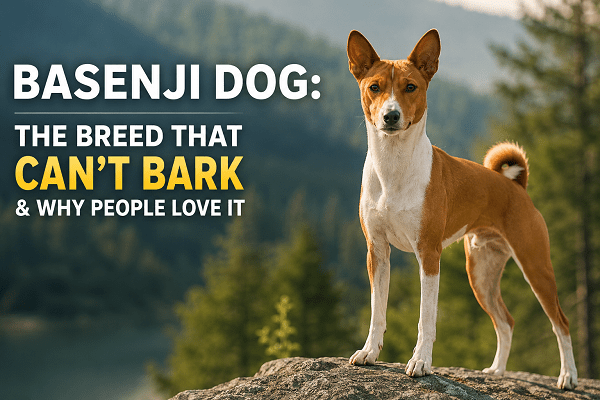
Basenjis can’t bark like most dogs because of an unusually shaped larynx. The AKC points to the flattened larynx as the reason for their yodel-like sounds. People love them because they’re clean, athletic, funny and almost cat-like. But they’re also independent, clever escape artists with a strong prey drive. That makes them best for active, patient owners, not for anyone who wants an easy, obedient first dog.
Table of Contents
- What Is a Basenji? (Quick Facts)
- Why Can’t Basenjis Bark?
- Basenji History: From Congo Hunters to Hollywood
- Why People Love Basenjis
- Basenji Temperament: What They’re Really Like
- How to Train a Basenji
- Exercise and Enrichment
- Living With a Basenji: Real-Life Management
- Basenji Health, Lifespan and Fanconi Syndrome
- Buying a Basenji: Costs and Breeder Checklist
- Is a Basenji Right for You?
- A Handler’s Perspective (Trainer Note)
- FAQs
- Final Thoughts
Introduction
You type “barkless dog” into Google. You picture a calm, silent, elegant companion who won’t annoy the neighbours. Then you meet a Basenji.
Here’s the problem. The “can’t bark” label makes the Basenji sound like the perfect low-effort pet, and that’s where a lot of owners go wrong. This dog is quiet in one way and loud in several others. It may yodel, scream when frustrated, climb your fence, and open your door.
In this guide you’ll learn why Basenjis don’t bark and what they do instead. You’ll see where the breed came from, what living with one is really like, and how to train a dog that thinks for itself. You’ll also get the health facts, including the kidney disease every Basenji owner should know about, and an honest checklist for deciding whether this breed fits your life.
What Is a Basenji? (Quick Facts)
The Basenji is a small hunting dog from Central Africa, including the Congo region. The AKC classes it as a hound, while the FCI places it with the spitz and primitive types. If you’re in the UK or Europe, that’s the same breed you’ll see in the ring under those systems.
| Trait | Detail |
|---|---|
| Height | About 16–18 inches (41–46 cm) |
| Weight | About 20–24 lb (9–11 kg) |
| Coat | Short and fine |
| Colours | Red, black, tricolour, brindle, always with white feet, chest and tail tip |
| Lifespan | Typically 13–14 years (more on this below) |
| Top speed | Reported at 30–35 mph (48–56 km/h) |
| Energy | High |
| Best for | Active, experienced owners |
They’re square-built, as long as they are tall, and they’re surprisingly powerful for their size. They’re also a “cult breed.” In the AKC’s 2025 rankings, the Basenji came in at number 92 out of 202 breeds. You won’t see one on every street, which matters when you go looking for a good breeder.
Why Can’t Basenjis Bark?
Short answer: Basenjis can’t produce a normal bark because their larynx (voice box) is shaped differently from most dogs’. Instead, they make yodel-like sounds, chortles and howls.
The larynx explanation
The AKC says the breed’s yodel-like vocalizations come from the unusual flattened shape of its larynx. That’s the standard answer you’ll find on almost every site.
Here’s what most articles skip
Is the breed truly barkless? Some long-time breed enthusiasts say not quite. In older writing from the Basenji community, owners report that Basenjis do have a warning call, usually just one or two low “woofs” when startled or very excited. So “barkless” is closer to “rarely barks, and never like a Labrador.”
I’d rather tell you the nuance than sell you a myth. If a stranger bangs on your door, your Basenji may still let you know. It just won’t be a 20-minute barking marathon.
The sounds they do make
- The yodel. A warbling, rising sound, often when they’re happy or want attention.
- The “baroo.” Owners describe it as a sound halfway between a howl and a yodel.
- Chortles, whines, howls and growls. Basenjis can yodel, chortle, whine, howl and growl, even though they don’t make a true bark.
- The scream. Many owners describe a piercing, high-pitched cry when a Basenji is frustrated, scared or left alone. Ask any owner in a breed forum and you’ll hear a story.
Why would a hunting dog evolve to be silent?
Nobody knows for sure, but the hunting story is a good one. In the Congo, Basenjis silently tracked birds and small animals in thick vegetation, and hunters tied wooden bells with monkey-bone clappers to them. The hunters then followed the sound of the bells to keep up with the dogs. So the dog stayed quiet for the hunt, and the humans stayed in touch by bell.
So are Basenjis quiet dogs?
Not really. A bored or lonely Basenji can be noisy and destructive. Vetstreet notes that Basenji owners often swap stories about the damage their dogs have caused. If your only goal is a silent home, a calmer breed may suit you better (more on that later).
Basenji History: From Congo Hunters to Hollywood
Most articles give you one line about “ancient Africa.” The real story is more interesting, and it explains a lot about the dog on your sofa.
Ancient roots. Egyptian murals as old as 4,500 years show curly-tailed, erect-eared dogs called Tesem, which many link to the Basenji. DNA studies also place the breed among the “basal” dogs that predate modern breeds. A 2021 genome study found the Basenji has few copies of the starch-digesting AMY2B gene, like wolves and dingoes, which suggests its ancestors lived before farming spread. In plain terms, this is a hunter-gatherer’s dog.
A royal visitor. A painting from 1843 in Queen Victoria’s collection includes a dog researchers believe is a Basenji, brought back from the Niger expedition of 1841.
Failed imports. Getting Basenjis to Europe was brutal. In the 1920s, Lady Helen Nutting brought six Basenjis from South Sudan, and all six died after receiving the new distemper vaccine, which could turn virulent in those days. Breeders finally established the breed in the UK by the late 1930s. Two dogs, Bongo and Bokoto, were shown at Crufts in 1937.
The American start. A male named Bois and a female named Congo became the first Basenjis bred in the United States. The AKC officially accepted the breed in 1943.
Hollywood. In 1956, the film “Good-bye, My Lady” starred a Basenji named My Lady of the Congo alongside 13-year-old Brandon deWilde. The contract gave the dog to the boy once filming ended. A real-life happy ending, and a big boost for the breed in America.
A small gene pool. Here’s the part that matters for you. Nearly all Western Basenjis descend from a handful of original imports. To widen it, the Basenji Club of America asked the AKC to reopen the stud book in 1990, and breed safaris to Africa followed. An American-led expedition even collected breeding stock from villages near Basankusu in the Democratic Republic of Congo in 2010. That narrow starting point is one reason health testing matters so much today.
Why People Love Basenjis
Ask owners why they’re hooked and you’ll hear the same things.
- They’re clean. Basenjis groom themselves like cats, so they lack the usual doggy smell.
- Their heat cycle is different. Females come into heat once a year, like wild canids, rather than twice.
- They’re cat-like in a funny way. They’ll often stand on their hind legs like a meerkat when curious, and they dislike wet weather.
- They’re clever. Basenjis can quickly learn to open lever-style door handles. That’s charming until it’s your front door.
- They’re compact and athletic. Small enough for a flat, fast enough to surprise a Greyhound owner.
- They’re not clingy. They’re affectionate but don’t shadow you around the house.
- They look unique. Wrinkled forehead, almond eyes, tightly curled tail. Nothing else looks like them.
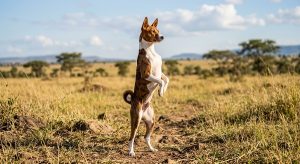
Basenji Temperament: What They’re Really Like
Here’s the thing most beginners miss. A Basenji isn’t “stubborn.” It’s a different kind of smart.
Psychologist Stanley Coren ranked breeds by how well they follow commands in The Intelligence of Dogs. The Basenji came in second from the bottom, ahead of only the Afghan Hound. But that test measures obedience, not problem-solving. Their real intelligence shows when they’re solving problems for their own goals, like getting food or getting out. If you want to understand the gap, read our guide on obedience intelligence versus instinctive intelligence. A Basenji is a textbook case of instinctive intelligence.
Core personality traits
- Independent. They were bred to hunt out of sight of people, so they make their own decisions. Their hunting heritage rewarded intelligence, courage and adaptability, since the dogs often worked beyond the hunters’ view.
- Reserved with strangers. They prefer to make the first move when meeting someone new.
- Often bonded to one or two people.
- High prey drive. A squirrel, lizard or cat can flip them from sofa potato to rocket in half a second.
Basenjis and cats
It can work, but it’s never guaranteed. Orvis notes that cats and small animals aren’t ideal companions for this hunting breed, though a Basenji raised with cats may be able to live with them. My rule: if you have a cat, introduce them young, use barriers, reward calm behaviour, and supervise until trust is proven over months. And remember, “barkless” doesn’t mean “low prey drive.” Rabbits, hamsters and guinea pigs? Keep them out of reach.
Basenjis and children
They can do well with respectful, older kids. Their reserved nature means they won’t tolerate grabbing, climbing or hugging. Teach children to let the dog come to them, and never leave small kids unsupervised with any dog.
How to Train a Basenji
Training this breed is less like teaching a Labrador and more like negotiating with a smart teenager. You win by making the right choice the most rewarding one.
The 7-step handler’s playbook
- Find their currency. Test three rewards: tiny pieces of cooked meat, a chase game, and access to something they want (like going outside). Basenjis are picky about what’s worth working for, so rank them.
- Keep sessions short. Five minutes, a few times a day, beats one 30-minute drill. Stop while they’re still keen.
- Cue once, reward fast. Don’t repeat “sit, sit, sit.” A Basenji learns you don’t mean it the first time. Ask once, wait, reward the moment they do it.
- Socialise early. Aim to expose a puppy to people, surfaces, sounds and other dogs in a calm, positive way during the first 16 weeks. Reserved breeds need this more, not less.
- Treat recall as a lifelong project. Many Basenji experts and owners agree: don’t trust one off-leash outside a fenced area. Use a long line and practise in secure spaces.
- Use a well-fitted harness. Hundeo notes that this breed is skilled at slipping out of collars, so a secure harness is important.
- Teach impulse control. Make “wait” at doors, gates and the car a daily habit. It’s a safety skill for a dog who can open levers and bolt.
What doesn’t work
- Repetition drills. They get bored fast.
- Harsh corrections. They shut down or avoid you.
- Dominance-style handling. It breaks trust with a dog who already keeps his own counsel. (Our piece on dominance versus discipline explains why.)
Crate training helps more than you’d think
A crate gives your Basenji a safe place and protects your furniture when you can’t supervise. Follow our crate training guide and build positive associations first. Never use the crate as punishment.
Want a proven system for independent dogs?
My e-book Beyond the Bark: Inside a Pro Handler’s Playbook for Raising the Ideal Dog walks you through engagement, focus and obedience using the same principles I teach handlers, without force.
Exercise and Enrichment
You’ll often hear that a good Basenji is a tired Basenji. Vetstreet repeats that saying too. Most breed guides land around an hour of activity a day. I’d treat that as the minimum for a healthy young adult, and add brain work on top.
A sample day
| Time | Activity | Why it works |
|---|---|---|
| Morning | 30–40 min structured walk or run on harness | Burns energy before you leave |
| Midday | 10 min scent game or food puzzle | Tires the mind, not just the legs |
| Afternoon | 10–15 min training session (split in two) | Builds focus and the bond |
| Evening | 20–30 min fenced play or a lure chase | Satisfies the hunting drive |
Activities that suit the breed
- Lure coursing (it matches their speed and chase instinct)
- Agility and trick training
- Scent work and “find it” games
- Secure, fenced sprints
If you want to understand why a breed’s natural drives need an outlet, see our post on the difference between a working dog and a pet dog.
Living With a Basenji: Real-Life Management
This is the section the top articles barely touch, and it’s where owners succeed or fail.
Escape-proof your space
Basenjis like to climb and can scale chain-link fences. Orvis also notes the breed can jump high and squeeze into surprising spaces. Walk your fence line like a burglar would. Check for climbable furniture or bins next to it, gaps at the bottom, and weak gates. Use a double-gate or a lock on any gate they can reach.
Basenji-proof the house
- Swap lever door handles for knobs, or add child-proof locks.
- Keep food, shoes and remote controls out of reach. They’re counter-surfers and chewers.
- Offer tough chews and puzzle feeders so they have a legal outlet.
Weather matters (especially globally)
They hate rain. Basenjis dislike wet weather and often refuse to go outside in damp conditions. In hot climates, like Lagos or Dubai, their short coat suits them well, but walk in the cool hours and give them shade. In cold or wet places like the UK, Ireland or Canada, plan for a warm coat and a patient approach to wet-weather toilet breaks.
Are they good apartment dogs?
Yes, a well-exercised Basenji can suit apartment life, but they can become destructive and noisy if left alone too long. The lack of barking helps with noise complaints. But if you work long hours and there’s nobody home, expect trouble unless you plan for a dog walker or daycare. (Orvis adds that a walker can help, but the breed can be standoffish with new people, so introduce them first.)
Grooming is easy
Basenjis are meticulous groomers, needing only occasional brushing and baths when necessary. Do check their nails, teeth and ears regularly. And though they shed little, no breed is truly allergy-proof.
Basenji Health, Lifespan and Fanconi Syndrome
The good news first. Basenjis are long-lived for their size.
Lifespan
In the UK Kennel Club’s 2004 health survey, 46 deceased Basenjis had a median lifespan of 13.6 years, and the oldest reached 17.5. That’s a small sample, so treat it as a guide, not a guarantee. Most breed profiles say 13–14 years.
The big one: Fanconi syndrome
If you remember one health fact from this article, make it this one.
What it is: An inherited kidney condition where the kidney tubes fail to reabsorb nutrients and electrolytes.
When it shows up: Usually between 4 and 8 years old, though sometimes as early as 3 or as late as 10.
Signs: Drinking and peeing a lot, and sugar in the urine. This can lead to a mistaken diabetes diagnosis.
The home test: Owners are advised to check their dog’s urine for glucose once a month from age 3, using inexpensive strips made for human diabetics. Treatment works best when started early, because treating it sooner reduces organ damage. That’s a cheap habit that could add years to your dog’s life.
The DNA test that changed the breed
In September 2011, the Basenji Club of America announced that Dr. Gary Johnson had found the mutation behind recessive Fanconi syndrome, and a direct DNA test became available through the OFA. Each dog tests as Clear, Carrier or Affected. A Carrier will probably never get sick but can pass the gene on if bred to another Carrier or an Affected dog. In plain terms, two Clear parents can’t produce a Fanconi puppy, and a good breeder will test both.
How common was the gene? In early 2011 linkage-test data, about 40% of tested dogs came back as probable carriers and about 3% as probable affected, though the club cautioned these numbers don’t represent the whole breed. Even with that caveat, it shows why you shouldn’t skip testing.
Other conditions to know
| Condition | What it is | What to do |
|---|---|---|
| Hemolytic anemia (HA) | A recessive gene, with a simple non-invasive DNA test | Ask for parent test results |
| Progressive retinal atrophy (PRA) | Slow retinal degeneration that leads to blindness | Annual eye exams; breeder eye clearances |
| Persistent pupillary membrane / coloboma | Less serious inherited eye issues | Eye exam |
| Hip dysplasia | Can cause loss of mobility and arthritis-like signs, so breeding dogs should be tested via OFA or PennHIP | Ask for hip scores |
| Malabsorption (IPSID) | An autoimmune gut disease causing chronic diarrhea and weight loss, which a special diet can help | See a vet for ongoing diarrhea or weight loss |
This is general information, not veterinary advice. If your dog is drinking and peeing more than normal, see your vet promptly.
Buying a Basenji: Costs and Breeder Checklist
What will it cost?
Prices vary a lot by country. Older owner posts put reputable-breeder puppies in the US Northeast at around $1,000 to $1,200. Treat that as a rough guide and expect to pay more in many places today. The bigger costs come later: a securely fenced yard, chew-proof toys, vet care, and (if needed) lifelong Fanconi management.
Red flags
- Pricing by colour, sex or registration status.
- No health test results for the parents.
- A breeder who says “Basenjis don’t have health problems.”
- Puppies always available, from many different litters.
Your breeder checklist
- Fanconi DNA results (Clear, Carrier or Affected) for both parents.
- HA DNA test results.
- Current eye clearance and hip scores.
- Willingness to take the dog back at any age.
- A frank talk about the breed’s downsides. A good breeder will give you a reality check on the breed’s challenges.
- For the US, start with the breeders’ directory at the Basenji Club of America (basenji.org). In other countries, use your national kennel club.
Also consider adoption. Breed-specific rescues often have adults whose personalities are already known.
Is a Basenji Right for You?
| A Basenji is a great fit if you… | Think twice if you… |
|---|---|
| Enjoy training and problem-solving | Want instant obedience |
| Can give an hour or more of daily activity | Work long hours with no help |
| Have a secure, tall, climb-proof yard | Have rabbits, hamsters or free-roaming cats |
| Like a cat-like, independent personality | Want a dog who follows you everywhere |
| Value a clean, low-odour dog | Need a completely silent dog |
| Are an experienced owner (or a committed learner) | Are a first-time owner with little time |
Need something calmer?
If you love the idea of a quiet dog but this sounds like too much, have a look at our list of quiet toy dog breeds that don’t bark nonstop. There’s no shame in picking the breed that fits your life, and that’s the whole point of choosing well.
A Handler’s Perspective (Trainer Note)
I’m Cpl. Rofiat Muritala, a Nigerian Army military working dog instructor and handler with more than 14 years at the Nigerian Army Dog Centre. My days are spent with dogs bred for biddability: shepherds and Malinois that live to work with a handler. A Basenji sits at the opposite end of that scale, which is exactly why handlers find them so instructive.
What I teach any handler, and what applies here, comes down to three rules:
- Motivation beats pressure. If the dog doesn’t see the point, no amount of repetition fixes it.
- Management comes before training. A fence, a harness and a crate prevent more problems than any command.
- Respect the breed’s job. A dog built for decades of independent hunting won’t turn into a lap dog because you want it to.
How this article was researched: I reviewed breed history and standards from the American Kennel Club and the Basenji Club of America. I also used the UK Kennel Club/BSAVA 2004 health survey, the OFA’s Fanconi testing information, Stanley Coren’s research, and a 2021 peer-reviewed genome study. Health information is educational only. Always consult a qualified vet.
Frequently Asked Questions
1. Why can’t Basenjis bark?
Their larynx is shaped differently from most dogs’, which stops them making a normal bark. They yodel, chortle, howl and growl instead. Some owners report a low “woof” or two when startled, so “rarely barks” is more accurate than “never barks.”
2. Are Basenjis good for first-time owners?
Usually not. They’re clever, independent and prey-driven, which demands patience and consistent management. A first-time owner who commits to daily training, a secure yard and early socialisation can succeed, but it’s a steeper climb than with a Labrador or Golden Retriever.
3. Are Basenjis good apartment dogs?
They can be, if they get enough exercise and aren’t left alone for long stretches. Their lack of barking helps with neighbours. Bored or lonely Basenjis can still become destructive and vocal, so plan for walkers, puzzle toys and crate training.
4. Do Basenjis get along with cats and kids?
With kids, yes, if the children are respectful and supervised. With cats, sometimes: a Basenji raised with a cat may coexist, but the strong prey drive means careful introductions and ongoing supervision. Small pets like rabbits and hamsters aren’t safe.
5. How long do Basenjis live, and what are their main health risks?
Most live 13–14 years, and some reach their mid-teens or beyond. The main concerns are Fanconi syndrome (a kidney disease), hemolytic anemia, progressive retinal atrophy and hip dysplasia. Buy from a breeder who tests both parents, and check your dog’s urine for glucose monthly from age 3.
Final Thoughts: Should You Bring a Basenji Home?
The Basenji isn’t really “the dog that can’t bark.” It’s an ancient, independent hunter that happens to be wired differently. If you love a dog with brains, personality and style, and you’re ready to train with motivation instead of force, you’ll get a clever, clean, funny companion for well over a decade.
If you want a quiet life with minimal effort, pick a calmer breed.
Your action plan:
- Be honest about your time, fence and experience.
- Meet adult Basenjis and talk to owners before choosing a puppy.
- Insist on Fanconi and HA DNA results for both parents.
- Set up the harness, crate, secure fence and door locks before the puppy arrives.
- Start socialising and short training sessions from week one.
- Test urine glucose monthly from age 3 and keep up annual vet and eye checks.
📬 Get Weekly K9 Tips in Your Inbox
Want more breed guides, training tips and handler insights? Subscribe to our weekly articles roundup newsletter.
Sources and further reading: American Kennel Club (“Basenji History: From Jungle Hunters to Agile Athletes,” “Basenji Facts You May Not Know,” 2025 Most Popular Breeds); Basenji Club of America (Fanconi testing FAQ and 2011 health announcement); UK Kennel Club/BSAVA Purebred Dog Health Survey (2004); Coren, S. (1995), The Intelligence of Dogs; Edwards et al. (2021), BMC Genomics; OFA Fanconi Syndrome DNA test information.

Her work centres on obedience, detection, protection and operational readiness. She favours proven methods built on repetition, consistency and real-world conditioning, so that both dogs and handlers are prepared for high-pressure tasks.
Rofiat represented the Nigerian Army Dog Centre at the Nigerian Army Day Celebration (NADCEL) 2026, where she led demonstrations in obedience, explosive detection, agility and tactical movement. Through articles, training content and documentaries, she shares field-based insight into how structured training, clear communication and trust between handler and dog affect performance and reliability.
She is the author of Beyond the Bark: Inside a Pro Handler's Playbook for Raising the Ideal Dog, a practical guide that helps dog owners and handlers apply professional training principles in everyday situations.
- Dog Agility Course Layout: Easy DIY Setup - October 7, 2026
- Local Dog Breeds: Temperament, Health & Training Guide - October 6, 2026
- How Long Do Military Working Dogs Serve? Full Guide - October 5, 2026