Working Dog vs Pet Dog: 5 Key Differences You Must Know
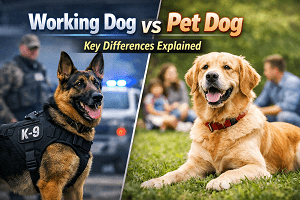
Discover the crucial differences between working dogs and pet dogs, from breeding purpose and training intensity to legal rights and daily care. Learn which type fits your lifestyle.
When you see a dog wearing a vest in public, do you know whether it’s a working dog or simply a well-dressed pet? The distinction goes far beyond appearance. Understanding the difference between working dogs and pet dogs is essential for potential owners, animal lovers, and anyone who encounters these dedicated animals in daily life.
While all dogs offer companionship, working dogs are bred and trained for specific professional tasks that serve human society in remarkable ways. From herding livestock to detecting explosives, these canines have jobs that require specialized skills, intense focus, and rigorous training protocols that set them apart from their pet counterparts.
This comprehensive guide explores the fundamental distinctions between working dogs and pet dogs, covering everything from genetic breeding and legal classifications to care requirements and lifestyle compatibility.
Table of Contents
Introduction
What Defines a Working Dog?
Historical Context and Breeding Purpose
Categories of Modern Working Dogs
What Defines a Pet Dog?
Characteristics of Pet Dogs
Critical Differences: Working Dogs vs. Pet Dogs
Legal Status and Public Access Rights
Training Intensity and Methodology
Daily Lifestyle and Care Requirements
Genetic Selection and Instinctual Drive
Can Working Dogs Be Pets? Can Pets Become Working Dogs?
Transitioning Working Breeds to Pet Life
Training Pet Dogs for Working Roles
Choosing Between a Working Dog and a Pet Dog
Ethical Considerations and Common Misconceptions
The Problem of “Fake” Service Dogs
Working Dog Welfare
Conclusion
- Frequently Asked Questions (FAQs)
What Defines a Working Dog?
A working dog is any canine specifically bred, selected, and trained to perform tasks that assist humans in professional capacities. If you’re new to the concept, our detailed guide on what defines a working dog explains the various K9 careers, breed classifications, and specialized roles these dogs perform.These dogs aren’t just pets with hobbies, they have defined occupational roles that leverage their natural instincts, intelligence, and physical capabilities.
Historical Context and Breeding Purpose
Working dogs have served humanity for millennia, with breeds developed to excel at specific jobs:
- Guardian breeds (Rottweilers, Doberman Pinschers, Bullmastiffs) protect property and livestock from predators and intruders.
- Herding breeds (Border Collies, Australian Shepherds, German Shepherds) manage and move livestock across challenging terrain.
- Sled dogs (Siberian Huskies, Alaskan Malamutes) are engineered for endurance and strength in Arctic environments.
- Water rescue dogs (Newfoundlands, Portuguese Water Dogs) possess webbed feet and swimming instincts for maritime assistance.
Unlike pet dogs, which are often bred primarily for temperament and appearance, working dogs maintain genetic drives tied to their original functions. For instance, a Border Collie retains an intense “eye” and herding instincts even if living in a suburban home.
Categories of Modern Working Dogs
Modern working dogs fall into specialized categories, each with distinct training protocols and legal standings:
| Type | Primary Function | Training Duration | Public Access Rights |
|---|---|---|---|
| Service Dogs | Assist individuals with disabilities | 18–24 months | Full ADA protection |
| Police/Military K9s | Law enforcement, detection, protection | 12–18 months | Limited to duty |
| Search and Rescue | Locate missing persons, disaster recovery | 12+ months | Mission-specific |
| Therapy Dogs | Provide comfort in clinical settings | 6–12 months | By invitation only |
| Livestock Guardians | Protect farm animals from predators | 6–12 months | Private property |
| Detection Dogs | Identify drugs, explosives, medical conditions | 8–12 months | Facility-specific |
What Defines a Pet Dog?
A pet dog sometimes called a companion dog, is primarily bred and kept for companionship, emotional support, and family integration. While pet dogs can learn impressive tricks and provide immense emotional value, they aren’t trained to perform occupational tasks that their handlers depend on for safety or independence.
Characteristics of Pet Dogs
Pet dogs encompass the majority of canines in households worldwide. Their defining traits include:
- Flexible purpose: Selected for temperament, size, and family compatibility rather than work performance.
- Variable training: Basic obedience and house manners, without specialized task training.
- No legal public access: Restricted to pet-friendly spaces unless specifically certified otherwise.
- Emotional primary role: Focus on bonding, play, and companionship rather than functional assistance.
Many working dog breeds successfully transition to pet life, but this requires owners who understand and accommodate their breed-specific needs.
Critical Differences: Working Dogs vs Pet Dogs
1. Legal Status and Public Access Rights
The biggest distinction lies in legal classification and accompanying rights.
- Service Dogs enjoy comprehensive protection under the ADA, allowing access to virtually all public spaces including restaurants, hospitals, and transportation. These dogs must be individually trained to perform tasks directly related to their handler’s disability.
- Therapy Dogs and Emotional Support Animals provide valuable services but do not have full public access rights. Therapy dogs visit facilities by invitation only, and emotional support animals are restricted to housing accommodations under the Fair Housing Act.
- Pet Dogs have no special legal status and are limited to pet-friendly environments.
2. Training Intensity and Methodology
Working dogs undergo rigorous, professional training:
- Service dogs: 18–24 months intensive training costing $15,000–$50,000 for tasks like retrieving medication or interrupting panic attacks.
- Police K9s: Continuous training in bite work, scent detection, and handler protection.
- Detection dogs: Daily practice to identify specific scents (narcotics, explosives, medical conditions).
For readers interested in the advanced conditioning behind professional K9s, our article on how military working dogs are trained breaks down the selection process, obedience development, scent work, patrol training, and handler integration.
Pet dogs typically complete 6–8 weeks of basic obedience for manners, leash walking, and socialization.
3. Daily Lifestyle and Care Requirements
| Aspect | Working Dogs | Pet Dogs |
|---|---|---|
| Exercise | 2–4 hours daily of high-intensity activity | 30–60 minutes depending on breed |
| Diet | Performance diets for energy and cognitive function | Standard commercial or homemade diets |
| Rest | Structured downtime to prevent burnout | Flexible, free play and relaxation |
| Relationship | Professional bond with handler, task-focused | Emotional bond, play, and companionship |
4. Genetic Selection and Instinctual Drive
Working dogs are bred for high drive:
- Prey drive: chase, grab, and hold instincts for herding/protection. These natural drives work alongside learned behaviors. Understanding obedience vs instinct in dog intelligence helps explain why some dogs excel in structured work while others rely more heavily on inherited behavioral traits.
- Play drive: motivation for toys/games (used in detection/service work)
- Defense drive: protective instincts for guarding and police work
- Pack drive: desire for social structure and handler cooperation
Pet dogs are bred for moderate energy, stable temperaments, and adaptability.
Can Working Dogs Be Pets? Can Pets Become Working Dogs?
Transitioning Working Breeds to Pet Life
High-success transitions require:
- Mental enrichment: puzzle toys, training games, “jobs” like retrieving items
- Physical outlets: agility training, hiking, dog sports
- Consistent leadership: structured routines to satisfy their need for purpose
Breeds like Labrador Retrievers and Golden Retrievers adapt well. Breeds like Belgian Malinois and Border Collies may struggle without significant activity.
Training Pet Dogs for Working Roles
Not all pets are suited for professional work. Successful working dogs usually have:
- High trainability
- Stable temperament
- Physical soundness
- Balanced drive
Therapy dog work is the most accessible for pet dogs, requiring certification from organizations like Pet Partners or Alliance of Therapy Dogs.
Choosing Between a Working Dog and a Pet Dog
You Might Be Ready for a Working Dog If:
- You can dedicate 2–4 hours daily to training and care
- You need specific services (assistance, protection, detection)
- You have experience with high-drive breeds
- You provide consistent structure and leadership
- You understand legal responsibilities and public access protocols
If you’re considering raising a working breed or want practical guidance from a professional handler’s perspective, Beyond the Bark provides real-world training, handling, grooming, and relationship-building strategies for developing a well-balanced dog.
A Pet Dog Is Likely Better If:
- You seek companionship and emotional connection
- You have time for moderate exercise (≈1 hour/day)
- You want flexibility in living situations and travel
- You prefer predictable, lower-intensity interactions
- You’re a first-time dog owner
Ethical Considerations and Common Misconceptions
The Problem of “Fake” Service Dogs
Misrepresenting pets as service dogs creates safety hazards, distracts true working dogs, and undermines public trust.
Working Dog Welfare
Working dogs are partners, not tools. Ethical programs ensure:
- Regular veterinary care and retirement planning
- Adequate rest and “off-duty” time
- Positive reinforcement training
- Proper rehoming after service
A working dog often performs tasks beyond companionship. Yet a pet dog mainly offers presence without assigned duties. One trains for activity like herding or guarding. The other lives for interaction, shaped by shared daily moments. Purpose drives the first; comfort shapes the second. Each answers different human needs, though both stem from similar ancestry.
What sets working dogs apart from pets begins long before they reach a home. Breeding goals shape their paths in ways most people overlook. While one may train for tasks like guiding or guarding, the other grows up focused on companionship alone. Training depth varies sharply, some endure rigorous programs, others learn basic cues through casual practice. Legal protections often apply only to certain roles, leaving many without formal status despite similar duties. Daily routines reflect these distinctions: diet, exercise, and mental demands shift based on function. A dog’s role changes how it interacts with environments, handlers, even strangers. Choosing depends less on preference than on what kind of responsibility suits your days.
Most people notice when a dog has a vest on, yet few pause to wonder what that really means. Not every canine in gear performs tasks – some just wear fashion statements. What separates assistance animals from household companions isn’t fabric, but function. Clarity on this shapes how we interact, behave, wherever paths cross with four-legged helpers. Recognizing purpose behind the outfit affects reactions, respect, even safety around such dogs.
Born to do more than just bond, working dogs take on duties shaped by purposeful breeding and careful instruction. Though every dog brings comfort, these animals perform roles like guiding the visually impaired or sniffing out drugs – tasks demanding precision, stamina, under strict regimens. Unlike household pets, they thrive where challenge meets duty, guided not by leisure but by structured expectation. Their abilities emerge through repetition, discipline, early exposure, environments fine-tuned for performance.
Starting off differently each time, this full look at working versus pet dogs dives into key contrasts. From how genetics shape their roles to the rules that define them legally. One moment it’s about breeding history, the next it’s what laws say. Care needs shift depending on type, not one-size-fits-all. Living with a dog? Your daily rhythm must match its purpose. What works for a herder fails for a house companion. Each section adjusts focus – sometimes genes, sometimes environment. Not every canine fits neatly into boxes, yet patterns emerge clearly. Ownership means understanding these layers before choosing.
Working Dogs Explained Simply?
A dog bred for labor steps beyond companionship, shaped by purpose rather than chance. Task-focused training draws out traits like scent tracking, strength, or alertness – qualities built through generations of careful selection. Instead of casual play, these animals engage in structured duties where instinct meets instruction. Their work spans fields such as herding, protection, detection, or rescue, each role demanding precision. What sets them apart isn’t loyalty alone – it’s the ability to execute complex functions under pressure. From farms to airports, their presence fills gaps machines cannot.
History and Why They Were Bred
Fur-covered helpers have stood by people’s sides across ages, their skills sharpened through generations of focused breeding. Some were shaped for herding movements across open fields, others built for guarding spaces with sharp awareness. Tasks carved into each lineage reveal purpose behind every trait. Centuries folded labor into bloodlines now seen in modern roles. Each breed carries history within its stride, a legacy paced out in daily duties
- Barking loud at night, Rottweilers scare off trespassers near fences. Moving fast through fields, Doberman Pinschers chase threats before they get close. Standing tall by barns, Bullmastiffs watch silently until danger appears.
- Flocks shift under guidance when dogs like Border Collies, Australian Shepherds, or German Shepherds lead through rough landscapes. Though bred for control, their instinct drives motion where paths twist unpredictably beneath hooves and paws alike.
- Built for stamina, sled dogs like Siberian Huskies and Alaskan Malamutes thrive where cold bites hard. Their bodies handle long runs through snow without tiring easily. Power comes naturally in these breeds when pulling heavy loads across ice fields. Cold climates shape their thick fur and steady pace. While many dogs fade in frost, they push forward with ease.
- Floating alongside swimmers, Newfoundlands rely on webbing between their toes. Portuguese Water Dogs dive without hesitation when signals come. Instinct drives each stroke they make near open waters.
Bred not just for looks or personality, unlike household pets, working breeds carry inherited urges shaped by past roles. Take the Border Collie, its sharp focus and impulse to gather animals persist, despite growing up far from farms.
Types of Today’s Working Dogs
Today’s trained canines sort into focused roles, each shaped by unique instruction methods and recognized differently under law
Dogs trained for disability support require a year and a half to two years of preparation – access allowed everywhere under federal law. When it comes to police or military work, these animals spend 12 to 18 months learning detection and protection tasks – they operate only during official duties. For finding people after disasters, rescue training takes at least one full year, entry depends entirely on operational needs. Comfort delivery in hospitals or care centers defines therapy dog roles – their prep lasts half a year to twelve months, they attend events only when requested. Guarding livestock against wild threats shapes the purpose of farm-based dogs, training spans six months up to a year, access limited to private land. Spotting substances like narcotics or health changes guides detection canines, their development phase runs eight to twelve months, they enter certain sites by design.
What Makes a Dog a Pet?
A dog kept at home often labeled a companion animal, is raised mainly to share life alongside people, offering comfort and fitting into household routines. Though these animals might master complex behaviors and bring deep emotional rewards, their role does not include specialized training for duties tied to physical safety or daily autonomy. Instead of working roles, they thrive through presence, bonding, and subtle interaction woven into domestic settings.
Pet Dog Traits
Besides living indoors, pet dogs make up most household animals across nations. Notable features often involve loyalty, alongside responsiveness to human cues. Some follow routines; others adapt quickly to change. Typically, they rely on caretakers, yet contribute companionship in return. Behavior varies widely, still affection remains a common thread. Though bred differently, many share similar social needs. Size differs greatly, even so their role inside homes stays consistent
- Chosen not by how well they perform tasks, yet mainly for their calm behavior, manageable body dimensions, one key factor being ease within household settings.
- Training covers fundamental obedience along with household behavior basics, though it does not include specific skill development for particular duties.
- Few areas allow pets legally; entry depends on official approval beyond standard rules.
- Bonding comes first when emotions lead the way. Play becomes a central part of connection, not just activity. Companionship matters more than completing tasks. Function takes a back seat to feeling close. Interaction thrives through shared moments instead of goals. The heart shapes the relationship before any utility does.
A number of dogs bred for labor adapt well to home environments, yet such shifts depend on caregivers recognizing unique traits tied to each lineage. Still, success often follows when daily routines reflect those instincts. Some thrive only if mental and physical demands mirror original purposes. Without that alignment, even calm-tempered individuals may struggle. Adjustment hinges less on temperament alone, more on thoughtful structure shaped by awareness.
Critical Differences Between Working Dogs and Pet Dogs
1. Legal Standing and Public Entry Permissions
What sets them apart most is how the law defines each, along with the protections tied to that status.
- A service dog gains full rights through the ADA, meaning it can enter nearly every public area – like eateries, clinics, or buses. Because they assist people with disabilities, each one learns specific actions tailored to its owner’s needs.
- Not every trained animal can enter public spaces freely. While therapy dogs offer comfort during organized visits, they go where invited. Emotional support animals, on the other hand, help individuals at home and are protected only within residential settings. Access beyond private dwellings remains limited for both.
- Pets like dogs aren’t recognized under most laws, existing mostly within spaces that allow them. Their presence depends entirely on permission, not rights.
2. training intensity and how it is done
Working dogs undergo rigorous, professional training:
- A dog trained to assist takes nearly two years of focused work, often between eighteen and twenty-four months. Costs range widely, starting at fifteen thousand dollars and reaching fifty thousand. These animals learn specific actions – fetching medicine, for example – or stepping in during moments of intense anxiety. Each task is practiced until reliable under real conditions. Training intensity depends on what the person needs day to day.
- A dog trained by officers keeps sharpening skills – biting drills one day, tracking odors the next. Practice never stops when it comes to guarding its human partner. Each session builds on what came before, yet feels entirely new. Focus shifts often, preventing routines from forming too deeply.
- Detection dogs: Daily practice to identify specific scents (narcotics, explosives, medical conditions).
Puppies usually begin training around six weeks, sometimes stretching into the eighth. Their days involve learning how to behave calmly indoors, often guided through short walks on a lead. Lessons mix repetition with small rewards, shaping responses over time. Interaction with people and other animals forms a quiet backbone of early development. By the second month, most show noticeable shifts in routine habits.
3. Daily Lifestyle and Care Needs
Daily exercise for working dogs means two to four hours of intense physical effort. By contrast, pet dogs need about half an hour up to one full hour, shaped by their type. These active animals eat specialized food built for stamina and sharp thinking. Meanwhile, household pets live well on typical store-bought meals or home-prepared ones. Recovery time is planned carefully in working roles to avoid exhaustion. In homes, rest happens naturally through casual play and quiet moments. Their connection with people centers on trained tasks and reliability. Family pets form ties rooted in affection, shared activities, and presence.
4. Genetic Selection Shapes Instinctive Behavior
Working dogs are bred for high drive:
- Prey drive: chase, grab, and hold instincts for herding/protection
- Play drive: motivation for toys/games (used in detection/service work)
- Defense drive: protective instincts for guarding and police work
- Pack drive: desire for social structure and handler cooperation
Bred not just for calm minds but also resilience, pet dogs carry a balanced drive. Their nature shifts well between settings, shaped by careful selection. Stability stands out, yet flexibility remains woven into their behavior. Energy levels stay in check – neither too high nor flat, fitting varied homes.
Can Working Dogs Be Pets? Can Pets Become Working Dogs?
Changing Working Dogs to Family Pets
High-success transitions require:
- Mental enrichment: puzzle toys, training games, “jobs” like retrieving items
- Jumping through hoops builds quick footwork. Hiking trails challenge balance on uneven ground. Dog sports test coordination under pressure
- A steady hand at the helm brings order through predictable patterns that meet a deep need for meaning
Besides their friendly nature, Labradors and Goldens adjust easily to new settings. When exercise drops off, Belgians and Border Collies often show signs of stress.
Teaching pet dogs to do jobs
A few animals never adjust to job demands. Dogs that thrive in roles often show calmness when challenged. Some handle pressure smoothly. Others adapt quickly to new tasks. Temperament matters more than breed. Energy levels must match the work type. Focus during distractions sets top performers apart. Training consistency builds reliability over time
- High trainability
- Stable temperament
- Physical soundness
- Balanced drive
A single step into therapy dog roles opens many doors for household pets, needing only official approval through groups such as Pet Partners or the Alliance of Therapy Dogs. Though simpler than other canine jobs, it still depends on passing evaluations set by recognized networks.
Working Dog or Pet Dog
You Might Be Ready for a Working Dog
- Spending a couple of hours each day works well for practice and attention. Some days might take longer, depending on progress. Time adds up when done regularly. A few focused sessions make a difference. Consistency matters more than long stretches. Even short periods help if repeated every day
- You require particular types of support – help, safety measures, ways to identify issues
- You have experience with high-drive breeds
- You provide consistent structure and leadership
- Legal duties become clear when examining how information reaches the public. Access rules shape what people see, influencing awareness of obligations. Knowing these frameworks changes how openly details move through communities
A Pet Dog Might Be Better
- You seek companionship and emotional connection
- You have time for moderate exercise (≈1 hour/day)
- You want flexibility in living situations and travel
- You prefer predictable, lower-intensity interactions
- You’re a first-time dog owner
Ethical Questions and Widespread Myths
The Problem With Fake Service Dogs
Fake claims about pets being service animals put people at risk. When untrained animals enter spaces meant for helpers, real working dogs struggle to focus. Public confidence erodes each time someone brings a pet into restricted areas under false pretenses.
Working Dog Welfare
Besides being helpers, working dogs share a bond built on respect. Programs that follow fair practices show this through daily actions
- A trip to the vet on a routine basis ensures animals stay healthy over time. Meanwhile, setting aside resources early supports stable living later in life
- Adequate rest and “off-duty” time
- Positive reinforcement training
- Proper rehoming after service
Conclusion
It begins with purpose, working dogs are shaped by selective breeding, rigorous preparation, their role woven into daily function. These animals support human needs in ways that demand consistency, structure, time. On another note, ownership differs sharply when the dog serves beyond home boundaries. Tasks matter: guiding, guarding, detecting – all call for sustained effort from both animal and handler. Meanwhile, a pet thrives on presence alone, offering quiet loyalty without expectation of performance. Their lives center around shared moments, not measurable outcomes. Training leans casual; schedules stay flexible. Legal recognition often follows this split – responsibility expands if the dog works publicly. Choosing one path over another reshapes routine, commitment level, even where access is permitted. Clarity comes through recognizing what each type brings, what each requires.
A well-matched breed sets the stage for stronger bonds, fewer worries. Happier dogs thrive when their role fits how they were bred to live. Compatibility shapes daily life more than most realize. A working dog kept idle grows restless fast. Pets placed wisely bring calm to homes. Mismatched expectations lead to stress on both ends. Thoughtful selection opens doors to smoother days. The right fit shows in energy levels, behavior, long-term harmony.
Thoughts on working dogs or high-energy breeds? Drop them here. Your take might spark something new. Real stories help others see different paths. What has your journey been like with these animals? Maybe someone else is walking a similar road. Insights often come from quiet moments shared openly. Let what you’ve learned find its way into this space.
Frequently Asked Questions (FAQs)
1. Do emotional support animals (ESAs) have the same public access rights as service dogs?
No. Under the Americans with Disabilities Act (ADA), service dogs are individually trained to perform specific tasks for a person with a disability and are granted full access to almost all public spaces. Emotional support animals provide comfort through their presence but are not task-trained, meaning they do not have public access rights and are generally restricted to housing accommodations under the Fair Housing Act.
2. Can a high-drive working breed like a Belgian Malinois or Border Collie successfully live as a family pet?
Yes, but it requires a significant commitment. High-drive working breeds possess intense instinctual energy and can become stressed or destructive if left idle. To live successfully as family pets, owners must provide them with 2 to 4 hours of daily physical exercise alongside continuous mental stimulation, such as puzzle toys, obedience training, or dog sports like agility.
3. What is the easiest working role for a standard household pet to transition into?
Therapy dog work is the most accessible professional pathway for household pets. Unlike service or detection work, which requires intense task training, therapy work relies primarily on a dog having a naturally stable temperament, excellent basic obedience, and a calm disposition around strangers. Pets can achieve this through certification programs like Pet Partners.
4. How long does it typically take to fully train a professional working dog?
Training duration depends heavily on the specific job. While basic pet obedience takes about 6 to 8 weeks, professional working dogs require extensive preparation. Scent detection dogs and therapy dogs generally train for 6 to 12 months, police K9s take 12 to 18 months, and service dogs require 18 to 24 months of rigorous training to perform reliably.
5. Why is misrepresenting a standard pet as a service dog considered a serious ethical issue?
Bringing an untrained pet into restricted public spaces under the guise of it being a service dog creates major safety hazards. Untrained dogs are more likely to behave unpredictably, which can directly distract or endanger legitimate working dogs executing vital tasks. Additionally, bad behavior from “fake” service animals erodes public trust and increases skepticism toward individuals who genuinely rely on their service dogs for independence.

Her work centres on obedience, detection, protection and operational readiness. She favours proven methods built on repetition, consistency and real-world conditioning, so that both dogs and handlers are prepared for high-pressure tasks.
Rofiat represented the Nigerian Army Dog Centre at the Nigerian Army Day Celebration (NADCEL) 2026, where she led demonstrations in obedience, explosive detection, agility and tactical movement. Through articles, training content and documentaries, she shares field-based insight into how structured training, clear communication and trust between handler and dog affect performance and reliability.
She is the author of Beyond the Bark: Inside a Pro Handler's Playbook for Raising the Ideal Dog, a practical guide that helps dog owners and handlers apply professional training principles in everyday situations.
- Bousnic Dog Training Collar Review: Is It Safe? - September 30, 2026
- Gravy Train Dog Food Review: Ingredients & Recalls - September 30, 2026
- How to Spot Fake AKC Registered Dogs: 5 Warning Signs - September 29, 2026