Cane Corso Guide: Cost, Training, Danger & Insurance
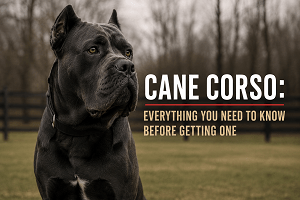
A Cane Corso costs $1,500–$3,500 to buy but closer to $25,000–$30,000 over a 9–12 year lifespan once you factor in food, vet care, training, and insurance. They’re loyal, trainable guardians for experienced owners, but their size (up to 140 lbs), rapid strength development, and place on most home insurance “restricted breed” lists make them a poor fit for first-time dog owners or renters. Training and socialization aren’t optional extras, they’re the difference between a dependable family guardian and a liability.
Table of Contents
- What Is a Cane Corso? Origins & History
- Physical Characteristics: Size, Weight & Growth
- Temperament: What Living With One Is Actually Like
- Cane Corso vs. Other Guardian Breeds
- Are Cane Corsos Good Family Dogs?
- Training Timeline & Milestones
- Exercise Requirements by Age
- Health Issues & Lifespan
- The Real Cost of Owning a Cane Corso
- The Insurance & Housing Problem Nobody Warns You About
- Are Cane Corsos Dangerous? The Honest Answer
- Is a Cane Corso Right for a First-Time Owner?
- Choosing a Breeder: Red Flags to Avoid
- Your First 30 Days: A Practical Checklist
- Daily Care & Grooming
- Conclusion & Actionable Advice
- FAQs
What Is a Cane Corso? Origins & History
If you’ve ever stood next to a Cane Corso, you already know they don’t feel like an ordinary dog. That’s not an accident. This breed descends directly from the Molossian war dogs that marched with Roman legions, animals bred to subdue boar, guard camps, and hold ground in battle. The name itself gives it away: “Corso” comes from the Latin cohors, meaning guardian or protector.
After Rome fell, these dogs didn’t disappear, they just changed jobs. Italian farmers in the south (particularly Puglia) kept using them for centuries as all-purpose working dogs:
- Guarding farms and livestock from thieves and predators
- Driving cattle and pigs to market
- Hunting wild boar, a task that demanded serious courage and bite strength
- Protecting the family home, a role they still take seriously today
Here’s the part most articles skip: the breed nearly vanished. By the 1970s, so few purebred Cane Corsos remained in rural Italy that dedicated breeders had to actively hunt down surviving farm dogs to rebuild the gene pool. It’s a genuine conservation success story.
| Year | Milestone |
|---|---|
| 1970s | Breed-revival effort begins, tracking down remaining farm dogs in Puglia |
| 1994 | Recognized by the Fédération Cynologique Internationale (FCI) |
| 1996 | Cane Corso Association of America founded |
| 2007 | Full American Kennel Club (AKC) recognition |
| 2025 | Ranked #11 on the AKC’s most popular breeds list, up from around 50th just a decade earlier |
That jump from 50th to 11th in ten years matters more than it looks. It means an enormous wave of first-time owners, casual buyers, and backyard breeders have entered the Cane Corso world in a short window, which is exactly why the guidance in this article carries more weight now than it did five years ago. If you want to see how the Cane Corso fits into the wider working and guardian dog world, our piece on what it actually means for a dog to be a “working dog” is a good place to start.
Physical Characteristics: Size, Weight & Growth
How Big Does a Cane Corso Get?
Let’s get the numbers straight, because a lot of listings understate them.
| Male | Female | |
|---|---|---|
| Height | 25–27.5 in (63.5–70 cm) | 23.5–26 in (59.5–66 cm) |
| AKC standard weight | 99–110 lbs | 85–99 lbs |
| Real-world working weight | 110–140 lbs | 85–115 lbs |
Notice the gap between the official AKC standard and real-world weight. Well-muscled, working-line males routinely exceed the “official” upper limit once they’re fully filled out at two to three years old. If a breeder tells you their line stays neatly under 110 lbs, ask to see the sire and dam in person, not just photos.
Growth Timeline
Cane Corsos grow fast, and that speed is exactly why early training matters so much (more on that below).
- 8 weeks: 15–20 lbs
- 6 months: 60–75 lbs (roughly 60-70% of adult weight)
- 12 months: 90–110 lbs, near-full height but still filling out
- 18–24 months: Fully mature muscle mass and bone density
Growth plates typically close between 18 and 24 months. That’s a hard line, not a suggestion, over-exercising a Cane Corso puppy before then (think jogging, jumping, or repetitive stair use) is one of the most common preventable causes of early joint damage I see in this breed.
Coat, Colors & Distinguishing Features
- Head: Broad, blocky skull with a pronounced stop
- Ears: Naturally floppy; cropping is still common in the US, though several European countries have banned the practice
- Coat: Short and stiff with a light undercoat, easy to maintain but offers little insulation in cold climates
- Colors: Black, gray (often called “blue”), fawn, red, and both black and gray brindle
Temperament: What Living With One Is Actually Like
If you’ve worked a Malinois, you know what “intense” looks like. A Cane Corso’s intensity is quieter. They’re not the type to bounce off the walls; they’re the type to plant themselves between you and the front door the moment a stranger knocks, then go right back to lying at your feet once the threat has passed.
Their core traits:
- Deep loyalty — they bond hard to their household and tend to shadow their person from room to room
- Natural, low-key guarding instinct — alert without constant barking, in my experience
- Sensitivity — this breed does not respond well to harsh handling; it tends to shut down or become defensive instead
- Slow emotional maturity — physically grown by two, but mentally still “teenager-ish” until closer to three
That sensitivity point is one people underestimate. The Cane Corso Association of America and most reputable breed clubs are blunt about it: this is a breed that needs confident, calm leadership, not dominance-based corrections. If you want to understand the real difference between the two (and why “alpha rolling” a Corso is a bad idea), read our breakdown on dominance vs. discipline in K9 training.
One more honest note: their protective instinct extends to small animals in the household. Cats, rabbits, and small dogs can trigger prey drive in an under-socialized Corso, so mixed-species households need a deliberate, supervised introduction plan, not a hope-for-the-best approach.
Cane Corso vs. Other Guardian Breeds
I get asked constantly how the Cane Corso stacks up against other big guardian breeds people are also considering, especially the Boerboel, which shares a similar build and job description.
| Trait | Cane Corso | Boerboel | German Shepherd |
|---|---|---|---|
| Weight (male) | 110–140 lbs | 150–200 lbs | 65–90 lbs |
| Origin | Italy (Roman Molosser) | South Africa (farm guardian) | Germany (herding/working) |
| Trainability | High, needs patience | High, but stubborn streak | Very high |
| Best suited for | Experienced handlers | Very experienced handlers | First-time to experienced |
| Insurance restricted (common) | Yes | Sometimes | Yes |
If you’re weighing a Corso directly against a Boerboel, we go much deeper on bite force, structure, and working ability in Boerboel vs. Cane Corso: Which Breed Is Stronger?, worth reading before you commit to either.
Are Cane Corsos Good Family Dogs?
Short answer: yes, for experienced families who commit to real training. No, for casual or first-time owners.
Why They Work Well in the Right Home
- Deep, patient affection with children they’re raised alongside
- Natural, low-drama protectiveness (they don’t need to be “activated”)
- A calm indoor presence once properly exercised
- Genuine loyalty across their full 9–12 year lifespan
I’ve placed and trained enough of these dogs to tell you the “gentle giant” reputation is earned, but only when the owner does their half of the work.
What Success Actually Requires
- Early socialization, starting at 8–16 weeks, exposing the puppy to new people, sounds, surfaces, and situations
- Consistent obedience work for life, not just puppy class and done
- 1–2 hours of daily exercise once mature
- Adult handlers confident enough to manage a 100+ lb dog on leash
- Secure fencing, 6 feet minimum
If you’re building a family guardian rather than just a pet, structured commands matter more than most owners realize. Our guide on basic protection commands for the family pet walks through exactly how to build control without accidentally encouraging unnecessary aggression.
Training Timeline & Milestones
The Cane Corso Association of America puts it plainly: training this breed isn’t optional, it’s a requirement. Given how fast they grow, waiting even a few months to start puts you behind.
8–16 Weeks: Foundation Phase
- Handling desensitization: paws, ears, mouth, nails
- Basic commands: sit, stay, come
- Positive exposure to strangers, traffic, other dogs, and new environments
- Establishing you as a calm, reliable leader
16 Weeks–6 Months: Reinforcement Phase
- Leash manners (critical, since an untrained adolescent Corso can genuinely pull you off your feet)
- Impulse control exercises
- Advanced commands: down, heel, leave it
6–18 Months: Adolescent & Adult Training
- Reinforcing everything above under distraction
- Increasing structure around visitors and new environments
- Optional advanced protection work, only through a qualified professional trainer
| Method | Why It Works With This Breed |
|---|---|
| Positive reinforcement | Builds willingness without triggering defensiveness |
| Consistency | Large, powerful dogs need predictable boundaries |
| Early socialization | Prevents fear-based reactivity later |
| Patience | Corsos mature slowly mentally; rushing backfires |
Avoid harsh corrections. In a sensitive, protective breed like this one, punishment-heavy methods are far more likely to produce a defensive or fearful dog than a well-behaved one. If you want a structured, field-tested framework for raising a dog like this from puppyhood through full maturity, I put the entire process, drive-building, leadership, and real-world problem solving, into my e-book, Beyond the Bark: Inside a Pro Handler’s Playbook for Raising the Ideal Dog.
Crate training is part of this foundation too, and it pays off fast with a breed this size. If you’re starting from scratch, our step-by-step crate training guide covers the timeline and common mistakes.
Exercise Requirements by Age
| Age | Daily Exercise |
|---|---|
| 8–16 weeks | ~5 minutes per month of age, twice daily |
| 6–12 months | 30–45 minutes, split into sessions |
| 18–24+ months | 1–2 hours of vigorous activity |
Best activities: structured walks, secure-yard play, obedience drills (mental exercise counts too), and supervised fetch. Skip jogging, hard hiking, or repetitive jumping until growth plates close around 18–24 months, and avoid strenuous exercise in high heat, their short coat and deep chest make them prone to overheating.
Health Issues & Lifespan
Lifespan
The average Cane Corso lives 9–12 years. A multi-country study of 232 Cane Corsos across 25 countries put the median lifespan at 9.29 years (interquartile range 6.98–11.12), with well-bred, well-cared-for individuals occasionally reaching 14–16.
Common Health Conditions
| Condition | Notes |
|---|---|
| Hip & elbow dysplasia | Common in large breeds; screen parents via OFA or PennHIP |
| Bloat / GDV | Deep-chested breeds carry elevated risk; see below |
| Hypothyroidism | Weight gain, coat changes, lethargy |
| Cardiac issues | Regular vet auscultation catches most cases early |
| Cherry eye / entropion | Less common but breed-associated |
Bloat (GDV): The Emergency Most Owners Underestimate
This is where I want to slow down, because it’s genuinely life-or-death and most breed guides mention it in a single line. Gastric dilatation-volvulus, or bloat, happens when the stomach fills with gas and twists on itself. Mortality runs 10–60% even with treatment, and large, deep-chested breeds like the Cane Corso sit squarely in the high-risk category.
Know the warning signs cold: a distended, firm abdomen, unproductive retching (trying to vomit but nothing comes up), restlessness, drooling, and weakness. This is an emergency vet visit, not a wait-and-see situation. Ask your vet about prophylactic gastropexy, a procedure that tacks the stomach in place, often performed at the same time as spay/neuter. Studies show gastropexy drops GDV recurrence from roughly 54% down to about 4% in dogs that have already had one episode, and many large-breed vets now recommend it preventively.
Preventive Care Checklist
- Choose a breeder who screens for hip/elbow dysplasia and cardiac issues
- Keep your dog lean, extra weight worsens joint problems
- Feed 2–3 smaller meals rather than one large one (reduces bloat risk)
- Avoid vigorous exercise for an hour before and after meals
- Schedule vet checkups every 6 months once adult
- Discuss prophylactic gastropexy with your vet, especially if buying from working lines
The Real Cost of Owning a Cane Corso
Purchase Price: $1,500–$3,500
That’s the going rate from a reputable breeder. Show or champion-line pups run $4,000–$6,000+. Anything advertised under $1,000 should raise questions about health testing and socialization.
First-Year & Ongoing Costs
| Expense | Cost Range |
|---|---|
| Puppy purchase | $1,500–$3,500 |
| First-year vet visits & vaccinations | $600–$1,200 |
| Premium large-breed food (annual) | $1,000–$1,500 |
| Training classes | $500–$1,500 |
| Pet insurance (annual) | $600–$1,200 |
| Supplies (crate, gear, fencing) | $300–$800 |
Lifetime Cost
Add it all up across a 9–12 year lifespan, food, routine and emergency vet care, training, insurance, and supplies, and you’re realistically looking at $20,000–$30,000+ over the dog’s life. Emergency surgery for something like GDV alone can run $3,000–$7,000 in a single incident, which is exactly why insurance matters so much for this breed, and exactly why the next section matters.
The Insurance & Housing Problem Nobody Warns You About
This is the section most Cane Corso articles skip entirely, and it’s arguably the most practical thing you’ll read before bringing one home.
The Cane Corso appears on the “restricted breed” list of a large number of US homeowners and renters insurance carriers, often alongside Pit Bulls, Rottweilers, Doberman Pinschers, German Shepherds, and Presa Canarios. Depending on your carrier and state, this can mean:
- Denial of a new policy if you disclose the breed
- Non-renewal or cancellation of an existing policy once the insurer finds out
- A liability exclusion, meaning your policy still covers your home but won’t pay out if your dog bites someone
- A significantly higher premium, even where outright bans aren’t used
Industry data backs up why insurers are cautious: dog-related liability claims in the US topped 19,000 claims in 2023, totaling roughly $1.12 billion, with an average payout of about $58,500 per claim. That’s the actuarial reality driving these lists, whether or not it reflects your individual, well-trained dog.
What to actually do about it, before you bring a puppy home:
- Call your insurer first, not after. Ask directly whether Cane Corsos are excluded, restricted, or subject to a liability rider on your specific policy, not just “large dogs” in general.
- Check your lease or HOA rules if you rent or live in a managed community. Many have breed and weight restrictions that mirror insurer lists, sometimes capping dogs at 40–50 lbs, which rules out an adult Corso entirely.
- Ask about breed-neutral carriers. Some major insurers (State Farm and USAA are commonly cited examples) underwrite based on bite history rather than breed lists, though this varies by state, so verify directly.
- Consider a standalone dog liability policy if your homeowners insurer excludes the breed but you still want liability coverage.
- Keep records of training and behavioral evaluations. A Canine Good Citizen certification or a completed obedience program can sometimes help with underwriting or with disputing a non-renewal.
Outside the US, the picture shifts but doesn’t disappear. In the UK, Cane Corsos aren’t currently on the Dangerous Dogs Act’s banned list, but the breed has drawn scrutiny following high-profile attacks, and calls for tighter regulation of large Molosser-type breeds resurface periodically. If you’re in the UK or EU, check current local and national regulations before purchasing, these lists do change.
Bottom line: treat the insurance and housing check as step one, before you put down a deposit on a puppy, not step ten after you’ve already fallen for one.
Are Cane Corsos Dangerous? The Honest Answer
This is the most searched, most emotionally loaded question about the breed, so let’s handle it carefully.
Cane Corsos have been involved in a disproportionate number of severe and fatal dog attacks relative to their population size, including 21 fatal attacks recorded in the US between 1979 and 1998, and several more recent, widely reported cases involving inadequately trained or unsupervised dogs. That’s a real pattern, not something to wave away.
At the same time, it doesn’t mean every Cane Corso is a ticking clock. What the data actually shows is a breed capable of catastrophic harm when genetics, poor breeding, inadequate socialization, and untrained owners combine. Remove any one of those variables and the risk profile changes dramatically.
Cane Corsos tend to become dangerous through:
- Inadequate or inconsistent training
- Poor or skipped early socialization
- Neglect, abuse, or chronic under-exercise
- Irresponsible breeding for aggression or unstable temperament
- Owners who underestimate the dog’s size and strength until it’s too late
Responsible ownership changes the equation. A well-bred, well-socialized, consistently trained Cane Corso is, in my professional experience, one of the more predictable and controllable large guardian breeds out there, precisely because their drive to please their handler is so strong. The danger isn’t the breed in isolation, it’s the breed in the wrong hands.
Is a Cane Corso Right for a First-Time Owner?
Generally, no, and I’ll be direct about why, since this is where I see the most owners get in over their heads.
- Their size and strength alone demand confident, experienced handling
- Training complexity is higher than with more forgiving breeds
- Socialization windows are short and unforgiving if missed
- Daily exercise needs (1–2 hours) require real commitment
- Insurance and housing hurdles (see above) catch first-timers off guard constantly
The exceptions: if you’ve already handled large, strong-willed breeds, you’re working with a professional trainer from day one, or you have direct mentorship from an experienced Corso owner, a first attempt can succeed. Even then, I’d still ask you to seriously weigh whether a more forgiving breed might set you both up better for a first go-round.
Choosing a Breeder: Red Flags to Avoid
Given how fast this breed’s popularity has climbed (that #11 AKC ranking again), backyard breeding has increased right alongside it. Watch for:
- No health testing documentation — you should see OFA hip/elbow scores and cardiac clearance for both parents
- Puppies available “today,” no waitlist, no questions asked — reputable breeders screen buyers, not just sell to whoever pays first
- Refusal to let you meet the parents in person
- Pressure to buy under 8 weeks old — puppies need that time with their litter for proper development
- No lifetime take-back policy — established breeders will always take a dog back if a placement doesn’t work out, no matter the dog’s age
- Prices dramatically below market ($800–$1,000) for supposedly purebred, health-tested stock
The Cane Corso Association of America maintains a breeder referral list as a reasonable starting point if you want a vetted contact rather than the first Google result.
Your First 30 Days: A Practical Checklist
- [ ] Confirm insurance and housing eligibility before pickup day
- [ ] Schedule a vet visit within the first 72 hours
- [ ] Start handling desensitization (paws, ears, mouth) day one
- [ ] Begin crate training immediately, don’t wait for “settling in”
- [ ] Enroll in a puppy socialization class by week 10–12
- [ ] Install secure 6-foot fencing before the dog needs it, not after an escape
- [ ] Introduce the puppy to visitors, sounds, and surfaces weekly, in short, positive sessions
- [ ] Book a session with a professional trainer if you have zero large-breed experience
- [ ] Set a consistent feeding and exercise schedule (2–3 smaller meals, not one large one)
- [ ] Research and note the nearest 24-hour emergency vet, in case of bloat symptoms
Daily Care & Grooming
The good news: the short coat is genuinely low-maintenance.
| Task | Frequency |
|---|---|
| Brushing | Weekly |
| Nail trimming | Every 2–3 weeks |
| Ear cleaning | Weekly |
| Teeth brushing | 2–3 times weekly |
| Bathing | Every 2–3 months, or as needed |
Nutrition Basics
- Adults: 3–4 cups of high-quality large-breed food daily, split into 2–3 meals
- Puppies: 4–6 smaller meals daily
- Protein: 25–30% minimum; fat: 15–20%
- Avoid free-feeding, overweight Corsos face significantly higher joint and bloat risk
Conclusion: Making the Right Decision
A Cane Corso is a nine-to-twelve-year commitment to a dog that can weigh as much as a person and was bred, quite literally, to guard and to fight boar. Done right, that translates into one of the most loyal, capable family guardians you’ll ever share a home with. Done carelessly, it becomes a genuine safety and financial liability, one that can cost you your insurance policy as easily as it can cost you a vet bill.
Key Takeaways
- Size: 110–140 lbs (males), 85–115 lbs (females)
- Lifespan: 9–12 years, median 9.29 years
- Cost: $1,500–$3,500 to buy, $20,000–$30,000+ over a lifetime
- Popularity: AKC’s #11 breed in 2025, up from ~50th a decade ago
- Insurance: Commonly restricted; check your policy before you buy, not after
- Training: Non-negotiable, start at 8 weeks
- First-time owners: Generally not recommended
What to Do Next
- Call your insurance provider and check your lease/HOA rules first
- Find a health-tested, reputable breeder using the red flags above as your filter
- Line up a trainer or enroll in socialization classes before pickup day, not after problems start
- Budget realistically for the full lifetime cost, not just the purchase price
- If you’re new to large or protective breeds, get hands-on guidance early rather than learning by trial and error
If you’re ready for the work, a properly raised Cane Corso is about as steady and devoted a guardian as you’ll find. If you’re not quite there yet, that’s a completely reasonable conclusion to reach, and exactly why doing this homework first matters more than any breed’s reputation.
Frequently Asked Questions
1. Are Cane Corsos good family dogs?
Yes, for experienced families who commit to consistent training and socialization from 8 weeks onward. They bond deeply with children they’re raised alongside and offer natural protection, but their size and power make them a poor match for casual or first-time owners.
2. How much does a Cane Corso cost?
Purchase price runs $1,500–$3,500 from a reputable breeder, but lifetime costs, food, vet care, training, and insurance, typically total $20,000–$30,000 or more across the breed’s 9–12 year lifespan.
3. Are Cane Corsos dangerous?
They’re capable of serious harm when poorly bred, socialized, or trained, and the breed shows up disproportionately in severe-attack statistics. But with responsible breeding, early socialization, and consistent training, they’re widely regarded as predictable, controllable guardians. The risk sits mostly in the owner, not solely in the breed.
4. Will my home insurance cover a Cane Corso?
Often not without complications. The Cane Corso appears on many US insurers’ restricted-breed lists, which can mean denial, non-renewal, or a liability exclusion. Call your specific carrier before buying, and check your lease or HOA breed/weight restrictions too.
5. Is a Cane Corso good for first-time owners?
Generally no. Their size, training complexity, and intensive exercise and socialization needs call for prior large-breed experience. Exceptions exist for buyers working closely with a professional trainer or an experienced mentor from day one.
Rofiat Muritala is a veteran military K9 handler and certified dog trainer with over 14 years of hands-on experience in military working dogs and security operations. She represented the Nigerian Army Dog Centre at NADCEL 2026 and is the author of Beyond the Bark: Inside a Pro Handler’s Playbook for Raising the Ideal Dog.

Her work centres on obedience, detection, protection and operational readiness. She favours proven methods built on repetition, consistency and real-world conditioning, so that both dogs and handlers are prepared for high-pressure tasks.
Rofiat represented the Nigerian Army Dog Centre at the Nigerian Army Day Celebration (NADCEL) 2026, where she led demonstrations in obedience, explosive detection, agility and tactical movement. Through articles, training content and documentaries, she shares field-based insight into how structured training, clear communication and trust between handler and dog affect performance and reliability.
She is the author of Beyond the Bark: Inside a Pro Handler's Playbook for Raising the Ideal Dog, a practical guide that helps dog owners and handlers apply professional training principles in everyday situations.
- Australian Cattle Dog vs Blue Heeler: Any Difference? - October 1, 2026
- Bousnic Dog Training Collar Review: Is It Safe? - September 30, 2026
- Gravy Train Dog Food Review: Ingredients & Recalls - September 30, 2026