Is a Giant Schnauzer a Good Protection Dog? Full Guide
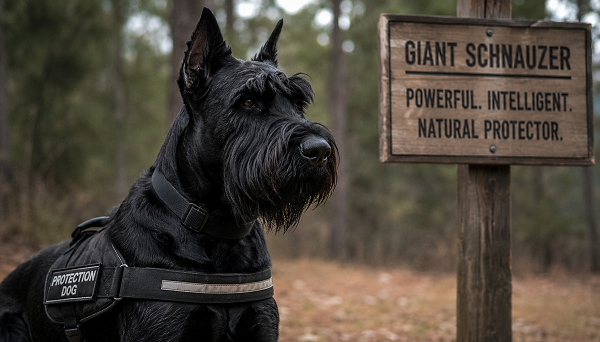
Yes, a Giant Schnauzer can be an excellent protection dog. It was bred to guard, it’s smart, and it’s naturally wary of strangers. But the breed only becomes a reliable protector with early socialization, solid obedience, and an experienced owner. For true personal protection (controlled bite work on command), you’ll also need professional training, a clean legal footing, and about 2 to 3 years for the dog to mature. Most families don’t need that last step. A well-raised Giant Schnauzer already deters intruders just by being big, alert, and loud on cue.
Table of Contents
- Introduction
- What Is a Giant Schnauzer? (Key Facts)
- Where the Guarding Instinct Comes From
- The 3 Levels of Protection (and Where the Giant Fits)
- Giant Schnauzer Temperament: Strengths and Weak Spots
- Giant Schnauzer vs German Shepherd, Malinois, Rottweiler and Doberman
- How to Choose a Protection-Quality Puppy
- Training Timeline and Real Costs
- Legal and Liability Rules You Can’t Ignore
- Kids, Family and Other Pets
- Health, Lifespan and Daily Care
- Is a Giant Schnauzer Right for You?
- Why You Can Trust This Guide
- FAQs
- Conclusion
Introduction
Ever seen a Giant Schnauzer walk into a room? Everything goes quiet. The beard, the heavy brow, the steady stare. It looks like it’s already decided whether you’re welcome.
That look is exactly why people ask, “Is a Giant Schnauzer a good protection dog?” The problem is that most answers online stop at “yes, they’re great guard dogs.” That’s not enough when you’re about to spend years, and maybe thousands of dollars, raising a 70-pound working dog.
In my years selecting and evaluating dogs for handler work, I’ve learned one thing: a breed gives you raw material, not a finished protector. In this guide you’ll learn what the Giant Schnauzer really brings to protection work, where it falls short, how to pick the right puppy, what training takes, and what the law says. No hype, just what a handler would tell you over coffee.
What Is a Giant Schnauzer? (Key Facts)
The Giant Schnauzer is the largest of the three Schnauzer breeds (Miniature, Standard, Giant). It isn’t a bigger Miniature. It’s a separate working breed. The Giant Schnauzer is also one of the many breeds in the herding, working and guardian families we explain in our guide to the 7 types of dogs.
| Trait | Giant Schnauzer |
|---|---|
| Height | Males 25.5–27.5 in (65–70 cm); females 23.5–25.5 in (60–65 cm) |
| Weight | Roughly 55–85 lb (25–38 kg) |
| Coat | Hard, wiry double coat; black or pepper-and-salt |
| Lifespan | About 10–13 years (AKC estimate; some sources say up to 15) |
| Energy | Very high, needs hours of daily exercise |
| Kennel club group | Working (AKC and UK Kennel Club); Utility (Australia) |
Westminster Kennel Club rates the breed 5 out of 5 for protectiveness, trainability and energy, but only 3 out of 5 for being good with strangers, children and other dogs. That one line sums up the breed. Great at guarding, less easy with everyone else.
The breed also got a big popularity boost when a Giant Schnauzer named Monty won Best in Show at Westminster in 2025. Remember that when you shop for a puppy. Popularity attracts breeders who care more about money than temperament (more on this below).
Where the Guarding Instinct Comes From
You can’t train instinct into a dog that doesn’t have it. The Giant Schnauzer has it because people bred for it.
In 17th and 18th century Bavaria, farmers needed one dog to do two jobs: drive cattle to market and guard the farm. Breeders are believed to have crossed the Standard Schnauzer with black Great Danes and the Bouvier des Flandres, creating a strong herding dog with real guarding instinct. The exact recipe is still debated, but the result was a dog that could hold its ground.
Later, the dogs moved into Munich’s breweries and butcher shops as night guards. Then they served as police and military dogs through both World Wars. That’s a long, real working history, not a marketing story.
Here’s why it matters to you today: guarding is built in, but so is a strong will. These dogs were bred to make decisions without a farmer standing next to them. That independence is a gift in a real threat. It’s also why they test you in training.
The 3 Levels of Protection (and Where the Giant Fits)
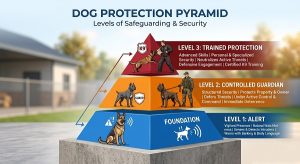
This is the part most articles skip. “Protection dog” isn’t one thing. I explain it to clients as three levels:
- Level 1: Alert and deterrent. The dog barks at strangers, watches the door, and looks intimidating. This is what 90% of families actually need.
- Level 2: Controlled guardian. The dog stays calm with guests when told, reacts to real threats, and obeys “out,” “leave it,” and “come” even when excited. It takes serious obedience work.
- Level 3: Trained personal protection. The dog bites and releases on command. It needs professional trainers, long proofing, and legal permission in many places.
Where does the Giant Schnauzer fit? A well-bred, well-socialized Giant reaches Level 1 almost naturally. Level 2 is very achievable for a committed owner. Level 3 is possible, but only with the right individual dog and an expert trainer. The breed has fewer proven working lines than the German Shepherd or Malinois, so you must be picky.
Giant Schnauzer Temperament: Strengths and Weak Spots
I’ve seen plenty of owners confuse a barking, lunging dog with a good protector. Real protection temperament looks boring most of the time. The dog watches, settles, and acts only when needed.
Strengths:
- Naturally alert. They tend to be quiet but bark when someone enters their territory. That’s a useful alarm without constant noise.
- Deep bond with family. They attach hard and take their “job” seriously.
- Smart and trainable. They learn fast when you’re consistent.
- Confident look. Size and presence deter many people before anything happens.
Weak spots (be honest with yourself):
- Stubborn streak. If you’re not clear, they’ll lead.
- Same-sex dog aggression and low tolerance for small animals. Orvis notes they can be aggressive toward other dogs, cats and small animals, and they do best as the only pet.
- Boredom problems. A bored Giant destroys things. A frustrated one can turn reactive.
- Slow maturity. Expect “teenager” behavior until around 2 to 3 years old.
Two traits decide everything:
- Nerve strength. Does the dog stay calm under pressure, or does it fold or panic?
- Discrimination. Can it tell a threat from your child’s friend running through the yard?
Both come from breeding and upbringing. A great-nerve dog raised badly becomes a problem. A mediocre-nerve dog raised well still has limits.
Giant Schnauzer vs German Shepherd, Malinois, Rottweiler and Doberman
Here’s how it stacks up with the usual shortlist:
| Breed | Best at | Watch out for |
|---|---|---|
| Giant Schnauzer | Calm guardian, strong bond, wary of strangers, wiry coat | Smaller pool of proven working lines; heavy grooming; stubborn |
| German Shepherd (working line) | Most versatile; huge pool of trained dogs | Hip problems; can be too intense for casual owners |
| Belgian Malinois | Elite drive, top choice for police and military | Extreme energy; needs a real job daily |
| Rottweiler | Natural guarding, steady and powerful | Shorter lifespan; heavy and less agile |
| Doberman | Fast, athletic, bred for personal protection | Needs lots of human contact; thinner coat |
My take: Choose a Giant Schnauzer if you want a thinking guardian with more “off switch” than a Malinois. Choose a working-line German Shepherd or Malinois if you want to buy a dog already proven in protection sport or police work. The honest trade-off for the Giant is availability. Far fewer breeders title their dogs in IGP (formerly Schutzhund), so finding proven lines takes real digging.
How to Choose a Protection-Quality Puppy
This is where most buyers fail, and where you can outsmart the market.
Step 1: Ask for health clearances on both parents.
Look for hip and elbow results (OFA or PennHIP), eye exams, and a thyroid test. Ask about CHIC numbers, but don’t treat a number as a guarantee.
Step 2: Ask about the parents’ temperament and work.
Do they have working titles (IGP, PSA, obedience, tracking)? Can you meet the mother? A nervous or shy mother usually means nervous puppies.
Step 3: Watch the litter.
You want a puppy that is curious, recovers quickly from a loud noise, and comes to people. Skip the one that hides or the one that bites hard and won’t stop.
Step 4: Choose the sex for your needs.
Males are bigger and often more territorial. Females usually mature a bit earlier and can be easier to live with. For a first guardian dog, many handlers I know lean toward a female with strong nerves. But a stable individual matters more than sex.
Red flags to walk away from:
- Breeder won’t show health papers
- Puppies sold at 5 to 6 weeks
- “Guard dog guaranteed” promises (no one can guarantee that)
- Several litters ready at once
Price check: Giant Schnauzer puppies tend to cost around $1,500 or more. Good working-line puppies often cost more. A very cheap puppy usually means skipped health tests.
Training Timeline and Real Costs
If you’re raising your own dog, this is the path that works. Start with the foundation, and our crate training guide gives you the structure for the first weeks.
Realistic timeline:
- 8 to 16 weeks: Socialization. Meet many people, surfaces, sounds, and calm dogs. This window closes fast, so don’t skip it.
- 4 to 6 months: Basic obedience: sit, down, place, recall, “leave it.” Start impulse control.
- 6 to 12 months: Build confidence and drive through tug and structured play. Keep socializing through adolescence.
- 12 to 18 months: Formal bite work, only if you’re pursuing sport or personal protection, and only with a qualified trainer. Joints and nerves need time to develop.
- 2 to 3 years: Full mental maturity. This is when many Giants “settle in.”
Rough costs (vary by country):
| Route | Typical cost | What you get |
|---|---|---|
| Family guardian (DIY plus obedience classes) | About $3,000–$6,000 total including the puppy | A calm, alert dog that deters |
| Sport club (IGP, PSA) | Roughly $500–$2,000 per year in dues and helper fees | Real skills in a controlled setting |
| Fully trained protection dog | Often $25,000 and up | Professionally proofed dog |
One trainer quoted by PetsRadar said a trained Giant Schnauzer can cost up to about $37,000, and that finding a good one takes years of research. That fits my experience. Sport titles show skill in a controlled field, but they don’t automatically prove how a dog behaves against a real intruder.
Practical advice: Unless you face a specific, serious threat, put your money into obedience and socialization first. A large, alert dog that barks on cue is one of the cheapest and most effective home-security tools you can own.
Daily exercise matters too. The breed needs several hours of vigorous exercise each day. Our guide on how often to exercise a working dog shows how to balance physical work and mental tasks so your Giant stays calm, not wired.
Want the full puppy-to-adult playbook? My book, Beyond the Bark: Inside a Pro Handler’s Playbook for Raising the Ideal Dog, walks through the exact principles I use with working dogs, and it’s useful before you bring a pup home.
Legal and Liability Rules You Can’t Ignore
Almost no competitor covers this, and it can cost you more than the dog.
Rules differ a lot by country, state and even city. Check yours before you start bite training. Here are real examples:
- Victoria, Australia: Protection training is restricted to licensed security guards, the dog must be at least 12 months old, and attack-trained dogs are automatically classed as dangerous dogs.
- United Kingdom: The Dangerous Dogs Act can apply if a dog is dangerously out of control, including on private property. Owners can face fines or worse.
- United States: Many states hold owners responsible when their dog bites someone, and a bite-trained dog can raise your liability and insurance problems.
What to do:
- Call your home insurer and ask about protection-trained dogs before you train.
- Post clear signs and keep fences secure.
- Never rely on the dog to decide who is a threat without strong obedience control.
This isn’t legal advice. Ask a local lawyer or your council.
Kids, Family and Other Pets
Giant Schnauzers can be gentle with their own family’s children, but they’re big and bouncy. They’re usually not ideal for homes with very young kids, and all contact should be supervised.
My rules for families:
- Teach kids not to run screaming at or hug the dog.
- Train the dog to settle in a “place” when friends visit.
- Never leave a large dog alone with a small child. It’s about safety, not distrust.
For other pets, a Giant raised with a cat or another dog from puppyhood can do fine. An adult introduced late often won’t.
Health, Lifespan and Daily Care
A protection dog only matters if it stays healthy. Watch these:
- Hip and elbow dysplasia: Ask for clearances on both parents.
- Hypothyroidism: Look for weight gain, dull coat, tiredness. Vets can treat it.
- Bloat (gastric torsion): A deep-chested dog can twist its stomach. This is an emergency. Feed two or three smaller meals and avoid hard exercise right after eating.
- Eye problems and toe cancer: Have any odd nail or toe swelling checked quickly.
Daily care:
- Food: About 4 to 5 cups of quality dry food per day, split into meals (adjust for activity).
- Grooming: Weekly brushing, plus professional stripping or clipping every 6 to 8 weeks. The coat sheds less than many guard breeds, but no dog is truly hypoallergenic.
- Mental work: Tracking, obedience drills, and sport keep a Giant balanced.
Is a Giant Schnauzer Right for You?
A good match if you:
- Have owned strong-willed or working breeds before
- Can give hours of daily exercise and training
- Want a loyal guardian that bonds closely with the family
- Can handle grooming costs and a late-maturing dog
Think twice if you:
- Are a first-time dog owner
- Live in a small space with little exercise access
- Want a dog that loves every stranger
- Expect a “protection dog” to work perfectly without training
Why You Can Trust This Guide
This guide was written by Cpl. Rofiat Muritala, a Nigerian Army military working dog instructor and handler with more than 14 years of experience. Her background includes dog selection, foundation training, behavior shaping, and performance evaluation in real operational settings. She completed advanced obedience, K9 patrol, and explosive detection courses, and she is the author of Beyond the Bark.
Breed facts come from the AKC, Westminster Kennel Club, Dogs Victoria and breed health references. Legal notes come from government sources where available.
FAQs
Is a Giant Schnauzer good for first-time owners?
Usually no. Their intelligence, strong will and protective drive suit handlers who can stay calm and consistent. First-timers often under-exercise and under-socialize them, which leads to reactivity.
Are Giant Schnauzers good with kids?
They can bond well with their own family’s children, but their size and energy make them a poor fit for homes with toddlers. Always supervise and teach children how to act around the dog.
Do Giant Schnauzers need bite training to protect you?
No. A well-bred, well-socialized Giant already alerts, deters and guards its home. Bite training is a separate, specialist step, and in some places it’s restricted by law.
Is a Giant Schnauzer better than a German Shepherd for protection?
Not better, just different. A working-line German Shepherd has a bigger pool of proven lines and trained dogs. The Giant offers strong guarding with a low-shedding coat and often a calmer indoor attitude, but fewer proven breeders.
How much does a trained Giant Schnauzer protection dog cost?
A puppy from a good line starts around $1,500 or more. A professionally trained personal protection dog often starts near $25,000, and top-level dogs can cost far more.
Conclusion
So, is a Giant Schnauzer a good protection dog? Yes, when it comes from sound, stable lines and gets the socialization, exercise and training it needs. It brings real guarding instinct, sharp intelligence and a deep bond with its people. But no dog is born a finished protector.
Here’s your action plan:
- Decide which protection level you need (alert, controlled guardian, or trained).
- Choose a breeder who shows health tests and temperament proof.
- Start socialization on day one.
- Build obedience before any bite work.
- Check your local laws and insurance.
Do the early work well and you’ll have a loyal, impressive guardian for years.
Want more breed guides and training tips every week? Subscribe to our weekly articles roundup newsletter and get new posts straight to your inbox.

Her work centres on obedience, detection, protection and operational readiness. She favours proven methods built on repetition, consistency and real-world conditioning, so that both dogs and handlers are prepared for high-pressure tasks.
Rofiat represented the Nigerian Army Dog Centre at the Nigerian Army Day Celebration (NADCEL) 2026, where she led demonstrations in obedience, explosive detection, agility and tactical movement. Through articles, training content and documentaries, she shares field-based insight into how structured training, clear communication and trust between handler and dog affect performance and reliability.
She is the author of Beyond the Bark: Inside a Pro Handler's Playbook for Raising the Ideal Dog, a practical guide that helps dog owners and handlers apply professional training principles in everyday situations.
- How to Enter the COBA National Dog Championship - October 20, 2026
- K9 Advantix Dosage Chart & Safety Guide for Dogs - October 19, 2026
- How to Set Up & Use Bousnic Dog Training Collar - October 18, 2026