Before the Bite: Warning Signs Every Owner Should Know
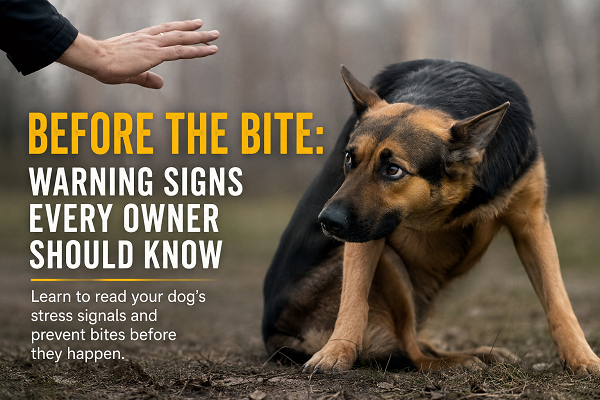
Dogs almost never bite without warning. Before a bite, most dogs move through a predictable sequence of stress signals, lip licking, yawning, whale eye, a stiff body, freezing, growling, and finally snapping, known as the Ladder of Aggression. If you learn to spot these signals early (especially the quiet ones at the bottom of the ladder), you can step in, give your dog space, and stop things from ever reaching a bite.
Table of Contents
- Introduction
- The Myth of the Sudden Bite
- The Ladder of Aggression: How Dogs Escalate
- 15 Warning Signs Every Owner Should Learn to Read
- When Bite Risk Goes Up: Common Triggers
- A Story From the Field
- What to Do the Moment You Spot a Warning Sign
- Working Dogs Are Different: Controlled vs. Fear-Based Aggression
- Trainer’s Note: About the Author
- FAQs
- Conclusion
Introduction
Nobody gets a dog thinking it’ll ever bite someone. Not the family with the golden retriever, not the guy down the street with the rescue pit mix, not the handler who’s spent years working a Malinois on a decoy sleeve. But dog bites happen constantly, and in the vast majority of cases, they’re preventable. The problem isn’t that dogs don’t warn us. The problem is that humans are terrible at reading dog body language, and we’re taught almost nothing about it growing up.
In this guide, I’ll walk you through the actual science and field experience behind pre-bite warning signs, so you know exactly what to look for, whether you’re raising a family pet, managing a reactive rescue, or handling a working dog. This isn’t theory pulled from a textbook. It’s a mix of established behavioral science and what I’ve personally seen play out, over and over, in real homes and real training sessions.
The Myth of the Sudden Bite
Let’s start with the numbers, because they tell an important story. In the United States, roughly 4.5 million people are bitten by dogs every year, and around 800,000 of them need medical treatment for it. In England, hospital admissions for dog bites and strikes have climbed from about 6.3 per 100,000 people in 1998 to nearly 15 per 100,000 by 2018, with the steepest rise happening in adults, not children, which surprises most people.
Here’s the detail that matters most for this article: the majority of biting dogs belong to the victim’s own family or a close friend. These aren’t feral strays attacking strangers on the street. They’re household pets, often dogs the person had petted a hundred times before without incident.
So why does it feel sudden? Because most of us were never taught to read the early signals. A dog doesn’t go from “relaxed” to “biting” in one step. It moves through a sequence, and the earliest steps in that sequence are subtle, quiet things like a lip lick or a slow blink, signals that look almost like nothing if you don’t know what you’re looking at.
The Ladder of Aggression: How Dogs Escalate
The single most useful framework here is the Ladder of Aggression, developed by UK veterinary behaviorist Kendal Shepherd in 2004. Her idea was simple but powerful: dogs typically escalate through an increasingly obvious series of signals, starting with small appeasement gestures and ending, only if every earlier signal is ignored, in a bite. Every rung on the ladder is really an off-ramp. The dog is asking for the pressure to stop.
This connects closely to the work of Norwegian trainer Turid Rugaas, who documented what she called “calming signals”, the specific behaviors dogs use to defuse tension and avoid conflict, such as turning away, licking their lips, yawning, and moving slowly. Rugaas’s core point still holds up decades later: these gestures aren’t random tics. They’re a dog actively trying to keep the peace.
The Lower Rungs: Calming Signals
These are the quietest signals, and they’re the ones almost everyone misses:
- Lip licking or a quick tongue flick (unrelated to food)
- Yawning in a tense, non-tired moment
- Blinking rapidly or softening/squinting the eyes
- Turning the head away from the trigger
- Sniffing the ground for no obvious reason
The Middle Rungs: Clear Stress Signals
If the lower signals get ignored, most dogs escalate to behavior that’s harder to miss:
- Whale eye (you can see the whites of the eyes)
- A stiff, frozen body posture
- Ears pinned back or held unusually rigid
- Tail tucked, lowered, or held stiff and high
- Moving away or trying to create distance
- A low growl
The Upper Rungs: Last-Resort Warnings
These are the loudest, most obvious signals and the ones people wrongly assume come “out of nowhere”:
- Showing teeth or snarling
- A hard, fixed stare
- Snapping without contact (an air snap)
- Lunging
- A bite
The critical thing to understand is that not every dog climbs every rung in order. Some dogs skip steps, especially if they’ve been punished in the past for growling or stiffening, a dog that gets scolded every time it growls doesn’t stop feeling threatened, it just stops warning you before it bites. That’s one reason trainers strongly discourage punishing a growl. The growl isn’t the problem; it’s the most honest, useful signal your dog can give you.
15 Warning Signs Every Owner Should Learn to Read
Here’s a practical, categorized checklist you can actually use in the moment.
Face and Eyes
- Whale eye, whites of the eyes visible, often with a hard stare
- Furrowed brow or tense facial muscles
- Yawning at a moment that has nothing to do with tiredness
- Lip licking outside of mealtime
Ears and Head
- Ears pinned flat back, or unnaturally stiff and forward
- Head turned away, avoiding eye contact
- Head lowered while the body stays tense
Tail and Body
- Tail tucked tightly under the body
- Tail held high and rigid, wagging in short, stiff strokes (not the loose, full-body wag of a relaxed dog)
- A stiff, frozen “statue” posture
- Weight shifted backward, away from a person or object
Mouth and Vocalization
- Lip curling to show teeth
- Low, sustained growling
- Air snapping (a bite that doesn’t make contact, used as a final warning)
Behavioral Red Flags
- Sudden stillness after a period of normal movement, this “freeze” is one of the most underrated warning signs in the entire list. A dog that goes completely still, especially over a resource like food, a toy, or a resting spot, is often one interruption away from escalating.
A quick note on the “wagging tail means happy” myth, because it causes more bites than almost any other misconception: a wagging tail only tells you a dog is emotionally aroused, not what kind of emotion it is. A stiff, high, fast wag over food or a stranger can mean tension just as easily as excitement. Always read the whole dog such as tail, ears, eyes, and posture together, not one signal in isolation.
When Bite Risk Goes Up: Common Triggers
Certain situations reliably raise the odds of a bite, even in dogs with no history of aggression:
- Resource guarding – food bowls, chews, toys, or even a favorite resting spot
- Pain or illness – an arthritic dog or one with an ear infection may snap when touched somewhere that normally wouldn’t bother them
- Being cornered or restrained – a dog that can’t retreat is far more likely to escalate quickly
- Startling a sleeping dog – waking a dog abruptly, especially an older or hard-of-hearing dog, removes its ability to see the interaction coming
- Unsupervised interactions with young children – children move fast, make direct eye contact, and often hug or lean over dogs, all of which read as threatening in dog body language
- Approaching an unfamiliar dog head-on – direct approaches, leaning over, and prolonged eye contact are all confrontational in canine communication, even when the human means well
- Fear of strangers, other dogs, or loud environments – a dog that hasn’t been well socialized during its critical developmental window is statistically far more prone to fear-based aggression later in life. If you’re raising a puppy right now, this is exactly why early socialization matters so much, we cover the specifics in our guide to essential training steps for high-drive breeds.
A Story From the Field
A few years back, I got called in to evaluate a dog after a bite incident involving a family member. The owners were adamant the dog had “just snapped” while their teenage son was sitting on the floor with him. When we walked through it slowly, frame by frame, the picture was completely different. The dog had been resting, the boy sat down close beside him and leaned his weight against the dog’s side, and the dog gave a lip lick, then a head turn, then went stiff. Nobody in the room noticed any of it, because nobody had ever been taught what those signals meant. By the time the dog growled, the boy had already draped an arm over him, and the bite happened seconds later.
That dog wasn’t “bad.” He gave four separate warnings before the bite. This is the pattern I see over and over in bite consultations, and it’s backed up by the broader data: research on confrontational training methods found that techniques like staring a dog down, forcing an item out of its mouth, or physically correcting a growl provoked an aggressive response in roughly a quarter to over 40% of dogs on which they were tried. Punishing the warning signal doesn’t remove the discomfort causing it. It just removes the warning.
What to Do the Moment You Spot a Warning Sign
- Stop what you’re doing immediately. Whatever triggered the signal, pause it. Don’t push through a lip lick or a stiff body hoping it “settles down.”
- Add distance, not pressure. Step back, or let the dog move away. Never corner a dog that’s already showing stress.
- Lower the intensity of the environment. Quiet your voice, slow your movements, and remove other people or dogs from the immediate area if you can.
- Never punish the growl. Redirect the situation instead of correcting the warning itself.
- Give the dog a clear, safe exit. A crate, another room, or simply open space to retreat to teaches the dog that removing itself works, so it doesn’t have to escalate next time.
- Debrief afterward, not in the moment. Once everyone is calm, think through what triggered the reaction so you can manage or train around it going forward.
- Bring in a professional for repeat patterns. One-off stress signals are normal dog communication. A pattern of escalating reactivity is a training and management issue, and it’s worth working with a certified trainer or veterinary behaviorist rather than guessing.
If you want a structured, step-by-step framework for building calmer, more confident, more predictable behavior in your dog from the ground up, our practical training guide walks through the exact conditioning principles handlers use to build reliable dogs, including how to read and respond to stress before it becomes a problem.
Working Dogs Are Different: Controlled vs. Fear-Based Aggression
One thing that surprises a lot of pet owners: working and protection dogs are trained to bite under very specific, controlled conditions, on command, on a decoy sleeve, in a structured environment. That is a completely different animal from fear-based or reactive aggression in an untrained pet. A well-trained protection dog isn’t unpredictable; it’s actually more predictable than an anxious, undersocialized pet dog, because its bite behavior has been deliberately shaped, tested, and put under command control.
Breed also plays a smaller role than most people assume. Belgian Malinois, for example, have a reputation for being “aggressive,” but what they actually have is intensity and drive, not a hair-trigger temper and that distinction matters when you’re choosing between working breeds. We cover this in more depth in our German Shepherd vs. Belgian Malinois comparison. The same goes for big, powerful guardian breeds like the Boerboel and Cane Corso, where proper protection training, not raw size or strength, determines whether the dog becomes a reliable guardian or a genuine liability, something we break down fully in our Boerboel vs. Cane Corso breed guide.
If you’re curious how professional handlers actually read these subtle body language shifts under real operational pressure, it’s worth seeing how certified K9 teams train for it, from decoy work to controlled bite training. Our breakdown of how police K9 teams train and certify shows just how much of the job comes down to reading tiny shifts in posture long before anything visible happens.
Trainer’s Note: About the Author
I’m Rofiat Muritala, a veteran military K9 handler and certified dog trainer with over 14 years of hands-on experience across military working dogs, security operations, and handler-dog development. My background covers dog selection, foundational and behavior-shaping training, detection work, and operational evaluation in genuinely high-pressure, real-world environments, not just a classroom or a quiet training field. Reading a dog’s body language correctly isn’t optional in this line of work; it’s the difference between a safe, controlled operation and a serious injury. That’s the same lens I bring to family dogs and pet owners: the signals are the same, whether the dog is guarding a border post or guarding its food bowl. If you want to go deeper into how handlers build that kind of reliable, well-conditioned dog from day one, our guide to basic K9 training techniques is a good next stop.
Frequently Asked Questions
1. Do dogs really always give warning signs before biting?
Almost always, yes. True “no-warning” bites are rare and usually involve a dog that was previously punished for showing earlier signals like growling or stiffening, which teaches the dog to skip straight to the bite. In the overwhelming majority of cases, a dog gives several signals, often starting with subtle ones like lip licking or a head turn, minutes or even seconds before a bite.
2. What is the number one warning sign people miss?
The “freeze,” or sudden stillness. A dog that suddenly stops moving, especially while guarding food, a toy, or a resting spot, is showing one of the clearest and most urgent pre-bite signals there is. It’s frequently mistaken for calmness.
3. Is a wagging tail always a good sign?
No, and this misconception causes real injuries. A wagging tail only signals arousal, not the type of emotion behind it. A stiff, fast, high wag can just as easily signal tension as excitement. Always read the tail alongside the ears, eyes, and overall body posture.
4. Should I punish my dog for growling?
No. A growl is valuable communication, not misbehavior. Punishing it tends to suppress the warning without resolving the underlying discomfort, which can produce a dog that bites with less warning in the future. Instead, remove whatever is causing the stress and address the root cause with training.
5. Are certain breeds more likely to bite without warning?
Breed influences bite force and how a dog was historically bred to work, but it doesn’t reliably predict whether a dog gives warning signals. Socialization, training history, pain, and how consistently a dog’s early warnings were respected matter far more than breed alone when it comes to bite risk.
Conclusion
Dog bites feel random from the outside, but almost every single one has a paper trail of warning signs behind it. The lip licks, the freezes, the whale eyes, the stiff tails, these aren’t quirks, they’re a dog’s honest attempt to communicate discomfort before things escalate. Once you know how to read the Ladder of Aggression and respect the earliest, quietest signals, you’re not just preventing bites. You’re building a dog that trusts you to listen, which is the actual foundation of a safe, well-behaved companion, working or otherwise.
If you take one thing from this article, let it be this: never punish a warning. Manage the trigger, give your dog space and time, and if the pattern repeats, bring in a qualified professional. A dog that feels heard rarely needs to shout.
Sources referenced: CDC dog bite estimates; NHS England / Scientific Reports (Oxley et al.) hospital admissions data 1998–2018; Kendal Shepherd’s Ladder of Aggression (2004); Turid Rugaas’s work on canine calming signals; survey data on confrontational training methods published via Purdue University’s Canine Welfare research archive.

Her work centres on obedience, detection, protection and operational readiness. She favours proven methods built on repetition, consistency and real-world conditioning, so that both dogs and handlers are prepared for high-pressure tasks.
Rofiat represented the Nigerian Army Dog Centre at the Nigerian Army Day Celebration (NADCEL) 2026, where she led demonstrations in obedience, explosive detection, agility and tactical movement. Through articles, training content and documentaries, she shares field-based insight into how structured training, clear communication and trust between handler and dog affect performance and reliability.
She is the author of Beyond the Bark: Inside a Pro Handler's Playbook for Raising the Ideal Dog, a practical guide that helps dog owners and handlers apply professional training principles in everyday situations.
- Local Dog Breeds: Temperament, Health & Training Guide - October 6, 2026
- How Long Do Military Working Dogs Serve? Full Guide - October 5, 2026
- National Puppy Day 2026: Date, Best Deals & Freebies - October 4, 2026