Dog Training For Belgian Malinois: 5 Vital Steps
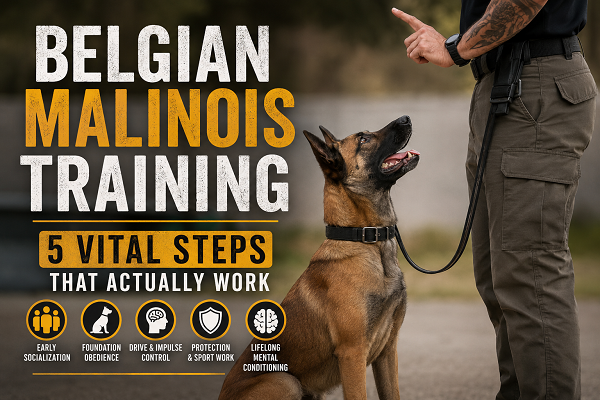
How do you train a Belgian Malinois? Follow five steps in order:
- Socialize your puppy for neutrality between 8 and 16 weeks.
- Build foundation obedience using toys, food, and clear markers.
- Teach impulse control and an “off switch” through adolescence.
- Give that drive a real job, such as sport, scent work, or professionally supervised work.
- Keep up daily mental and physical work for life.
Most Malinois learn basic commands in 6 to 8 weeks. Reliable self-control usually takes 12 to 18 months of steady work.
Table of Contents
- Why Malinois Training Is Different
- Is a Malinois Right for You? (Be Honest First)
- Step 1: Socialization for Neutrality (8–16 Weeks)
- Step 2: Foundation Obedience (2–6 Months)
- Step 3: Impulse Control and the Off Switch (6–18 Months)
- Step 4: Give the Drive a Job (12 Months and Up)
- Step 5: Lifelong Mental and Physical Conditioning
- A Sample Daily Routine
- Troubleshooting Common Malinois Problems
- Gear, Costs, and Timelines
- What I’ve Learned Around Working Dogs
- Mistakes That Set Owners Back
- FAQs
- Final Thoughts
Introduction: Why So Many Malinois Owners Struggle
Dog training for Belgian Malinois isn’t like training a Labrador. You can’t sit through one puppy class, teach “sit,” and call it done.
The breed’s fame makes this worse. Cairo, the Malinois on the 2011 raid on Osama bin Laden’s compound, made the breed famous. Today Malinois work as police, military, and detection dogs around the world. Social media turned that image into a trend.
The trend has a cost. In Spain, Malinois registrations jumped 35.2% in four years, and rescue centres report more Malinois handed in by owners who can’t cope. In the US, the American Belgian Malinois Club has warned about the same pattern since 2015. It said most people drawn to the breed after a movie wouldn’t be equipped for its extreme energy and intensity.
So here’s the problem: this breed rewards the prepared owner and punishes the casual one.
In this guide, you’ll learn:
- The five steps that build a stable Malinois
- What to do at each age
- A daily routine you can copy
- How to fix the problems that make people give up
Why Malinois Training Is Different
Ever wonder why police and military units keep choosing the Malinois? It comes down to drive. The breed was developed around Mechelen, Belgium, in the late 1800s to herd livestock all day. That never-quit engine is still there.
An adult Malinois is a lean athlete. Males usually weigh 60 to 80 pounds, and females 40 to 60. The dog is fast, sharp, and quick to read your body language. That’s a gift when you handle well. When you handle badly, the dog learns bad habits just as quickly.
Handlers who’ve worked both breeds often call the Mal more intense than a German Shepherd. It reacts faster and forgives less. Your training has to match.
Here’s the mindset shift I give every new owner: with this breed, training isn’t a separate activity. Every walk, meal, and doorway teaches something. The only question is whether you’re teaching on purpose.
Is a Malinois Right for You? (Be Honest First)
Before Step 1, answer these questions honestly. Skip this part and you’re likely to join the surrender statistics.
A Malinois may suit you if:
- You can give 2 to 3 hours of daily time (exercise, training, and rest management)
- You have experience with strong, driven dogs, or a good mentor
- You want a sport, scent, or work partner
- Your household agrees on the rules
Think twice if:
- You work long hours with no daily structure
- You want a dog that “just hangs out”
- You live with small children and can’t supervise constantly
- It’s your first dog and you have no trainer or club nearby
Rescue groups often recommend that first-timers consider adopting an older Malinois with a known personality. That advice comes from the American Belgian Malinois Rescue, and it’s sound.
The consequences of a poor match are real. In 2025, rescuers in New York City found nearly 50 Malinois in one apartment. Staff said the dogs had likely never touched grass, walked on a leash, or met a stranger. That’s an extreme case, but it shows what the breed becomes without outlets.
Step 1: Socialization for Neutrality (8–16 Weeks)
The first 16 weeks shape the adult dog more than any later training. Vets and behaviorists call this the critical socialization window. For a sharp, reactive breed, it’s the foundation.
Aim for neutrality, not friendship. Many owners get this wrong. You don’t want a Malinois that runs up to greet everyone. You want one that sees people, dogs, and traffic and thinks, “Not my business.” Breeders and trainers who work with the breed stress this point.
What good socialization looks like:
- Meet lots of people. Many breeders use “100 people by 16 weeks” as a target. Aim for variety: kids, tall men, people in hats, people with canes.
- Cover surfaces and sounds. Try grates, stairs, gravel, tile, vacuums, and traffic noise. Keep each session short.
- Pair every new thing with a reward. Keep it positive, and never flood a nervous puppy.
- Practice calm watching. Sit with your puppy on a bench and reward it for noticing people without reacting.
- Start handling early. Touch paws, ears, mouth, and collar daily. You’ll thank yourself at the vet.
- Start the crate on day one. Our guide to crate training a puppy covers the routine step by step.
Watch for fear periods. Puppies often have a sensitive period around 8 to 10 weeks and another during adolescence. If your pup suddenly spooks at something familiar, don’t push. Stay calm, create distance, and let the dog recover.
One safety note: Until vaccinations are complete, avoid dog parks and public ground where unvaccinated dogs go. Carry the puppy, or use clean, private spaces.

Step 2: Foundation Obedience (2–6 Months)
Malinois learn fast. A puppy can pick up “sit” in a few short sessions. The real challenge is keeping it fun.
Teach in this order:
- Name and eye contact (“look at me”)
- Sit
- Down
- Place (go to a mat and stay)
- Come (recall)
- Loose-leash walking
- Leave it
- Wait at doors
How to structure training:
- Keep sessions short. Think 3 to 5 minutes, several times a day. Stop while the puppy still wants more.
- Use a marker word. Say “yes” or click the instant the dog gets it right, then reward. Precise timing matters more with this breed than with slower, more forgiving dogs.
- Find your dog’s real motivator. For many Malinois, it’s toys or movement. A tug, ball, or quick chase may beat any treat. Food works well for early shaping.
- Make food a training tool. Skip the bowl sometimes. Scatter kibble to forage for, or feed it during practice.
- Teach one new skill at a time. Review old ones in each session.
- Never punish a recall. If your dog comes to you and something bad happens, it stops coming.
Protect the joints. Growth plates stay open until roughly 12 to 18 months. A common rule of thumb is about 5 minutes of structured exercise per month of age, twice a day. Avoid repeated jumping, long runs, and hard-surface impact until the dog matures. Guides like the Petful puppy guide list over-exercising as a mistake that damages growing joints.
Step 3: Impulse Control and the Off Switch (6–18 Months)
This is where most owners hit a wall. Your sweet puppy turns into a teenager, and everything you’ve taught seems to vanish. Chewed furniture, fence-running, nipping at heels, and ignoring commands are all normal here. The dog isn’t bad. A driven teenager has too much energy and not enough direction.
Teach the off switch first. If you teach only one thing in this step, teach this. Place a mat or raised platform in the house. Reward your dog for settling on it, first for seconds, then minutes, then while you move around. Trainers recommend early crate training and teaching an off switch on a placemat or lifted platform.
Build impulse control with daily habits:
- Sit before meals, doors, and toys. This is a habit, not a dominance game. It teaches the dog to check in before acting.
- Practice “wait” and “leave it” with real temptation. Start with a low-value item, then raise the difficulty.
- Do a calm exercise each day. Reward the dog for lying quietly while you read.
- Use controlled trigger work. If your dog reacts to bikes, joggers, or dogs, work at a distance where the dog stays calm. Reward calm behavior, then close the gap over weeks, not days.
Tire the brain, not just the body. Here’s something I tell everyone: a Malinois that gets only physical exercise just becomes a fitter, more athletic version of the same restless dog. Add scent games, puzzle feeders, trick training, and thinking drills. Our post on how often to exercise a working dog explains how to balance exercise and mental work.
Expect regression. Around 8 to 14 months, a dog that was perfect at 5 months may act like it’s never heard “sit.” Go back a step. Practice in easier places. Raise the reward. This phase passes if you stay consistent.
Step 4: Give the Drive a Job (12 Months and Up)
A Malinois without a job will invent one. You won’t like its choices. This step is about channeling drive into something useful and safe.
Options, from easiest to most demanding:
- Scent and nose work. Great for every home, since a dog can start with a hidden toy or treat. Dogs love it, and it tires the brain fast.
- Agility, obedience, and trick sports. These build teamwork and body awareness.
- Herding and tracking. These use the breed’s original instincts.
- Bite and protection sports. These include IGP (formerly Schutzhund), French Ring, Mondioring, and KNPV, the Dutch police-dog program.
- Professional working roles. These include police, military, detection, and search and rescue.
Safety rules for bite and protection work:
- Wait until obedience and impulse control are solid. That usually means well past the first year.
- Work only with a qualified trainer and decoy. Poorly done bite work creates a dangerous dog, not a useful one.
- Choose gear carefully. A bad bite sleeve or a poorly fitted harness can hurt the dog’s grip and training associations. Our post on obedience vs. instinct explains why obedience must override instinct before any protection work.
- Ask yourself if you need it. Most owners don’t. A well-socialized, well-trained Malinois that’s bonded to you is already a strong deterrent. Think of protection training as a specialty, not a requirement.
Realistic timeline: Getting from an adolescent dog to a titled IGP1 dog usually takes 12 to 18 months of weekly work with a qualified club. There’s no shortcut that produces a reliable dog.
Step 5: Lifelong Mental and Physical Conditioning
Training a Malinois never ends. It just changes shape. A dog that “finishes” obedience at 18 months still needs structure for its whole life, commonly 14 to 16 years.
What lifelong work looks like:
- Weekly refreshers. Skills fade without practice, even in older dogs.
- Rotating activities. Switch between tracking, scent games, agility, and tricks so the dog doesn’t get bored.
- Adult socialization. Keep exposing your dog to new places and people so it stays stable.
- Daily exercise. Some guides suggest an adult Malinois needs 60 to 90 minutes of aerobic work plus 30 to 60 minutes of mental work. Treat that as a starting range and adjust for your dog’s age, health, and fitness.
- Senior planning. As joints slow down, swap high-impact work for scent games and gentle walks. Keep the brain working.
How to tell if you’re getting it right: A well-exercised Malinois is lean, calm at home, and sleeps soundly. A dog that’s destructive, vocal, or reactive isn’t getting enough, or isn’t getting the right kind.
A Sample Daily Routine
Here’s an example for an adult Malinois (about 18 months old). Adjust it for your schedule, age, and climate.
| Time | Activity | Purpose |
|---|---|---|
| Early morning | 30–45 minute structured walk or run (cool hours) | Burn energy, practice heel |
| After walk | Breakfast, fed through puzzle or training | Mental work |
| Mid-morning | Rest on mat or in crate (1–2 hours) | Off switch |
| Afternoon | 10–15 minute obedience session, then tug or flirt pole | Focus and drive |
| Late afternoon | Rest | Recovery |
| Evening | 20–30 minute sniff walk, scent game, or sport practice | Mental workload |
| Night | Settle on mat while family relaxes | Calm habit |
Puppy version (12 weeks): Several 3-to-5-minute training sessions, short play, plenty of naps, and crate time. Puppies need 18 to 20 hours of sleep. Don’t skip it.
Troubleshooting Common Malinois Problems
| Problem | Likely Cause | What to Do |
|---|---|---|
| Nipping heels or clothes (herding) | Natural instinct plus excess energy | Redirect to a tug toy, teach “leave it,” and give a “place” cue when excited |
| Fence-running or spinning | Boredom, frustration | Cut fence access, add scent games and a daily job, and use a mat for calm time |
| Constant barking | Demand, boredom, alert behavior | Ignore demands, reward quiet, add mental work, and teach a “quiet” cue |
| Reactivity to dogs, bikes, or people | Weak socialization or high arousal | Work at a distance, reward calm focus, and consider a qualified trainer |
| Destructive chewing | Under-stimulation or teething | Give appropriate chews, crate when unsupervised, and boost mental work |
| Separation anxiety | Not learning to be alone | Build alone time in tiny steps, use the crate, and make departures boring |
| Can’t settle | Never taught an off switch | Daily mat practice and rewards for calm |
If problems are serious (growling, biting, or severe fear), get help from a qualified behavior professional. Don’t wait.
Gear, Costs, and Timelines
Basic gear:
- Well-fitted flat collar and a Y-front harness
- 6-foot leash and a 15 to 30-foot long line for recall work
- Crate, mat, or raised platform
- Tug toys, a flirt pole, and puzzle feeders
- Treat pouch and marker (clicker or word)
E-collars: They’re banned or restricted in some countries and regions. If you ever consider one, do it only where it’s legal, and only under a qualified trainer. They’re not a shortcut, and they’re not needed for most Malinois.
Approximate costs and timelines (rough US ranges; yours will vary):
| Stage | Age | Typical Time | Rough Cost |
|---|---|---|---|
| Socialization and puppy class | 8–16 weeks | Daily, ongoing | $0–$300 |
| Basic obedience | 2–6 months | 6–8 weeks to reliable basics | $150–$600 |
| Impulse control and private coaching | 6–12 months | 3–6 months | $500–$2,000 |
| Sport or working titles (e.g., IGP1) | 12–24 months | 12–18 months | $3,000–$15,000+ |
| Fully trained working dog (purchase) | 18–24+ months | Years of work | $10,000–$60,000+ |
Featured answer: How long does it take to train a Belgian Malinois? Most Malinois learn basic commands in 6 to 8 weeks of consistent training. Real impulse control and calm behavior typically take 12 to 18 months, and lifelong maintenance continues after that.
What I’ve Learned Around Working Dogs
I’m Cpl. Rofiat Muritala, a Nigerian Army military working dog instructor and handler with over 14 years at the Nigerian Army Dog Centre. My work covers dog selection, foundation training, behavior shaping, and performance evaluation. In 2026, I led obedience, explosive detection, agility, and tactical movement demonstrations at the Nigerian Army Day Celebration (NADCEL).
Here’s what that work keeps teaching me:
- Consistency beats intensity. A handler who trains calmly every day gets better results than one who trains hard twice a week.
- Structure builds confidence. Dogs relax when they know the rules.
- Heat changes the plan. I work in a hot climate, so I schedule hard work for cool hours, bring water, and watch for overheating. Short coats don’t make a dog heat-proof. Hot pavement can also burn paws.
- Handlers matter as much as dogs. Most failures I see come from unclear communication, not “bad” dogs.
Mistakes That Set Owners Back
- Treating a Malinois like a “smart German Shepherd.” The intensity gap is real.
- Skipping the off switch. A dog that can’t settle becomes exhausting and sometimes unsafe.
- Exercising the body only. A tired but under-stimulated Malinois often stays reactive.
- Over-exercising a puppy. Growing joints need protection.
- Rushing bite or protection work. Wait for solid obedience and a mature dog.
- Letting family members use different rules. Malinois spot mixed signals fast.
- Skipping socialization, or overdoing it. Aim for calm neutrality, not constant greetings.
- Waiting too long to ask for help. A good trainer early saves months of trouble later.
FAQs
1. When should I start training my Belgian Malinois?
Start the day your puppy comes home, usually around 8 weeks. Begin with socialization, crate training, handling, and name recognition. Add short obedience sessions right away.
2. How long does it take to train a Belgian Malinois?
Basic commands usually take 6 to 8 weeks. Impulse control and calm behavior often take 12 to 18 months. Sport or working titles can take another 12 to 24 months. Training continues for life.
3. Are Belgian Malinois good for first-time owners?
Usually not. Their drive, speed, and need for structure challenge even experienced owners. If you’re a first-timer determined to own one, adopt an older dog with a known temperament and work with a qualified trainer from day one.
4. Can I train a Belgian Malinois myself?
Yes, for socialization, basic obedience, and impulse control, if you’re consistent and informed. Get professional help for reactivity, aggression, bite work, and any protection training.
5. How much exercise does a Belgian Malinois need?
Adults usually need 60 to 90 minutes of aerobic exercise plus 30 to 60 minutes of mental work daily, based on common guidelines. Puppies need much less, because growing joints need protection. Adjust for age, health, and climate.
Final Thoughts: Your Malinois Game Plan
Training a Belgian Malinois is a long-term commitment built one short session at a time. Here’s the plan in brief:
- Weeks 8 to 16: Teach neutrality, start crate training, and handle your puppy daily.
- Months 2 to 6: Build obedience with short sessions, clear markers, and the right motivator.
- Months 6 to 18: Teach the off switch and impulse control, and expect regression.
- Year 1 and beyond: Give the drive a job, and only add bite work with qualified professionals.
- For life: Keep daily mental and physical work going, and adapt as your dog ages.
Start today with one small habit: five minutes of mat practice. That single skill pays off in every other step.
Want the full process from a professional handler’s view? My e-book, Beyond the Bark: Inside a Pro Handler’s Playbook for Raising the Ideal Dog, walks through the methods in more depth than any one article can.
Get more training tips every week. Subscribe to our weekly articles roundup newsletter and get new K9 guides in your inbox.

Her work centres on obedience, detection, protection and operational readiness. She favours proven methods built on repetition, consistency and real-world conditioning, so that both dogs and handlers are prepared for high-pressure tasks.
Rofiat represented the Nigerian Army Dog Centre at the Nigerian Army Day Celebration (NADCEL) 2026, where she led demonstrations in obedience, explosive detection, agility and tactical movement. Through articles, training content and documentaries, she shares field-based insight into how structured training, clear communication and trust between handler and dog affect performance and reliability.
She is the author of Beyond the Bark: Inside a Pro Handler's Playbook for Raising the Ideal Dog, a practical guide that helps dog owners and handlers apply professional training principles in everyday situations.
- How to Enter the COBA National Dog Championship - October 20, 2026
- K9 Advantix Dosage Chart & Safety Guide for Dogs - October 19, 2026
- How to Set Up & Use Bousnic Dog Training Collar - October 18, 2026