Top Dog Training Books That Stop Bad Behavior Fast (2026)
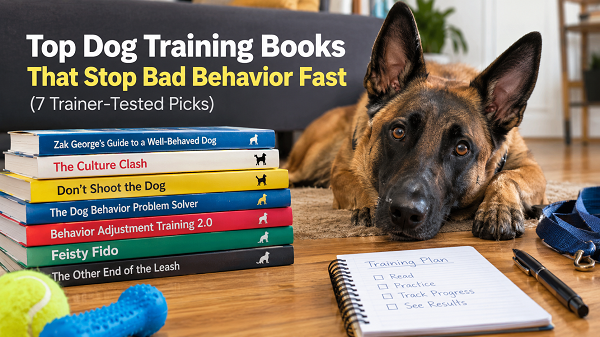
If your dog is barking at everything that moves, shredding your couch cushions, or dragging you down the street on leash, you’re not alone and you don’t necessarily need to hire a trainer to start turning things around. The right book, read the right way, can start changing behavior in as little as 1 to 2 weeks for simple issues like jumping or mouthing, and 6 to 12 weeks for tougher problems like leash reactivity or separation anxiety. Below are the seven dog training books I actually recommend to owners, picked for how fast and how reliably they produce results, plus a realistic week-by-week plan for using them.
Table of Contents
- How I Chose These Books (And Why That Matters)
- How Fast Can a Book Actually Fix Bad Behavior?
- The 7 Best Dog Training Books That Stop Bad Behavior Fast
- My Top 3 Picks to Buy Right Now
- How to Actually Use a Training Book to See Results Fast
- 5 Mistakes That Make Dog Training Books “Not Work”
- When a Book Isn’t Enough: Signs You Need a Professional
- FAQs
- Conclusion
Introduction
Here’s a stat that surprises most dog owners: in a nationwide study of a dozen U.S. shelters, 40% of dogs surrendered were given up because of a behavior problem the owner couldn’t solve. More recent shelter data from Colorado (2018–2023) puts behavior issues at 28% of all surrenders, the single biggest reason, ahead of moving, cost, or having too many pets. And the behaviors driving it are almost always the everyday stuff: barking (reported daily by 41% of surrendering owners in one study), hyperactivity (45%), chewing (24%), and house-training accidents (21%).
In other words, most dogs aren’t given up because they’re “bad dogs.” They’re given up because nobody showed the owner how to fix a fixable problem before it became a breaking point.
That’s where a good training book earns its keep. I’ve spent years handling working and security dogs, and I still keep a small shelf of these books because even professional handlers hit behavior puzzles that a well-written book solves faster than trial and error. In this guide, I’ll walk you through the books I actually recommend (not just the ones ranking on other “best of” lists), what specific problem each one solves, roughly how long it takes to see change, and a simple weekly plan so the book doesn’t just sit on your shelf collecting dust.
How I Chose These Books (And Why That Matters)
A lot of “best dog training books” articles are written by people who’ve never run a training session. I approached this list differently. Every book here had to meet three bars:
- Written or co-written by a credentialed trainer or applied animal behaviorist, someone with CPDT-KA, CAAB, or an equivalent professional certification, or a documented track record training real dogs (not just writing about them).
- Built around positive reinforcement and evidence-based methods, not outdated dominance theory. The science on this shifted decades ago, modern behaviorists have moved away from “alpha rolls” and physical corrections because they tend to increase fear and aggression rather than resolve it.
- Organized so you can find your specific problem fast. A 300-page general obedience manual is not what you want at 11 p.m. when your dog has just eaten another pair of shoes. You want a book with a clear index or chapter for “chewing,” “barking,” “jumping,” and so on.
I cross-checked this list against what’s currently ranking for this topic, sites like Rover, Canine Bible, and The Academy of Pet Careers and one gap kept showing up: almost none of them tell you how long it actually takes to see results, or what a week-by-week reading-and-practice schedule looks like. That’s the part I’ve added here, because a list of book titles without a usage plan is just a shopping list.
How Fast Can a Book Actually Fix Bad Behavior?
Short answer: simple habits (jumping, mouthing, pulling on leash) usually start improving within 1 to 2 weeks of consistent daily practice. More entrenched issues, separation anxiety, reactivity, resource guarding, or aggression, typically take 6 to 12 weeks of structured work, and some cases need professional support alongside the book.
Books don’t train dogs, consistent, correctly timed repetition does. A book’s real job is to teach you the mechanics (timing, reinforcement, body language reading) so your daily 10-to-15-minute sessions actually work instead of accidentally reinforcing the wrong thing. I’ve seen owners “fail” with a perfectly good book simply because they read it cover to cover once and never opened it again during actual training sessions.
The 7 Best Dog Training Books That Stop Bad Behavior Fast
1. Zak George’s Guide to a Well-Behaved Dog — Best Overall
Best for: Owners who want one book that covers most common problems in an easy-to-navigate format.
Written by Zak George, the YouTuber behind the most-watched dog training channel in the world, with co-writer Dina Roth Port. At 224 pages, it’s a problem-based guide, meaning instead of reading straight through, you flip to the chapter matching your issue: chewing, jumping up, barking, play biting, begging, not listening, thunderstorm phobia, separation anxiety, or aggression. Veterinary behaviorist Dr. John Ciribassi has publicly praised its science-based, humane approach.
Why it tops this list over denser academic texts: the writing is genuinely easy to follow, and each chapter ends with a clear action plan rather than just theory. Most owners report noticing a shift in day-to-day cooperation within the first 10 to 14 days of applying a single chapter consistently.
- Length: 224 pages | Published: July 2019 | Format: Paperback, ebook, audiobook (narrated by Zak George)
- Price range: roughly $12–$18 for the paperback
2. The Culture Clash by Jean Donaldson — Best for Understanding Why Dogs Misbehave
Best for: Owners who keep fixing one symptom only to have a new one pop up.
Jean Donaldson founded The Academy for Dog Trainers in San Francisco, one of the most respected trainer-education programs in North America, and this book is considered required reading there. Instead of a quick-fix list, it explains the mismatch between what dogs naturally do (bark, dig, chew, sniff, guard resources) and what we expect from them, which is exactly why so many “obedience” fixes don’t stick long-term.
This isn’t the book to grab if your dog is mid-meltdown right now. It’s the book that stops you from getting a new behavior problem every six months because you finally understand dog psychology instead of just patching symptoms.
- Length: ~256 pages (2nd edition) | Best for: intermediate owners ready to go beyond quick fixes
3. Don’t Shoot the Dog by Karen Pryor — Best for Learning Positive Reinforcement Properly
Best for: Owners who’ve tried treats and praise but aren’t seeing consistent results.
Karen Pryor was a marine mammal trainer at Hawaii’s Sea Life Park before she became the person most credited with bringing clicker training into mainstream dog training. First published over 40 years ago and still in print, this book explains the actual mechanics of operant conditioning, timing, shaping, and the “10 laws of shaping behavior”, in plain English.
Here’s the problem it solves that most owners don’t realize they have: giving a treat after the good behavior happened is not the same as reinforcing it correctly. Bad timing is the single most common reason positive reinforcement training “doesn’t work” for people, and this book fixes that specific gap.
- Length: ~208 pages (2019 Simon & Schuster reprint) | ISBN: 978-1982106461
- Price range: roughly $14–$20
4. The Dog Behavior Problem Solver by Teoti Anderson — Best for Troubleshooting Multiple Issues Fast
Best for: Owners dealing with two or three problems at once and needing a lookup-style reference.
Teoti Anderson, CPDT-KA, is a past president of the Association of Professional Dog Trainers (APDT). This revised edition (256 pages) is organized almost like a symptom checker, barking, chewing, digging, jumping, resource guarding, and general anxiety each get their own diagnostic section with step-by-step correction plans.
I recommend this one specifically to owners juggling multiple small issues at once, because it saves you from buying five separate specialist books.
- Length: 256 pages | Format: Paperback
5. Behavior Adjustment Training 2.0 by Grisha Stewart — Best for Reactive or Aggressive Dogs
Best for: Dogs that lunge, growl, snap, or bark aggressively at other dogs or strangers.
Grisha Stewart developed the BAT (Behavior Adjustment Training) method and founded Growl University, a training program specifically for reactive and aggressive dogs. This book is more advanced and more clinical than the others on this list, but it’s the one professional trainers reach for when basic obedience books haven’t touched the aggression.
Fair warning: this is not a weekend fix. Reactivity and aggression cases realistically take 8 to 16 weeks of structured, gradual exposure work even with excellent technique, and severe cases should be worked alongside a Certified Dog Behavior Consultant (IAABC-CDBC) or a veterinary behaviorist, not from a book alone.
- Best for: intermediate-to-advanced owners and trainers | Not recommended as a first book for a brand-new puppy owner
6. Feisty Fido: Help for the Leash-Reactive Dog by Patricia McConnell — Best Fast, Focused Read
Best for: Owners who need one specific problem solved this week and don’t have time for a 250-page book.
At just 59–63 pages, this is the fastest read on the list, most owners finish it in a single evening. Patricia McConnell, Ph.D., CAAB, is one of the most respected applied animal behaviorists in the field, and this booklet focuses on exactly one problem: dogs that bark and lunge at other dogs on leash. It’s short by design, so you can read it once and start practicing the same day.
- Length: ~59 pages (2nd edition, with Karen London) | Price range: roughly $8–$11
7. The Other End of the Leash by Patricia McConnell — Best for Fixing the Human Side of the Problem
Best for: Owners who suspect they might be accidentally confusing their dog.
This one’s different from the rest: it’s not primarily about training exercises. It’s about how dogs read human body language, tone, and timing and how much of what we call “bad behavior” is actually a dog responding logically to mixed signals we don’t realize we’re sending. McConnell, a veterinary behaviorist and longtime radio host of Calling All Pets, draws on her academic background in animal behavior to make this genuinely eye-opening rather than preachy.
I recommend this as a companion read alongside any of the books above, it explains the “why” behind training hiccups that technique-focused books can’t.
- Length: ~288 pages (revised edition)
My Top 3 Picks to Buy Right Now
If you only buy one or two books from this list, here’s exactly where I’d start.
1. Zak George’s Guide to a Well-Behaved Dog — the best all-around starting point for 90% of owners, because it covers the most common problems in one place and won’t overwhelm a beginner. 👉 Check current price on Amazon
2. Don’t Shoot the Dog by Karen Pryor — pair this with any problem-specific book above. It fixes your technique, which multiplies the effectiveness of everything else you’re reading. 👉 Check current price on Amazon
3. Feisty Fido by Patricia McConnell — if leash reactivity is your specific, urgent problem, this is the fastest path from “book on shelf” to “actually training tonight.” 👉 Check current price on Amazon
As an Amazon Associate, we may earn a small commission from qualifying purchases made through these links, at no extra cost to you.
How to Actually Use a Training Book to See Results Fast
This is the part most “best books” lists skip entirely, and it’s the difference between a book that sits on a shelf and one that actually stops the behavior.
Week 1–2: Diagnose and Set Up
Read only the chapter that matches your specific problem, skip the rest for now. Identify the exact trigger (is your dog barking at the doorbell specifically, or at any noise?) and start one short session per day, 5 to 10 minutes, at a consistent time. Track what you notice in a simple notes app: what happened right before the behavior, and what you did right after.
Week 3–4: Build Repetition
This is where most of the actual change happens. Keep sessions short but increase frequency to two short sessions daily if you can manage it. Most owners see a noticeable drop in frequency or intensity of the unwanted behavior by day 21 to 28 for common issues like jumping, mild barking, or leash pulling, assuming timing and consistency are on point.
Week 6–12: Generalize and Maintain
A dog that “sits” perfectly in your kitchen but ignores you at the park hasn’t actually learned the behavior, it’s learned it only in one context. This stage is about practicing in new locations, with new distractions, gradually. For reactivity or aggression specifically, this is usually where the real work happens, and it’s normal for progress to be slower and less linear here.
A Quick Reality Check on Timelines
- Jumping, mouthing, basic leash pulling: 1–3 weeks with daily practice
- Barking (attention-seeking or boredom-based): 2–4 weeks
- House-training regressions in adult dogs: 2–6 weeks
- Separation anxiety (mild to moderate): 6–12 weeks, sometimes longer
- Leash reactivity: 6–12 weeks minimum
- Aggression (any type): highly variable; often 3+ months, frequently requires professional support alongside the book
5 Mistakes That Make Dog Training Books “Not Work”
- Reading the whole book before doing anything. You’ll retain more and see faster results by reading one chapter and immediately practicing it than by reading cover-to-cover first.
- Inconsistent timing. Reinforcing (or correcting) a behavior even 2–3 seconds too late teaches the dog the wrong lesson entirely. This is the single biggest gap Karen Pryor’s book addresses.
- Practicing only in one location. As mentioned above, dogs don’t generalize automatically, a behavior “learned” only at home often falls apart anywhere else.
- Mixing methods from multiple books that contradict each other. Pick one method, run it consistently for 2–3 weeks, then adjust, don’t switch strategies every few days.
- Expecting a book to handle a safety issue. If your dog has bitten someone, guards food or objects aggressively, or shows sudden unexplained aggression, that’s a signal to bring in a professional immediately, not a reason to keep reading.
When a Book Isn’t Enough: Signs You Need a Professional
Books are genuinely powerful for the everyday stuff, barking, chewing, jumping, mild leash pulling, basic obedience. But there’s a point where reading needs to hand off to hands-on professional help. Bring in a certified trainer or behaviorist if:
- Your dog has bitten or snapped at a person or another animal
- The behavior is getting worse despite 3–4 weeks of consistent, correct practice
- You see sudden, unexplained aggression or fear (this can sometimes have a medical root)
- Resource guarding is escalating rather than easing
- You genuinely feel unsafe managing the dog day to day
If you’re at that point, our guide on how to choose the right dog behavior therapist walks you through exactly what credentials to look for and the questions to ask before you book a session.
It’s also worth understanding the difference between genuine misbehavior and simple miscommunication before you escalate, our piece on dominance vs. discipline in dog training breaks down a distinction that even experienced owners get wrong, and it pairs well with anything you’ll read in The Culture Clash. If your dog is highly driven or working-line (Malinois, GSD, Dutch Shepherd), our article on balancing obedience and instinct is worth reading alongside any book on this list, since high-drive breeds often get mislabeled as “badly behaved” when they’re actually under-stimulated.
FAQs
What is the best dog training book to stop bad behavior fast?
For most owners, Zak George’s Guide to a Well-Behaved Dog is the fastest practical starting point because it’s organized by specific problem (barking, chewing, jumping, and so on) rather than as a straight-through read, so you can act on it the same day you buy it.
Can a dog training book really work as well as hiring a trainer?
For common, non-safety issues like jumping, mild barking, leash pulling, and basic obedience, yes, a good book paired with daily consistent practice can get you most of the way there. For aggression, severe anxiety, or resource guarding, a book is a useful supplement but shouldn’t replace professional, in-person guidance.
How long does it take to fix bad behavior in a dog using a book?
Simple habits like jumping or mouthing often start improving within 1 to 3 weeks of daily practice. More complex issues like separation anxiety or leash reactivity typically take 6 to 12 weeks of consistent work, and severe aggression cases can take several months, often alongside professional support.
Are older dog training books like “Don’t Shoot the Dog” still relevant today?
Yes. While published decades ago, the core science of operant conditioning and positive reinforcement hasn’t changed, it’s still the foundation modern certified trainers use. What has changed is our understanding of dominance theory, which most of these updated books have already moved away from.
Do dog training books work for puppies and adult dogs equally well?
Most of the books on this list work for both, though a few (like Zak George’s Guide) specifically note they’re designed to help “old dogs” too, meaning established adult habits, not just puppy behaviors. The core principles of timing and reinforcement apply at any age; adult dogs with long-standing habits may just take a bit longer to see full results.
Conclusion
The right book won’t magically fix your dog overnight, but it will save you months of guessing and, based on the shelter data above, it might genuinely be the thing that keeps your dog in your home instead of becoming a statistic. Start with one book that matches your dog’s specific problem rather than trying to read everything at once, commit to short daily sessions instead of marathon weekend efforts, and track what’s working so you can adjust early instead of three months in.
If you want a next step beyond books, our downloadable guide, Beyond the Bark, expands on a lot of the real-world troubleshooting we cover with clients at ARFS K9 Team.
And if you’d like more breakdowns like this delivered straight to your inbox, new gear reviews, training guides, and behavior deep-dives, subscribe to our free weekly newsletter. We don’t spam, and you can unsubscribe any time.

Her work centres on obedience, detection, protection and operational readiness. She favours proven methods built on repetition, consistency and real-world conditioning, so that both dogs and handlers are prepared for high-pressure tasks.
Rofiat represented the Nigerian Army Dog Centre at the Nigerian Army Day Celebration (NADCEL) 2026, where she led demonstrations in obedience, explosive detection, agility and tactical movement. Through articles, training content and documentaries, she shares field-based insight into how structured training, clear communication and trust between handler and dog affect performance and reliability.
She is the author of Beyond the Bark: Inside a Pro Handler's Playbook for Raising the Ideal Dog, a practical guide that helps dog owners and handlers apply professional training principles in everyday situations.
- K9 Advantix Dosage Chart & Safety Guide for Dogs - October 19, 2026
- How to Set Up & Use Bousnic Dog Training Collar - October 18, 2026
- Westminster Dog Show 2026: Winners & Full Results - October 17, 2026