German Shepherd vs Belgian Malinois: Which Breed Is Right For You
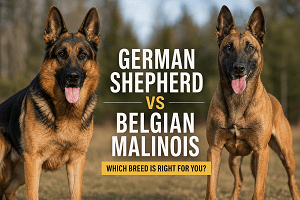
A German Shepherd is the better choice for most people. It’s steadier, settles faster after work, and forgives handler mistakes. A Belgian Malinois is the better choice only if you’re an experienced handler who can give it 2+ hours of structured exercise and training every single day. Both are elite working dogs. They are not interchangeable, and picking the wrong one is the most expensive mistake in this hobby.
At a glance
| Factor | German Shepherd | Belgian Malinois |
|---|---|---|
| Best for | First-time working-dog owners, families, mixed-use roles | Experienced handlers, sport, tactical work |
| Temperament | Steady, loyal, confident | Intense, driven, sensitive |
| Weight (male) | 65–90 lb (30–41 kg) | 60–80 lb (27–36 kg) |
| Daily exercise (minimum) | 60–90 min | 90–120+ min |
| Forgives mistakes? | Mostly yes | Rarely |
| Typical lifespan | 9–13 years | 12–14 years |
| Hip dysplasia risk | Higher | Lower |
| 2025 AKC popularity rank | #4 | #32 |
Table of Contents
- Introduction
- Where Each Breed Comes From
- Size and Looks: How to Tell Them Apart
- Temperament: The Real Difference
- Energy and Exercise
- Training and Intelligence
- Working Roles: Police, Military and Protection
- Family Life: Kids, Pets, Apartments and Climate
- The Part Most Guides Skip: Working Line vs Show Line
- Health and Lifespan
- What They Really Cost
- The Malinois Boom: Why Shelters Are Filling Up
- Which Breed Is Right for You? A Decision Guide
- 5 Mistakes I See Again and Again
- If Neither Feels Right: Other Options
- Why You Can Trust This Guide
- FAQs
- Conclusion
Introduction
Ever seen a German Shepherd and a Belgian Malinois side by side and thought, “They look almost the same”? You’re not alone. From across a field, even experienced people take a second look. Up close, though, these two dogs live in completely different worlds.
The German Shepherd vs Belgian Malinois debate comes up in almost every conversation I have with new handlers. And here’s the problem: most people choose with their eyes. They’ve seen a Malinois jump out of a helicopter in a film, or a German Shepherd guarding a police van, and they decide from there. Then the dog arrives, and real life starts.
This guide helps you skip that mistake. You’ll learn how the two breeds differ in temperament, energy, training, health, family fit and real cost. You’ll see what the data says, including hip scores, breed rankings and the shelter surge that’s hitting Malinois right now. You’ll also get a simple self-test to find out which dog actually fits your life.
If you’re new to this world, it helps to understand what defines a working dog first. These breeds aren’t pets with extra energy. They’re tools built for a job, and they behave that way at home too.
Where Each Breed Comes From
Both breeds started as herding dogs in the late 1800s. That shared history explains the look, the intelligence and the need for a job.
German Shepherd. Captain Max von Stephanitz set out in Germany to build the perfect all-purpose herding dog. He founded the breed around 1899 and pushed breeders to prove their dogs through work, not just looks. That idea led to Schutzhund, now called IGP, the sport that tests tracking, obedience and protection. Industrial Germany had fewer sheep to herd, so the breed moved quickly into police and military work.
Belgian Malinois. The Malinois is one of four Belgian Shepherd varieties. It takes its name from the city of Malines, near Brussels. Breeders there favored sharp reactions, speed and stamina. As farm life faded, police forces took notice. The American Kennel Club recognized the Malinois as its own breed in 1959.
The short version? The German Shepherd was shaped to be versatile. The Malinois was shaped to be fast and relentless.
Size and Looks: How to Tell Them Apart
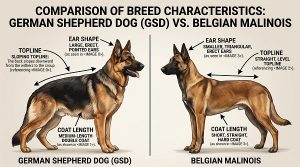
Height is almost identical. Build is where you see the gap.
| Measurement | German Shepherd | Belgian Malinois |
|---|---|---|
| Height, male | 24–26 in (61–66 cm) | 24–26 in (61–66 cm) |
| Height, female | 22–24 in (56–61 cm) | 22–24 in (56–61 cm) |
| Weight, male | 65–90 lb (30–41 kg) | 60–80 lb (27–36 kg) |
| Weight, female | 50–70 lb (23–32 kg) | 40–60 lb (18–27 kg) |
| Body shape | Longer than tall, sloping topline | Square and compact, straighter topline |
| Coat | Medium double coat | Short, weather-resistant coat |
| Ears | Large, pointed | Smaller, more triangular |
Quick field tips for spotting them:
- A Malinois looks lean and “squared off,” like a sprinter. A German Shepherd looks heavier through the chest and bone.
- Most Malinois are fawn with a black mask. Most German Shepherds are black and tan, sable or solid black.
- The German Shepherd’s back slopes toward the rear, especially in show lines. The Malinois stands level.
Temperament: The Real Difference
Size doesn’t decide this choice. Temperament does.
The German Shepherd: steady and settled
A good German Shepherd has a calm confidence. It watches, thinks, then acts. Most bond with the whole family, not just one person. After a hard training session, a well-bred GSD usually lies down and switches off.
That “off switch” is the biggest quality-of-life difference between the breeds.
The Belgian Malinois: intense and sensitive
A Malinois never fully relaxes. After the same two-hour session, I’ve seen Malinois still scanning the yard for the next job. They tend to bond very closely with one handler. They often show stronger prey drive too, which means chasing bikes, cats, joggers and even leaves in the wind. Many are also reactive toward other dogs without early, careful socialization.
They’re sensitive as well. A Malinois reads your body language and your mood. Inconsistent rules or a stressful home can turn that sensitivity into anxiety and frustration.
So here’s the thing: the Malinois isn’t “more aggressive.” It’s more intense, faster to react and less forgiving. Aggression problems usually come from poor training and poor socialization, in either breed.
| Trait | German Shepherd | Belgian Malinois |
|---|---|---|
| Off switch | Good | Weak without training |
| Bonding | Whole family | Often one person |
| Prey drive | Moderate to high | High to very high |
| Sensitivity to stress | Moderate | High |
| Reactivity to other dogs | Moderate | Higher |
Energy and Exercise
Both breeds need real work. But the gap is bigger than most guides admit.
- German Shepherd: plan on 60–90 minutes of exercise daily, plus short training sessions. It can handle a skipped day without falling apart.
- Belgian Malinois: plan on 90–120 minutes at minimum, often more, split between hard physical work and thinking work. A walk around the block does nothing for this dog.
A tired Malinois is a good Malinois. An under-worked one starts eating drywall, spinning, barking at shadows or herding your kids.
Good outlets for both include running, hiking, tracking games, scent work, obedience, bite sports, agility and structured fetch. Add short “thinking” sessions, such as search games or learning new tricks, because mental work tires these dogs faster than physical work alone.
Want the full breakdown? Read our guide on how often to exercise a working dog.
Training and Intelligence
Both breeds sit near the top for working intelligence. (We compared them in depth in our German Shepherd vs Belgian Malinois intelligence comparison.) The difference is how they learn.
The German Shepherd learns at a steady pace and handles small handler errors well. If you mistime a reward or skip a day, you usually lose little ground.
The Malinois learns very fast, and that cuts both ways. A Malinois picks up bad habits just as quickly as good ones. If you accidentally reward barking at the door three times, you’ve trained it. Timing, clarity and consistency matter far more here.
Rough timelines from my experience. These are estimates, not rules. Genetics, age and the handler’s skill change everything.
| Stage | German Shepherd | Belgian Malinois |
|---|---|---|
| Reliable basic obedience | 3–5 months | 2–4 months |
| Solid off-leash and distraction work | 8–12 months | 6–10 months |
| Working-ready (sport or security) | 12–24 months | 12–20 months |
For comparison, US military working dogs usually arrive as carefully selected young adults and then spend roughly six months in basic training at Lackland Air Force Base in Texas before they’re ready to deploy. Selection does half the job.
Training tips that work for both breeds:
- Start socialization at 8 weeks. Expose the puppy to people, surfaces, sounds and vehicles in safe, calm doses.
- Teach an “off switch” early. Reward your dog for lying quietly on a mat. Do it daily.
- Use reward-based training with clear markers and fair corrections. Skip harsh methods. They backfire on sensitive dogs, especially Malinois.
- Build impulse control first: wait at doors, wait for food, wait for the release word.
- Keep sessions short and sharp: 5–10 minutes, several times a day.
If you want a full handler’s system for this, my ebook, Beyond the Bark: Inside a Pro Handler’s Playbook for Raising the Ideal Dog, walks through the same principles I use with working dogs, written for everyday owners.
Working Roles: Police, Military and Protection
Both breeds do serious work around the world. They just get picked for different jobs.
Where the Malinois leads: special operations, tactical teams and any job built on speed and agility. Their lighter frames suit parachute jumps and rappelling. The most famous example is Cairo, a Belgian Malinois who flew with SEAL Team Six on the 2011 raid in Abbottabad. Only a small share of Malinois ever make it to that level. For most dogs, the bar is brutal.
Where the German Shepherd leads: patrol, search and rescue, guide and service work, detection and any role that needs steady nerves around crowds. Handlers also like how a GSD can switch from public contact to calm waiting in a vehicle.
Don’t think it’s an either/or story at an organizational level. The US military’s working dog program, for example, uses German Shepherds, Belgian Malinois and Dutch Shepherds. Police departments across the US, UK and Europe run mixed kennels, and they choose per task. Curious how dogs are chosen and trained for this work? See how military working dogs are trained.
| Role | Best fit |
|---|---|
| Special operations and tactical entry | Malinois |
| Patrol with public contact | German Shepherd |
| Search and rescue | German Shepherd (Malinois also strong) |
| Detection (drugs, explosives) | Both, depending on the dog’s drive |
| Bite sports (IGP, PSA, Mondioring) | Both. Malinois dominate speed-based sports |
| Guide and service work | German Shepherd |
| Personal protection at home | German Shepherd for most families |
Family Life: Kids, Pets, Apartments and Climate
This is where people get hurt, and where dogs get surrendered.
Children. A well-bred, well-socialized German Shepherd usually does well with kids and shows protective patience. A Malinois can be wonderful with a calm, experienced family, but it moves fast, mouths things and may herd running children by nipping. Always supervise both breeds around young kids.
Other pets. Early socialization helps either breed. Malinois with high prey drive often don’t mix well with cats, small dogs or rabbits unless they grow up with them.
Apartments. Neither breed loves small spaces. A GSD with a serious daily routine can make it work. A Malinois in an apartment is a hard sell unless you’re out exercising it for hours.
Hot climates. This matters if you live somewhere warm, like much of Africa, the Middle East or the southern US. The Malinois’ short coat is easier in heat, and it sheds less. Still, exercise either breed early morning and late evening and always provide shade and water.
Being home alone. Both breeds suffer when left alone for long stretches. If you work 9–10 hours away from home with no dog walker or daycare, neither breed is a good match.
The Part Most Guides Skip: Working Line vs Show Line
Here’s a truth almost every comparison article misses: “German Shepherd” isn’t one type of dog.
A show-line German Shepherd and a working-line German Shepherd can behave like different breeds. Breeders have split the breed into two broad camps, and the gap is wide.
| Type | What breeders select for | Typical behavior |
|---|---|---|
| Show line (including many American and West German show lines) | Looks, movement, coat | Calmer, more social, lower drive |
| Working line (including West German working, DDR and Czech lines) | Drive, nerve, trainability | High energy, intense focus, needs a job |
The working-line German Shepherd lives much closer to a Malinois than to a show-line GSD. Some Czech and DDR lines are every bit as intense as a Malinois, and some are tougher to handle.
Malinois have lines too. Sport and police lines carry sharp drive. Some pet-oriented breeders produce slightly softer dogs, but even those are not couch potatoes.
What this means for you:
- If you want a family guardian with an easy off switch, look at a show-line or moderate working-line German Shepherd from a breeder who tests temperament.
- If you want a sport or security dog, a working-line GSD or a Malinois both fit. Your experience level decides.
- Never judge a puppy by the breed name alone. Ask to meet the parents. Watch how they behave when the doorbell rings.
Health and Lifespan
Both are generally healthy when bred responsibly. The patterns differ, though.
German Shepherd health
- Hip and elbow dysplasia. Historical OFA figures put hip dysplasia at roughly 19% in German Shepherds.
- Bloat (gastric dilatation-volvulus). Deep-chested dogs are at risk. It’s an emergency. Feed smaller meals, avoid hard exercise right after eating, and learn the warning signs: a swollen belly, unproductive retching and restlessness.
- Degenerative myelopathy. A spinal condition seen in older GSDs. DNA tests exist for the gene.
- Digestive sensitivity. Common. Stick to steady, high-quality food.
Belgian Malinois health
- Hips. A large published breed-prevalence study in PLOS ONE (2017) listed the Malinois among the breeds with the lowest hip dysplasia rates, at about 5.2%. Different studies use different methods, so treat the gap between breeds as a pattern, not an exact number.
- Overuse injuries. Malinois don’t know when to quit. Cruciate tears, sprains and stress injuries happen when owners let the dog go flat out on hard ground.
- Heat and stress management. High-drive dogs push through discomfort. You have to watch for them.
| Factor | German Shepherd | Belgian Malinois |
|---|---|---|
| Typical lifespan | 9–13 years | 12–14 years (some sources say up to 16) |
| Hip dysplasia | Higher risk (about 19% historically) | Lower risk (about 5% in one large study) |
| Main concerns | Hips, elbows, bloat, DM | Overuse injuries, stress |
| Health testing to ask for | Hips, elbows, DM | Hips, elbows |
Ask any breeder for: OFA, PennHIP or equivalent hip and elbow results for both parents, plus a written health guarantee. If a breeder shrugs at this, walk away.
What They Really Cost
Prices swing a lot by country, bloodline and breeder. These are typical ranges in the US, UK and Europe. Treat them as planning numbers, not quotes.
| Cost | German Shepherd | Belgian Malinois |
|---|---|---|
| Pet-quality puppy from a health-tested breeder | $1,200–$3,500 | $1,200–$3,500 |
| Puppy from proven working or sport parents | $2,500–$5,000+ | $2,500–$5,000+ |
| Professionally trained protection or security dog | $25,000–$80,000+ | $30,000–$90,000+ |
| Private training (group classes to board-and-train) | $200–$10,000+ | $300–$12,000+ |
| Yearly food, vet, insurance, gear | $2,000–$3,500 | $2,000–$3,500 |
The hidden costs nobody mentions:
- Fencing. Malinois jump and dig. Plan for a secure 6 ft (1.8 m) fence.
- Chewed furniture and car interiors. Budget for it with a young Malinois.
- Behavior help. If training goes wrong, correction work can cost thousands. Start right and you avoid it.
- Time. The biggest cost of all. Two hours a day over 12 years is more than 8,000 hours.
The Malinois Boom: Why Shelters Are Filling Up
This is the part of the story I wish more buyers knew.
Malinois are surging in popularity. In the 2025 American Kennel Club rankings, the German Shepherd sits at #4 while the Malinois sits at #32, and the Malinois keeps climbing. In Spain, registrations jumped about 35% in four years, according to a September 2026 report, and welfare groups there warn of rising surrenders. Shelter-sector research cited in the same report found a 15% rise in abandonment among so-called trendy breeds, the Malinois among them.
It’s not just Europe. In May 2025, rescuers from Animal Care Centers of NYC and the ASPCA pulled dozens of Malinois from a single Queens apartment. Many of the dogs had never been outside. The American Belgian Malinois Club also warned years ago, after the film Max, that most viewers weren’t equipped for a dog with this much intensity.
What’s the lesson? Film Malinois are the result of years of selection and training. The one in your living room is a dog, with all that drive and no script.
If you love the breed but doubt your experience, consider adopting an adult Malinois through a breed rescue. Adults come with known temperaments, and rescues will match you honestly.
Which Breed Is Right for You? A Decision Guide
Answer these eight questions honestly. Give yourself 1 point for each “yes.”
- Have you trained a high-drive working dog before?
- Can you give 2+ hours of exercise and training daily, every day, including bad-weather days?
- Do you have a secure 6 ft fence and a quiet, structured home?
- Do you have kids under 10 or lots of daily chaos in the house?
- Do you want a dog that relaxes indoors on its own?
- Do you have cats, small pets or another dog that’s new or unfamiliar?
- Do you plan to compete in bite sports or do detection or protection work?
- Can you afford a good trainer and possible vet bills for injuries?
How to read it. Questions 1, 2, 3, 7 and 8 favor a Malinois when you answer yes. Questions 4, 5 and 6 favor a German Shepherd when you answer yes. If you said yes to 4, 5 or 6 and no to 1 or 2, choose a German Shepherd. Then pick the line (show or working) based on how much drive you can handle.
Choose a German Shepherd if…
- This is your first working breed.
- You want a family guardian that settles in the evening.
- You need a dog that handles public places and new situations calmly.
- Your schedule sometimes slips.
Choose a Belgian Malinois if…
- You’re an experienced handler or you’re working with a professional trainer.
- You want a dog for sport, detection or tactical work.
- You can give daily structure, and you enjoy the process.
- You have a calm home with no small kids or small pets to worry about.
5 Mistakes I See Again and Again
- Buying for looks. The movie dog isn’t your dog.
- Skipping early socialization. Weeks 8–16 matter hugely. A fearful, under-socialized Malinois or German Shepherd becomes a problem dog fast.
- Confusing exercise with training. A tired dog without rules is still an untrained dog.
- Rewarding the wrong behavior by accident. Fast learners learn everything you do, including your mistakes.
- Choosing the breeder by price or by availability. Cheap puppies from unhealthy parents cost more later.
If Neither Feels Right: Other Options
- Dutch Shepherd. Similar drive to the Malinois, often slightly calmer. Used in military programs too.
- Belgian Tervuren or Groenendael. Belgian cousins with a longer coat and a somewhat softer edge.
- Moderate-line German Shepherd. Many of the best family guardians come from this middle ground.
- Adult rescue of either breed. A dog with a known personality removes most of the guesswork.
Why You Can Trust This Guide
I’m Cpl. Rofiat Muritala, a Nigerian Army military working dog instructor and handler with more than 14 years at the Nigerian Army Dog Centre. My background covers dog selection, foundation training, behavior shaping and performance evaluation. I’ve completed advanced obedience, K9 patrol and advanced explosive detection courses. In 2026 I led obedience, detection, agility and tactical movement demonstrations at the Nigerian Army Day Celebration (NADCEL).
This guide combines that field experience with published data: AKC 2025 popularity rankings, OFA hip dysplasia figures, a PLOS ONE breed-prevalence study, reporting from ACC/ASPCA and Euro Weekly News, and military working dog program information from Texas Monthly. Prices and timelines are estimates and will vary by country and provider. Always check with a licensed vet and a qualified trainer before major decisions.
Sources: AKC Most Popular Breeds 2025 · PLOS ONE hip and elbow dysplasia prevalence table · Euro Weekly News on Spain’s Malinois trend · Texas Monthly: Dogs of War
FAQs
1. Which is better, a German Shepherd or a Belgian Malinois?
Neither wins every time. A German Shepherd is better for most families and first-time working-dog owners because it’s steadier and more forgiving. A Belgian Malinois is better for experienced handlers who want speed, drive and sport or tactical performance.
2. Is a Belgian Malinois good for first-time owners?
Usually not. Malinois need daily structure, precise timing and a lot of exercise. First-timers who want the breed should work with a professional trainer from day one or consider adopting an adult from a breed rescue.
3. Which is better for family protection?
For most homes, a well-bred German Shepherd. It protects with more control and settles easily around children. A Malinois can protect well, but it demands a calm, highly managed home and an experienced handler.
4. Do police and military prefer Malinois?
Many elite units do, because of the Malinois’ speed and agility. But police and military programs still rely heavily on German Shepherds too, and many also use Dutch Shepherds. They choose by task, not by trend.
5. Which breed lives longer and stays healthier?
Malinois typically live a bit longer (12–14 years, sometimes more) and show lower hip dysplasia rates. German Shepherds average 9–13 years and face higher risks for hip dysplasia and bloat. Health-tested parents matter more than breed alone.
Conclusion
The German Shepherd vs Belgian Malinois decision isn’t about which dog is tougher. It’s about which dog fits your skills, your schedule and your home.
Remember the key points:
- German Shepherds are steadier, more forgiving and better for most families.
- Malinois are faster, more intense and best with experienced handlers.
- A working-line German Shepherd can be as demanding as a Malinois, so check the line.
- Malinois often have lower hip dysplasia rates, and German Shepherds need more careful health screening.
- The Malinois boom is real. Don’t become a shelter statistic.
Your next steps:
- Take the eight-question self-test above.
- Visit breeders and rescues. Meet adult dogs, not just puppies.
- Ask for health test results and watch the parents in action.
- Book a trainer before the puppy comes home.
Want more guides like this? Join our weekly articles roundup: subscribe to the ARFS K9 Team newsletter.
Need one-on-one help choosing or training your dog? Contact ARFS K9 Team for consultations and training services.

Her work centres on obedience, detection, protection and operational readiness. She favours proven methods built on repetition, consistency and real-world conditioning, so that both dogs and handlers are prepared for high-pressure tasks.
Rofiat represented the Nigerian Army Dog Centre at the Nigerian Army Day Celebration (NADCEL) 2026, where she led demonstrations in obedience, explosive detection, agility and tactical movement. Through articles, training content and documentaries, she shares field-based insight into how structured training, clear communication and trust between handler and dog affect performance and reliability.
She is the author of Beyond the Bark: Inside a Pro Handler's Playbook for Raising the Ideal Dog, a practical guide that helps dog owners and handlers apply professional training principles in everyday situations.
- Westminster Dog Show 2026: Winners & Full Results - October 17, 2026
- 10 K9-Approved Tricks to Teach Your Dog (Step-by-Step) - October 16, 2026
- COBA National Dog Championship 2026: Full Guide - October 15, 2026