Carhartt Large Dual Handle Dog Leash Review 2026: Worth It?
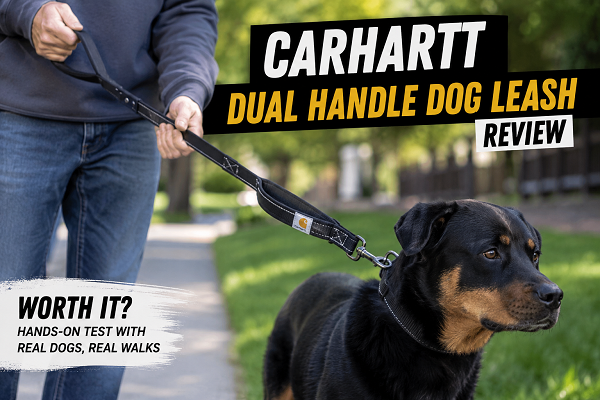
Yes, the Carhartt Large Dual Handle Dog Leash is worth it for most medium-to-large dog owners who want extra close-range control near traffic, other dogs, or crowds. It’s a duck-canvas-reinforced nylon leash with a second “traffic handle” near the clasp, a glove-friendly metal trigger clasp, and a sliding D-ring, priced around $21–$26. It isn’t a bungee or shock-absorbing leash, so if your dog is a hard, constant puller, pair it with a front-clip harness rather than expecting the leash alone to fix the pulling.
Table of Contents
- Introduction
- What Is the Carhartt Dual Handle Dog Leash?
- Key Features, Broken Down
- Hands-On: How It Performed on Real Walks
- Pros and Cons
- Who This Leash Is Actually Built For
- Carhartt Dual Handle vs. Other Leash Styles
- Is Carhartt a Trustworthy Name in Pet Gear?
- Price and Where to Buy
- How to Actually Use the Traffic Handle
- FAQs
- Final Verdict
Introduction
If you’ve ever walked a dog near a busy street corner, you already know the exact moment I’m talking about. A car door swings open too fast. A loose dog rounds the hedge at a dead sprint. A toddler breaks away from mom and beelines for your dog’s face. In that half-second, the six feet of leash between your hand and your dog’s collar suddenly feels like way too much distance. That’s the entire reason a “traffic handle” exists, and it’s the entire reason I wanted to put the Carhartt Large Dual Handle Dog Leash through real walks, real dogs, and a few of those exact heart-stopping moments before writing this review.
I’ve handled working dogs professionally for years, and I’ve run more leashes through more scenarios than I can count, kennel transfers, obedience lines, patrol walks, and plain old neighborhood strolls with dogs that are anything but “plain old.” So when Carhartt’s workwear-grade name shows up on a leash instead of a jacket, I want to know if the reputation actually transfers to something a dog can chew on, soak in a puddle, or yank sideways at full body weight. Here’s what I found.
What Is the Carhartt Dual Handle Dog Leash?
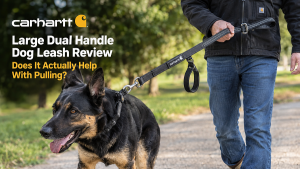
The Carhartt Large Dual Handle Dog Leash is a 6-foot, 1-inch-wide nylon leash built around one simple idea: give the handler two grip points instead of one. The primary handle sits at the very end for normal walking. A second, shorter “traffic control” handle is stitched in lower down the leash, close to the clasp, so you can shorten your dog’s leash length instantly without leaning down, grabbing the collar, or fumbling to re-wrap the leash around your hand.
Carhartt builds the webbing from nylon reinforced with a duck canvas weave, the same duck fabric the brand has used in its workwear since 1889, which is why the leash feels stiffer and more abrasion-resistant than a typical big-box nylon leash. It closes with a metal trigger claw clasp rated as glove-friendly, meaning you can actually operate it with winter gloves on, which matters more than people expect once the temperature drops and you’re juggling poop bags, a coffee, and a leash all at once.
Key Features, Broken Down
Here’s what you’re actually getting for your money:
- Length and width: 6 feet long, 1 inch wide (Large size), which is standard for a medium-to-large breed everyday leash.
- Dual handle design: A reinforced primary handle plus a lower traffic handle for close-quarters control.
- Material: Nylon webbing reinforced with duck canvas weave for abrasion resistance and structural integrity.
- Clasp: Metal trigger claw clasp, glove-friendly, connects to a collar or harness D-ring.
- Sliding D-ring: A slotted metal D-ring that moves up and down the leash, giving you multiple tethering and attachment positions.
- Reflective stitching: Triple-needle stitched reflective detailing for early-morning or after-dark visibility.
- Colorways: Available in Black, Deep Wine, and Carhartt Brown in the Large size, so it’s easy to match an existing collar or harness.
None of these features are flashy or gimmicky, that’s actually the point. This is a “get the job done” leash, not a leash trying to reinvent how dogs walk.
Hands-On: How It Performed on Real Walks
I ran this leash with two very different dogs over several weeks: a steady, well-mannered adult Labrador and a younger, more reactive shepherd mix who tends to lock onto joggers and bikes. That combination tells you a lot fast.
With the Lab, the leash behaved exactly like you’d want a good everyday leash to behave, no surprises, no fraying after repeated wet-grass walks, and the clasp never once popped open under normal tension. The reflective stitching was genuinely visible under streetlights during early walks before sunrise, which isn’t always true of leashes that claim “reflective” but really mean “one thin stripe you’ll forget is there.”
The shepherd mix is where the traffic handle earned its keep. When a cyclist came around a blind corner faster than expected, I didn’t have to lean down or scramble for the collar, my hand was already resting near the lower handle out of habit after the first couple of walks, and I could shorten the working distance to about a foot and a half in a single motion. That’s the entire value proposition of a dual-handle leash in one sentence: it turns a two-step scramble into a one-step correction.
One honest note on durability: this webbing is tougher than a basic nylon leash but it is still nylon, not a chain or a bungee cord. If you’ve got a dog north of 80–90 pounds who hits the end of the leash at a dead run regularly, the clasp and stitching will take real strain over time, and I’d pair it with a front-clip harness rather than relying on the leash and a flat collar alone to absorb that kind of force.
Pros and Cons
Pros:
- Traffic handle genuinely speeds up close-range control in real emergencies
- Duck canvas reinforcement holds up well to daily wear and wet conditions
- Glove-friendly clasp is a small detail that matters a lot in cold climates
- Reflective stitching is actually visible, not just marketing language
- Reasonably priced compared to specialty traffic-handle leashes from smaller brands
Cons:
- Not a shock-absorbing or bungee leash, hard pullers will feel every jolt
- Traffic handle position works better for taller handlers; shorter handlers may need to bend slightly more
- Duck canvas adds stiffness, so it takes a short break-in period before it feels fully broken-in in the hand
- Metal hardware means it’s noisier at rest (light jingling) than some minimalist leashes
Who This Leash Is Actually Built For
This leash makes the most sense for city and suburban dog owners walking medium-to-large dogs in areas with real foot traffic, sidewalks, crosswalks, apartment hallways, dog-friendly downtowns, or trail heads shared with other dogs off-leash. If your walks regularly involve moments where you need to close distance fast, the traffic handle isn’t a novelty, it’s a genuine safety feature.
It’s a weaker fit if your dog is under about 20 pounds, since the leash’s weight and width are built for larger-breed control rather than a toy or small-breed frame. It’s also not the leash I’d reach for with a dog in active reactivity rehab that needs a longer working line for distance-based desensitization work, for that, you want a longer line, not a 6-foot leash, even a well-built one.
I’d also flag it as a smart pickup for anyone who lives near a dog park, school pickup zone, or apartment elevator bank, the kind of environments where you go from “totally calm” to “need control right now” in about two seconds, with no time to think through your next move.
If leash reactivity is what brought you here, the traffic handle on this leash pairs well with distance-management and “engage-disengage” techniques once your dog is ready to work closer to real-world triggers. For the full step-by-step protocol, browse our Training & Handling articles, where we cover leash-manners work in depth.
Carhartt Dual Handle vs. Other Leash Styles
| Leash Type | Best For | Shock Absorption | Close-Range Control | Typical Price |
|---|---|---|---|---|
| Carhartt Dual Handle | Everyday walks near traffic/crowds | No | Excellent (built-in handle) | $21–$26 |
| Standard 6-ft Nylon Leash | Calm, well-trained dogs | No | Poor (must choke up by hand) | $10–$20 |
| Shock-Absorbing/Bungee Leash | Strong pullers, in-training dogs | Yes | Moderate | $20–$35 |
| Long Training Line (15–30 ft) | Reactive dog distance work, recall training | No | Poor at close range | $15–$25 |
The takeaway: the Dual Handle leash occupies a specific niche, it’s not trying to be a training tool for pullers, and it’s not a distance-work line. It’s a control tool for handlers who need to react instantly in tight, unpredictable spaces. For a broader look at how leashes fit alongside collars, harnesses, and other must-have equipment, see our full K9 gear category.
Is Carhartt a Trustworthy Name in Pet Gear?
Carhartt is a 130-plus-year-old workwear brand, not a pet-gear startup, and that matters for how this leash is built. The company’s dog line reuses the same duck canvas and Cordura nylon it puts into work jackets and overalls, rather than a thinner fabric made just to look tough in a product photo. On Amazon, the Large Black Dual Handle leash carries a modest but positive early review count, and the pattern across Carhartt’s broader leash lineup, including the standard Nylon Duck leash and the Shock Absorbing leash, is consistent: most owners report solid durability with medium and large dogs, while a smaller number of reviewers flag clasp issues under sudden, hard force. That’s worth knowing going in, no clasp on any nylon leash, Carhartt or otherwise, is a substitute for a properly fitted harness on a dog that lunges hard and often.
Price and Where to Buy
At the time of writing, the Carhartt Large Dual Handle Dog Leash runs around $21.68 on Amazon for the Large size in Black, with Deep Wine and Carhartt Brown available at similar pricing. That puts it right in line with and often cheaper than, boutique traffic-handle leashes from smaller pet brands that charge $30 or more for a similar feature set without Carhartt’s material reputation behind it.
Carhartt Large Dual Handle Dog Leash — Black: Check current price and availability on Amazon
Carhartt Large Dual Handle Dog Leash — Deep Wine: Check current price and availability on Amazon
Pairs well with — Carhartt Nylon Duck No Pull Dog Harness: Check current price and availability on Amazon
How to Actually Use the Traffic Handle
A lot of owners buy a dual-handle leash and never use the second handle correctly, which defeats the point. Here’s how I coach handlers to use it:
- Keep your primary hand on the main handle during normal walking, don’t pre-grip the traffic handle the whole time, or you’ll shorten your dog’s natural walking space unnecessarily.
- Rest your other hand loosely near the leash body, not white-knuckling it, so you can slide down to the traffic handle without looking down.
- When a trigger appears, such as a car, a loose dog, a kid running over, slide your free hand to the traffic handle and step your dog in toward your leg, rather than yanking backward, which can spook a dog further.
- Pair the physical control with a verbal cue like “with me” or “close,” so your dog eventually starts associating the shortened leash with a calm check-in rather than a punishment.
- Release back to the primary handle once the trigger has passed, so your dog learns that close control is temporary, not a permanent state.
This technique works even better once your dog already understands loose-leash walking fundamentals. For dogs still building that foundation, our guide on essential K9 training equipment every handler needs covers how leashes, collars, and timing tools work together during the training phase, not just the maintenance phase. Working dog handlers in particular rely on this same close-control principle in the field, our profile of the Fort Collins K9 police unit touches on how tactical leash discipline factors into patrol work.
FAQs
Is the Carhartt Dual Handle Leash good for large, strong dogs?
It handles large dogs well for everyday walking and sudden close-control moments, but it isn’t a shock-absorbing leash. For dogs over roughly 80 pounds that pull hard and often, pair it with a front-clip harness so the harness, not just the leash and clasp, absorbs the force.
Does the traffic handle placement work for shorter handlers?
Mostly yes, though shorter handlers may need to bend slightly more to reach it comfortably compared to taller handlers. It’s still faster than fumbling to choke up on a single-handle leash.
Is this leash waterproof?
The duck canvas weave resists moisture and abrasion better than plain nylon, but it isn’t fully waterproof. It handles wet grass, light rain, and mud fine; it’s not designed for submersion.
How does it compare to a bungee or shock-absorbing leash?
A bungee leash cushions the jolt when a dog hits the end of the leash; the Dual Handle leash doesn’t have that give. If your main problem is a hard puller, a shock-absorbing leash addresses that specific issue better. If your main problem is needing fast close-range control, the Dual Handle leash wins.
What sizes and colors does it come in?
The Large size runs 6 feet by 1 inch wide and is available in Black, Deep Wine, and Carhartt Brown, so it’s easy to match to an existing Carhartt collar or harness.
Final Verdict
The Carhartt Large Dual Handle Dog Leash does exactly what it claims to do, without overselling itself as something it isn’t. It’s a well-built, duck-canvas-reinforced nylon leash with a genuinely useful second handle for the split-second moments every dog handler eventually faces, the car door, the loose dog, the kid running over. At roughly $22–$26, it’s priced fairly against both basic leashes and pricier boutique alternatives, and the glove-friendly clasp and reflective stitching are small details that add up on daily use.
It’s not the right tool if your dog’s main issue is hard, constant pulling; for that, look at a shock-absorbing leash or a front-clip harness instead. But as an everyday leash for a handler who wants a built-in way to tighten control fast, it earns its price tag.
About the Author
She has field-tested gear across obedience, patrol, and everyday family-dog contexts, and writes ARFS K9 Team’s equipment reviews based on hands-on use rather than spec sheets alone.
This article contains Amazon affiliate links. ARFS K9 Team may earn a commission on qualifying purchases at no extra cost to you. See our affiliate disclosure for details.

Her work centres on obedience, detection, protection and operational readiness. She favours proven methods built on repetition, consistency and real-world conditioning, so that both dogs and handlers are prepared for high-pressure tasks.
Rofiat represented the Nigerian Army Dog Centre at the Nigerian Army Day Celebration (NADCEL) 2026, where she led demonstrations in obedience, explosive detection, agility and tactical movement. Through articles, training content and documentaries, she shares field-based insight into how structured training, clear communication and trust between handler and dog affect performance and reliability.
She is the author of Beyond the Bark: Inside a Pro Handler's Playbook for Raising the Ideal Dog, a practical guide that helps dog owners and handlers apply professional training principles in everyday situations.
- Local Dog Breeds: Temperament, Health & Training Guide - October 6, 2026
- How Long Do Military Working Dogs Serve? Full Guide - October 5, 2026
- National Puppy Day 2026: Date, Best Deals & Freebies - October 4, 2026