Best Washable Dog Pee Pads vs Disposable: Which Wins?
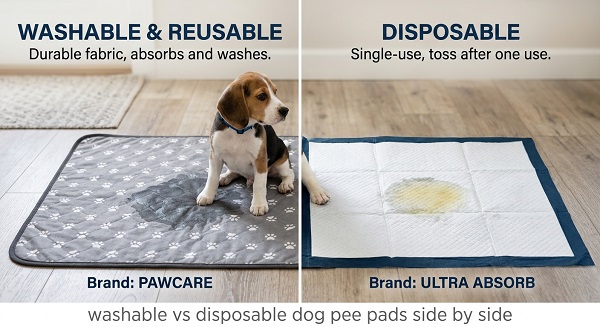
Which is better: washable or disposable dog pee pads? For most owners, washable dog pee pads win. They cost roughly half as much over three years, dogs can’t shred them easily, and they create far less trash. Disposable pads still win for travel, for puppies who have lots of accidents, and for homes with no easy laundry access. The smartest setup for many families is a hybrid: washable pads at home, a small stash of disposables for trips and bad days.
Table of Contents
- Introduction
- The Quick Verdict: Washable vs Disposable Dog Pee Pads
- How Each Type Works
- The Real Cost: A 3-Year Breakdown
- Absorbency and Leaks
- Training Results: Which Pad Helps Puppies Learn Faster?
- Safety and Hygiene
- The Environmental Impact (The Honest Version)
- Which Pad Fits Your Dog?
- How to Wash Reusable Dog Pee Pads
- The Hybrid System Most Handlers End Up Using
- What to Look for When Buying
- Why You Can Trust This Guide
- FAQs
- Conclusion
Introduction
You’re standing in the pet aisle (or scrolling a shop) looking at two choices. A giant pack of disposable pads for the price of a takeaway meal, or a pair of washable dog pee pads that cost three times as much. Which one actually saves you money? Which one keeps your floors dry? And what happens when your puppy grabs a pad and turns your living room into a snowstorm?
Most guides on this topic just list products. They skip the part that matters: how pads behave in a real home, with a real dog, over months of use. In this guide, you’ll get a cost breakdown that includes laundry (most articles leave it out), a simple absorbency test you can run at home, the training problems each pad type causes, and the safety risks nobody likes to mention. By the end, you’ll know exactly which pad fits your dog and your routine.
The Quick Verdict: Washable vs Disposable Dog Pee Pads
Here’s the short version, category by category. Details follow below.
| Category | Washable | Disposable | Winner |
|---|---|---|---|
| Cost over 3 years | About $390–$670 | About $660–$1,320 | Washable |
| Upfront cost | $60–$120 for a 4-pad set | $15–$50 per big pack | Disposable |
| Convenience | Needs laundry | Roll up and bin | Disposable |
| Chew and shred resistance | High | Low | Washable |
| Capacity per pee | Moderate, varies by brand | Often higher with a gel core | Disposable (usually) |
| Waste created | Very low | High | Washable |
| Travel and car trips | Bulky when wet | Light and easy | Disposable |
| Senior or incontinent dogs | Great as a base layer | Good as a top liner | Hybrid |
| Attracting a puppy to the spot | Unscented | Scented versions exist | Disposable |
The cost numbers above are our own estimates. The next section shows exactly how we got them, so you can plug in your own prices.
How Each Type Works
Disposable pee pads
A disposable pad is a sandwich. A soft top layer, an absorbent core (fluff pulp plus gel-forming polymer beads), and a plastic backing that stops leaks. The gel turns liquid into a thick jelly so it doesn’t slosh around. Some brands add an attractant scent to nudge puppies toward the pad, and some add adhesive strips to hold the corners down.
You use it, you roll it up, you bin it. That’s the whole appeal.
Washable (reusable) pee pads
A washable pad is also layered, but built from fabric. Most have a quilted polyester top, a thick absorbent middle, and a waterproof lining (often TPU) on the bottom. Many add a silicone anti-slip backing so the pad stays put on tile and wood.
Many manufacturers rate their pads for roughly 200 to 300 machine washes. That’s the number to watch, because it decides how long one set will last.
The Real Cost: A 3-Year Breakdown
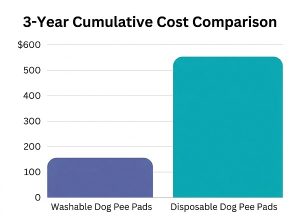
Here’s where most competitor articles fall short. They say “washable pads save money” and stop. But washable pads aren’t free to run. You pay for water, electricity and detergent every time you wash them. So let’s do the math properly.
Our assumptions
- Your dog needs 2 pad changes per day (730 per year). That’s typical for a puppy or a small dog using pads as the main toilet.
- Disposable pads cost $0.30–$0.60 each for standard large pads. Premium, extra-large or scented pads can run over $1.00 each.
- A washable pad costs $15–$30. You’ll want a rotation of 4 pads (one in use, one in the wash, one drying, one spare), so the set costs $60–$120.
- You wash all 4 pads in one load every other day (about 182 loads a year). A load costs $0.60–$1.00 in water, power and detergent.
The numbers
| Time | Disposable (cumulative) | Washable incl. laundry (cumulative) |
|---|---|---|
| Year 1 | $220–$440 | $170–$300 |
| Year 2 | $440–$880 | $280–$480 |
| Year 3 | $660–$1,320 | $390–$670 |
So over three years, washable pads come out around 40–50% cheaper in most scenarios. If you buy premium disposables at about $1.25 per pad, the yearly bill climbs past $900. In that case, washable pads win by a mile.
When disposables can still be cheaper
Be honest with yourself about your situation:
- Cheapest disposables plus priciest washables plus costly laundry. In this worst case, the savings are tiny and break-even can take close to three years.
- Light use. If your dog uses one pad a day or less, the gap shrinks.
- Short-term use. If your puppy will use pads for only 6–8 weeks, buying a full washable set may not pay off.
In the best case (pricey disposables, budget washables, laundry done with your regular loads), break-even happens in a few months. Most families land somewhere in the middle: break-even between 6 and 12 months.
Absorbency and Leaks
Absorbency is where marketing claims get wild, so test it yourself. A medium or large dog can release around half a cup to a full cup of urine (120–240 ml) or more in one go. If a pad can’t handle that, it’ll leak onto your floor no matter how good the brand sounds.
The 5-minute water test
Try this before you trust any pad with a puppy or a senior dog:
- Place the pad on a flat surface (a baking tray works well).
- Pour half a cup of water (about 120 ml) onto the center. Add a drop of food coloring so you can see where it goes.
- Time how long the surface takes to feel dry to the touch. Under 30 seconds is good for a disposable.
- Press a paper towel on the pad after one minute. Any color on the towel means the pad is holding moisture at the surface.
- Lift the pad. Check the floor or tray for leaks, especially along the edges.
What we usually see: Disposable pads with a gel core lock liquid away from the surface. Washable pads usually hold a good amount, but the surface can feel damp for longer, and they leak faster if the dog pees near the edge. Several brands warn about this in their care notes, so aim for the center of the pad.
The edge problem
Dogs rarely pee in the dead center. Males tend to aim at the edge or the wall behind the pad. If that’s your dog, pick a larger pad (around 36 x 41 inches or 90 x 100 cm for big dogs) or put the pad against a waterproof barrier, like a puppy pad holder tray or a wall protector.
Training Results: Which Pad Helps Puppies Learn Faster?
This section matters most if you’re raising a puppy. Pads can help, but they can also slow you down. Here’s the trainer’s view.
Do disposables teach better?
Disposable pads have one real training advantage: the scented ones. A mild attractant draws a young puppy toward the right spot. Washable pads are almost always unscented, so you’ll need to help your puppy get the idea.
Trainer trick for washable pads: After your puppy pees on a washable pad, don’t wash it right away. Leave it down for the next potty break (as long as it isn’t soaked). The faint smell tells your puppy “this is the toilet.” Then wash it at the end of the day.
The look-alike problem
A washable pad looks like a small rug or bed. To a puppy, that’s confusing. Why pee on the thin mat but not the thick bath mat? The American Kennel Club notes that cloth pads can resemble rugs and bedding, which can blur the lines for a young dog.
Here’s how to fight that:
- Pick a pad that looks clearly different from your household rugs (a solid, plain color works better than a cute pattern).
- Keep rugs out of the puppy’s zone during training.
- Always put the pad in the same spot, and take your puppy there on a leash for every potty break.
Pad-to-outside transition plan
Pads are a bridge, not a destination (unless you live in a high-rise or need indoor potty options for medical reasons). Most puppies need about 4–6 months to become reliable, and some take up to a year, so don’t panic if progress feels slow. Here’s a simple plan:
- Weeks 1–2: Pad in one fixed spot. Take your puppy there after meals, naps and play. Reward right away.
- Weeks 3–4: Slowly shrink the pad area (fold it, or use a smaller pad).
- Weeks 5–6: Move the pad about a foot closer to the door each day or two.
- Weeks 7–8: Put the pad outside on the spot you want your dog to use. Praise like crazy.
- After that: Take the pad away and go straight to the outdoor spot.
Want a strict day-by-day schedule to go with this? Our guide on how to potty train a puppy in 7 days shows you exactly when to take your puppy out. If you’d like the full system in one place, our e-book Beyond the Bark: Inside a Pro Handler’s Playbook for Raising the Ideal Dog walks you through potty training and the behavior habits that go with it.
A note on crates
Avoid putting pads inside a crate during house-training. It teaches your puppy that the crate is a toilet, which undoes the main benefit of crate training. Washable pads make better crate liners for seniors, dogs recovering from surgery, or long travel days. If you’re building crate habits, read our crate training guide for puppies first.
Safety and Hygiene
This is the area almost no competitor covers well. And it’s the one that can end up at the vet’s office.
The shredding and swallowing risk
Puppies love to shred disposable pads. Most of the time they just make a mess. But the gel core and plastic backing don’t break down in a dog’s gut. Vets who write about diaper ingestion warn that the absorbent filling can swell into a gel and cause a blockage, and some blockages need surgery. Pad cores work in a similar way.
Washable pads are harder to rip, which is a real safety win. But they aren’t risk-free. A chewed-up washable pad can shed threads and bits of fabric. Long threads are especially dangerous in the gut.
Call your vet right away if your dog swallows part of any pad. Don’t wait for symptoms. Watch for vomiting, a swollen or painful belly, no appetite, low energy, or straining without pooping. These signs can take hours or even days to show up.
Handler tip: If your dog is a chewer, don’t use pads without supervision. Use a washable pad inside a puppy pad holder, or switch to an indoor grass patch or a litter-style potty.
Wet surfaces and skin health
Washable pads have a fabric top. If the pad stays wet, your dog can end up lying in it. That’s a problem for seniors and dogs who can’t move well, because constant moisture causes urine scald (red, sore skin around the belly, rear and legs).
- Change a soiled washable pad quickly, especially for incontinent dogs.
- Pick pads with a fast-wicking top sheet.
- For overnight use with seniors, put a disposable pad on top of the washable one. Many owners swear by this combo.
Don’t ignore frequent accidents
An older, house-trained dog who suddenly needs pads may have a urinary tract infection, kidney or hormone problem, or cognitive changes. If it’s sudden or new, book a vet visit. A pad hides the problem. It doesn’t fix it.
The Environmental Impact (The Honest Version)
Most articles say “washable is eco-friendly” and move on. It’s mostly true, but there’s more to the story.
Disposables: One dog using two pads a day sends about 730 pads to landfill every year. The plastic backing and gel core can last for generations in the ground.
Washables: They cut waste dramatically (one set can replace hundreds of disposables). But they use water and electricity, and polyester sheds tiny microfibers in the wash.
Here’s how to shrink the footprint of washable pads:
- Wash in cold or warm water, not hot.
- Run full loads instead of two-pad loads.
- Air-dry when you can. It also helps the waterproof lining last longer.
- Use a washing-machine microfiber filter or a laundry bag made to catch fibers.
Which Pad Fits Your Dog?
This table is the part most buyers wish every guide had.
| Your situation | Best pick | Why |
|---|---|---|
| Young puppy, many accidents | Disposable (scented), maybe plus washables | Easy to bin, attractant helps |
| Puppy who shreds everything | Washable | Hard to tear up (supervise anyway) |
| Small or toy breed, apartment | Washable or hybrid | Steady daily use means big savings. See our guide to the hardest toy dog breeds to housebreak |
| Large or giant breed | Extra-large washable | Bigger target, bigger capacity, less edge leakage |
| Male dog who aims at walls | Large pad plus wall barrier | Cuts splash and edge leaks |
| Senior dog with incontinence | Washable base plus disposable liner | Comfort, skin care and easy cleanup |
| Post-surgery recovery | Disposable (short term) | Hygiene and quick changes |
| Travel or car trips | Disposable | Light, easy to bin |
| Under a water bowl or crate mat | Washable | Reusable and durable |
How to Wash Reusable Dog Pee Pads
Bad washing is the number one reason reusable pads stop working. Follow these steps and they’ll last.
- Scrape or rinse first. Shake off any poop. Rinse heavily soiled pads in cold water.
- Wash cold or warm. Check the care label, but 30–40°C (about 85–105°F) is a safe range for most. A few brands allow up to 60°C (140°F).
- Use regular detergent. Skip bleach and skip fabric softener. Both are often named in care labels as things that reduce absorbency.
- Wash them away from other laundry. Mixing with towels is fine, but keep them apart from clothes.
- Add odor fighters if needed. A small splash of white vinegar in the rinse, or an oxygen-based laundry booster (one without fabric softener in it), helps lift smells. For stuck-on odors, soak the pads in a baking soda and water mix for a few hours.
- Dry low or air-dry. Tumble dry on low heat if the label allows it. High heat can damage the waterproof lining.
- Wash a new pad before first use. Several brands say this improves absorbency.
Common washing mistakes
- Fabric softener or dryer sheets (they coat the fibers so liquid slides off)
- Hot dryer cycles (they crack the waterproof layer)
- Letting pads sit soiled for days (the smell sets in)
- Washing with greasy or oily clothes
The Hybrid System Most Handlers End Up Using
After years around dogs of every size, here’s what we see work again and again. Few people stay 100% on one side.
The 3-part hybrid:
- Home base: Two to four washable pads in your main potty spot.
- Backup stash: One small pack of disposables for travel, vet visits, sick days, and when the laundry pile wins.
- Senior or overnight layer: A disposable liner on top of a washable pad, so you swap the top layer and keep the bottom clean.
This gives you most of the savings and none of the stress.
What to Look for When Buying
Whether you go washable or disposable, check these:
- Size: Match the pad to your dog. Large breeds need pads of 36 x 41 inches (90 x 100 cm) or more.
- Waterproof backing: Look for leakproof lining on washables and a sealed backing on disposables.
- Anti-slip bottom: Silicone dots or paw-shaped grips on washables, adhesive strips on disposables.
- Washes rating: Aim for pads rated for 200+ washes.
- Care instructions: Choose pads you can machine wash and tumble dry low.
- Fabric: Quick-wicking tops are better than thick, fluffy ones that stay damp.
When to replace a washable pad
- Water beads stop forming and starts soaking through the bottom
- Corners curl or the backing peels
- Odor stays after a proper wash
- The pad leaks in the water test
Why You Can Trust This Guide
This guide comes from the ARFS K9 Team, a group of working-dog handlers and trainers. We spend our days around dogs of all sizes, from family pets to security and detection dogs, and we answer owner questions about house-training and gear every week.
Here’s how we built this article:
- We compared the care labels, wash ratings and size ranges of mainstream washable and disposable pads sold in the US, UK and Europe.
- We ran the cost math ourselves and showed our assumptions, so you can check them.
- We read what top-ranking guides cover and filled the gaps: laundry costs, training problems, safety risks and a simple home test.
- We checked safety points against veterinary advice. For any health concern, always call your own vet.
FAQs
1. Are washable pee pads better than disposable ones?
For most owners, yes. They cost about half as much over three years, resist chewing and create much less waste. Disposables are better for travel, short-term needs and homes with no easy laundry access.
2. How many washable pee pads do I need?
Four per dog is the ideal rotation: one in use, one in the wash, one drying and one spare. A small dog with light use can manage with two. Heavy users, like seniors with incontinence, may need six.
3. How long do washable pee pads last?
Most are rated for 200–300 washes. If you wash each pad about once every two days, that’s roughly 2 to 3 years. Wash less often or less roughly and they’ll last longer. Replace them when they stop absorbing or the backing peels.
4. Can I use washable pads to potty train a puppy?
Yes, but they’re a little harder because they’re usually unscented and can look like a rug. Keep the pad in one fixed spot, reward every success and consider keeping a lightly used pad down for the next break so the scent guides your puppy. Many trainers start with disposables for the first few weeks, then switch.
5. Do washable pee pads smell?
Only if you wash them wrong or leave them soiled too long. Rinse them first, skip fabric softener, add a little white vinegar or baking soda to the wash, and dry them fully. If smell lingers after a few washes, replace the pad.
Conclusion
So, which wins: washable or disposable dog pee pads? Here’s the short recap.
- Washable pads win on long-term cost, durability and waste. Over three years, they usually cost about half as much.
- Disposable pads win on convenience. They’re ideal for travel, vet days and early puppy chaos.
- Training matters more than the pad. Use a fixed spot, reward fast and plan your exit from pads from day one.
- Safety comes first. Supervise chewers, and call your vet if your dog swallows any part of a pad.
- A hybrid setup works best for most homes. Keep washables as your base and a small pack of disposables as backup.
Your next step: Try the 5-minute water test on the pad you’re thinking of buying, set your pad in one spot, and start your potty routine today. For more practical dog care, training and gear tips, subscribe to our weekly articles roundup at arfsk9team.com.ng/newsletter. It lands in your inbox once a week.
Sources and Further Reading
- American Kennel Club, “Best Materials to Use for Puppy Housetraining” (akc.org)
- Pet Parents, washing instructions for pee pads (petparentsbrand.com)
- Chewy product care notes for washable potty pads (chewy.com)
- Hepper vet-reviewed article on dogs eating diapers (hepper.com)
- Dogster, “Best Washable Dog Pee Pads” (dogster.com)
- Reader’s Digest, “6 Best Washable Dog Pee Pads” (rd.com)

Her work centres on obedience, detection, protection and operational readiness. She favours proven methods built on repetition, consistency and real-world conditioning, so that both dogs and handlers are prepared for high-pressure tasks.
Rofiat represented the Nigerian Army Dog Centre at the Nigerian Army Day Celebration (NADCEL) 2026, where she led demonstrations in obedience, explosive detection, agility and tactical movement. Through articles, training content and documentaries, she shares field-based insight into how structured training, clear communication and trust between handler and dog affect performance and reliability.
She is the author of Beyond the Bark: Inside a Pro Handler's Playbook for Raising the Ideal Dog, a practical guide that helps dog owners and handlers apply professional training principles in everyday situations.
- Food Aggression Dog Training: Pro K9 Guide - November 21, 2026
- DIY Dog Scent Training: Easy 4-Week Home Guide - November 20, 2026
- Buckeye Puppies Review: 5 Red Flags to Check - November 19, 2026