Are Springer Spaniels Easy to Train? A Trainer’s Honest Take
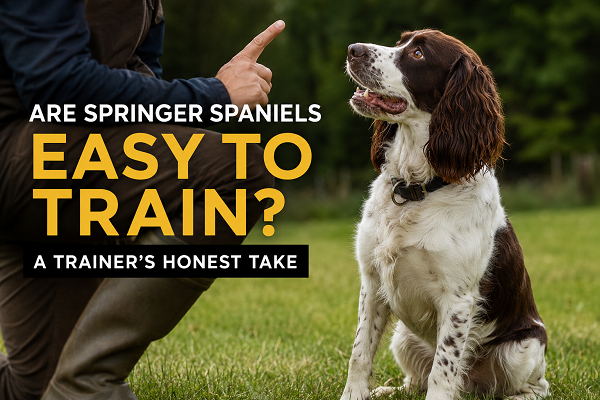
Yes, English Springer Spaniels are one of the easier sporting breeds to train. Stanley Coren’s landmark intelligence study placed them 13th out of 138 breeds for working and obedience intelligence, meaning most Springers learn a new command in 5 to 15 repetitions and obey a known command on the first try at least 85% of the time. That said, “easy” doesn’t mean “effortless.” Their high energy, people-focused nature, and sensitivity to harsh corrections mean training success depends heavily on how you train, not just the breed’s raw smarts.
Table of Contents
- Why Springer Spaniels Have a Reputation for Being Trainable
- Working Lines vs. Show Lines: Does It Change Trainability?
- What Makes Springer Training Genuinely Easy
- Where Owners Get Tripped Up
- A Realistic Training Timeline, Month by Month
- Step-by-Step: How I Train a Springer Puppy
- Real-World Proof: Springers at Work
- What Professional Training Actually Costs
- Trainer Notes: Health Issues That Affect Training
- FAQs
- Final Thoughts
Why Springer Spaniels Have a Reputation for Being Trainable
Let’s start with the receipts, because “easy to train” gets thrown around loosely in dog breed marketing, and I’d rather show you the actual data.
Psychologist Dr. Stanley Coren surveyed nearly 200 obedience trial judges across the US and Canada for his book The Intelligence of Dogs, then ranked breeds by working and obedience intelligence. The English Springer Spaniel landed at #13, placing it in the “Excellent Working Dogs” tier. Dogs in that bracket typically:
- Learn a brand-new command in 5 to 15 repetitions
- Obey a command they already know 85% of the time or better on the first ask
For comparison, breeds at the bottom of Coren’s list (Afghan Hounds, Basenjis, and similar independent thinkers) can take 80-100+ repetitions to learn the same command. So a Springer really is working with a different starting point.
But intelligence rankings only tell half the story. The other half is why Springers are built this way. This breed was developed in England specifically to work in close partnership with a human hunter, flushing (“springing”) game birds from cover and then holding steady while the shot was taken. That job requires a dog that reads its handler’s body language constantly, responds to subtle cues, and genuinely wants to stay close. Breeders selected for that partnership instinct for well over a century before the breed was formally recognized in 1927. You’re not just getting a smart dog. You’re getting a dog whose whole genetic purpose is paying attention to you.
That’s the trainer’s edge with this breed: Springers aren’t smart in a “figures out how to open the fridge and ignores you” way (that’s more of a working-line Border Collie or a terrier trait). They’re smart in a “watches your face for the next instruction” way. That distinction matters enormously for training success.
Working Lines vs. Show Lines: Does It Change Trainability?
Here’s something a lot of general breed guides skip over, and it’s genuinely important if you’re comparing two Springer puppies side by side.
For decades, English Springer Spaniels have split into two distinct types within the same breed:
- Field/working-line Springers — bred by hunters for stamina, drive, and a tighter, more athletic build. Coats are shorter, coarser, and mostly white with brown ticking. These dogs are hard-wired for nonstop activity and tend to be even more biddable in a working context, but they need a job or they’ll invent one (often destructively).
- Show/bench-line Springers — bred to the AKC conformation standard, heavier-bodied, with the classic long silky ears and coat you see in the show ring. Generally calmer in the house, still very trainable, but with somewhat less raw drive than their field cousins.
If your goal is a mellow family companion who picks up basic obedience quickly, a show-line pup from a reputable breeder is usually the easier path. If you want a hunting partner or you’re training for detection/scent work, a field-line dog will out-perform a show-line dog on drive and stamina, but expect a more demanding first 18 months.
Ask breeders directly which line their litter comes from. It’s one of the most useful questions you can ask, and surprisingly few first-time owners think to ask it.
What Makes Springer Training Genuinely Easy
I don’t want to oversell this breed, but there are real, practical reasons Springers train faster than most:
- Food and toy motivation runs high. Most Springers will work for a piece of kibble, a squeaky toy, or a game of tug, which makes positive reinforcement training straightforward from week one.
- They bond fast and hard. A Springer that trusts you will offer behaviors just to get your attention, which speeds up shaping and luring.
- Retrieve drive is baked in. Teaching a Springer to fetch, hold, and deliver an object is often the fastest “trick” you’ll ever teach, because it’s instinctive rather than learned from scratch.
- They generalize well. Once a Springer understands “sit” in the kitchen, it usually transfers that understanding to the yard, the park, and the vet’s office faster than more stubborn breeds.
- Handler focus. Because they were bred to work a field 20-30 yards from a hunter while still checking in constantly, off-leash recall training tends to go smoother than with scent hounds or independent breeds.
If you’ve read our guide on how to crate train a puppy for faster results, the same “build trust before you build structure” approach applies well to Springer puppies. They settle into a crate routine quickly once they understand it’s not a punishment.
Where Owners Get Tripped Up
This is the part most SEO articles gloss over, and it’s the part I actually get calls about.
1. Energy outpaces training time
A field-bred Springer needs a genuine 60-90 minutes of purposeful exercise a day, not a 15-minute stroll. Skip this and you’ll be trying to teach “stay” to a dog that’s vibrating with unspent energy. It won’t stick. If you’re unsure how much activity your dog actually needs, our piece on how often you should exercise a working dog breaks this down by drive level, not just breed name.
2. Sensitivity to harsh handling
Springers were bred for a soft, cooperative working style. Heavy-handed corrections, yelling, or old-school “alpha roll” methods tend to backfire badly with this breed, you’ll get a dog that shuts down, avoids eye contact, or becomes anxious rather than one that respects you more. I’ve fixed more “stubborn” Springers with a switch to reward-based methods than with any correction-based tool.
3. The “springer rage” myth (and the real story)
You may have come across old forum posts mentioning “Springer rage syndrome,” a sudden, unprovoked aggression sometimes linked to certain UK show bloodlines in the 1990s. It’s real, but it’s rare, poorly understood even by veterinary behaviorists, and largely traced to a narrow set of pedigrees that reputable breeders have worked hard to breed away from. It is not a general breed trait. If you’re buying from a breeder who health-tests and screens temperament, this is not something you need to plan around. I mention it only because owners deserve the full picture, not a sanitized one.
4. Separation and velcro tendencies
Because Springers bond so intensely, they’re prone to separation-related behavior problems if left alone for long stretches without preparation. Training “alone time” needs to start in puppyhood, the same way you’d start crate training or grooming handling early.
5. Ear and coat maintenance gets skipped, which affects training focus
A Springer with itchy, infected ears (a common issue given how their long, floppy ears trap moisture) is a distracted, uncomfortable dog. If your training sessions aren’t landing, rule out a health issue before blaming the dog’s “attitude.” Our essential grooming guide for healthy puppies covers ear care specifically, and it’s worth a read even if your dog is past puppyhood.
A Realistic Training Timeline, Month by Month
Every dog is different, but here’s the timeline I actually use with Springer owners, based on real training progressions rather than a generic “8 weeks and done” promise.
| Age | Focus | What “on track” looks like |
|---|---|---|
| 8-12 weeks | Name recognition, potty training, crate comfort, gentle handling, first sit/come lures | Responds to name 70%+ of the time indoors; sleeps in crate without prolonged crying |
| 3-4 months | Sit, down, come, loose-leash walking basics, bite inhibition, socialization to 100+ new people/dogs/surfaces | Holds a sit for 5-10 seconds with distraction; walks without constant pulling for short stretches |
| 5-6 months | Stay, wait at doors, recall with distractions, introduction to retrieve games | Reliable recall in a fenced yard; settles on a mat during meals |
| 7-12 months (adolescence) | Reinforcing everything under real-world distraction, impulse control, adolescent “reset” of recall | Expect some regression around 7-9 months, this is normal, not a training failure |
| 12-18 months | Advanced obedience, off-leash reliability, gundog or scent work foundations if desired | Most owners see a genuinely “finished” household dog by 18 months |
A realistic expectation: basic household manners in 8-12 weeks of consistent daily training, and a genuinely reliable, well-mannered adult dog by 12-18 months. Gundog handlers training for field trial work often budget a full 2 years to reach a fully polished working dog.
Step-by-Step: How I Train a Springer Puppy
If you want a practical starting framework, here’s the approach I use:
- Lock in the name game first. Say the puppy’s name, mark with a clicker or “yes,” reward instantly. Do this 10-15 times a day for the first week. Everything else builds on reliable attention.
- Use short sessions, often. Five minutes, five times a day beats one 30-minute session for a Springer’s attention span, especially under 6 months.
- Teach recall before anything else off-leash. Start in a hallway, then a fenced yard, then a quiet park. Never call your dog for something unpleasant (baths, nail trims), that erodes recall fast.
- Channel the flush-and-retrieve instinct. Instead of fighting the urge to chase and grab, redirect it into structured fetch games. This becomes your best training reward later.
- Introduce mild distractions early and gradually. A Springer that’s only ever practiced “sit” in a silent kitchen will struggle at the vet or on a busy sidewalk. Layer in distractions deliberately.
- Keep corrections calm and brief. A verbal “eh-eh” and a reset is usually enough. Avoid escalating; this breed shuts down under pressure rather than pushing back.
- Protect the crate as a safe space. Never use it for punishment. Feed meals in it occasionally so it stays a positive association.
Real-World Proof: Springers at Work
This breed’s trainability isn’t theoretical. English Springer Spaniels have quietly become one of the go-to breeds for professional detection work worldwide. Their combination of a powerful nose, high drive, and a friendly, non-threatening appearance makes them popular with customs agencies, explosives-detection teams, and conservation-detection programs, where a dog needs to work confidently in crowded public spaces without looking intimidating.
On the family side, Springers have a long history as celebrity companions precisely because they train so readily into well-mannered household pets, the Bush family kept Springers in the White House across two administrations, and Oprah Winfrey adopted a pair of rescue Springers, Sunny and Lauren, both examples of the breed adapting well from working stock into settled companions.
I’ve also seen the working-line difference firsthand. A field-bred Springer I trained for a client’s hunting program picked up steady-to-flush in about six weeks, largely because the instinct was already there. I was refining, not building from zero.
What Professional Training Actually Costs
If you’re weighing DIY training against professional help, here’s a realistic budget range (figures vary by region and trainer experience):
- Group puppy classes: roughly $150-$300 for a 6-8 week course
- Private one-on-one sessions: roughly $50-$150 per session
- Board-and-train programs: roughly $1,000-$3,500 for 2-4 weeks, depending on the trainer’s credentials and whether gundog work is included
- Specialized gundog/field training: often billed seasonally, commonly $500-$1,200 per month during active training periods
Given how quickly Springers pick up basics, many owners find a handful of private sessions plus consistent daily home practice gets them 80% of the way there without needing a full board-and-train program.
Trainer Notes: Health Issues That Affect Training
Because this article is meant to give you the full picture, not just the marketing version, here are the health factors I flag to every new Springer owner, since they directly affect training consistency:
- Ear infections — the floppy, low-set ears trap moisture and debris; check and clean weekly.
- Hip dysplasia — a known concern in the breed; avoid excessive jumping or forced exercise before growth plates close (roughly 12-18 months).
- Progressive retinal atrophy (PRA) — an inherited eye condition; ask breeders for health clearances (OFA or equivalent) before buying.
- Springer rage syndrome — as discussed above, rare and linked to specific historic bloodlines, not the breed as a whole.
A dog that’s uncomfortable or in pain will look “untrainable” when the real issue is medical. Rule this out before assuming a training problem.
FAQs
1. Are Springer Spaniels good for first-time dog owners?
Yes, with a caveat. Their trainability makes them forgiving of beginner mistakes, but their exercise needs (60+ minutes daily) can overwhelm owners expecting a low-key pet. First-timers who are active and consistent tend to do very well with this breed.
2. How long does it take to house-train a Springer Spaniel puppy?
Most Springer puppies are reliably house-trained within 4-6 months with a consistent schedule, though full bladder control often isn’t complete until closer to 6 months of age.
3. Do Springer Spaniels need professional training?
Not necessarily. Their high trainability means many owners succeed with home training plus a basic puppy class. Professional help is most useful for gundog work, competitive obedience, or if you’re dealing with anxiety-related behaviors.
4. Are English Springer Spaniels aggressive?
No. As a breed, Springers are friendly and people-oriented. The rare “rage syndrome” cases were tied to specific historic bloodlines, not a general breed trait, and reputable breeders screen against it.
5. What’s the difference between training a working-line vs. show-line Springer?
Working-line Springers have more raw drive and need more structured outlets (retrieving, field work), while show-line Springers are generally calmer and easier to satisfy with standard obedience and moderate exercise.
Final Thoughts
So, are Springer Spaniels easy to train? By the numbers and by real-world experience, yes, this is a breed built for partnership with people, and that shows up in how fast they pick up commands, how well they generalize training, and how naturally they bond with a handler. Coren’s research backs it up, and so does every field trial, detection program, and well-mannered household Springer I’ve worked with.
But “easy” only holds true if you match the training to the dog. Give a Springer enough physical outlet, keep your corrections calm, start socialization and recall early, and rule out health issues before blaming attitude. Do that, and you’ll likely have a dog with solid household manners inside three to four months, and a genuinely polished companion by 18 months.
If you’re just starting out and want a deeper, structured framework beyond what a blog post can cover, covering everything from the first week home through advanced obedience, our book Beyond the Bark walks through the exact system we use with working and pet dogs alike, breed by breed.
And if you’re weighing a Springer against another breed for detection or field work, take a look at our roundup of the top 7 search and rescue dog breeds for more context on how sporting breeds compare to other working lines. For more training guides like this one, browse our Training & Handling category.

Her work centres on obedience, detection, protection and operational readiness. She favours proven methods built on repetition, consistency and real-world conditioning, so that both dogs and handlers are prepared for high-pressure tasks.
Rofiat represented the Nigerian Army Dog Centre at the Nigerian Army Day Celebration (NADCEL) 2026, where she led demonstrations in obedience, explosive detection, agility and tactical movement. Through articles, training content and documentaries, she shares field-based insight into how structured training, clear communication and trust between handler and dog affect performance and reliability.
She is the author of Beyond the Bark: Inside a Pro Handler's Playbook for Raising the Ideal Dog, a practical guide that helps dog owners and handlers apply professional training principles in everyday situations.
- Dog Agility Course Layout: Easy DIY Setup - October 7, 2026
- Local Dog Breeds: Temperament, Health & Training Guide - October 6, 2026
- How Long Do Military Working Dogs Serve? Full Guide - October 5, 2026