Top 10 Police Dog Breeds Ranked and Explained
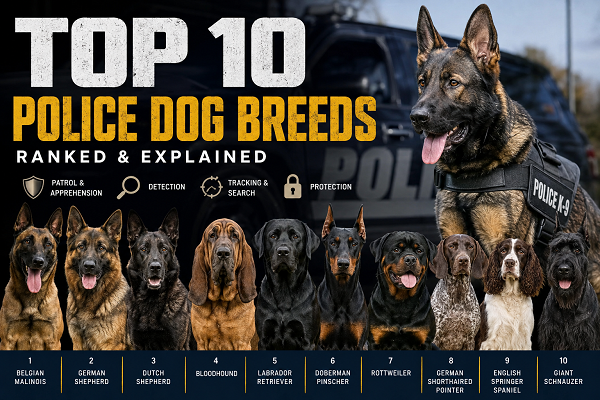
The top 10 police dog breeds used by law enforcement agencies worldwide are the Belgian Malinois, German Shepherd, Dutch Shepherd, Bloodhound, Labrador Retriever, Doberman Pinscher, Rottweiler, German Shorthaired Pointer, English Springer Spaniel, and Giant Schnauzer. Departments rank the Belgian Malinois and German Shepherd highest because they combine trainability, drive, scenting ability, and physical durability into one dual-purpose package, while breeds like the Bloodhound and Labrador Retriever dominate single-purpose tracking and detection roles where nose accuracy matters more than bite work.
Table of Contents
- Introduction: Why Breed Selection Makes or Breaks a K9 Program
- How We Ranked These Breeds
- 1. Belgian Malinois
- 2. German Shepherd
- 3. Dutch Shepherd
- 4. Bloodhound
- 5. Labrador Retriever
- 6. Doberman Pinscher
- 7. Rottweiler
- 8. German Shorthaired Pointer
- 9. English Springer Spaniel
- 10. Giant Schnauzer
- Dual-Purpose vs. Single-Purpose Dogs: What’s the Difference?
- Trainer Note
- FAQs
- Conclusion
Introduction: Why Breed Selection Makes or Breaks a K9 Program
If you’ve ever watched a K9 team roll up to a scene, you’ll have noticed something: it’s almost never a random dog on the end of that leash. There’s a reason a department doesn’t hand a rookie handler a Golden Retriever and send them chasing armed suspects through a warehouse. Breed selection for police work isn’t a preference thing, it’s a survival thing, both for the officer and the dog.
So here’s the problem a lot of new handlers, K9 coordinators, and even curious dog owners run into: there’s a mountain of conflicting information out there about which police dog breeds actually get the job done. Some sites just recycle the same “German Shepherds and that’s it” answer without explaining why departments are shifting away from them, or why a Bloodhound with a mediocre bite would still get hired over a Malinois for a missing-person search.
In this guide, you’ll get a real, ranked breakdown of the top 10 police dog breeds used by agencies across the US, UK, Europe, and beyond, what each one is actually good at, real numbers on training timelines and costs, and the honest trade-offs departments weigh before writing that first paycheck for a working dog. Whether you’re a handler prepping for your first K9 assignment, a department researching procurement, or a dog owner just fascinated by working canines, you’ll walk away knowing exactly why these ten breeds keep showing up on patrol.
How We Ranked These Breeds
Before we get into the list, it’s worth being upfront about the criteria, because “best” means different things depending on the job. We ranked these breeds using five factors that actual K9 procurement officers weigh:
- Trainability and drive – how quickly the breed learns and how consistently it wants to work
- Physical suitability – structure, stamina, and durability for the specific task (patrol vs. detection vs. tracking)
- Scenting or bite-work aptitude – whichever is relevant to the role
- Global adoption rate – how widely departments actually deploy the breed, not just how capable it is in theory
- Health and working lifespan – because a dog that burns out at four years old costs a department more than one that works until nine or ten
With that out of the way, let’s get into it.
1. Belgian Malinois
Best for: Patrol, apprehension, dual-purpose narcotics/explosives detection, military and elite tactical units
If you’ve spent any time around working dog circles, you already know where this list was going to start. The Belgian Malinois has become the number one choice for police and military K9 units worldwide over the past two decades, and it’s not close.
Originally bred in the Belgian town of Malines as a herding dog, the Malinois carries an early-developing, intense prey drive that herding work needed and police work happens to need just as badly. That same instinct that once had these dogs nipping at the heels of cattle now channels into suspect apprehension with a level of focus that’s hard to match.
A few things push the Malinois to the top:
- Lighter build, lower injury risk – Malinois typically weigh 40-80 lbs, noticeably lighter than a German Shepherd, which translates to lower rates of hip dysplasia and often a longer working career.
- Endurance – these dogs can work in extreme heat and sustain high-intensity effort longer than most comparable breeds, which is part of why military units in desert climates lean on them so heavily.
- Global track record – this is the breed behind Cairo, the Navy SEAL Team Six K9 involved in the 2011 raid on Osama bin Laden’s compound, and you’ll find Malinois on active duty with the U.S. Secret Service and dozens of European and American K9 units.
A published comparison study on scent-detection performance found Belgian Malinois and German Shepherds statistically undifferentiated in narcotics detection accuracy, meaning the Malinois isn’t just winning on bite work, it’s every bit as reliable on the nose side too.
Trade-off: That relentless drive is a double-edged sword for anyone outside a working environment. A Malinois without a job goes looking for trouble, chewing furniture, herding kids, redirecting bite drive onto anything that moves. If you’re weighing a Malinois for home protection rather than professional deployment, our guide on stopping Belgian Malinois biting and drive is worth reading before you commit.
2. German Shepherd
Best for: Patrol, apprehension, tracking, public-facing community policing roles
For most of the last century, the German Shepherd was the police dog. Ask anyone off the street to picture a K9, and this is the dog they see. It’s still the breed most associated with law enforcement globally, even as the Malinois edges it out numerically in newer programs.
What made the German Shepherd the default for a hundred years still holds true: confidence, courage, exceptional intelligence, and a temperament that’s steadier around crowds and cameras than the higher-strung Malinois. That steadiness matters more than people realize. A K9 doing community outreach at a school assembly or standing calmly for photos at a press conference needs a different demeanor than one clearing a building, and the Shepherd handles both roles without much drama.
Key numbers worth knowing:
- German Shepherds and Belgian Malinois showed only about a 4% difference in obedience scoring in comparative service-dog studies, essentially a toss-up.
- Working-line German Shepherds (bred specifically for nerve strength and drive, not show-ring looks) are the ones departments actually procure, not the show-line dogs you’d see at a conformation show.
- A German Shepherd’s working career typically runs 6-9 years before retirement, assuming good hip and elbow health, which is a genuine concern in the breed due to decades of over-breeding for appearance in some lines.
If you’re comparing the two market leaders directly, our deep dive on German Shepherd vs. Belgian Malinois: which breed is right for you walks through the decision framework departments and private buyers actually use. And if you want to understand why working-line breeding matters so much for this role, working line vs. show line GSD training differences explains exactly what separates a dog that can do the job from one that just looks like it can.
3. Dutch Shepherd
Best for: Patrol, apprehension, tracking, tactical/military operations
The Dutch Shepherd doesn’t get the same public recognition as its Belgian and German cousins, but ask any experienced handler and they’ll tell you this breed deserves to be higher on more people’s radar. Originally an all-purpose farm dog in the Netherlands, tending livestock, pulling carts, and guarding property, the Dutch Shepherd developed into one of the most balanced working breeds on the planet.
What sets it apart:
- Genetic health advantage – because the breed was never bred primarily for looks, Dutch Shepherds tend to carry fewer structural problems than some German Shepherd lines.
- Brindle coat, functional camouflage – sounds minor, but the brindle pattern was actually selected partly because it made the dog harder to spot at a distance while working livestock, a trait that transfers surprisingly well to tactical scenarios.
- Balanced drive – Dutch Shepherds sit temperamentally between the German Shepherd’s steadiness and the Malinois’s intensity, which makes them adaptable across patrol, detection, and tracking without needing a specialist handler.
Programs like Fort Collins Police Services build much of their K9 unit around Dutch Shepherds paired with German Shepherds precisely because that dual-purpose blend, patrol work plus narcotics detection in the same dog, delivers more value per canine. If you want to see exactly how a real department structures its breed selection and certification process, our breakdown of Fort Collins K9 police dogs is a genuinely useful case study.
4. Bloodhound
Best for: Search and rescue, fugitive tracking, missing-persons cases
Here’s where the list shifts from bite-capable patrol dogs to single-purpose scent specialists, and nothing beats a Bloodhound at what it does. This breed has an estimated 300 million scent receptors, several times more than most working breeds, and its trailing ability is admissible as legal evidence in many U.S. courts, a distinction few other breeds carry.
Bloodhounds aren’t apprehending anyone. They’re not trained for bite work, and their gentle, almost goofy temperament off the clock is part of the point, you want a dog obsessively focused on a scent trail, not one that gets distracted trying to intimidate a suspect. Their droopy ears and loose facial skin actually funnel ground-level scent particles up toward the nose, which is why this breed has been used for tracking since the Middle Ages, long before anyone called it “police work.”
Real-world impact: Bloodhound trails have led directly to the location of missing children, lost hikers, and fleeing suspects in cases where the trail was hours, sometimes over a day, old. That kind of scent persistence is something even a well-trained Malinois can’t consistently replicate.
5. Labrador Retriever
Best for: Narcotics detection, explosives detection, airport and TSA-style security screening
The Labrador is the friendliest name on this list, and that’s exactly why departments and federal agencies use so many of them. Labs bring elite scenting ability, they’re consistently ranked among the top breeds for detection accuracy in comparative studies, alongside a non-threatening, approachable public image that’s perfect for crowded environments like airports, stadiums, and courthouses.
Why agencies love them for detection work:
- Food and toy drive over aggression drive – Labs work for a reward, not a fight, which makes them easier and cheaper to train for pure detection roles.
- Public relations asset – a wagging Lab in an airport terminal doesn’t spook travelers the way a Malinois on a short lead might.
- Versatility across scent categories – the same breed trains effectively for narcotics, explosives, cash currency, and even electronic-device detection (increasingly relevant for evidence recovery).
The TSA alone deploys thousands of detection dogs across U.S. airports, and Labrador Retrievers make up a substantial share of that workforce specifically because they combine nose accuracy with a temperament that doesn’t require the same containment protocols as a bite-trained patrol dog.
6. Doberman Pinscher
Best for: Patrol, personal protection, historical military use
The Doberman was practically built for this role from the start. Karl Friedrich Louis Dobermann, a German tax collector, developed the breed in the 1890s specifically because he wanted a loyal, intimidating dog to protect him on his rounds. That original purpose, protection with intelligence, never really left the breed’s DNA.
Dobermans dominated K9 units through much of the mid-20th century, particularly in the U.S. Marine Corps during World War II, where they earned the nickname “Devil Dogs” in the Pacific theater. Today, they’ve been largely overtaken by Malinois and Shepherds in mainstream police procurement, mostly because of health concerns like dilated cardiomyopathy that shorten some lines’ working lifespans, but you’ll still find them active in European patrol units and widely used in private security and personal protection work.
What still makes the Doberman valuable:
- Speed – among the fastest breeds on this list, useful in pursuit scenarios
- Sleek, low-maintenance coat – less grooming overhead than a double-coated Shepherd
- Sharp territorial instinct – a natural fit for property and estate protection roles
7. Rottweiler
Best for: Patrol, personal and property protection, European K9 units
Rottweilers trace their working lineage back to Roman cattle-driving dogs, and that heritage of guarding livestock and property over long, unsupervised stretches gave the breed a natural, independent guarding instinct that police work later put to formal use. This is a breed that doesn’t need constant direction to know something’s wrong.
The Rottweiler’s bite force, commonly measured around 328 PSI, ranks among the strongest of any domestic dog breed, giving it serious apprehension capability when properly trained. Some European departments, particularly in Germany and the Netherlands, still field Rottweilers in patrol roles, though they’re less common in U.S. municipal K9 units today compared to Shepherds and Malinois.
Where the Rottweiler still shines:
- Property and estate security where sustained, independent vigilance matters more than agility
- Personal protection dogs for private clients, where the breed’s imposing size and territorial instinct are the primary deterrent
- Cross-training potential for handlers who want a dog capable of both companionship and serious protection work
8. German Shorthaired Pointer
Best for: Explosives detection, narcotics detection, high-energy scent work
This one surprises people who don’t follow K9 procurement closely. The German Shorthaired Pointer (GSP) was bred as a versatile hunting dog with an exceptional nose, and that same scenting ability made it a natural fit for detection roles once agencies started looking beyond the “obvious” breeds.
GSPs bring a level of stamina and drive that rivals the Malinois, they were built to hunt all day across varied terrain, but they’re not typically trained for bite work or apprehension. That makes them a lower-liability option for agencies that only need detection capability without the legal and insurance complexity that comes with a dog trained to bite.
You’ll find GSPs increasingly deployed at:
- Border checkpoints for narcotics and currency detection
- Correctional facilities screening for contraband
- Explosives detection units where a lean, agile dog can search vehicles and cargo quickly
9. English Springer Spaniel
Best for: Narcotics, explosives, and firearms detection, smaller-space search work
Don’t let the size fool you. The English Springer Spaniel is one of the most widely used detection breeds in the UK, where police forces and the British Transport Police have relied on them for decades. Their smaller size compared to a Labrador or Shepherd is actually an advantage in confined spaces, think aircraft cabins, vehicle interiors, and cluttered storage rooms, where a bigger dog struggles to maneuver efficiently.
Springer Spaniels bring:
- High energy and relentless enthusiasm, which translates into sustained search stamina over long shifts
- Excellent scent discrimination, frequently used to detect firearms and ammunition in addition to standard narcotics
- Compact size, making them easier to transport and deploy in tight urban environments
This breed is a strong example of how “best police dog breed” really depends on the job. A Springer Spaniel will never apprehend a fleeing suspect, but ask any UK transit officer and they’ll tell you this dog has probably found more hidden contraband than half the bite-trained dogs on this list combined.
10. Giant Schnauzer
Best for: Patrol, protection, versatile dual-purpose work in select European units
Rounding out the list is a breed that doesn’t get nearly enough credit outside working dog circles. The Giant Schnauzer was developed in Bavaria to guard cattle, breweries, and stockyards, and that same guarding instinct, combined with high intelligence and a naturally suspicious eye toward strangers, makes it a genuinely capable protection and patrol dog.
Giant Schnauzers aren’t a mainstream K9 choice in the U.S., but select European agencies and a growing number of private protection-dog programs use them for their combination of trainability, coat that handles harsh weather better than a short-haired breed, and imposing size without the extreme drive intensity that makes a Malinois hard for a first-time handler to manage.
If you’re curious whether this breed fits a protection role outside formal police work, our full breakdown, is a Giant Schnauzer a good protection dog, covers bite-force data, training costs, and honest temperament insights.
Dual-Purpose vs. Single-Purpose Dogs: What’s the Difference?
Ever wonder why some K9s only sniff luggage while others chase down suspects? It comes down to a basic procurement decision every department makes.
Dual-purpose dogs (Belgian Malinois, German Shepherd, Dutch Shepherd) are trained for both detection work AND apprehension. They cost more to train, roughly 12-16 weeks of initial certification versus 6-10 weeks for detection-only dogs, but they deliver more operational flexibility per canine, which matters a lot for smaller departments running lean K9 budgets.
Single-purpose dogs (Bloodhound, Labrador, GSP, Springer Spaniel) specialize in one discipline, usually detection or tracking. They’re generally cheaper to acquire and train, and because they’re not trained to bite, they come with lower liability exposure and often a friendlier public image, which matters enormously for airport, school, and courthouse deployments.
Neither approach is “better.” A department running narcotics interdiction at a border crossing has very different needs than a patrol unit responding to armed suspect calls, and the right breed choice flows directly from the job, not the other way around. This is exactly the kind of foundational thinking covered in our guide on what it means for a dog to be a working dog and the full range of K9 careers, which is worth a read if you’re mapping out breed choice against role.
Trainer Note
This breakdown draws on years of hands-on K9 selection, training, and handler development work, not a rewrite of someone else’s blog post. Choosing the right breed for a role is one of the first, and most consequential, decisions any K9 program or private handler makes, and getting it wrong costs departments real money in washed-out dogs and wasted training hours.
At ARFS K9 TEAM, we work directly with military, police, protection, and security dog programs on breed selection, foundational training, and handler development, and we’ve watched firsthand which breeds actually hold up under operational pressure versus which ones just look good on paper. If you’re building or refining a working dog program of your own and want a structured, field-tested approach to training rather than trial and error, our e-book walks through the exact framework professional handlers use: Get the training e-book here.
FAQs
What is the number one police dog breed in the world?
The Belgian Malinois currently holds the top spot in most modern K9 units worldwide, valued for its intense drive, agility, and lighter build compared to the German Shepherd. That said, the German Shepherd remains the breed most publicly associated with police work due to its century-long dominance in the role.
What breed of dog is best for narcotics and explosives detection?
Labrador Retrievers are widely considered the top choice for narcotics and explosives detection because of their exceptional scenting ability, non-aggressive temperament, and strong food/toy drive that makes reward-based training efficient. German Shorthaired Pointers and Springer Spaniels are also common in detection-only roles.
How long does it take to train a police dog?
Basic K9 certification for a dual-purpose patrol and detection dog typically takes 12-16 weeks, while single-purpose detection dogs can be certified in 6-10 weeks. Dogs are usually recertified annually to maintain operational status, and the full working relationship between handler and dog continues developing for years beyond initial certification.
Why are police departments switching from German Shepherds to Belgian Malinois?
Belgian Malinois generally have a lighter build and lower rates of hip dysplasia than German Shepherds, which often translates into a longer, more durable working career. Comparative studies have also found the two breeds statistically similar in scent-detection accuracy, so departments increasingly favor the Malinois’s physical durability without sacrificing performance.
Can any dog become a police dog, or does it have to be a specific breed?
While breed strongly influences a dog’s natural aptitude for the role, individual temperament testing matters just as much. Departments typically evaluate prey drive, nerve strength, sociability, and environmental confidence in individual dogs before committing to training, which is why not every German Shepherd or Malinois makes the cut even within a “proven” breed.
Conclusion
There’s no single “best” police dog breed, there’s only the best breed for the specific job in front of a department. The Belgian Malinois and German Shepherd earn the top two spots because they handle dual-purpose patrol and detection work better than almost anything else out there, but a Bloodhound will out-track both of them on a cold trail, and a Labrador will out-perform them in a crowded airport terminal where the last thing anyone needs is a dog trained to bite.
If you’re a department weighing procurement, start with the job description, not the breed name. If you’re a handler or dog owner drawn to these breeds for their working intelligence, remember that drive without direction turns into a management headache fast, so pair breed selection with real, structured training from day one. Whichever breed you’re working with, the fundamentals, consistency, clear communication, and never skipping the basics, are what actually separate a good working dog from a great one.
Have a question about which breed fits your K9 program or protection needs? Reach out to ARFS K9 TEAM, we work with handlers and departments across the world on exactly this kind of breed and training guidance.

Her work centres on obedience, detection, protection and operational readiness. She favours proven methods built on repetition, consistency and real-world conditioning, so that both dogs and handlers are prepared for high-pressure tasks.
Rofiat represented the Nigerian Army Dog Centre at the Nigerian Army Day Celebration (NADCEL) 2026, where she led demonstrations in obedience, explosive detection, agility and tactical movement. Through articles, training content and documentaries, she shares field-based insight into how structured training, clear communication and trust between handler and dog affect performance and reliability.
She is the author of Beyond the Bark: Inside a Pro Handler's Playbook for Raising the Ideal Dog, a practical guide that helps dog owners and handlers apply professional training principles in everyday situations.
- Dog Agility Course Layout: Easy DIY Setup - October 7, 2026
- Local Dog Breeds: Temperament, Health & Training Guide - October 6, 2026
- How Long Do Military Working Dogs Serve? Full Guide - October 5, 2026