Working Line vs Show Line GSD: Training Differences
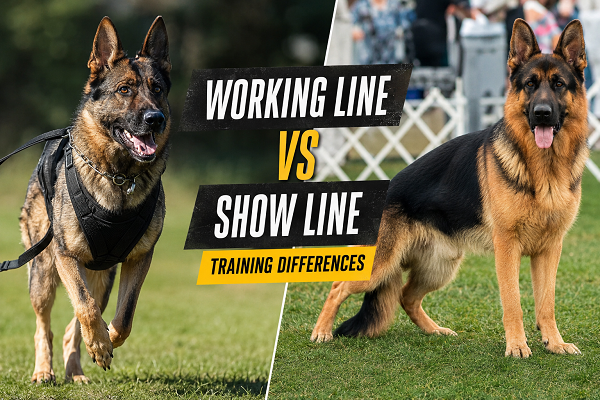
Working line GSDs have high drive, so training means building that drive with play and then teaching the dog to switch off. Expect 90 to 120 minutes of daily exercise and mental work, and start foundation games at 8 weeks. Show line GSDs are calmer and more forgiving of handler mistakes. They usually do well on 45 to 75 minutes a day, but they still need early socialization, structure and real training. In short, working lines need more drive control, and show lines need more confidence and focus building.
Table of Contents
- Working Line vs Show Line GSD Training at a Glance
- What “Line” Really Means (Labels Can Fool You)
- Drive, Nerve and the “Off Switch”
- How You Train Each Line: Rewards, Corrections and Timing
- Puppy Foundation: Weeks 8 to 16
- Training Timelines Side by Side
- Sub-Lines: DDR, Czech, West German and American
- Health Affects Training Too
- Real Costs of Training Each Line
- Common Mistakes and the Fix for Each
- Why Trust This Guide
- Which Line Fits You? A 5-Minute Self-Test
- FAQs
- Conclusion
Introduction
Picture two German Shepherds at the same park. One locks onto a thrown ball like a missile and won’t look away for ten minutes. The other trots over, checks in with its owner, and flops in the shade. Same breed name. Totally different training problem.
That’s the heart of working line vs show line GSD training. Owners often buy a pup because “a German Shepherd is a German Shepherd.” Then, six months later, they’re staring at chewed drywall or a dog that ignores them outside the house. Ever wonder why the same commands work in one dog and fall flat in the other?
In this guide, you’ll learn how each line learns, what motivates it, how to build a calm “off switch,” what timelines to expect, and how to pick the right line for your life. I’ll also fix a few things most articles on this topic get wrong.
Working Line vs Show Line GSD Training at a Glance
Here’s the quick comparison before we dig in.
| Training factor | Working line | Show line |
|---|---|---|
| Drive level | High prey, defense and food drive | Moderate, easier to live with |
| Best reward | Tug, ball, prey games (food second) | Food, praise and play (all tend to work) |
| Daily exercise and mental work | 90–120+ minutes | 45–75 minutes |
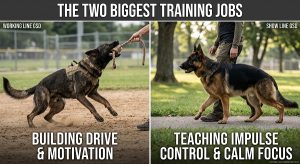
| Biggest training job | Teaching calm and control | Building focus and confidence |
| Tolerance for handler mistakes | Low (learns bad habits fast) | Higher |
| Pressure sensitivity | Often firmer, but varies by dog | Often softer, can shut down under heavy pressure |
| Best for | Sport, detection, protection, experienced owners | Families, obedience, rally, first-time owners |
| Usual first goal | BH test, then IGP | Canine Good Citizen, obedience classes |
What “Line” Really Means (Labels Can Fool You)
Both lines trace back to Captain Max von Stephanitz, who founded the breed in 1899 in Karlsruhe, Germany. He wanted a tireless, intelligent working dog. Over the 20th century, breeders split into two camps. One camp kept selecting for work ability. The other focused on how the dog looks and moves in the ring.
Here’s the part most blogs skip: “show line” isn’t one thing.
- West German show lines usually come through the SV (the German breed club). The SV program judges both structure and performance. It looks at working ability, drive and character alongside conformation.
- American and Canadian show lines often come from breeders who only compete in the conformation ring. Nobody tests work ability there.
The SV rules back this up. To pass a breed survey, a dog must be at least two years old and hold an endurance test (AD) and a BH title. It also needs certified hips and elbows and a breed show rating of “good” or better. A survey-passed dog from a European show line may therefore be steadier and more work-tested than the label suggests.
So don’t buy on the words “show” or “working.” Buy on the parents’ proof: titles, health certificates and temperament results. I’ll show you how in the health section.
Drive, Nerve and the “Off Switch”
Every training plan comes down to managing three drives:
- Prey drive: the urge to chase, grab and hold. Tug and ball work tap into it.
- Defense drive: the reaction to a perceived threat. It matures later and needs careful handling.
- Food drive: the willingness to work for a meal or treat.
Working lines carry all three close to the surface. That’s why they excel at IGP, police work and detection. A show line has the same drives turned down a few notches. That’s easier on your sofa, but you’ll rarely see the same intensity on a bite sleeve or in a long obedience routine.
But here’s the thing: drive alone doesn’t make a trainable dog. Nerve does. Nerve is how fast a dog recovers after a shock. A dog with big drive and weak nerves startles, spins up and struggles to come back down. A moderate-drive dog with solid nerves learns reliably.
The Off Switch: Where Working Line Training Is Won or Lost
A working line dog can go from zero to a hundred in a second. The real training challenge is the trip back down. Here’s the routine I use:
- Teach a mat or place. Reward every second the dog lies still on it.
- Capture calm. When your dog sighs, lies down or relaxes on its own, mark it and reward.
- Build duration slowly. Go from 1 minute to 5, then 15, then 30. Add distance only after time is solid.
- Settle while you’re busy. Cook, answer the door, fold laundry. The dog stays on the mat.
- Use the crate as a reset. After hard work, the dog rests. No debate. (Our guide on how to crate train a puppy like a K9 trainer walks through the setup.)
- Schedule rest days. A dog that never learns to rest becomes a dog that can’t.
Here’s a scenario I see again and again. A new owner exercises a working line pup for two hours, and the dog gets more wound up, not less. Exercise alone builds fitness. The dog needs practice at relaxing to get calm.
Show line dogs usually settle on their own. They still benefit from the same mat work, though, and it’s great for preventing separation anxiety in a breed that bonds hard.
If you want a deeper framework for building calm, reliable obedience in any working breed, my e-book Beyond the Bark: Inside a Pro Handler’s Playbook for Raising the Ideal Dog lays out the structure professional handlers use every day.
How You Train Each Line: Rewards, Corrections and Timing
1. Pick the right paycheck. Working lines often value a tug or a ball above a treat. Use toy rewards for hard work and food for precision, like position changes. Show lines frequently do beautifully on food and praise. Test both. Let the dog tell you what it loves.
2. Watch your timing. A working line learns everything fast, including your mistakes. Mark late and you’ve just taught the wrong behavior. Show lines forgive sloppy timing more. That’s why they suit first-time handlers.
3. Match the pressure to the dog. Some working lines, especially the tougher DDR types, shrug off firm handling. Many show lines are softer and shut down under heavy pressure. Whatever the line, harsh corrections create fear, not reliability. Aim for clear rules, quick marking and calm consistency.
4. Control arousal before you ask for obedience. With a working line, you often need two minutes to bring the dog’s energy down before a command makes sense. Skip that step and you’re teaching a dog to ignore you at high speed.
5. Keep sessions short. Puppies of either line max out around 5 to 10 minutes of focused work. Finish while the dog still wants more.
Puppy Foundation: Weeks 8 to 16
This stage is where the two lines look most alike. The goal is the same: a confident, social, focused pup.
What both lines need:
- Positive exposure to people, surfaces, sounds and other (safe) dogs
- Name recognition and a reward marker like “Yes!”
- Crate time, house training and bite inhibition
- Short, fun engagement games with you as the source of fun
Where the lines differ:
| Working line pup | Show line pup | |
|---|---|---|
| Session style | 3 short sessions a day, about 90% play | Slightly more calm, structured obedience |
| Key games | Tug with a trade (“out”), chase-and-catch, name game | Name game, hand targeting, recall games |
| Impulse control | Must start early: wait for food, wait at doors | Same, but usually easier |
| Biggest risk | Too much formal obedience can dull drive you want later | Too little socialization because the pup “seems chill” |
Protect the joints. Hip dysplasia typically shows up between 2 and 6 months of age in medium and large breeds. That’s exactly when owners love to run puppies hard. Skip forced running, repetitive jumping and slippery floors until your vet and breeder say the joints are ready.
Don’t start real bite work before the pup is emotionally mature, usually not before 8 to 10 months. When you reach protection training, our guide to essential protection dog commands every owner should master shows you the obedience base you need first.
Training Timelines Side by Side
Timelines vary by dog, breed line and trainer. Treat these as realistic averages.
| Age | Working line | Show line |
|---|---|---|
| 8–16 weeks | Engagement, tug, early tracking games, socialization, crate | Socialization, basics, crate, house training |
| 4–6 months | Play-based sit, down, position changes; longer tracking lines | Sit, down, stay, loose-leash walking |
| 6–10 months | Obedience around distractions; drive evaluation | Real-world distractions; reliable recall in safe areas |
| 10–15 months | Bite work typically begins; prepare for BH | CGC-level manners; advanced obedience or rally if desired |
| 15–24 months | BH test, first IGP trial attempts | Conformation or sport classes if you choose |
| 2–5 years | IGP1 to IGP3 titles take years of steady club work | Mature companion, optional titles |
A few notes on this table:
- IGP has three phases: tracking, obedience and protection, scored out of 100 each (300 total). Most FCI-style rules set a minimum trial age of about 15 months. Check your own club’s rulebook.
- Serious IGP handlers typically train with their club two or three times a week, plus short daily sessions at home. That adds up to hundreds of hours before a first trial.
- Adolescence hits both lines, usually between 6 and 18 months. Working lines get pushier and more intense. Show lines can get fearful or distracted. Keep your routine steady, and never punish fear.
Daily Exercise: What It Actually Looks Like
For a full breakdown of how much work is enough, read our guide on how often to exercise a working dog. Here’s a sample day:
- Working line adult: 45 minutes of physical work (fetch with a recall, a controlled run), 30–45 minutes of mental work (tracking, obedience, scent games), plus rest and mat time
- Show line adult: 30–45 minutes of walking or play, 15–30 minutes of training or puzzle work, plus a calm evening
Sub-Lines: DDR, Czech, West German and American
Many articles stop at “working vs show.” But a DDR dog and a West German sport dog can feel like different breeds in your hands.
| Sub-line | Typical feel in training | What to adjust |
|---|---|---|
| West German working | Fast, sporty and precise; often mature earlier | Teach the off switch early; keep timing sharp |
| DDR (East German) | Heavy-boned, firm nerve, slower mental maturity (often 2–3 years) | Be patient, keep the foundation long, avoid rushing bite work |
| Czech working | Very high drive and intensity | Heavy impulse-control work; strong, confident handler |
| West German show (SV) | Moderate drive, biddable, often work-tested through the SV | Great for obedience, rally and tracking; check hips and elbows |
| American show | Lowest drive, softest, most laid-back | Focus on confidence, socialization and weight control |
Ask your breeder directly which line dominates the pedigree. It changes your training plan more than most people expect.
Health Affects Training Too
A sore dog can’t learn. That’s why health belongs in a training guide.
Some breed guides point to the steeper angulation and sloped back of certain show lines as a risk factor for hip trouble. They say working lines tend to have straighter backs and fewer hip and elbow issues. That’s a fair general trend, but the X-ray beats the label. Plenty of show line dogs have excellent hips, and plenty of working dogs don’t.
Genes matter, but they’re not the whole story. One large study of 74 breeds put heritability at about 0.22 for hip scores and 0.17 for elbow scores. That means breeding choices matter, and so do your choices: weight, growth-phase exercise and surfaces.
Before you buy, ask for:
- Hip and elbow certification on both parents (SV or OFA, or your country’s equivalent)
- Proof of work or temperament testing: BH, AD, IGP titles or a character test
- A look at the parents in person, if possible
- The breeder’s plan for socialization before you take the pup home
Real Costs of Training Each Line
Prices change by country and breeder, so treat these as ballpark figures and confirm locally.
- Working line puppies from titled, health-tested parents often run about $1,800–$3,500.
- Show line puppies from health-tested parents commonly run about $2,000–$4,500, more for champion or imported bloodlines.
- Started working dogs (foundation work installed) often cost $5,000–$7,000.
- Fully trained protection or police-candidate dogs can reach $10,000–$20,000+.
- Training: club memberships usually run a few hundred dollars a year. Private protection or sport trainers often charge $150–$300 per session. A basic obedience series for a show line companion typically costs $150–$400.
The bigger cost is time. A working line dog needs hours every week for years. If that doesn’t fit your schedule, the cheaper puppy is the wrong puppy.
Common Mistakes and the Fix for Each
| Mistake | Line | Fix |
|---|---|---|
| Expecting a walk around the block to be enough | Working | Add structured mental work: tracking, obedience, scent games |
| Starting bite work too early | Working | Wait for emotional maturity (usually 8–10+ months) |
| Skipping obedience for “fun” protection | Working | Build foundation first, or you’ll get drive with no brakes |
| Never teaching rest | Working | Daily mat and crate practice |
| Thinking “calm” means “no training needed” | Show | Schedule weekly training and socialization |
| Skipping socialization because the pup seems chill | Show | Plan outings; fear often surfaces in adolescence |
| Easygoing leadership with no rules | Show | Keep structure to prevent clinginess and separation anxiety |
| Under-exercising | Both | Give every GSD real daily physical and mental work |
Why Trust This Guide
This article comes from field experience, not just research. The author, Cpl. Rofiat Muritala, is a Nigerian Army military working dog instructor and handler. She has more than 14 years at the Nigerian Army Dog Centre, with work in dog selection, foundation training, behavior shaping and performance evaluation. She led obedience, explosive detection, agility and tactical movement demonstrations at the Nigerian Army Day Celebration (NADCEL) 2026.
Her core rule? Build the dog the job needs, not the dog you imagined from puppy photos. And always check the facts against breed club rules and the parents’ records.
Which Line Fits You? A 5-Minute Self-Test
Count your “yes” answers.
- Can you give 90+ minutes a day, every day, for 9 to 13 years (the typical GSD lifespan)?
- Do you have a working dog club or an experienced trainer nearby?
- Do you want to compete in IGP, PSA, Mondioring or detection work?
- Have you owned a high-drive breed before?
- Can you handle a dog that needs firm, fair, perfectly timed training?
- Is your household calm enough to enforce rest time?
- 5–6 yes: A working line dog could be a great match.
- 3–4 yes: Consider a SV-survey show line or a carefully chosen mixed line.
- 0–2 yes: A calm show line (or a different breed) is the smarter, happier choice.
FAQs
1. Is a working line GSD harder to train than a show line?
It depends on your goal. For sport and protection work, working lines learn faster and go further. For basic family obedience, show lines are usually easier because they’re calmer and more forgiving. Working lines aren’t “harder,” but they punish sloppy timing and skipped rest.
2. Can a show line German Shepherd do protection work or IGP?
Some do. Individual show line dogs with strong nerve and enough drive have earned IGP titles. But they’re the exception, and most trainers evaluate each dog’s temperament first. If protection work is your main goal, a work-tested line gives you better odds.
3. At what age should serious training start?
Foundation games start at 8 weeks for both lines. Formal obedience grows through 4 to 10 months. Bite work, if you pursue it, typically begins around 8 to 10 months or later, once the dog is emotionally mature.
4. Do working line GSDs make good family dogs?
They can, in the right home. Families with time, structure and a trainer on their side do well. Without exercise, mental work and rest training, a working line dog gets destructive and wound up.
5. How do I teach a working line GSD to calm down indoors?
Use mat training, capture calm behavior, and build duration slowly. Add crate rest after exercise and keep a consistent routine. Make calm the job, and reward it the way you’d reward a bite.
Conclusion
Working line and show line German Shepherds share a name and a history, but they ask for very different things from you. Working lines give you extraordinary focus and drive, and in return you owe them structure, daily work and a trained off switch. Show lines offer an easier entry into GSD life, but they still need socialization, exercise and real training to become the dog you pictured.
Your next steps:
- Take the self-test above and answer it honestly.
- Ask any breeder for hip and elbow certificates, work titles and a chance to meet the parents.
- Find a trainer or club before the puppy comes home.
- Start mat and crate practice on day one.
Want more practical K9 training advice every week? Subscribe to our weekly articles roundup newsletter and get our best handler tips straight to your inbox.

Her work centres on obedience, detection, protection and operational readiness. She favours proven methods built on repetition, consistency and real-world conditioning, so that both dogs and handlers are prepared for high-pressure tasks.
Rofiat represented the Nigerian Army Dog Centre at the Nigerian Army Day Celebration (NADCEL) 2026, where she led demonstrations in obedience, explosive detection, agility and tactical movement. Through articles, training content and documentaries, she shares field-based insight into how structured training, clear communication and trust between handler and dog affect performance and reliability.
She is the author of Beyond the Bark: Inside a Pro Handler's Playbook for Raising the Ideal Dog, a practical guide that helps dog owners and handlers apply professional training principles in everyday situations.
- How to Enter the COBA National Dog Championship - October 20, 2026
- K9 Advantix Dosage Chart & Safety Guide for Dogs - October 19, 2026
- How to Set Up & Use Bousnic Dog Training Collar - October 18, 2026