Top 7 Search and Rescue (SAR) Dog Breeds
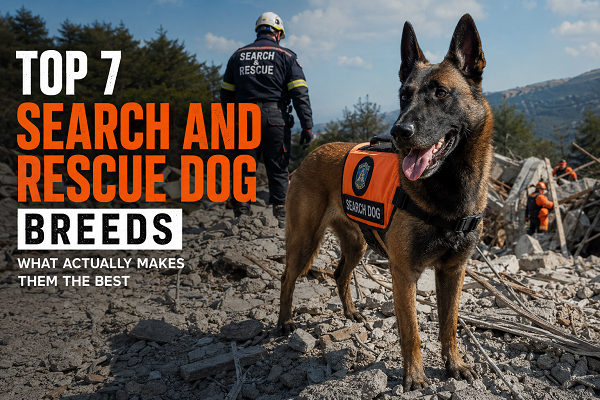
The top 7 search and rescue dog breeds are the Belgian Malinois, German Shepherd, Labrador Retriever, Border Collie, Bloodhound, Golden Retriever, and Newfoundland. Each one earns its spot for a different reason, the Malinois and German Shepherd dominate rubble and wilderness search, the Labrador and Golden Retriever lead disaster and cadaver work, the Border Collie brings unmatched trainability, the Bloodhound owns scent trailing, and the Newfoundland is still the gold standard for water rescue.
Table of Contents
- Introduction
- What Makes a Dog Suited for Search and Rescue Work
- The Top 7 Search and Rescue Dog Breeds
- How SAR Dogs Are Actually Trained and Certified
- The 4 Types of SAR Work (And Why Breed Matters for Each)
- Real Cases That Show What These Dogs Can Do
- How to Get Your Dog Started in SAR Work
- FAQs
- Conclusion
Introduction
Picture this: a building collapses after an earthquake, and somewhere under forty feet of concrete and rebar, a survivor is running out of air and hope. Human search teams can spend hours combing through rubble with cameras and listening devices and still miss them. A trained SAR dog can find that same person in minutes, using nothing but scent carried up through cracks in the debris.
That’s not an exaggeration, it’s the entire reason search and rescue dog programs exist. If you’re a dog owner wondering whether your Malinois or Lab has what it takes, a first responder building a K9 unit, or just someone who wants to understand why certain breeds keep showing up at disaster zones from Türkiye to Turkey Creek, this guide is for you.
By the end, you’ll know exactly which breeds dominate SAR work and why, what real certification actually costs and takes in time, the difference between air-scent, trailing, cadaver, and water rescue dogs, and how you can get your own dog started if you’re serious about the work. We’ll also walk through some real cases, including one dog who searched at Ground Zero, so you can see what separates a good family pet from a true working SAR dog.
What Makes a Dog Suited for Search and Rescue Work
Not every high-energy dog can do this job, and that surprises a lot of people. A dog that’s “smart” in the obedience-class sense isn’t automatically SAR material. What handlers actually look for is a very specific combination of traits:
- Independent hunt drive – the dog has to want to search even when the handler can’t see or direct them
- Strong toy or prey drive – most SAR dogs are trained using a reward-based system built around a favorite toy, not food
- Physical stamina and agility – climbing rubble, swimming, or covering miles of wilderness terrain for hours at a time
- Emotional stability under chaos – sirens, crowds, gunfire-level noise, unstable footing, and strong distracting smells can’t rattle them
- A clean bill of health – sound hips, elbows, and cardiovascular fitness, since the job is physically brutal
Here’s the twist most people don’t expect: the exact traits that get a dog labeled “too much dog” for a family home, obsessive drive, restlessness, an inability to settle, are frequently the traits that make a dog exceptional at this job. The National Disaster Search Dog Foundation (SDF) in the US has built its entire recruitment model around this idea, pulling dogs out of shelters specifically because their intensity made them unadoptable as pets.
The Top 7 Search and Rescue Dog Breeds
1. Belgian Malinois
If you’ve ever worked with a Malinois, you already know they operate on a different gear than most dogs. Originally bred in Belgium to herd livestock, Malinois have become the go-to breed for military and elite K9 units worldwide and that same intensity translates directly into disaster search work.
Why they excel:
- Extremely high work drive and near-obsessive focus once given a task
- Fast, agile, and built to move across unstable rubble without hesitation
- Can be trained for live-find search, cadaver detection, and even scent-based medical detection
One standout example is Shiraz, a Malinois out of Havana, Florida, who worked alongside police and sheriff’s departments specializing in human remains detection. Over a career spanning more than 70 searches, Shiraz earned an American Kennel Club Humane Fund Award for Canine Excellence, a reminder that this breed’s intensity, when channeled correctly, saves lives well into their senior years.
The tradeoff? Malinois are not a “set it and forget it” breed. Without a real job, that drive turns into destroyed furniture and a frustrated owner.
2. German Shepherd
The German Shepherd has been the backbone of K9 search work for decades, and honestly, it’s earned that reputation the hard way. The American Rescue Dog Association (ARDA) has spent more than 35 years building its search program largely around German Shepherds, and it’s easy to see why, they combine trainability, scenting ability, and raw physical toughness in a package that adapts to almost any environment.
Why they excel:
- Versatile enough to work wilderness, urban disaster, and cadaver search
- Strong bonding instinct with a single handler, which matters during long deployments
- Proven performance across decades of real-world FEMA and police deployments
German Shepherds also happen to be one of the five most common breeds used across the entire FEMA Urban Search & Rescue canine system, alongside Labradors, Golden Retrievers, Malinois, and Border Collies, which tells you everything about how well this breed holds up under real operational pressure.
3. Labrador Retriever
Here’s a fact that surprises a lot of casual dog owners: the friendly, food-obsessed Lab you see at the dog park is also the single most-used breed in American search and rescue work. Labs top the list not because they’re the flashiest workers, but because they combine trainability, temperament, and physical versatility better than almost any other breed.
Why they excel:
- Calm, social temperament that holds up around chaotic crowds and emergency responders
- Strong swimming ability and a water-resistant coat, making them excellent for water-adjacent disaster response
- High food and toy motivation, which makes scent training more consistent
Labs became forever linked to SAR work after 9/11, when Labrador search teams worked alongside German Shepherds and Golden Retrievers at Ground Zero, searching the wreckage for survivors and, later, remains. If you want to go deeper on how handlers build that kind of obedience-under-pressure in any working breed, our piece on dog obedience vs. instinct breaks down exactly how trainers balance the two.
4. Border Collie
You might not immediately think “Border Collie” when picturing a SAR dog, but ask any handler who’s worked with one, and they’ll tell you: this breed’s problem-solving ability is almost unfair. Bred for generations to read subtle body language and make independent decisions while herding sheep across open terrain, Border Collies bring that same sharp instinct to search work.
Why they excel:
- Exceptional trainability, often considered the most intelligent breed for complex command sequences
- High endurance for covering large wilderness search areas
- Strong air-scent ability paired with an intense desire to work
The tradeoff is size and coat. Border Collies aren’t ideal for confined-space rubble searches the way a Malinois or Lab is, which is why they’re used far more often in wilderness air-scent search than in urban disaster response.
5. Bloodhound
No breed on this list has a resume like the Bloodhound. This is the dog that made scent-tracking evidence admissible in a U.S. court of law in the first place, a distinction recognized by Guinness World Records. Bloodhounds carry between 230 million and 300 million scent receptors, roughly 40 times what a human has, and their long ears and loose facial skin are actually functional: they stir up and trap ground-level scent right at nose height.
Why they excel:
- Unmatched ability to follow a single, specific person’s scent trail over long distances and cold trails
- Used heavily for missing persons, escaped suspects, and lost hikers
- Can trail scent that’s days old under the right conditions
That said, don’t take Bloodhound accuracy as magic. Research into scent-discrimination dogs found accuracy ranging from roughly 53% to 97%, with the most reliable dogs being those with 18+ months of consistent, ongoing training and real case experience, not just kennel-club pedigree. This is exactly why serious SAR programs re-certify their teams every few years instead of assuming a title lasts forever.
6. Golden Retriever
Golden Retrievers get grouped with Labs a lot, and for good reason, the two breeds share a lot of the same traits that matter for SAR work. But Goldens bring their own edge: an almost eerie ability to stay calm and focused in emotionally charged environments, which matters enormously in disaster zones full of grieving families and stressed responders.
Why they excel:
- Steady, biddable temperament that handles high-stress environments well
- Strong scenting ability paired with a cooperative, handler-focused personality
- Frequently used in both live-find and human remains detection roles
Golden Retrievers are also one of the breeds SDF actively recruits and trains for its firefighter-partnered search teams in the US, right alongside Labs, Border Collies, and Malinois.
7. Newfoundland
If your search scenario involves water, flooding, capsized boats, drowning victims, this is the breed you want. Newfoundlands were originally bred to assist fishermen off the coast of Canada, hauling nets and pulling people from freezing water, and they’re built for exactly that: webbed feet, a thick double coat, and enormous physical strength.
Why they excel:
- Natural swimming ability strong enough to tow a person or even a small boat to shore
- Calm, gentle temperament despite their massive size (often 100–150+ pounds)
- Excellent in flood response and water rescue scenarios where other breeds struggle
They’re a specialist, not a generalist, you won’t see a Newfoundland climbing through earthquake rubble but for coastal and flood-response teams, nothing else on this list comes close in the water.
How SAR Dogs Are Actually Trained and Certified
This is where a lot of the romanticized version of SAR work falls apart, honestly. It’s not a weekend hobby.
According to FEMA’s own Urban Search & Rescue canine program, it typically takes six months to two years to bring a canine candidate to certification through either FEMA or the State Urban Search and Rescue Alliance (SUSAR), depending largely on the age training started. Dogs must be at least 18 months old to test, and most don’t test until closer to age two, once they’re physically and emotionally mature enough for the job.
Here’s what the process usually looks like:
- Screening and selection (early puppyhood to 12–18 months) — assessing hunt drive, toy possession, agility, and temperament
- Foundation scent and obedience training — building command response and search fundamentals
- Certification testing — dogs are tested on command response, agility, a focused bark alert for live finds, and the ability to keep working despite noise, weather, and food distractions; handlers are tested separately on search strategy, mapping, and briefing skills
- Recertification — teams must recertify every three years to stay operationally active
The National Disaster Search Dog Foundation has pushed this timeline down significantly through a professionally structured program, their goal is certifying teams within 18 months of pairing a dog with a firefighter handler, and in recent years some teams have certified in as little as six months.
And the cost? This part rarely makes it into glossy news segments. Most FEMA and SUSAR handlers fund their own training out of pocket, travel, fuel, equipment, veterinary care, and housing during multi-state training exercises are typically paid by the handler, not the agency. A working FEMA search dog’s career also isn’t a long one: five to seven years is typical, which means handlers usually have to start training a successor around the time their current dog turns 6–8 years old.
If you’re building the discipline foundation for any working dog, SAR or otherwise, it starts long before certification testing. Our guide on how military working dogs are trained covers a lot of the same foundational principles SAR programs rely on.
The 4 Types of SAR Work
Breed choice really comes down to which category a dog will specialize in:
- Air-scent search – the dog works off-leash, sweeping an area to detect any human scent carried on the wind (great for wilderness and missing-hiker cases)
- Trailing/tracking – the dog follows a specific individual’s scent trail from a known starting point, usually on a long lead (Bloodhounds excel here)
- Human remains detection (HRD/cadaver) – trained specifically to alert on deceased human scent, used after disasters and in criminal investigations
- Water and disaster-specific search – includes flood response, avalanche search, and rubble/collapsed-structure search, each requiring different physical builds and training protocols
A single dog is almost never cross-trained across all four categories at a high level, most programs specialize a dog in one or two disciplines to keep their alerts reliable and their training sharp.
Real Cases That Show What These Dogs Can Do
Numbers are useful, but stories are what stick with people.
- Oklahoma City, 1995 — Wilma Melville, a retired schoolteacher, deployed with her FEMA-certified Lab, Murphy, to search the bombing site. She discovered only 15 certified canine-human search teams existed in the entire country at the time. That gap led her to found the National Disaster Search Dog Foundation, which has since trained and certified more than 229 search teams.
- 9/11, New York City — Search dogs, heavily represented by Labrador Retrievers, German Shepherds, and Golden Retrievers, worked around the clock at Ground Zero, one of the most extensively documented large-scale SAR deployments in modern history.
- The Swiss Alps, more recently — a small Chihuahua made international headlines after her owner slipped into a glacier crevasse while hiking. The dog barked and refused to leave the scene until passing hikers noticed and alerted a rescue crew, proof that raw alerting instinct matters as much as breed size.
These aren’t outliers, they’re the pattern. Every major disaster response in the last three decades, from earthquakes to bombings to avalanches, has leaned on the same handful of breeds because they consistently deliver under pressure.
How to Get Your Dog Started in SAR Work
If this article has you seriously considering SAR work with your own dog, here’s the realistic starting point:
- Honestly evaluate drive and temperament — not every dog with energy has the specific hunt drive and toy obsession SAR training requires
- Get a full veterinary workup — hips, elbows, and cardiovascular health need to be cleared before serious training begins
- Connect with a local SAR or K9 unit — organizations like ARDA, SARDUS, or regional SUSAR groups often welcome new handler-dog teams into structured training
- Commit to the long game — expect 6 months to 2 years of consistent, weekly training before certification is even possible
- Understand this is a lifestyle, not a hobby — ongoing training, travel, and recertification every three years continue for the dog’s entire working life
Whatever discipline you and your dog end up in, the foundation is always the same, solid obedience, controlled drive, and a bond built on trust. If you want a deeper, practical breakdown of building that foundation from day one, our team put together the e-book Beyond the Bark, which walks handlers through exactly this kind of drive-and-obedience development for working dogs.
Trainer’s Note: Insights from the ARFS K9 Training Team
We work with high-drive breeds every day, the same Malinois, German Shepherd, and working-line temperaments that show up throughout this list and one thing stays consistent across every discipline, whether it’s protection work, military-style obedience, or search training: drive without structure is just chaos with four legs. The dogs that make it as SAR candidates are rarely the “easiest” dogs in the litter. They’re the ones that needed a job. If you’re evaluating whether your own dog could handle this kind of work, start by looking honestly at how they behave with unmet energy that tells you more than any breed chart ever will. And if you want to understand the difference between a dog that just obeys and one that thinks independently under pressure, our breakdown of K9 canine vs. pet dog differences is a good next read.
FAQs
1. What is the best all-around search and rescue dog breed?
There isn’t one single “best” breed for every scenario, but the German Shepherd and Labrador Retriever are the most versatile, performing well across wilderness, urban disaster, and water-adjacent search work, which is why they’re two of the five most commonly used breeds in the FEMA canine system.
2. How long does it take to train a search and rescue dog?
Most SAR dogs take between six months and two years to reach certification, depending on the age training starts and how consistently the handler-dog team trains. Programs like the National Disaster Search Dog Foundation have pushed some teams to certification in as little as six months using a structured, professional training model.
3. How much does it cost to train a SAR dog?
There’s no fixed number, but most FEMA and SUSAR handlers cover training-related travel, fuel, equipment, veterinary care, and housing out of pocket, since this work is largely volunteer-based. Nonprofits like SDF cover the cost of professionally trained dogs for partnered fire departments at no charge to the agency.
4. Can any dog breed become a search and rescue dog?
In theory, any breed with the right drive, health, and temperament can attempt basic scent work, but the physical and mental demands of certified SAR work consistently favor a small group of breeds, Belgian Malinois, German Shepherds, Labradors, Golden Retrievers, Border Collies, and Bloodhounds make up the vast majority of certified teams worldwide.
5. What breed is best for tracking a missing person’s scent trail?
The Bloodhound is the clear specialist here, with up to 300 million scent receptors and a proven legal track record, Bloodhound scent evidence has been recognized as admissible in U.S. courts since the late 1800s, longer than any other breed’s tracking ability.
Conclusion
If you take one thing away from this guide, let it be this: the “best” SAR dog breed depends entirely on the job in front of it. A Belgian Malinois climbing through earthquake rubble, a Bloodhound following a three-day-old scent trail, and a Newfoundland pulling a swimmer out of a flooded river are all doing search and rescue work, they’re just not doing the same job.
If you’re a handler or agency building a program, match the breed to your most common deployment scenario first, then screen individual dogs hard for drive, health, and temperament before you fall in love with a breed standard on paper. And if you’re a dog owner just curious whether your high-energy pup has what it takes, the honest answer is: maybe, but find a local SAR or working-dog training group before you assume anything. The dogs that succeed in this field aren’t chosen because of their pedigree alone. They’re built, over months and years, by handlers willing to put in the work right alongside them.
Author’s note: This article was researched and written with insights from the ARFS K9 Training Team, drawing on established programs including FEMA’s Urban Search & Rescue canine system, the National Disaster Search Dog Foundation, and the American Rescue Dog Association.

Her work centres on obedience, detection, protection and operational readiness. She favours proven methods built on repetition, consistency and real-world conditioning, so that both dogs and handlers are prepared for high-pressure tasks.
Rofiat represented the Nigerian Army Dog Centre at the Nigerian Army Day Celebration (NADCEL) 2026, where she led demonstrations in obedience, explosive detection, agility and tactical movement. Through articles, training content and documentaries, she shares field-based insight into how structured training, clear communication and trust between handler and dog affect performance and reliability.
She is the author of Beyond the Bark: Inside a Pro Handler's Playbook for Raising the Ideal Dog, a practical guide that helps dog owners and handlers apply professional training principles in everyday situations.
- Is K9 Advantix Safe for Dogs? A Handler’s Honest Review - October 2, 2026
- Australian Cattle Dog vs Blue Heeler: Any Difference? - October 1, 2026
- Bousnic Dog Training Collar Review: Is It Safe? - September 30, 2026