K9 Canine vs Pet Dog: 5 Key Differences You Should Know
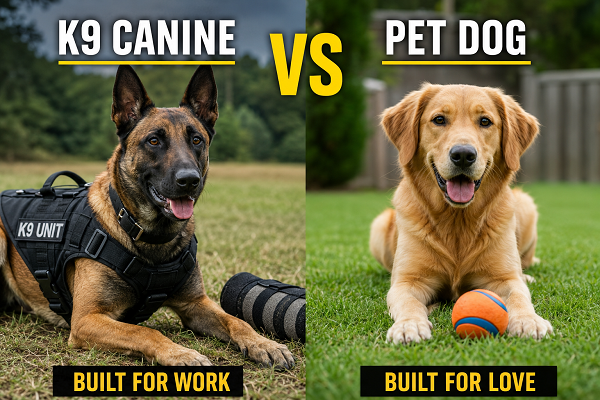
The five biggest differences between a K9 canine and a pet dog are (1) purpose-driven breeding versus companion breeding, (2) hundreds of hours of certified working training versus basic obedience, (3) legal status as equipment/personnel versus a family pet with no formal rights, (4) selectively bred drive and nerve strength versus a more balanced pet temperament, and (5) a working lifestyle with a defined retirement versus a lifelong role as a companion.
Table of Contents
- Introduction
- What Exactly Is a K9 Canine?
- Difference #1: Purpose-Built Breeding vs. Companion Breeding
- Difference #2: Training Intensity, Hours, and Certification
- Difference #3: Legal Status and Rights
- Difference #4: Drive, Nerve, and Temperament
- Difference #5: Daily Life, Working Career, and Retirement
- Can a Pet Dog Ever “Become” a K9?
- What This Means If You’re Choosing a Dog
- FAQs
- Conclusion
Introduction
I’ve spent years around working dogs, training decoys, running bite work, and watching green dogs turn into confident operational partners. I’ve also watched plenty of family pets grow up in the same neighborhoods, loved just as much but built for a completely different job. So let’s break this down properly, because understanding the difference matters whether you’re thinking about getting a working-line dog as a pet, considering a K9 career, or just trying to figure out why your neighbor’s Malinois acts nothing like your golden retriever.
What Exactly Is a K9 Canine?
A K9 (the term comes from the phonetic shorthand for “canine”) is a dog trained and certified to perform a specific working role for a government agency, security company, or licensed handler. Think patrol dogs, explosive detection dogs, narcotics detection dogs, search and rescue dogs, and protection dogs. In the US, agencies like the Transportation Security Administration run the National Explosives Detection Canine Team Program, which has certified thousands of handler-dog teams since it started in the 1970s. In the UK, the National Police Air Service and regional police forces run their own dog sections with similarly rigorous standards.
A pet dog, on the other hand, is bred and raised primarily for companionship. No certification, no deployment, no mission. Just a good boy or girl who’s there for walks, cuddles, and chewing your shoes.
That distinction sounds simple, but it shapes everything else, from the womb to retirement.
Difference #1: Purpose-Built Breeding vs. Companion Breeding
Here’s the thing most people don’t realize: K9s and pet dogs are often bred by completely different philosophies, even within the same breed.
Take the German Shepherd. A working-line German Shepherd (bred for police, military, or sport work) is selected generation after generation for drive, nerve strength, and physical endurance. A show-line German Shepherd is selected more for structure, movement, and conformation to breed standards. Both are technically the same breed, but their genetics point them toward very different lives. We covered this exact contrast in detail in our piece on working line vs show line GSD training differences, and honestly, it’s one of the clearest real-world examples of how breeding purpose shapes a dog before it ever meets a trainer.
Belgian Malinois breeders supplying police and military programs test litters as early as 6-8 weeks for prey drive, hunt drive, and object focus using ball and tug drive assessments. Breeders producing pets rarely run this kind of testing, they’re focused on temperament stability and adaptability to family life instead.
A few numbers that put this in perspective:
- The Belgian Malinois has become the dominant breed in US military and federal K9 programs, largely replacing the German Shepherd since the early 2000s, because of its lighter frame, higher drive, and faster recovery from heat stress.
- Reputable working-dog breeders often produce litters specifically earmarked for police or military evaluation before the puppies are even eight weeks old, sometimes under contract to agencies or brokers.
- Pet-line breeding programs, by contrast, prioritize traits like lower reactivity, easier trainability for a first-time owner, and a calmer “off switch” at home.
This is why you can’t just take any German Shepherd or Malinois puppy from a family breeder and expect it to have K9 potential. The genetics simply weren’t selected for it.
Difference #2: Training Intensity, Hours, and Certification
This is probably the difference people feel the most.
A pet dog might go through 6-8 weeks of basic obedience classes such as sit, stay, come, loose-leash walking and that’s considered “well trained.” Maybe some owners go further with advanced obedience or a canine good citizen test through a kennel club.
A K9, by comparison, goes through a completely different scale of training:
- Basic patrol dog certification in the US typically requires 400-600 hours of initial training before a dog is deployed, according to standards referenced by the United States Police Canine Association (USPCA).
- Detection dogs (narcotics, explosives) often need an additional 200+ hours specifically on odor recognition, imprinting, and false-alert reduction.
- Recertification isn’t optional. Most K9 units require annual or even biannual recertification through bodies like the USPCA or the North American Police Work Dog Association (NAPWDA) to keep the dog operationally valid.
- In protection sport circles, IGP (formerly Schutzhund) titling, tracking, obedience, and protection, takes most handlers 12-18 months of consistent, structured work just to reach IGP1, and that’s for a sport title, not even operational deployment.
I’ve trained dogs going through this pipeline, and the honest truth is that the dog isn’t the only one being trained, the handler is being built into a working team member too. That’s a huge difference from pet ownership, where the “team” is really just you and a companion navigating daily life together.
If you’re working with a working-line dog at home and want a structured approach to building real obedience and drive control (not just basic manners), our team put together a practical, field-tested training breakdown in our e-book on building obedient, confident working dogs. It’s the same framework we use with dogs headed into serious working roles, scaled down so pet owners with drivey breeds can actually use it.
Difference #3: Legal Status and Rights
Ever wonder why harming a police K9 often carries a felony charge, while harming someone’s pet dog (as horrible as that is) usually falls under a lesser offense? That’s not an accident, it’s because of how the law classifies working K9s.
In the US:
- Many states classify assaulting a police K9 as a felony under “law enforcement animal” statutes, similar to assaulting an officer. Federal law under 18 U.S. Code § 1368 also criminalizes harming government-owned animals used in law enforcement.
- Police K9s are frequently treated as agency equipment or personnel for liability and workers’ compensation purposes, which affects everything from injury claims to line-of-duty death benefits for the handler’s department.
In the UK:
- “Finn’s Law,” officially the Animal Welfare (Service Animals) Act 2019, was introduced specifically to close a loophole after a police dog named Finn was stabbed while protecting his handler and the attacker initially faced the same charge as if he’d damaged property. The law now allows courts to consider a service animal’s welfare independently, rather than only as “criminal damage.”
A pet dog doesn’t carry any of this legal weight. Emotionally, of course, a pet is family, but legally, in most jurisdictions, a pet is still classified as personal property, and offenses against it are treated very differently than offenses against a working K9.
There’s also the question of public access. Service dogs (a different category from K9s, but often confused with them) have legal public access rights under laws like the Americans with Disabilities Act in the US. A pet dog, no matter how well-behaved, generally doesn’t have the legal right to enter restaurants, stores, or public transport the way a certified service dog or an on-duty K9 does.
Difference #4: Drive, Nerve, and Temperament
So here’s where things get interesting from a training and behavior standpoint. K9s are selected and then further shaped through training, for traits that would honestly be a nightmare in most pet homes if left unchannelled.
Prey drive: The instinct to chase, grab, and hold onto moving objects. In a K9, this gets channeled into apprehension work and detection games (the dog thinks finding narcotics is basically a game of hide-and-seek with a toy reward). In an untrained pet, high prey drive without an outlet can mean chasing cars, cats, or joggers.
Defense drive: How a dog responds when it feels threatened, fight or flight. Working K9s are tested and developed for controlled fight drive, meaning they can engage confidently under pressure and then switch off on command. This is measured through “threshold testing,” where trainers assess how much pressure a dog can absorb before its behavior changes.
Nerve strength: This is the dog’s ability to stay stable under loud noises, sudden movement, gunfire, or unfamiliar environments. A K9 candidate that startles at a dropped metal bowl and doesn’t recover within a few seconds usually gets washed out of the program, this is one of the most common reasons working-dog candidates fail evaluation, alongside weak hunt drive and poor environmental stability.
Pet dogs are bred and selected for something closer to the opposite: emotional stability without needing that same level of controlled intensity. A well-bred family dog should be confident, sure, but nobody’s testing whether it can hold a bite grip through a gunshot simulation.
This is also why so many working-line dogs struggle in pet homes without a job. We’ve talked before about the dog training mistakes handlers and owners make when they underestimate how much structured outlet a high-drive dog actually needs, a bored working-line dog isn’t a calm dog, it’s a dog looking for its own job, and that job is often something you didn’t sign up for (hello, destroyed drywall).
Difference #5: Daily Life, Working Career, and Retirement
A pet dog’s life follows a fairly predictable arc: puppyhood, adolescence, adulthood, senior years, all spent largely in the same home with the same routine.
A K9’s life is structured very differently:
- Deployment age: Most K9s begin operational work between 12 and 24 months old, after initial training and certification.
- Working career length: Typically 6-9 years of active service, depending on the role and the physical demands of the job. Detection dogs sometimes work longer than patrol/apprehension dogs because the physical wear is lower.
- Retirement: Historically, retired military and police K9s were sometimes euthanized or left behind, which sounds shocking today, but it was real practice for decades. Robby’s Law, passed by the US Congress in 2000, changed federal policy so that retired military working dogs could be adopted rather than destroyed. Most police departments now have adoption policies too, and it’s become common (and honestly heartwarming) for handlers to adopt their own retired partner.
- Cost of a working dog’s career: Training and acquiring a single certified police K9 can cost a department anywhere from $10,000 to $25,000+ in the US, before ongoing veterinary care, equipment, and handler training are factored in. Many K9 units rely partly on donations and nonprofit fundraising to cover these costs.
Pet dogs, meanwhile, live their whole lives as family members, no deployment, no retirement ceremony, no adoption paperwork when they get older. Their “job,” if you can call it that, is simply being loved and loving you back.
Can a Pet Dog Ever “Become” a K9?
Technically, some family-owned dogs have gone on to working roles, especially in detection work, which relies more on nose and drive than raw physical intensity. Programs like Guide Dogs for the Blind and various detection-dog nonprofits do pull dogs from foster and even shelter environments.
But realistically? It’s rare, and it usually still comes back to genetics. A dog needs the right drive, nerve, and physical soundness baked in from breeding before training can build the rest. You can’t train drive into a dog that simply wasn’t born with it, you can only develop what’s already there.
What This Means If You’re Choosing a Dog
If you’re reading this because you’re trying to decide what kind of dog to bring home, here’s my honest take as someone who’s spent time on both sides of this line:
- Want a companion who fits into a normal household routine? Look at pet-line breeding, not working-line, even within the same breed.
- Want a working-line dog as a pet anyway (it happens, they’re gorgeous, smart dogs)? Be ready to give it a real job: structured training, sport work like IGP or agility, or serious daily mental and physical outlets. Our Security & Family Safety articles go deeper into what that structure looks like for protection-capable breeds specifically.
- Considering a K9 career yourself? Most handlers come from a law enforcement, military, or licensed security background first, then apply into a canine unit, it’s rarely an entry-level role.
- Already own a high-drive breed and struggling with structure at home? That’s exactly the gap our training resource was built to close, it walks through the same foundational obedience and drive-channeling techniques we use with working dogs, adapted for home life.
And whichever path you’re on, don’t neglect the basics of canine health and nutrition either, a working dog’s diet and conditioning needs are genuinely different from a low-activity pet’s, something we cover more in our Health & Nutrition section.
FAQs
1. What does K9 actually stand for?
K9 isn’t an acronym, it’s simply a phonetic play on the word “canine.” It’s used worldwide to refer to working dogs employed by police, military, and security agencies.
2. Can any breed become a K9?
No. While German Shepherds, Belgian Malinois, Dutch Shepherds, and Labrador Retrievers dominate most K9 programs, the dog also needs to pass drive, nerve, and health evaluations specific to the working role. Breed alone doesn’t guarantee suitability.
3. Is it illegal to hurt a police dog?
In most US states and under UK law (via Finn’s Law), harming a working police or service animal carries harsher penalties than harming a typical pet, often treated closer to assaulting an officer rather than simple property damage.
4. How long does it take to train a K9?
Initial certification for a patrol dog generally takes 400-600 hours, often over 12-16 weeks of dedicated training, with additional specialty training (detection, tracking) layered on afterward. Ongoing recertification continues throughout the dog’s working career.
5. Do retired K9s live normal pet lives afterward?
Yes, in most modern programs. Thanks to laws like Robby’s Law in the US, retired K9s are typically adopted, often by their own handler, and go on to live out their remaining years as a family pet, sometimes their first real taste of a “normal” dog life.
Conclusion
A K9 canine and a pet dog might share the same species, and sometimes even the same breed, but they’re built and raised for two very different purposes. From selective breeding and hundreds of certified training hours, to legal protections and an entirely different life arc, the gap between them is bigger than most people realize until they see it up close.
If there’s one thing I want you to take away from this: don’t judge a working-line dog by pet-dog standards, and don’t expect a pet-line dog to perform like a K9 without the genetics and training behind it. Match the dog’s breeding and drive to the life you’re actually going to give it, that’s the single biggest predictor of whether you end up with a happy, balanced dog or a frustrated one looking for a job you never gave it.
Whether you’re raising a family companion or working toward something more operational, understanding this distinction from day one will save you a lot of confusion and set your dog up for the life it was actually built for.
Insights from the ARFS K9 Team: written with input from handlers with hands-on military and security K9 experience, combining field-tested training knowledge with current global standards for working and pet dogs.

Her work centres on obedience, detection, protection and operational readiness. She favours proven methods built on repetition, consistency and real-world conditioning, so that both dogs and handlers are prepared for high-pressure tasks.
Rofiat represented the Nigerian Army Dog Centre at the Nigerian Army Day Celebration (NADCEL) 2026, where she led demonstrations in obedience, explosive detection, agility and tactical movement. Through articles, training content and documentaries, she shares field-based insight into how structured training, clear communication and trust between handler and dog affect performance and reliability.
She is the author of Beyond the Bark: Inside a Pro Handler's Playbook for Raising the Ideal Dog, a practical guide that helps dog owners and handlers apply professional training principles in everyday situations.
- Bousnic Dog Training Collar Review: Is It Safe? - September 30, 2026
- Gravy Train Dog Food Review: Ingredients & Recalls - September 30, 2026
- How to Spot Fake AKC Registered Dogs: 5 Warning Signs - September 29, 2026