Fix Bad Dog Habits: Simple Obedience Tips That Work
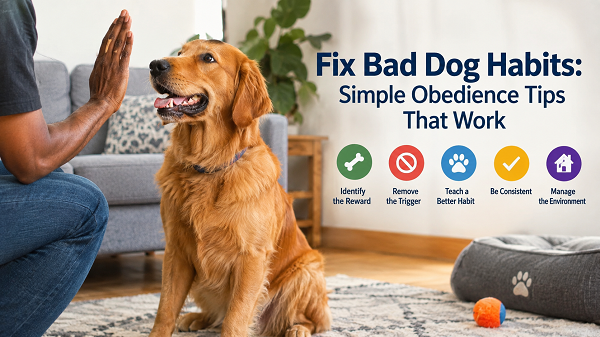
To fix a bad dog habit, identify what’s rewarding the behavior, remove that reward, teach an incompeting “replacement” behavior, reinforce it consistently for 2–8 weeks depending on how long the habit’s been practiced, and manage the environment so your dog can’t rehearse the old habit while the new one sticks. Most simple habits (jumping, mild pulling, begging) improve within 2–3 weeks of daily 5–10 minute sessions; deeper-rooted ones (leash reactivity, separation-related destruction) can take 8–12 weeks or professional support.
Table of Contents
- Why Dogs Develop Bad Habits in the First Place
- The 5-Step Framework for Fixing Any Bad Habit
- Fixing the Most Common Bad Habits, One by One
- How Long Does It Actually Take to Fix a Bad Habit?
- Mistakes That Make Bad Habits Worse
- Does Breed Matter? What the Data Says
- When to Call a Professional Trainer (and What It Costs)
- A Trainer’s Honest Take: Why This Approach Works
- FAQs
- Conclusion: Your Next Steps
Introduction
Your dog isn’t giving you a hard time. He’s having a hard time, and somewhere along the way, he learned that jumping, barking, pulling, or counter-surfing gets him what he wants. The good news? Bad habits aren’t permanent character flaws. They’re learned behaviors, and anything learned can be un-learned with the right approach..
I’ve spent years working hands-on with working and pet dogs, from green puppies to dogs that came to me because three other approaches had already failed. Almost every single “stubborn” or “disobedient” dog I’ve met wasn’t stubborn at all. The habit was being accidentally rewarded by the owner, and nobody had shown the dog a better option. This guide walks you through exactly how to break that cycle, with real timelines, real numbers, and the same framework professional trainers use.
By the end of this article, you’ll know why dogs develop bad habits in the first place, the 5-step framework trainers use to fix almost any behavior problem, specific fixes for the most common bad habits (jumping, barking, pulling, chewing, begging, mouthing, and more), realistic timelines for each one, when it’s worth paying for a professional, and the mistakes that quietly make bad habits worse instead of better.
Why Dogs Develop Bad Habits in the First Place
Here’s the thing most owners don’t realize: dogs don’t do things because they’re being “bad.” They do things because those things have worked before.
Every bad habit your dog has is being maintained by some kind of payoff. Jumping gets attention (even negative attention counts, since to a dog, being pushed off or yelled at is still social contact). Counter-surfing occasionally scores a sandwich. Pulling on the leash gets your dog to the smell faster. Barking at the mail carrier “chases them away” every single time, from your dog’s point of view, since the carrier always leaves eventually.
This is basic operant conditioning, the same learning principle B.F. Skinner described decades ago, and it applies to every dog on the planet regardless of breed or age. Behaviors that get rewarded increase. Behaviors that stop getting rewarded fade out. That’s really the whole game.
There’s a well-documented wrinkle here that most blog posts skip entirely: the extinction burst. When you stop rewarding a habit your dog has relied on, the behavior almost always gets worse before it gets better. If your dog used to get picked up off the counter and now you simply block access and ignore the attempt, expect a few days where he tries harder, longer, and louder. Owners who don’t know this quit right at the point where the plan was actually starting to work. Knowing this in advance is one of the biggest predictors of whether owners stick with a plan long enough to see it through.
The Real Numbers Behind “Bad Behavior”
This isn’t just trainer folklore. Research backs it up:
- A 2018 University of Pennsylvania and Center for Canine Behavior Studies survey of over 1,560 dog owners in the US and UK found a clear link between the use of confrontational, punishment-based training methods and higher rates of problem behavior in dogs.
- Behavior problems are consistently cited among the top reasons dogs are surrendered to shelters. A five-year Colorado shelter study found roughly 28% of surrenders were behavior-related, and aggression-related issues alone made up over a third of all behavior surrenders nationally.
- One widely cited industry estimate suggests the overwhelming majority of behavior problems that lead to surrender, things like jumping, pulling, and general “unruliness”, are resolvable with consistent obedience training, and some cases improve noticeably within a single structured session.
The pattern is obvious once you see it: most “bad dogs” aren’t aggressive or damaged. They’re under-trained, under-exercised, or accidentally reinforced. That’s genuinely good news, because it means the fix is usually more about your habits than your dog’s.
The 5-Step Framework for Fixing Any Bad Habit
Professional trainers don’t reinvent the wheel for every single behavior. They run the same framework every time. Here it is, in plain English.
Step 1: Identify the Reward
Ask yourself honestly: what is my dog getting out of this? Attention, access, food, escape from something uncomfortable, or just plain fun? You can’t remove a reward you haven’t identified.
Step 2: Remove or Block the Reward
This is where management comes in. Baby gates, closed doors, a leash indoors, put food out of reach, blocked window views. Management doesn’t teach your dog anything by itself, but it stops the bad habit from being practiced (and therefore reinforced) while you work on step 3.
Step 3: Teach and Reward a Replacement Behavior
You can’t just tell a dog what not to do. Dogs need to know what to do instead. Want him to stop jumping on guests? Teach and heavily reward “sit at the door.” Want him to stop counter-surfing? Teach and reward “place” or a mat settle during meal prep.
Step 4: Reinforce Consistently, Every Single Time (At First)
In the early stages, your dog needs a payoff nearly every time he chooses the right behavior. This is called a continuous reinforcement schedule. Once the behavior is reliable, you shift to an intermittent schedule, occasional rewards, which actually makes the behavior more resistant to fading over time (this is the same principle that keeps people pulling slot machine handles).
Step 5: Get the Whole Household on the Same Page
This is the step almost every article skips, and it’s often the reason training plans fail. If one person lets the dog on the couch and another doesn’t, or one person feeds from the table “just this once,” you’re not training a habit out, you’re training your dog to read which human is in the room. Write your house rules down. Literally put them on the fridge if you have to.
Fixing the Most Common Bad Habits, One by One
1. Jumping on People
Why it happens: Dogs jump to get to your face, since that’s where all the good stuff (eye contact, affection, scent information) is concentrated.
The fix:
- Turn your body away and fold your arms the instant paws leave the ground. No pushing, no talking, since both count as attention.
- The moment all four paws are on the floor, mark it (“yes!”) and reward calmly.
- Practice with a leash on for greetings at the door, using it to prevent the jump rather than to yank or correct.
- Ask visitors to ignore the dog completely until he’s sitting.
Realistic timeline: 2–3 weeks of consistent practice with everyone in the household and regular visitors on board.
2. Excessive Barking
Why it happens: Barking is either attention-seeking, alarm/territorial, boredom, or anxiety-driven. The fix genuinely depends on which one you’re dealing with.
The fix:
- Identify the trigger before doing anything else. Doorbell? Passersby? Being left alone?
- Teach a “quiet” cue by rewarding the natural pause after a bark or two, not by yelling over him (yelling reads as you joining in, and often increases barking).
- For window/territorial barking, manage the environment first: block the sightline with a static cling film, curtain, or furniture placement.
- Add enrichment (a snuffle mat, a frozen food-stuffed toy) before peak barking times, not after the barking has started.
Realistic timeline: 3–4 weeks for attention-seeking barking; alarm barking tied to genuine territorial instinct in guarding breeds can take longer and often never disappears completely, only reduces to a manageable level.
3. Leash Pulling
Why it happens: Pulling works. It gets your dog to the smell, the squirrel, or the next dog faster, every single time you keep walking while he pulls.
The fix:
- Stop moving the instant the leash goes tight. Don’t yank back, just become a tree.
- Only resume walking once the leash is slack again.
- Reward generously for walking near you, especially in the first ten minutes of a walk when your dog is most aroused.
- Consider a front-clip harness as a management tool while the skill is still developing; it’s not a fix on its own, but it reduces the physical strain while you train.
We’ve broken this one down in far more depth, including gear recommendations and a week-by-week plan, in our full guide on fixing leash pulling for good.
Realistic timeline: 4–6 weeks for a dog that pulls out of excitement; longer for dogs pulling toward other dogs or people out of frustration or fear.
4. Destructive Chewing
Why it happens: Teething (in puppies under 7 months), boredom, anxiety, or simply never having been taught what’s appropriate to chew.
The fix:
- Puppy-proof first: remove access to shoes, cables, and furniture edges rather than relying on willpower.
- Offer 2–3 appropriate chew options and rotate them weekly so they stay interesting.
- Redirect, don’t punish, when you catch him mid-chew on the wrong item; swap it for the right one and praise the switch.
- Crate or confine during unsupervised time until the habit is reliably broken. If you’re setting up a crate routine from scratch, our step-by-step crate training guide walks through exactly how to make the crate a place your dog wants to be, not a punishment box.
Realistic timeline: Teething-related chewing resolves largely on its own by 7–8 months as adult teeth come in; learned/boredom chewing in adult dogs usually improves within 3–4 weeks of consistent management and enrichment.
5. Counter-Surfing and Begging
Why it happens: One successful raid is enough to create a habit that can take weeks to fully fade, because the payoff (food) is so high-value.
The fix:
- Never feed from the table, even “just once.” Intermittent reinforcement is powerful, and one slip resets weeks of progress.
- Keep counters genuinely clear during the training period; this is pure management, not a moral failing on the dog’s part.
- Teach a rock-solid “place” or mat command and use it during meal prep and family meals.
Realistic timeline: 2–4 weeks, faster if the household has zero slip-ups.
6. Mouthing and Nipping (Especially in Puppies)
Why it happens: Puppies explore with their mouths, and littermates taught them that a hard bite ends the play session. Humans need to teach the same lesson.
The fix:
- Yelp or say “ouch” in a higher pitch the instant teeth touch skin, then briefly withdraw attention.
- Redirect immediately to an appropriate chew toy.
- Never physically punish (no tapping the nose, no holding the muzzle shut); this tends to increase fear-based biting later, not reduce it.
Realistic timeline: Most puppies show real improvement within 2–3 weeks, with full resolution by 5–6 months as adult teeth settle in.
7. Ignoring Recall (“Come” Command)
Why it happens: Coming when called has, at some point, led to something unpleasant (bath time, end of park time, nail trims), so your dog has learned that ignoring you extends the fun.
The fix:
- Never call your dog to come for something he’ll dislike; go get him instead.
- Practice recall constantly in low-distraction settings with high-value rewards before ever testing it off-leash near distractions.
- Make coming back the single best thing that happens on a walk, jackpot rewards, a favorite toy, genuine enthusiasm from you.
Realistic timeline: 6–8 weeks for a reliable recall around real-world distractions; this is one of the slower skills to build properly, and rushing it is the single most common reason dogs “randomly” stop responding later.
How Long Does It Actually Take to Fix a Bad Habit?
There’s no single number, and any article that gives you one flat timeline for every dog and every habit is oversimplifying. What actually determines the timeline is:
- How long the habit’s been practiced. A habit rehearsed daily for two years takes longer to fade than one that started last month.
- How rewarding the behavior is. Food-based habits (counter-surfing) are stickier than attention-based ones because the payoff is more intense.
- Consistency across the household. One inconsistent family member can double your timeline.
- The dog’s age and learning history. Puppies under a year generalize new habits faster; adult dogs with years of rehearsal need more repetitions.
As a rough, honest benchmark based on the fixes above:
| Habit | Typical Timeline with Daily Practice |
|---|---|
| Jumping on people | 2–3 weeks |
| Begging/counter-surfing | 2–4 weeks |
| Mouthing (puppies) | 2–3 weeks |
| Attention-seeking barking | 3–4 weeks |
| Leash pulling | 4–6 weeks |
| Destructive chewing (learned) | 3–4 weeks |
| Reliable recall | 6–8 weeks |
| Separation-related destruction | 8–12+ weeks, often with professional guidance |
These are averages from typical, non-clinical cases. Genuine separation anxiety, resource guarding, or fear-based aggression are behavior disorders, not habits, and they usually need a certified behavior consultant rather than a DIY approach.
Mistakes That Make Bad Habits Worse
I see the same handful of mistakes over and over, in first-time owners and experienced ones alike.
- Punishing after the fact. If you find the chewed shoe an hour later and scold your dog, he has no idea what he’s being corrected for. Dogs connect consequences to actions within about 1–2 seconds, not minutes or hours.
- Inconsistent rules. Letting the dog on the bed on weekends but not weekdays doesn’t confuse a “stubborn” dog, it teaches a smart one that the rule is negotiable.
- Quitting during the extinction burst. As covered earlier, behavior often spikes right before it improves. Owners who bail at that exact moment accidentally teach their dog that trying harder eventually works.
- Overcorrecting with aversive tools before addressing the root cause. Tools like prong or e-collars are sometimes appropriate in the hands of an experienced trainer for specific, well-diagnosed problems, but reaching for them first, before management and positive reinforcement have been genuinely tried, tends to suppress the visible symptom while leaving the underlying frustration or anxiety untouched, and can create fallout like increased fear or redirected aggression.
- Skipping exercise and mental stimulation. A huge share of “bad habits” in high-drive breeds are simply excess energy with nowhere to go. Fifteen minutes of sniffing on a walk can be more tiring, mentally, than an hour of ball-throwing.
- Not distinguishing instinct from disobedience. A herding breed nipping at heels or a terrier digging isn’t being defiant, it’s expressing hardwired behavior that needs an appropriate outlet, not just suppression. We go deeper into this distinction in our piece on balancing drive and control in working and pet dogs.
Does Breed Matter? What the Data Says
Yes and no. Every dog is an individual, but breed background does shift the odds on which habits show up and how intensely.
- Herding breeds (Border Collies, Australian Shepherds, Belgian Malinois) are statistically more prone to nipping, chasing, and hyper-focus behaviors when under-stimulated, since these are the exact instincts they were selectively bred for over generations.
- Scent hounds (Beagles, Bassets) are more likely to “check out” and ignore recall once nose-down on a trail; this isn’t stubbornness, it’s a nose that’s roughly 10,000–100,000 times more sensitive than a human’s, actively overriding other input.
- Independent working and guardian breeds (Akitas, Chow Chows, livestock guardian breeds) tend to respond less to food-only motivation and more to relationship-based, structured training.
- In a UK study on dog relinquishment advice uptake, pastoral (herding-type) breeds had the highest rate of owners accepting free behavioral advice at 29.6%, while toy breeds had the lowest at 14.6%, suggesting owners of small dogs are statistically less likely to seek help for behavior problems, even though small dogs develop just as many habit-based issues as large ones.
The takeaway: know your breed’s original job. A dog bred to think independently for hours unsupervised (like many livestock guardians) will never respond to training exactly like a dog bred to watch your every hand signal (like a Border Collie). Adjust your expectations and methods accordingly, not the goal itself.
When to Call a Professional Trainer (and What It Costs)
DIY works for the vast majority of everyday bad habits. Call in a professional when:
- You see any sign of aggression (growling, snapping, biting) toward people or other animals.
- The behavior is getting worse despite 3–4 weeks of consistent, correct effort.
- There’s a genuine anxiety or fear component (panic during storms, destructive behavior specifically tied to being left alone, shaking or hiding).
- You simply want expert eyes on your technique before a small mistake becomes a bigger habit.
What it typically costs (global averages, 2026):
- Group obedience classes: $30–$50 (£25–£40) per session in the US and UK, usually sold in 4–6 week packages.
- Private in-home sessions: $75–$200 (£60–£150) per session, depending on region and trainer experience.
- Board-and-train programs: $1,000–$3,500+ for 2–4 weeks, though results still require owner follow-through afterward.
- Certified behavior consultants (for anxiety, aggression, or complex cases): often $150–$300+ for an initial consultation.
How to vet a trainer: Look for recognized credentials like CPDT-KA (Certified Professional Dog Trainer – Knowledge Assessed), CBCC-KA for behavior consulting, or membership with bodies like the Association of Professional Dog Trainers (APDT) or the International Association of Animal Behavior Consultants (IAABC). We’ve laid out a full vetting checklist, including red flags to avoid, in our guide on how to choose a dog trainer.
If you’d rather work through the fundamentals at your own pace before booking anyone, our team put together Beyond the Bark, a practical field guide that expands on a lot of what’s covered here with more detailed, day-by-day protocols. You can grab a copy here.
A Trainer’s Honest Take: Why This Approach Works
I want to be straight with you: there’s no magic command, tool, or “secret trick” that fixes bad habits overnight, and anyone selling you that isn’t being honest. What actually works, every single time I’ve seen it applied consistently, is the boring stuff: identify the reward, remove it, teach a replacement, repeat it more times than feels necessary, and get everyone in the house rowing in the same direction.
I’ve applied this exact framework across working dogs used for protection, detection, and obedience demonstrations, as well as ordinary family pets dealing with nothing more dramatic than jumping on the mailman. The framework doesn’t change. What changes is the dog’s drive, the household’s consistency, and how quickly you catch the habit before it becomes deeply rehearsed. If you’re weighing whether a “stubborn” streak in your dog is really disobedience or something closer to a leadership and structure gap, our breakdown of dominance versus discipline in dog training is worth a read before you assume the worst about your dog’s personality.
FAQs
1. Can old dogs really learn new habits, or is that just a myth?
It’s a myth. Dogs of any age can learn, though senior dogs may need more repetitions and patience since deeply ingrained habits (sometimes practiced for years) take longer to override than newer ones. Health issues like pain or hearing loss should be ruled out first if an older dog suddenly seems unresponsive to training.
2. Is punishment ever necessary to fix bad habits?
Rarely, and almost never as a first step. The research linking aversive, punishment-heavy methods to higher rates of aggression and anxiety in dogs is fairly consistent. Reward-based training combined with firm, consistent management resolves the vast majority of common bad habits without needing to introduce fear or pain into the relationship.
3. Why does my dog behave perfectly for the trainer but ignore me at home?
Because the trainer has built consistent habits and clear communication with your dog, and you likely haven’t yet, not because your dog respects them more. This is normal and fixable; it just means the training needs to transfer to you through guided practice, not be outsourced entirely.
4. How many training sessions per day does it take to fix a bad habit?
Two to three short sessions of 5–10 minutes daily beat one long 45-minute session. Dogs learn better with frequent, focused repetition and clear breaks, and shorter sessions keep both of you motivated instead of frustrated.
5. My dog “knows” the command but won’t do it outside the house. What’s going on?
This is called poor generalization, and it’s extremely common. Dogs don’t automatically transfer a skill learned in one environment to a new one; they need the same command practiced gradually across increasingly distracting locations (your yard, then a quiet street, then a busy park) before it becomes truly reliable everywhere.
Conclusion: Your Next Steps
Bad habits aren’t a verdict on your dog’s character, and they’re definitely not proof that you’ve failed as an owner. They’re just behaviors that got rewarded before you had a plan in place, and now you do.
Here’s your actionable checklist to get started this week:
- [ ] Pick just one habit to focus on first; trying to fix everything at once overwhelms both you and your dog.
- [ ] Identify exactly what’s rewarding that behavior right now.
- [ ] Set up management (gates, leash, closed doors) so the habit can’t be practiced while you retrain it.
- [ ] Choose a specific replacement behavior and start rewarding it, every time, for the first week.
- [ ] Get everyone in the household to agree on the same rules, out loud, today.
- [ ] Expect a rough patch a few days in (the extinction burst), and push through it rather than quitting.
- [ ] If there’s any aggression or genuine anxiety involved, book a certified professional rather than troubleshooting alone.
Give it two to four consistent weeks before judging whether the plan is working. Most owners see visible progress far sooner than they expect, once they stop accidentally rewarding the very habit they’re trying to fix.

Her work centers on applied training across obedience, detection, protection, and operational readiness, with a strong focus on Military Working Dogs (MWDs) and security K9 programs. Rather than relying on theory alone, Rofiat emphasizes proven training methods built on repetition, consistency, and real-world conditioning principles that prepare both dogs and handlers for high-pressure tasks.
Through articles, training content, and documentaries, she shares experience-based insights from the field, highlighting how structured training, clear communication, and trust between handler and dog directly impact performance and reliability.
Drawing from years of frontline experience, she is also the author of “Beyond the Bark: Inside a Pro Handler’s Playbook for Raising the Ideal Dog,” a practical guide designed to help dog owners and handlers apply professional training principles in everyday situations.
She remains committed to responsible K9 development, continuous skill refinement, and practical education for handlers, trainers, and dog professionals.
- How Many Teeth Do Dogs Have? Puppy vs Adult Chart - September 22, 2026
- What Colors Do Dogs See? (Dog Vision Spectrum) - September 22, 2026
- Is Cinnamon Bad for Dogs? Safe Dosage by Weight - September 21, 2026