Red Heeler vs Blue Heeler: What’s Really Different?
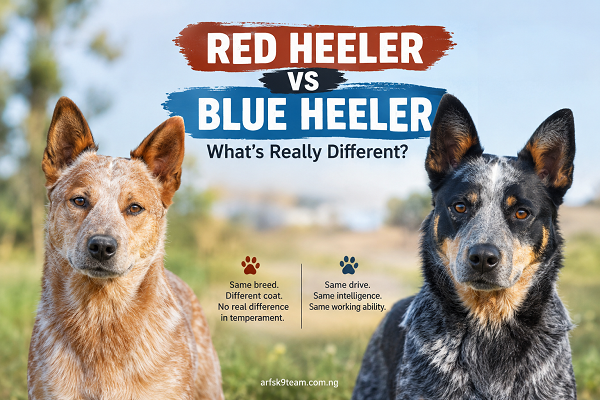
Red Heelers and Blue Heelers are the same breed, the Australian Cattle Dog and differ only in coat color, which comes from a different set of pigment genes. There’s no proven difference in temperament, trainability, size, or working ability between the two colors; documented health risks (like hereditary deafness) are tied to specific facial and body markings, not to being “red” versus “blue.”
Table of Contents
- Same Breed, Two Coats: The Real History
- The Genetics: Why Some Puppies Turn Red and Others Turn Blue
- Red Heeler vs Blue Heeler: Side-by-Side Comparison
- Does Coat Color Affect Temperament?
- Health Differences: What the Research Actually Shows
- Working Dog and Protection Dog Suitability
- Price Comparison: Red vs Blue Heeler
- Which One Should You Choose?
- From the Field: What Handlers Actually Notice
- FAQs
- Conclusion
Introduction
If you’ve been scrolling through cattle dog puppy listings wondering whether to pick the rusty-red pup or the speckled blue one, here’s the short version: you’re not choosing between two breeds. You’re choosing a coat color.
Red Heelers and Blue Heelers are both Australian Cattle Dogs (ACD), same standard, same working drive, same stubborn brilliance. But “same breed” doesn’t mean “no difference at all,” and that’s where most articles on this topic stop short. Coat genetics, deafness risk tied to specific markings, whether a puppy will actually turn out red or blue, and whether color has any bearing on drive and trainability, those are the questions real buyers and handlers actually ask, and they deserve real answers.
I’ve trained and evaluated working dogs for years, including cattle dogs pulled in for protection and detection foundation work, and I can tell you the color debate matters a lot less than people think but the few places it does matter are worth knowing before you put down a deposit.
Same Breed, Two Coats: The Real History
Here’s something most “red vs blue” articles skip entirely: where the colors actually came from.
In the 1840s, a Australian cattleman named Thomas Hall crossed blue-merle Smithfield-type droving dogs (some sources say Highland Collies) with the dingo, hoping to breed a dog tough enough to handle Australia’s brutal terrain and semi-wild cattle. The result, nicknamed “Hall’s Heelers”, worked, but they were still a bit too independent for comfort. Later breeders, notably brothers Jack and Harry Bagust, added Dalmatian blood to build loyalty toward people and handlers, then a splash of black-and-tan Kelpie for extra herding instinct.
That Dalmatian cross is exactly why Red and Blue Heeler puppies are both born almost pure white, Dalmatians pass along that same “born white, color fills in later” trait. Watch a litter over its first four to six weeks and you’ll see red or blue hairs slowly work their way through the coat as the pigment genes switch on.
By 1893, the breed had a formal standard, and by 1980 the American Kennel Club recognized it as the Australian Cattle Dog. Today it sits at #49 out of roughly 200 breeds on the AKC’s 2024 U.S. registration list, respectable for a dog most people still assume is a designer mix rather than a 180-year-old working breed.
The Genetics: Why Some Puppies Turn Red and Others Turn Blue
This is the part almost every competing article glosses over with “it’s just coat color” and moves on. Let’s actually unpack it.
An ACD’s base coat is genuinely white with pigmented (colored) hairs “ticked” through it, that’s called the ticking gene, and it’s the same trait you see in Dalmatians and English Setters. What determines whether those ticked hairs come in black (which reads as “blue” once mixed with the white base) or red comes down to pigment-switching genes that control the balance between two pigment types dogs produce: eumelanin (black/dark pigment) and phaeomelanin (red/yellow pigment). Geneticists at the UC Davis Veterinary Genetics Laboratory, which runs commercial coat-color testing for the breed, catalog several of the loci involved, including the gene that governs whether a dog’s pigment defaults toward black or toward red.
In practical terms, breeders don’t have to guess anymore. Cheek-swab DNA panels can now tell a breeder in advance roughly what colors a litter is likely to produce, which is why you’ll increasingly see “genetically tested” mentioned in serious ACD breeder listings.
A few genetic facts worth knowing before you buy:
- Both colors are born white. The pigmented patches (like a mask over one or both eyes) are the only color visible at birth; everything else fills in over the following weeks.
- Mottled vs. speckled is a separate trait from red vs. blue. A dog can be red-speckled, red-mottled, blue-speckled, or blue-mottled, mottling and speckling describe the pattern of the ticking, not the base color.
- Tan or “cream” points can appear on blue dogs on the legs, chest, and eyebrows, this is a separate, unrelated gene and isn’t something red dogs display.
- True chocolate and cream Cattle Dogs exist but aren’t accepted in the AKC/ANKC breed standard, which recognizes only red and blue.
- Color has zero effect on eye color, coat texture, or shedding, both colors carry the same short, dense double coat that sheds moderately year-round with a heavier blow-out twice a year.
Red Heeler vs Blue Heeler: Side-by-Side Comparison
| Trait | Red Heeler | Blue Heeler |
|---|---|---|
| Official name | Australian Cattle Dog (red) | Australian Cattle Dog (blue) |
| Base coat color | Red/rust hairs ticked through white | Black hairs ticked through white (reads as “blue”) |
| Coat patterns | Red mottled, red speckled | Blue mottled, blue speckled, blue with tan points |
| Born color | White, with any solid patches visible | White, with any solid patches visible |
| Height | 18–20 in (male), 17–19 in (female) | Same |
| Weight | 35–50 lbs | Same |
| Life expectancy | 12–16 years | 12–16 years |
| AKC recognition | Yes, since 1980 | Yes, since 1980 |
| Temperament | No documented color-based difference | No documented color-based difference |
| Working ability | Equal | Equal |
| Average puppy price (pet-quality) | $500–$1,500 | $500–$1,500 |
| Average puppy price (working/show lines) | $800–$5,000 | $800–$5,000 |
Does Coat Color Affect Temperament?
Short answer: no controlled study has ever found a temperament difference tied to coat color in the Australian Cattle Dog, and there’s no genetic mechanism that would link pigment genes to behavior genes in this breed.
You’ll find plenty of individual owners online swearing their red is calmer, or their blue is more intense and I don’t doubt what they’re seeing in their own two dogs. But that’s an n of 2 comparison, not data. Litter position, sex, the specific breeding line, how early the puppy was socialized, and the handler’s own consistency all swamp whatever tiny effect coat color could theoretically have.
What actually drives ACD temperament, red or blue:
- Working drive is bred in, line by line. A red pup from a station-working bloodline in Queensland will be a different animal to live with than a blue pup from a laid-back companion line, regardless of color.
- Herding instinct shows up early. Nipping at heels (yes, ankles, moving joggers, and toddlers included) is a breed trait in both colors, and it needs to be redirected through training, not colored away.
- Socialization windows matter more than genetics. Cattle Dogs that are well-socialized between 8 and 16 weeks are noticeably more adaptable adults, red or blue.
If you want a deeper breakdown of how working drive and instinct actually get shaped versus how much is hard-wired, our piece on obedience vs. instinct in working dogs walks through exactly that distinction, and it applies directly to heelers.
Health Differences: What the Research Actually Shows
This is where I’ll push back on almost every other article on this topic, because most of them either skip health entirely or repeat the vague line “both colors have the same health issues” without citing anything.
Here’s actual peer-reviewed data. A 2012 study out of the University of Queensland’s School of Veterinary Science, published in BMC Veterinary Research, tested 899 Australian Cattle Dogs using brainstem auditory evoked response (BAER) testing, the gold-standard hearing test for dogs and found:
- 10.8% of the dogs tested were deaf in at least one ear (7.5% unilateral, 3.3% bilateral).
- Dogs with bilateral facial masks (color over both eyes) had a five-times lower risk of deafness than dogs without masks.
- Dogs with pigmented body spots also showed meaningfully reduced deafness risk.
This is the piece nearly every competitor article misses: deafness risk in the breed tracks with markings, not with red-versus-blue base color. A red dog with no facial mask and a blue dog with no facial mask carry a similar elevated risk; a red dog with a full mask and a blue dog with a full mask carry a similarly lower risk. If you’re buying a puppy of either color, ask the breeder for BAER test results on the litter, reputable Cattle Dog breeders in the US, UK, and Australia do this routinely now, and a 2014 follow-up study from the same research group found that structured BAER screening programs measurably reduced deafness prevalence in tested kennel lines over time.
Beyond deafness, the UC Davis Veterinary Genetics Laboratory lists several inherited conditions the breed is screened for, regardless of coat color:
- Progressive Retinal Atrophy (PRA) — gradual, inherited vision loss
- Primary Lens Luxation (PLL) — a painful eye condition that can cause sudden blindness if untreated
- Hyperuricosuria (HUU) — an inherited disorder that raises the risk of bladder and kidney stones
- Hip dysplasia — common across active, medium-large working breeds, though ACDs fare better than many due to their compact, athletic build
- Degenerative Myelopathy (DM) — a rare, late-onset neurological condition
On lifespan, both colors average 12–16 years, and the breed holds an extraordinary outlier: the oldest verified dog in recorded history was a Blue Heeler named Bluey, who lived to 29 years and 5 months. That’s not typical, but it says something about the breed’s overall hardiness when it’s well-bred and well-cared-for, red or blue.
Working Dog and Protection Dog Suitability
Because this site focuses on working and protection dogs, I want to be direct here: color should never be a deciding factor in a working prospect. What actually matters is the same for every color:
- Bloodline and working lineage — pups from parents that were actually herding, competing in agility/obedience, or doing scent work will show drive earlier than pups from purely companion lines.
- Hearing status (BAER-confirmed) — non-negotiable for any dog going into serious obedience or protection foundation work, since a unilaterally or bilaterally deaf dog needs an adjusted training approach.
- Structure and hip/eye clearances — a working dog needs joints and vision that will hold up over a career, not just a pretty coat.
- Early temperament testing — pack drive, prey drive, recovery from startle, and handler focus tell you far more at 8 weeks than color ever will.
Cattle Dogs, red or blue, are increasingly used outside their original herding role, in agility, dock diving, scent detection, and as personal protection prospects for handlers who want a smaller, more portable dog than a Malinois or German Shepherd. They’re not a traditional guard breed (they’re more “alert and vocal” than “physically imposing”), so if raw deterrence and size are the priority, it’s worth comparing them against dedicated guard breeds, our guide to top guard and protection dog breeds breaks down which breeds are actually built for that job.
If you’re weighing an ACD against another herding-type breed for a family-guardian role, our comparison of Pembroke vs Cardigan Corgi guard traits is a useful companion read, since Corgis share some of the same “watchdog, not guard dog” profile.
Price Comparison: Red vs Blue Heeler
A question I get constantly from prospective owners: “Are blues more expensive because they’re more popular?” In most markets, no, color alone rarely moves the price needle much. What actually drives cost is pedigree, health testing, and whether the line is bred for work, show, or companionship.
General U.S./UK/Australia pricing ranges (2025–2026):
- Pet-quality puppy, either color: $500–$1,500 / £600–£800
- Health-tested puppy from a reputable breeder: $800–$2,500
- Working-line or show-prospect puppy: $2,500–$5,000+
- Adoption/rescue fee: typically $150–$400, and ACDs are commonly surrendered by owners who underestimated their exercise needs, so rescues are a genuinely good option if you’re not fixed on getting a puppy
- Monthly upkeep (food, preventatives, routine vet care): roughly $70–$150/month
Litters often produce a mix of red and blue puppies from the same two parents, which is itself proof that color isn’t a premium trait the way it can be in, say, rare merle colorations in other breeds, it’s simply which pigment genes each individual puppy happened to inherit.
Which One Should You Choose?
Since color won’t meaningfully change your day-to-day life with the dog, base your decision on these instead:
- Meet both parents if possible. Temperament and drive are heritable; color is not a proxy for either.
- Ask for BAER hearing certification, especially if the puppy (of either color) has little to no facial mask, that’s the one place color-adjacent markings genuinely correlate with a health risk.
- Match the breeder’s line to your lifestyle. Working-line pups (again, red or blue) need a serious job, herding, sport, structured daily training. Companion-line pups still need real exercise but are generally easier to live with in a suburban home.
- Pick based on which coat pattern you personally prefer, speckled vs. mottled, or whether you want the tan points that show up on some blues. That’s a completely legitimate reason once health and temperament are equal, which they are here.
- Consider your household aesthetics and shedding tolerance equally, both colors shed at the same rate, so this really does come down to taste.
If you’re bringing home a puppy of either color, getting the early routine right matters more than the coat ever will, our step-by-step crate training guide for puppies and our breakdown of how much exercise a working-type dog actually needs are both written with high-drive breeds like the ACD specifically in mind.
From the Field: What Handlers Actually Notice
I’ve handled and evaluated both colors over the years, including cattle dogs brought in for foundation obedience and drive-building work. Here’s the honest, unscientific-but-repeated pattern I’ve seen: owners notice color for about the first two weeks, and then it disappears completely as a topic, because what actually occupies their attention is managing the breed’s relentless drive to have a job. A bored ACD, red or blue, will invent its own “job,” and you usually won’t like what it picks (that’s the herding nip directed at your kids’ ankles, or the demolished couch cushion).
The single biggest misjudgment I see new owners make isn’t picking the “wrong” color, it’s underestimating the mental workload this breed needs. If you want a structured breakdown of building real obedience and impulse control in a high-drive dog like this, that’s exactly what I cover in my e-book, Beyond the Bark, built from real K9 handling experience rather than generic pet-care advice.
FAQs
Are Red Heelers and Blue Heelers the same breed?
Yes. Both are Australian Cattle Dogs. “Red Heeler” and “Blue Heeler” are informal nicknames describing coat color, not separate breeds, there’s no AKC, UKC, or ANKC breed standard that treats them as distinct.
Are Red Heelers rarer than Blue Heelers, or vice versa?
Neither color is officially rarer. A single litter from the same two parents can produce both red and blue puppies, since color depends on which pigment genes each individual puppy inherits, not on which color is “in demand.”
Is a Blue Heeler more aggressive than a Red Heeler?
No documented study supports a color-based aggression difference. Both colors can be reserved with strangers and nippy with children if under-socialized or under-exercised, that’s a breed trait, not a color trait.
Why are Red and Blue Heeler puppies born white?
Because of the ticking gene inherited generations back from the Dalmatian crosses used to develop the breed in the 1800s. Pigmented hairs grow in gradually over the first several weeks of life, along with any solid facial or body markings.
Do Blue Heelers live longer than Red Heelers?
No, both colors have the same average life expectancy of 12 to 16 years. The longest-lived dog ever verified, a Blue Heeler named Bluey, reached 29 years and 5 months, but that’s an extreme outlier, not a color-linked trend.
Conclusion
Red Heeler vs Blue Heeler isn’t really a breed comparison, it’s a coat-color comparison wearing a breed comparison’s clothes. Both are Australian Cattle Dogs with identical size, lifespan, working drive, and breed-standard health screening needs. The genuinely useful distinctions aren’t red versus blue at all; they’re mask-versus-no-mask for deafness risk, working-line versus companion-line for energy level, and health-tested versus untested for long-term cost and heartbreak.
If you’re choosing between a red pup and a blue pup right now, pick by temperament testing, parent health clearances, and your gut feeling meeting the puppy in person, then let color be the fun, guilt-free tiebreaker it was always meant to be.
Sources: University of Queensland/BMC Veterinary Research (2012, 2014) BAER deafness studies; UC Davis Veterinary Genetics Laboratory breed panel; American Kennel Club 2024 breed registration statistics; ANKC and AKC Australian Cattle Dog breed standards.

Her work centers on applied training across obedience, detection, protection, and operational readiness, with a strong focus on Military Working Dogs (MWDs) and security K9 programs. Rather than relying on theory alone, Rofiat emphasizes proven training methods built on repetition, consistency, and real-world conditioning principles that prepare both dogs and handlers for high-pressure tasks.
Through articles, training content, and documentaries, she shares experience-based insights from the field, highlighting how structured training, clear communication, and trust between handler and dog directly impact performance and reliability.
Drawing from years of frontline experience, she is also the author of “Beyond the Bark: Inside a Pro Handler’s Playbook for Raising the Ideal Dog,” a practical guide designed to help dog owners and handlers apply professional training principles in everyday situations.
She remains committed to responsible K9 development, continuous skill refinement, and practical education for handlers, trainers, and dog professionals.
- How Many Teeth Do Dogs Have? Puppy vs Adult Chart - September 22, 2026
- What Colors Do Dogs See? (Dog Vision Spectrum) - September 22, 2026
- Is Cinnamon Bad for Dogs? Safe Dosage by Weight - September 21, 2026