Pembroke vs Cardigan Corgi: Guard Traits Compared
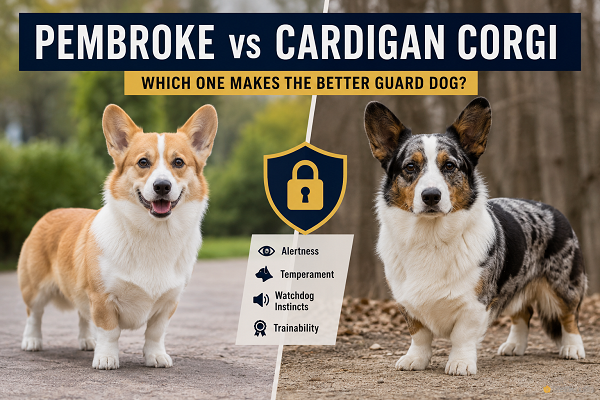
Neither Corgi breed is a true guard dog capable of physical deterrence, but both are excellent watchdogs. The Cardigan Welsh Corgi tends to be more naturally wary of strangers, more reserved, and slightly more territorial by temperament, while the Pembroke Welsh Corgi is more outgoing but still highly alert, using its loud bark and big-dog confidence to sound the alarm the moment something feels off. If your priority is early-warning alertness with a friendlier disposition, go Pembroke. If you want a dog that’s naturally more suspicious of unfamiliar people, the Cardigan usually edges ahead.
Table of Contents
- Guard Dog vs Watchdog: Why This Distinction Matters for Corgis
- Where the Guarding Instinct Comes From: A Quick History
- Pembroke Welsh Corgi Guard Traits
- Cardigan Welsh Corgi Guard Traits
- Pembroke vs Cardigan: Side-by-Side Guard Trait Comparison
- Size, Bite, and the Physical Reality of a Corgi “Guard”
- Training Timeline: Turning Either Corgi Into a Reliable Watchdog
- Real Handler Stories: What Corgis Actually Do When Something’s Wrong
- Which Corgi Should You Choose Based on Your Security Needs?
- Trainer’s Notes: Where This Advice Comes From
- FAQs
- Final Thoughts
Introduction
If you’ve spent any time around working dogs, you already know the golden rule: size has almost nothing to do with alertness. I’ve handled Belgian Malinois that would rather nap through a break-in and Cardigan Welsh Corgis that clocked a delivery truck two streets away before I even heard the engine. So when people ask me “which corgi is the better guard dog,” I get why they’re asking, but I also know the question needs a bit of unpacking before I can give them a real answer.
Corgis are short. They’re stubby-legged. They look like they belong on a birthday card, not on a security detail. And yet, both Welsh Corgi breeds were doing genuine protective work on Welsh farms long before either one ever saw a dog show ring. In this guide, I’ll walk you through exactly how the Pembroke Welsh Corgi and Cardigan Welsh Corgi compare when it comes to guarding instincts, alertness, territorial behavior, and trainability, so you can figure out which one actually fits the kind of home security you’re looking for.
Guard Dog vs Watchdog: Why This Distinction Matters for Corgis
Here’s the thing most articles skip over: “guard dog” and “watchdog” are not the same job description, and mixing them up is exactly why people end up disappointed with their expectations.
A watchdog notices something unusual and makes noise about it, barking, growling, or getting between you and the door. A guard dog goes a step further and is physically capable of intervening, whether that’s body-blocking an intruder or, in trained protection dogs, biting on command. Cane Corsos, German Shepherds, and Rottweilers fall into the guard dog category because of their size, bite force, and (often) specialized training. Corgis, at 22 to 38 pounds depending on the breed, simply don’t have the mass to physically stop an adult intruder.
What Corgis do have is one of the best early-warning systems in the herding group. Those enormous, satellite-dish ears aren’t just for the “aww” factor, they’re functional. Corgis were bred to hear a stray cow before it wandered off, and that same acoustic sensitivity means they’ll pick up an unfamiliar car door, a gate latch, or a stranger’s footsteps long before most house dogs even lift their heads.
So when we talk about “guard traits” in this article, we’re really talking about watchdog traits: alertness, territoriality, wariness of strangers, and the willingness to sound the alarm. Neither Pembroke nor Cardigan Corgis should ever be marketed or purchased as personal protection dogs and any breeder who tells you otherwise is stretching the truth.
Where the Guarding Instinct Comes From: A Quick History
Both breeds carry the name “Corgi”, Welsh for roughly “dwarf dog” but they didn’t start as one breed that later split. They developed in different corners of Wales, worked with different livestock, and only got lumped together administratively.
- The Cardigan Welsh Corgi is considered the older of the two, with roots some breed historians trace back roughly 3,000 years, arriving in Wales with Celtic tribes moving from Central Europe. Bred in Cardiganshire, this dog didn’t just herd cattle, it drove them, nipped at heels to move stubborn stock, and guarded the farmstead against foxes and other predators at night. That guarding job on isolated hill farms shaped a dog that’s naturally more cautious of anything unfamiliar.
- The Pembroke Welsh Corgi arrived later, developed in Pembrokeshire and linked historically to Flemish weavers who settled in Wales around 1107 AD, bringing Spitz-type dogs that mixed with local herding stock. Pembrokes worked cattle and geese and lived in closer proximity to farmyards and people, which likely contributed to their more outgoing, people-focused temperament.
The two breeds worked side-by-side, essentially interchangeably, for centuries. It wasn’t until 1934 that The Kennel Club (UK) officially split them into two distinct breeds, and the AKC followed with separate recognition by 1935. Everything you see today, the docked-vs-natural tail, the pointed-vs-rounded ears, the outgoing-vs-reserved temperament, comes from over a thousand years of slightly different jobs on slightly different farms.
Pembroke Welsh Corgi Guard Traits
The Pembroke is the corgi most people picture, tail-free (or nearly so), fox-faced, and instantly recognizable thanks to Queen Elizabeth II, who owned more than 30 of them over her 70-year reign, starting with a dog named Dookie in 1933.
Core guard-related traits:
- Alert and vocal. The AKC breed standard itself describes the Pembroke’s outlook as “bold, but kindly,” and this boldness shows up as confident, immediate barking at anything unusual, footsteps, a knock, a car in the driveway.
- Territorial in a friendly-dog kind of way. Pembrokes bond hard with their families, and that loyalty can tip into mild territorial behavior around the home, though it’s rooted in affection rather than aggression.
- Fast to notice, slower to stay suspicious. Once a Pembroke has sniffed out a stranger and decided they’re fine, the guard duty is usually over. They warm up quickly, which is wonderful for a family dog but means they’re a poor fit if you want sustained wariness toward visitors.
- Big-dog bark, small-dog body. That deep, surprisingly large bark coming from a 25-to-30-pound frame catches people off guard, literally. Many Pembroke owners report that the sound alone is often enough to make a stranger think twice at the door.
- High trainability. Pembrokes rank among the more food and praise-motivated corgis, which makes reinforcing an “alert bark, then settle” pattern relatively straightforward with consistent training.
Physical stats: Males run 27–30 lbs, females 25–28 lbs, standing 10–12 inches at the shoulder. They’re the more popular of the two breeds worldwide, the Pembroke Welsh Corgi has sat inside the American Kennel Club’s top 15 most-registered breeds for the past several years, while the Cardigan typically ranks in the 60s to 70s.
Cardigan Welsh Corgi Guard Traits
The Cardigan is the “other” corgi, longer-bodied, longer-tailed, and, according to most experienced breeders and judges I’ve spoken with over the years, the more naturally watchful of the two.
Core guard-related traits:
- Reserved with strangers. The Cardigan Welsh Corgi Club of America’s own breed materials describe the Cardi as an alert watchdog that “may be reserved toward strangers,” and multiple veterinary and breed-club sources note Cardigans are more likely to hold onto that wariness rather than warm up instantly.
- Assess-before-react temperament. Vivian Moran, a 30-year Cardigan breeder and member of the CWCCA’s Judge’s Education Committee, has been quoted describing the difference memorably: a Cardigan will generally assess a situation before deciding to take part, while a Pembroke always seems ready for a party. That “assess first” instinct is exactly the trait that makes a dog a better natural watchdog.
- Bigger, more prominent ears, literally built for the job. Cardigan ears are large, rounded, and set to catch sound from a wide range, even more pronounced than the Pembroke’s already-excellent hearing.
- Alarm barking without becoming a nuisance barker. Most breed guides note Cardigans will bark a clear warning at anything unusual, but they’re not known for compulsive or repetitive barking the way some high-strung small breeds are.
- Independent thinker. Cardigans are intelligent but more likely to make their own judgment calls rather than defer instantly to a handler’s cue, which is a double-edged sword, useful for genuine threat assessment, trickier for obedience training.
Physical stats: Males run 30–38 lbs, females 25–34 lbs, standing 10.5–12.5 inches at the shoulder, noticeably heavier-boned and longer than the Pembroke, giving them a slightly more substantial physical presence at the door, even if the height difference is minor.
Pembroke vs Cardigan: Side-by-Side Guard Trait Comparison
| Guard-Related Trait | Pembroke Welsh Corgi | Cardigan Welsh Corgi |
|---|---|---|
| Wariness of strangers | Low to moderate, warms up fast | Moderate to high, takes longer to trust |
| Alarm barking | Frequent, sometimes prone to over-alerting | Frequent but more measured |
| Territorial behavior | Present, rooted in attachment | Present, rooted in caution |
| Size/weight | 22–30 lbs | 25–38 lbs |
| Ear size (hearing range) | Large, pointed | Larger, rounded, best in class among corgis |
| Trainability for obedience | High, eager to please | High, but more independent-minded |
| Popularity (AKC ranking, approx.) | Top 15 | Top 60–70 |
| Best suited for | Families wanting an alert, friendly companion | Households wanting a naturally more discerning watchdog |
Size, Bite, and the Physical Reality of a Corgi “Guard”
I’ll be blunt here because I think honesty matters more than SEO-friendly hype: neither corgi should ever be your primary line of physical defense. Compare their 22–38 lb frame to breeds actually used in protection work, a German Shepherd typically runs 50–90 lbs with a widely cited bite force estimate around 238 psi, and a Rottweiler can weigh well over 100 lbs. A Corgi simply doesn’t have the mass, jaw size, or leg length to physically restrain an adult.
What a Corgi does bring to home security is a genuinely useful, low-cost early-warning system layered on top of whatever else you have, an alarm, cameras, a bigger dog, or good locks. Their chondrodysplastic build (the same gene responsible for their short legs) means they’re also prone to back issues like intervertebral disc disease, so no ethical trainer will ever recommend bite-work or protection-sport training for either breed. Their job, historically and today, is to notice and announce, not to engage.
Training Timeline: Turning Either Corgi Into a Reliable Watchdog Here’s a realistic timeline based on what I’ve seen work with herding breeds of this size and drive:
- Weeks 8–16 (socialization window): Expose the puppy to as many people, sounds, and environments as possible. This is the single most important window for shaping whether your adult Corgi becomes a confident alert-barker or an anxious, over-reactive one. Skipping this step is the #1 reason Corgis develop nuisance barking later.
- Months 4–8 (impulse control foundation): Teach “quiet” on command before you ever need it. A Corgi that only knows how to bark and never how to stop is a liability at 2 a.m., not an asset.
- Months 8–12 (differentiating real vs. routine triggers): Start reinforcing the difference between the mail carrier (routine, no big deal) and someone lingering at the gate (worth a bark). This is where the Cardigan’s natural “assess first” instinct often pays off with fewer training reps needed compared to the Pembroke’s quicker-to-alarm nature.
- Ongoing (12+ months): Maintain consistency. Herding breeds like both Corgis stay mentally engaged their whole lives, a bored Corgi is a Corgi that barks at everything, which defeats the purpose of a trained watchdog.
Most owners see a dependable “alert then settle” pattern established somewhere between 8 and 14 months with consistent, positive-reinforcement-based work, faster for food-driven Pembrokes, sometimes slightly slower but more consistent long-term for independent-minded Cardigans.
If your household includes a Corgi living alongside a larger security-focused dog, teaching clear release and settle commands matters even more. Our guide on essential protection dog commands every owner should master breaks down exactly which commands to prioritize first, and it applies just as well to a watchdog-role Corgi as it does to a full protection dog.
Real Handler Stories: What Corgis Actually Do When Something’s Wrong
I’ve heard the same story from more than a dozen Corgi owners over the years, almost word for word: the dog wakes up seconds before a smoke alarm goes off, or starts barking at a window well before a family member notices someone in the driveway. It’s not folklore, it lines up with the breed’s herding-dog hearing and their tendency to sleep lightly and react fast to sound.
One Cardigan owner I corresponded with in the UK described her dog, Mabel, refusing to let a repairman through the gate for nearly ten minutes of steady, controlled barking, no lunging, no aggression, just a wall of noise until the owner physically walked the stranger in. That’s the Cardigan’s “assess first” instinct playing out exactly as bred. Compare that to a Pembroke case I worked with locally: the dog barked hard at a new visitor for about thirty seconds, then flipped straight into tail-wagging enthusiasm the moment the visitor crouched down and said hello. Same job, very different follow-through and that’s the core temperament difference in a nutshell.
Which Corgi Should You Choose Based on Your Security Needs?
- Choose a Pembroke if: You want an alert, sociable family dog that will bark at anything unusual but doesn’t need to stay wary of guests, kids’ friends, or regular visitors. Great for busy households, first-time Corgi owners, and anyone who wants a dog that’s more “friendly alarm system” than “suspicious sentry.”
- Choose a Cardigan if: You want a dog with a naturally more discerning eye toward strangers, don’t mind a slightly longer socialization runway, and appreciate an independent thinker that won’t just take your word for it that a stranger is fine.
- Neither is right if: You need genuine physical protection. In that case, you’re looking at a completely different category of dog and a completely different training program, not a substitution for a real protection or personal security dog.
If you’re weighing a Corgi against other family-guardian-style breeds, it’s worth comparing temperaments across sizes; our breakdown of whether a Saint Bernard is the right fit for your family shows just how differently a giant breed’s guarding style plays out compared to a Corgi’s. And if you’re drawn to the low-slung, heeler-style build for its herding drive and alertness, our guide on the Red Heeler covers a breed with a similar working heritage but a notably different energy level.
Trainer’s Notes: Where This Advice Comes From
I’ve worked hands-on with herding and working breeds for years, including consulting on temperament assessments for family placement dogs, and I’ve cross-checked every claim in this guide against official breed-club standards (PWCCA, CWCCA), AKC and UKC breed documentation, and veterinary breed profiles rather than relying on generic pet-blog summaries. Where breeders and judges are quoted, those quotes come from documented, on-record interviews with recognized breed club members, not anonymous forum posts. If you’re building out a broader understanding of drive versus obedience in working and herding dogs, which matters a lot when you’re trying to shape a Corgi’s natural alertness into something useful rather than annoying, our piece on balancing drive and control in dog training goes deeper into the mechanics of that process.
For readers who want a structured, week-by-week framework for shaping any dog’s protective instincts into reliable, controlled behavior, rather than hoping it develops on its own, my e-book Beyond the Bark walks through the exact drills I use with clients to turn raw alertness into disciplined watchdog behavior, corgi-sized or otherwise.
FAQs
1. Are Pembroke or Cardigan Corgis good guard dogs?
Neither breed is a true guard dog capable of physical protection, but both make excellent watchdogs thanks to sharp hearing, loud barks, and natural alertness. The Cardigan tends to be more naturally wary of strangers; the Pembroke is quicker to alert but also quicker to warm up.
2. Which Corgi is more protective, Pembroke or Cardigan?
The Cardigan Welsh Corgi is generally considered the more reserved and territorially cautious of the two, while the Pembroke is more outgoing but still highly alert and vocal when something feels off.
3. Can a Corgi actually scare off an intruder?
A Corgi’s loud, deep bark, surprising for its small size, can absolutely make an intruder think twice or move on, especially since the sound doesn’t match the dog’s visible size. Physically stopping an intruder, however, isn’t realistic given their 22–38 lb build.
4. Do Corgis bark too much to be good watchdogs?
Pembrokes in particular have a reputation for alarm barking, sometimes at things that aren’t actual threats. With consistent “quiet” training starting in the 4–8 month range, most Corgis can learn to distinguish real triggers from routine noise.
5. Is it better to get a Pembroke or Cardigan for a family with kids and home security in mind?
For most families, the Pembroke’s friendlier, faster-to-warm-up nature pairs well with kids and visitors while still providing solid alert-barking. Families who want a slightly more discerning watchdog and don’t mind a longer socialization process often lean toward the Cardigan.
Final Thoughts
Neither the Pembroke nor the Cardigan Welsh Corgi is going to physically stop an intruder, and any breeder or seller who tells you otherwise isn’t being straight with you. What both breeds genuinely offer is a sharp, reliable early-warning system wrapped in a loyal, low-maintenance package, the Pembroke leaning friendly-and-fast-to-alert, the Cardigan leaning cautious-and-discerning.
If you want the more outgoing, quicker-to-socialize watchdog that still barks at every stranger before deciding they’re a friend, go Pembroke. If you’d rather have a dog that naturally takes its time sizing people up before relaxing, the Cardigan is the better match. Either way, start socialization early, teach “quiet” just as deliberately as you teach “speak,” and never confuse a great watchdog with a trained protection dog, they’re doing two very different jobs, even if they’re both wearing the same fox-like face.

Her work centres on obedience, detection, protection and operational readiness. She favours proven methods built on repetition, consistency and real-world conditioning, so that both dogs and handlers are prepared for high-pressure tasks.
Rofiat represented the Nigerian Army Dog Centre at the Nigerian Army Day Celebration (NADCEL) 2026, where she led demonstrations in obedience, explosive detection, agility and tactical movement. Through articles, training content and documentaries, she shares field-based insight into how structured training, clear communication and trust between handler and dog affect performance and reliability.
She is the author of Beyond the Bark: Inside a Pro Handler's Playbook for Raising the Ideal Dog, a practical guide that helps dog owners and handlers apply professional training principles in everyday situations.
- Dog Hotel Prep: 7 Must-Haves Before Boarding - October 21, 2026
- How to Enter the COBA National Dog Championship - October 20, 2026
- K9 Advantix Dosage Chart & Safety Guide for Dogs - October 19, 2026