5 Dog Obedience Training Commands That Work
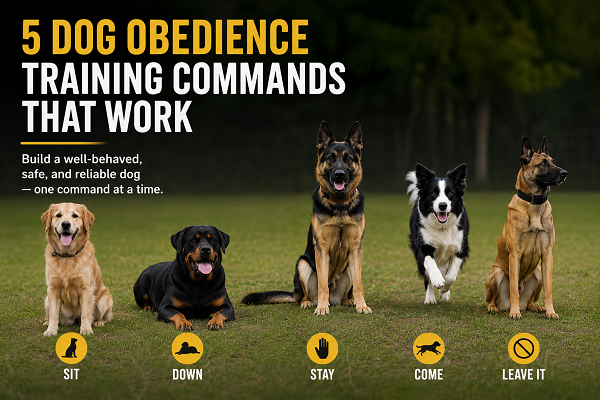
The five dog obedience training commands that work for almost any dog are Sit, Down, Stay, Come (recall), and Leave It. Taught with positive reinforcement, short daily sessions, and consistent hand signals or verbal cues, most healthy dogs can learn all five in 4 to 8 weeks, and keep sharpening them for life. These five commands form the backbone of obedience programs used by everyone from family dog trainers to professional K9 handlers.
Table of Contents
- Introduction
- Why These 5 Commands (And Not 10)
- Command 1: Sit
- Command 2: Down
- Command 3: Stay
- Command 4: Come (Recall)
- Command 5: Leave It
- What Actually Makes These Commands “Stick”
- Common Mistakes That Sabotage Obedience Training
- A Realistic Training Timeline
- Trainer’s Note: Real-World Experience
- FAQs
- Conclusion
Introduction
If you’ve ever stood in your backyard yelling “come here!” while your dog sprints the other way with your neighbor’s cat in its sights, you already know the problem. A dog without reliable obedience commands isn’t just frustrating, it’s a dog that’s harder to keep safe, harder to take places, and honestly, harder to enjoy.
Here’s the good news: you don’t need ten commands, a shock collar, or a $2,000 board-and-train program to get a well-behaved dog. You need five commands, taught properly, practiced consistently, and reinforced the right way. That’s it.
In this guide, you’ll learn exactly which five commands professional trainers and K9 handlers consider non-negotiable, how to teach each one step by step, how long it realistically takes (with breed and age factored in), and the mistakes that quietly wreck most people’s training progress. Whether you’ve got a Labrador puppy or a headstrong Belgian Malinois, this framework works.
Why These 5 Commands (And Not 10)
Ever wonder why professional obedience schools and K9 academies all seem to circle back to the same handful of commands? It’s not because trainers lack imagination. It’s because these five cover almost every real-world scenario a dog owner runs into:
- Sit – control and impulse management in everyday situations (greeting guests, waiting at doors, vet visits)
- Down – calming and settling, useful in public spaces, cafes, and around distractions
- Stay – safety command, keeps your dog in place during danger or chaos
- Come – the single most life-saving command a dog can know
- Leave It – prevents your dog from eating something toxic, picking a fight, or bolting after wildlife
The American Kennel Club’s Canine Good Citizen (CGC) program, one of the most widely recognized obedience benchmarks in the US, builds its 10-step test almost entirely around variations of these five behaviors. If your dog is solid on all five, you’re already most of the way to CGC-ready, and to a dog that’s genuinely pleasant to live with.
Command 1: Sit
Sit is usually the first command taught, and for good reason: it’s the foundation every other command builds on. A dog that can’t hold a sit reliably will struggle with stay, and a dog that won’t sit on cue is a dog that hasn’t learned to check in with you yet.
How to teach it
- Hold a treat close to your dog’s nose.
- Move your hand up and slightly back over their head, this naturally tips their nose up and their bottom down.
- The moment their rear touches the ground, mark it (“Yes!” or a clicker) and reward.
- Add the verbal cue “Sit” once your dog is offering the position reliably without the lure, usually after 15 to 20 successful reps.
Realistic timeline
Most puppies pick up a lured sit within the first 2 to 3 training sessions (roughly 10 minutes each). A reliable sit on verbal cue alone, without a treat in your hand, typically takes 1 to 2 weeks of daily short sessions.
Trainer tip
Don’t push your dog’s hindquarters down to force a sit. It can create tension around handling and actually slows learning. Luring works with the dog’s own body mechanics instead of against them.
Command 2: Down
Down (or “lie down”) asks more of a dog than sit does, it’s a more vulnerable position, so some dogs, especially anxious or dominant-leaning ones, resist it at first. That’s completely normal.
How to teach it
- Start from a sit. Hold a treat at your dog’s nose and lower it straight to the floor.
- As their head follows the treat down, slide it slightly forward along the ground, this encourages their front legs to stretch out into the down position.
- Mark and reward the instant their belly (not just their elbows) touches the floor.
- Layer in the verbal cue “Down” once the movement is consistent.
Realistic timeline
Expect 2 to 4 weeks for a solid down on cue, longer for larger or stiffer-jointed breeds who take longer physically settling into the position. Working breeds like German Shepherds and Belgian Malinois often pick it up faster because of their high food and toy drive, sometimes within 10 days of consistent practice.
Trainer tip
If your dog “play bows” instead of lying all the way down, you’re rewarding too early. Wait for full belly contact before marking, otherwise you’ll train a half-down that falls apart under distraction.
Command 3: Stay
Stay is where most owners quit too early, and where dogs “fail” the most in public. That’s because stay isn’t really one skill, it’s three: duration (how long), distance (how far you can move away), and distraction (what’s happening around them). Trying to build all three at once is the number one reason stay training falls apart.
How to teach it
- Ask for a sit or down.
- Say “Stay” and hold up an open palm as a visual cue.
- Wait just 2 to 3 seconds, then mark and reward while your dog is still in position.
- Gradually increase duration first (aim for 30 seconds before adding distance).
- Only after duration is solid, start adding distance, one small step back at a time.
- Distractions come last, once duration and distance are both reliable.
Realistic timeline
A basic 30-second stay: about 2 weeks. A stay that holds up with you out of sight for a minute or more, with real-world distractions like other dogs or traffic nearby, can take 2 to 3 months of consistent practice. Professional K9 and service dog programs often spend 6+ months building a truly bomb-proof stay under heavy distraction, which tells you how much this command can be pushed if you need it.
Trainer tip
Always release your dog from a stay with a clear word (“Okay!” or “Free!”). If you don’t mark the end of the behavior, your dog decides when the stay is over, not you, and that inconsistency is exactly what causes stays to break down in real situations.
Command 4: Come (Recall)
If you only ever nail one command properly, make it this one. A dog that comes reliably when called, even around distractions, is a dog that’s dramatically safer around traffic, wildlife, and off-leash situations. This is the command that keeps dogs alive.
How to teach it
- Start indoors or in a fenced yard, low distraction zones only.
- Say your dog’s name followed by “Come!” in an upbeat, excited tone (never a scolding one).
- The instant they start moving toward you, mark and reward heavily, treats, praise, a favorite toy, whatever gets the biggest reaction.
- Practice with a long training lead (15 to 30 feet) before ever attempting recall off-leash.
- Gradually add distance, then mild distractions, then real-world distractions like other dogs or food on the ground.
Realistic timeline
A reliable indoor recall: 1 to 2 weeks. A recall that holds up outdoors on a long line with moderate distractions: 4 to 8 weeks. A recall you’d trust off-leash near traffic or wildlife: honestly, 6 months to a year of consistent reinforcement, and even then, professional handlers rarely trust a 100% off-leash recall around high-value distractions like squirrels or other dogs in play drive.
Trainer tip
Never call your dog to you for something unpleasant, nail trims, baths, being put back on leash to leave the dog park. If “come” ever predicts something the dog dislikes, they’ll start hesitating, and that hesitation can cost you in a genuine emergency. Go get them instead, and save the recall cue for things they associate with good outcomes.
Command 5: Leave It
Leave It might be the most underrated command on this list. It’s the difference between your dog walking past a dropped grape, medication, or a dead bird on a trail versus grabbing it before you can react. It’s also a foundational skill for impulse control across the board.
How to teach it
- Hold a treat in a closed fist and let your dog sniff and paw at it.
- The moment they stop trying and pull back, even slightly, mark and reward from your other hand (never the fisted one, this teaches them that fixating on the item doesn’t pay off).
- Progress to placing a treat on the floor, covering it with your hand if needed, and rewarding disengagement.
- Add the verbal cue “Leave it” once your dog is reliably backing off from the closed fist and floor treat.
- Practice with higher-value items and real-world scenarios, dropped food, other dogs’ toys, trash on walks.
Realistic timeline
Basic leave it with low-value items: 1 to 2 weeks. Reliable leave it with high-value distractions (raw meat, another dog, squirrels): 2 to 4 months, and this is one command that genuinely benefits from lifelong “maintenance” practice, even well-trained dogs can slip if it’s not reinforced occasionally.
Trainer tip
Resist the urge to yank your dog away from the item instead of teaching disengagement. A dog that’s physically pulled away hasn’t learned self-control, they’ve just learned you’re stronger. The moment there’s no leash, that “leave it” disappears.
What Actually Makes These Commands “Stick”
Knowing the five commands is only half the equation. Here’s what separates dogs with rock-solid obedience from dogs that “kind of” listen at home but fall apart everywhere else.
1. Timing beats everything
Your marker (a clicker or a consistent word like “Yes!”) needs to land within about half a second of the correct behavior. Reward a beat too late, and you risk reinforcing whatever your dog did after the behavior you wanted, sniffing the ground, breaking position, glancing away.
2. Short, frequent sessions beat long ones
Five to ten minutes, two to three times a day, consistently beats one 45-minute session on the weekend. Dogs, especially puppies, have short attention spans, and training fatigue leads to sloppy repetitions that actually work against you.
3. Proof each command in three stages
Trainers call this the “3 D’s”: Duration, Distance, Distraction. Never train all three at once. Nail duration first in a boring environment, then add distance, then slowly introduce distractions. Skipping straight to the dog park is the number one reason a command that “worked at home” falls apart in public.
4. Reinforcement schedules matter long-term
Early on, reward every single correct repetition. Once a behavior is reliable, shift to a variable reward schedule, sometimes a treat, sometimes praise, sometimes a favorite toy. This unpredictability actually strengthens the behavior over time (it’s the same psychological principle that makes slot machines addictive, except here it’s working in your favor).
5. Positive reinforcement wins, and the research backs it up
A widely cited 2004 University of Bristol study comparing reward-based and punishment-based training methods found that dogs trained with confrontational or punishment-heavy techniques showed significantly higher rates of aggressive responses toward their owners. Most professional working dog programs today, including military and police K9 units, have shifted toward reward-based foundations for exactly this reason: a dog that works because it wants to perform better and more reliably than a dog working purely out of avoidance.
If you’re raising a higher-drive working breed and want the deeper mechanics behind reward-based foundation work, our team broke this down further in Essential Dog Training for Belgian Malinois: 5 Vital Steps That Work, it’s aimed at Malinois owners specifically, but the principles apply to any high-energy breed.
Common Mistakes That Sabotage Obedience Training
- Repeating the command over and over. Saying “sit, sit, sit, SIT” teaches your dog that the first two don’t count. Say it once, help them succeed, and reward.
- Training only at home. A command your dog only knows in your living room isn’t obedience, it’s a party trick. Practice everywhere, driveways, parks, pet stores, sidewalks.
- Inconsistent cues between family members. If one person says “down” and another says “lie down,” you’re teaching two different commands. Get everyone in the household using the same words and hand signals.
- Punishing a slow or wrong response. This is especially damaging for recall. A dog that gets scolded for coming back slowly learns that coming back at all is risky.
- Quitting too early. Most owners stop reinforcing a command once it “seems” learned. Dogs need ongoing practice, just like people forget a language they stop speaking.
- Skipping distraction training entirely. This is the single biggest gap between a dog that’s “obedient at home” and a dog that’s actually reliable. If you never practiced leave it around another dog, don’t expect it to work at the dog park.
If your dog’s issue is less about command fluency and more about an underlying drive or reactivity problem (mouthing, guarding, over-arousal), it’s worth reading How to Stop Belgian Malinois Biting & Drive for a breakdown of how drive and obedience interact, the concepts apply well beyond just the Malinois breed.
A Realistic Training Timeline
Every dog is different, but here’s a rough benchmark based on consistent daily practice with a healthy adult dog or puppy over 12 weeks old:
| Command | Basic Reliability | Reliable Under Distraction |
|---|---|---|
| Sit | 1–2 weeks | 3–4 weeks |
| Down | 2–4 weeks | 4–6 weeks |
| Stay | 2 weeks | 2–3 months |
| Come (Recall) | 1–2 weeks (indoors) | 6 months–1 year (off-leash) |
| Leave It | 1–2 weeks | 2–4 months |
Older dogs, dogs with no prior training, and dogs with high prey or defense drive (think Belgian Malinois, Dutch Shepherds, working-line German Shepherds) can take longer to reach “under distraction” reliability, but they’re often faster at the initial learning stage because of their intelligence and drive to work. If you’re working with a serious working breed, the equipment you’re using matters too, the right long line, marker tool, and reward system genuinely speeds this process up. We put together a practical breakdown in Essential K9 Training Equipment Every Working Dog Handler Needs if you want to make sure you’re not training with the wrong gear.
Trainer’s Note: Real-World Experience
This guide draws on training frameworks used across professional and military K9 programs, not just pet-store obedience classes. Our team at ARFS K9 Team works with handlers whose backgrounds include military working dog (MWD) programs, where obedience isn’t optional, it’s the difference between a dog that’s safe to deploy and one that isn’t.
The core five commands above are deliberately the same ones taught in the early foundation phase of most K9 academy programs before a dog ever moves into specialized detection, patrol, or protection work. If a working dog destined for high-pressure operational environments needs to master Sit, Down, Stay, Come, and Leave It before anything else, it’s a pretty strong sign these are the right five commands for a family pet, too. For a closer look at how professional programs structure this foundation phase, see our Ultimate Guide to Basic Training Techniques for Military K9s and how police departments apply the same principles in How K9 Units Train Their Dogs.
If you’d rather follow a structured, day-by-day system instead of piecing training together yourself, our step-by-step dog training ebook walks through this exact five-command foundation with printable tracking sheets and troubleshooting for the most common sticking points owners hit.
Frequently Asked Questions
1. What are the 5 basic obedience commands every dog should know?
Sit, Down, Stay, Come, and Leave It. These five cover control, safety, and impulse management in almost every everyday and emergency scenario.
2. How long does it take to train a dog in basic obedience?
Most dogs learn the basic mechanics of all five commands within 4 to 8 weeks of consistent daily practice. Full reliability under real-world distractions can take anywhere from 3 months to a year, depending on the dog’s age, breed, and prior training history.
3. What age should you start obedience training?
You can start basic cues like sit and leave it as early as 8 weeks old, using short, food-motivated sessions. Formal obedience classes typically accept puppies from around 10 to 12 weeks, once they’ve had their first round of vaccinations.
4. Is positive reinforcement really more effective than correction-based training?
Research, including a widely cited 2004 University of Bristol study, has found reward-based training produces more reliable results with fewer behavioral side effects like fear or aggression compared to punishment-based methods. Most modern professional and military K9 programs now build their foundation training around positive reinforcement for this reason.
5. Can older dogs still learn these commands?
Absolutely. The old saying about not being able to teach an old dog new tricks isn’t true. Older dogs often learn faster than puppies because they have longer attention spans, they may just need more patience if they’ve developed competing habits over the years.
Conclusion
You don’t need a dozen commands to have a well-behaved, safe, and genuinely pleasant dog to live with. Sit, Down, Stay, Come, and Leave It cover almost every situation you’ll actually run into, from a chaotic vet waiting room to an off-leash trail with deer crossing your path.
Start with short, five to ten minute sessions. Reward generously and consistently in the beginning. Build duration before distance, and distance before distraction. And don’t get discouraged if progress feels slow at first, even professional K9 handlers spend months building a truly bomb-proof recall.
Pick one command from this list and start today. Small, consistent reps beat one long, frustrating session every single time, for you and for your dog.
Have a specific obedience challenge you’re stuck on? Drop it in the comments, our team reads and responds to every one.

Her work centres on obedience, detection, protection and operational readiness. She favours proven methods built on repetition, consistency and real-world conditioning, so that both dogs and handlers are prepared for high-pressure tasks.
Rofiat represented the Nigerian Army Dog Centre at the Nigerian Army Day Celebration (NADCEL) 2026, where she led demonstrations in obedience, explosive detection, agility and tactical movement. Through articles, training content and documentaries, she shares field-based insight into how structured training, clear communication and trust between handler and dog affect performance and reliability.
She is the author of Beyond the Bark: Inside a Pro Handler's Playbook for Raising the Ideal Dog, a practical guide that helps dog owners and handlers apply professional training principles in everyday situations.
- How to Enter the COBA National Dog Championship - October 20, 2026
- K9 Advantix Dosage Chart & Safety Guide for Dogs - October 19, 2026
- How to Set Up & Use Bousnic Dog Training Collar - October 18, 2026