How to Stop Belgian Malinois Biting & Drive
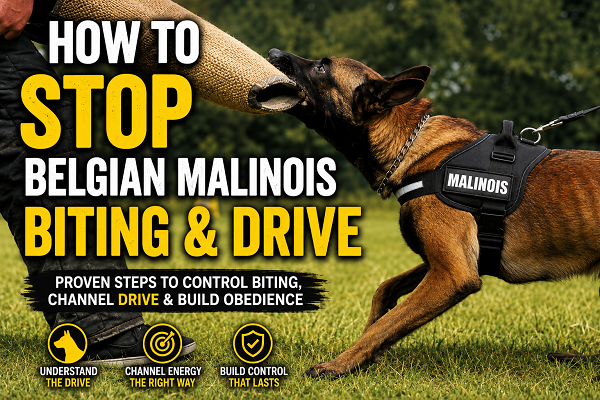
To stop unwanted Belgian Malinois biting, you redirect the dog’s prey drive onto appropriate outlets (tug toys, structured play, or sport work) while teaching bite inhibition and impulse control through consistent, calm handling, not punishment. Most handlers see real improvement within 4 to 8 weeks when training is done daily, though full impulse control in a high-drive Malinois often takes 12 to 18 months to mature.
Table of Contents
- Introduction
- Why Your Malinois Bites So Much
- Puppy Mouthing vs. Real Biting Problems
- The Three Drives Every Owner Should Know
- Stopping Unwanted Biting: Step-by-Step
- Channeling Drive the Right Way
- Managing Nipping and Mouthing in Adult Dogs
- When It Isn’t Drive at All
- Working With a Professional: Costs and Timelines
- A Real Case: From Chaos to Control
- FAQs
- Conclusion
Introduction
If you’ve ever raised a Belgian Malinois puppy, you already know the moment I’m talking about. You sit down on the couch, you reach out to pet your pup, and instead of a lick, you get a mouthful of needle-sharp teeth clamped onto your sleeve. Or maybe your dog is six months old now, and that “cute” puppy nipping has turned into full-body slamming, jumping, and grabbing at your arms every time you walk in the door.
Here’s the thing most new Malinois owners don’t realize: this isn’t really about biting. It’s about drive. And until you understand the difference, you’ll keep fighting the wrong battle.
In this guide, I’ll walk you through why your Malinois bites so much in the first place, how to tell normal puppy mouthing from a genuine problem, and exactly how working K9 handlers channel that drive instead of trying to switch it off (because you can’t switch it off and you shouldn’t want to).
Why Your Malinois Bites So Much
Ever wonder why a Malinois seems to “need” to bite something, anything, way more than most other breeds? It’s not bad luck, and it’s not a bad dog. It’s genetics doing exactly what it was bred to do.
The Belgian Malinois was developed in the Belgian town of Malines as a herding dog, originally used to nip at the heels of cattle and sheep to move them. Fast forward a century, and that same nipping instinct, combined with intense energy and a job-focused brain, is why military and police units around the world reach for the Malinois over almost any other breed. This is the dog behind Cairo, the Navy SEAL Team Six K9 involved in the 2011 raid that led to Osama bin Laden, and it’s the breed you’ll find on patrol with the U.S. Secret Service and dozens of European and American K9 units.
So when your pet Malinois grabs your sleeve, jumps on your kids, or bites at your hands during play, it’s tapping into the exact same drive that makes the breed so valuable in working roles. The problem isn’t that the drive exists. The problem is nobody taught the dog where and how to use it.
A few numbers worth knowing:
- The Belgian Malinois consistently ranks among the top 40 most popular breeds registered with the American Kennel Club, and demand has climbed sharply over the past decade thanks to military and police media coverage.
- Working-line Malinois typically need 60 to 90 minutes of real physical and mental work per day. Dogs getting less than that are far more likely to release pent-up drive through biting, chewing, and destructive behavior at home.
- Breeders and trainers commonly report that Malinois puppies show clear, obvious prey drive (chasing, grabbing, tugging) by 8 weeks of age, much earlier and more intensely than most companion breeds.
If you want the full picture on raising this breed from puppyhood, our team put together a complete walkthrough in Dog Training for Belgian Malinois: 5 Vital Steps That Work, which covers the foundation work that makes everything in this article easier.
Puppy Mouthing vs. Real Biting Problems
Not all biting is created equal, and mixing these up is the single biggest mistake I see new owners make.
Normal puppy mouthing looks like this:
- Soft, exploratory nipping during play
- Happens most during high excitement (greetings, tug, wrestling)
- Tail is loose and wagging, body is relaxed
- The dog lets go easily when redirected
A developing biting problem looks like this:
- Hard, repeated grabbing even outside of play
- Biting when the dog is told “no” or asked to stop an activity
- Grabbing at clothing, hair, or skin when the dog is frustrated
- Escalating intensity over weeks instead of settling down
Most Malinois puppies go through an intense mouthing phase between 8 weeks and 6 months old, right alongside teething. This is normal and, frankly, expected with this breed. It becomes a genuine problem when it’s still happening hard and often past 8 to 9 months, or when it starts showing up alongside guarding, growling, or fear responses.
The Three Drives Every Owner Should Know
Working dog trainers talk about “drive” constantly, but almost nobody explains it to pet owners in plain language. So here’s the short version, because understanding this changes how you train.
- Prey drive — the instinct to chase, grab, and “kill” moving objects. This is what makes your Malinois obsessed with tennis balls, tug toys, squirrels, and yes, your shoelaces and sleeves. It’s the easiest drive to spot: tail up, body loose, excited barking. This is also the drive trainers use to teach clean bite mechanics on equipment, long before any real protection work ever happens.
- Defense drive — the instinct to protect itself or its handler when it perceives a real threat. This drive matures later, usually between 1 and 3 years old, and it’s what gives a properly trained protection dog its seriousness. A dog working in defense looks and sounds completely different from one working in prey: hackles up, growling, stiff posture.
- Frustration — not a true drive, but a state that builds when a dog is blocked from something it wants (a person, another dog, a toy) and doesn’t yet have the impulse control to cope. Frustration-driven biting is one of the most common reasons pet Malinois “randomly” bite at leashes, hands, or clothing.
Most home biting problems come from prey drive with zero outlet, or frustration with zero impulse control training. Very few pet-home biting issues are actually rooted in defense drive, and that distinction matters, because the training approach is completely different for each.
Stopping Unwanted Biting: Step-by-Step
Here’s the process I walk new Malinois owners through, in order. Skipping steps is exactly how people end up with a dog that’s “impossible.”
1. Stop reinforcing the bite without realizing it
If your dog bites your hand and you pull away fast, laugh, or squeal, you just turned it into a game. Malinois are prey-driven; movement and reaction are rocket fuel for the behavior. Go still instead. No pulling, no yelling, no drama.
2. Redirect before the bite, not after
Watch your dog’s body language. The second you see that intense, fixed stare and the “loading up” posture before a grab, calmly present a toy or tug instead of your hand. Timing here matters more than almost anything else you’ll do.
3. Teach “out” or “leave it” from day one
A dog that will release on command is a dog you can actually live with. Start with low-value items and reward release generously, then build up to higher-value toys and, eventually, real-world distractions.
4. Use time-outs, not punishment
If the mouth connects with skin hard, calmly end the interaction. Stand up, step behind a baby gate, or place your dog in its crate for 30 to 60 seconds. No yelling, no physical correction for a young puppy. You’re teaching consequence, not fear.
5. Meet the drive somewhere else
This is the step almost everyone skips, and it’s the one that actually solves the problem long-term. A Malinois with an outlet for its drive bites far less around the house. More on exactly how to do this below.
6. Be relentlessly consistent
Every single person in the household needs to follow the same rules. If your kids are allowed to let the dog mouth their sleeves during play but you correct it, your dog gets a mixed signal and the behavior takes twice as long to fix.
Channeling Drive the Right Way
This is where most generic dog training advice falls flat for a Malinois, because it’s written for breeds that don’t have this level of drive to begin with.
Structured tug work is the single best tool for a driven Malinois. Real working dog trainers use tug not as a toy but as a training system: the dog only gets the tug on command, only bites the toy (never skin or clothing), and releases on command every single time. This teaches bite mechanics, builds handler focus, and burns off drive in a controlled way. Ten to fifteen minutes of structured tug, twice a day, does more for a biting problem than an hour of unstructured off-leash running.
A few rules for tug that working handlers swear by:
- Only use one specific toy for tug, and put it away when the session ends
- Always end the session with the dog giving up the toy calmly on command
- Never let the dog “win” by keeping the toy after a session
- Never allow tug to start on skin, clothing, or furniture
Protection sport foundations (even if you never plan to compete) give a Malinois an appropriate, rule-based place to use its bite. Sports like Schutzhund/IGP, KNPV (the Dutch police dog program that produces a huge share of the world’s working Malinois), Mondioring, and PSA all start dogs on bite sleeves and equipment, using prey drive, long before any decoy work resembling real confrontation happens. Even pet owners who just want a well-behaved companion often see major improvement after a few months in a beginner bite-work or sport foundations class, simply because the dog finally has a “job.”
If you’re building out a home training setup, our breakdown of Essential K9 Training Equipment Every Working Dog Handler Needs covers which tugs, sleeves, and long lines are actually worth buying versus what’s a waste of money for a home training program.
Managing Nipping and Mouthing in Adult Dogs
If your Malinois is already past a year old and still mouthing hard, the fix is the same principles, applied more strictly.
- Increase structured exercise first. Before you touch anything else, make sure your dog is getting real work: 45 to 90 minutes of active exercise, plus 10 to 15 minutes of obedience or scent games daily. An under-exercised adult Malinois will bite out of sheer pent-up energy, no matter how good your training technique is.
- Reinstate “out” training from scratch. Adult dogs that never solidified a release command need to relearn it with real consistency, not corrections.
- Watch for excitement triggers. Door greetings, the leash coming out, kids running in the yard, identify the specific triggers and build calm-before-reward routines around each one.
- Bring in a decoy or helper session. A single session with an experienced bite-work decoy can show you, in real time, exactly what your dog’s drive picture looks like and where the training gaps are.
When It Isn’t Drive at All
I want to be straight with you here: not every bite is a drive problem, and treating fear-based or resource-guarding aggression like it’s just “high drive” can make things worse, not better.
Watch for these red flags, which point toward something other than simple drive:
- Growling or snapping that happens with a stiff body, low tail, or whale eye (whites of the eyes showing)
- Guarding food, toys, or resting spots with real aggression
- Biting that appears to come from nowhere with no obvious trigger
- Biting directed at strangers or unfamiliar dogs with no socialization history
If you’re seeing any of these, this isn’t a “channel the drive” situation. It calls for a qualified behaviorist or trainer experienced with working breeds, and in some cases, a conversation with your veterinarian to rule out pain or medical causes, since dogs in physical discomfort often bite defensively with no warning.
Working With a Professional: Costs and Timelines
Here’s what real-world numbers look like, based on typical rates across the U.S., UK, and Europe as of 2026:
- Group puppy or basic obedience classes: roughly $150–$300 for a 6-week course
- Private in-home training for biting/mouthing issues: $75–$200 per session, with most owners needing 4–8 sessions
- Board-and-train programs focused on drive and obedience: $2,500–$6,000 for 3–4 weeks
- Beginner protection sport club dues (Schutzhund/IGP, Mondioring, PSA clubs): often $50–$150 per month, plus equipment
- One-on-one sessions with an experienced bite-work decoy: $60–$150 per session
Timeline-wise, expect noticeably calmer mouthing behavior within 2 to 4 weeks of consistent daily work. Full maturity in impulse control, where the “off switch” really kicks in, typically doesn’t arrive until somewhere between 18 months and 3 years old, which lines up with when defense drive fully matures in this breed. If you’re comparing how a Malinois’s drive and learning style stacks up against another popular working breed, our piece on Malinois vs. German Shepherd Intelligence for Security Work breaks down exactly why Malinois learn commands faster but need more structured outlets than a GSD.
A Real Case: From Chaos to Control
One of the most common calls we get involves a 7-month-old Malinois that had turned into what the owner called “an ankle-biting shark” every time visitors walked through the door. The dog had zero structured outlet for drive, was getting maybe 20 minutes of leash walking a day, and had never been taught a release command.
The fix wasn’t complicated, but it was consistent: 15 minutes of structured tug work twice daily, a solid “out” command built up over two weeks, a strict no-hands-as-toys rule for every family member, and a switch to 60 minutes of real exercise daily including scent games in the yard. By week three, the door-greeting biting had dropped by more than half. By week six, the family reported the dog would grab a designated toy at the door instead of a pant leg, almost on its own. That’s drive being channeled, not suppressed, and it’s the outcome every Malinois owner should be aiming for.
If you’re building a working-dog program from the ground up rather than just managing a pet, our guide on How to Start a Military K9 Training Program covers the broader structure professional programs use to develop a dog’s drive safely from puppyhood through certification.
FAQs
Why does my Belgian Malinois bite so much more than other breeds?
Malinois were bred as herding dogs and are now the top choice for police, military, and protection work worldwide, largely because of an unusually strong, early-developing prey drive. That same drive shows up at home as intense mouthing and biting when it doesn’t have a proper outlet.
At what age does Malinois biting usually calm down?
Puppy mouthing typically peaks between 3 and 6 months during teething, and most owners see a real drop in intensity by 9 to 12 months with consistent training. Full impulse control usually doesn’t settle in until 18 months to 3 years old.
Can you train the drive out of a Belgian Malinois?
No, and you shouldn’t try. Drive is genetic and it’s the reason this breed excels at working roles. The goal is to channel it into appropriate outlets like tug, obedience, and sport work, not eliminate it.
Is a Belgian Malinois too much dog for a first-time owner?
It can be. This breed does best with owners who commit to daily structured exercise and training, ideally with some prior dog-handling experience. First-time owners who succeed almost always invest early in classes or professional guidance.
Should I use a bite sleeve or bite suit training at home?
Bite sleeves and suits are decoy equipment meant to be used under the guidance of an experienced trainer or club, not tried solo at home. For home training, structured tug toys are the safe, effective equivalent.
Conclusion
A biting Belgian Malinois isn’t a broken dog. It’s a working breed doing exactly what generations of selective breeding built it to do, just without direction yet. The real fix isn’t punishment and it isn’t hoping the dog “grows out of it.” It’s redirecting that prey drive onto structured outlets like tug and sport foundations, teaching a rock-solid release command, keeping your dog genuinely exercised, and staying consistent across every person in the household.
Start with 10 to 15 minutes of structured tug twice a day, commit to a real “out” command, and increase your dog’s daily physical and mental work. Track the change over four weeks; most owners see a measurable difference by then. And if you’re seeing fear, guarding, or unpredictable aggression rather than straightforward drive, bring in a qualified trainer or behaviorist experienced with working breeds sooner rather than later.

Her work centres on obedience, detection, protection and operational readiness. She favours proven methods built on repetition, consistency and real-world conditioning, so that both dogs and handlers are prepared for high-pressure tasks.
Rofiat represented the Nigerian Army Dog Centre at the Nigerian Army Day Celebration (NADCEL) 2026, where she led demonstrations in obedience, explosive detection, agility and tactical movement. Through articles, training content and documentaries, she shares field-based insight into how structured training, clear communication and trust between handler and dog affect performance and reliability.
She is the author of Beyond the Bark: Inside a Pro Handler's Playbook for Raising the Ideal Dog, a practical guide that helps dog owners and handlers apply professional training principles in everyday situations.
- Australian Cattle Dog vs Blue Heeler: Any Difference? - October 1, 2026
- Bousnic Dog Training Collar Review: Is It Safe? - September 30, 2026
- Gravy Train Dog Food Review: Ingredients & Recalls - September 30, 2026