How to Start a Military K9 Training Program (Full Guide)
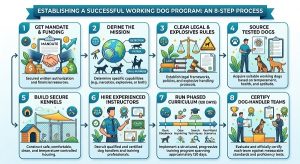
To start a military K9 training program, follow these eight steps:
- Get a written mandate and funding.
- Define the mission (detection, patrol or dual-purpose).
- Clear the legal and explosives-handling rules.
- Source tested dogs.
- Build secure, cool, clean kennels and training grounds.
- Hire experienced instructors.
- Run a phased curriculum of about 120 days.
- Certify every dog-and-handler team against a measurable standard.
The U.S. Army, for example, expects at least 95 percent detection accuracy before a team certifies. Plan on roughly 18 to 24 months from approval to your first certified teams. That timeline is our planning estimate, built from dog sourcing time, a 120-day course and handler certification.
Table of Contents
- Introduction
- First, Choose Your Path: Unit or Contractor?
- Step 1: Get a Mandate and Define the Mission
- Step 2: Sort Out the Legal Side
- Step 3: Source the Right Dogs
- Step 4: Build the Facility
- Step 5: Hire Instructors and Train Handlers
- Step 6: Build the Training Curriculum
- Step 7: Certify Teams to a Real Standard
- Step 8: Protect Welfare and Plan Retirement
- What Does It Cost? A Realistic Budget
- How to Win Contracts and Build Trust
- Your 24-Month Roadmap
- 7 Mistakes That Sink New Programs
- Why You Can Trust This Guide
- Frequently Asked Questions
- Final Thoughts
Introduction
Ever searched “how to start a military K9 training program” and found nothing but articles on becoming a handler? You’re not alone. Most guides out there tell you how to join the military as a dog handler. Others give you a generic “start a dog business” checklist. Almost none show you how to build an actual military K9 training program from the ground up.
That gap causes real problems. New programs buy dogs before they have kennels. They hire trainers before they write a standard. They promise “95 percent accuracy” and have no way to prove it. I’ve seen what happens when the order is wrong, and it’s expensive for the dogs, the handlers and the budget.
This guide fixes that. You’ll learn the two ways to start a program, the eight steps in the right order, real numbers from the U.S. Department of Defense, a sample budget, a 24-month roadmap and the mistakes that sink new programs. Whether you’re an officer planning a unit, a private security owner chasing contracts or an experienced handler who wants to build something, you can follow along.
First, Choose Your Path: Unit or Contractor?
Here’s the thing most articles skip. “Starting a military K9 program” means two very different jobs.
| Path A: Build an in-house unit | Path B: Run a contractor program | |
|---|---|---|
| Who you are | Army, air force, police or border agency | Private company serving military, police or security clients |
| Who pays | Government budget | Contracts, tenders and client fees |
| Who owns the dogs | The state | You, or the client after sale |
| Biggest hurdle | Funding, kennels, staffing, command support | Proving credibility and passing procurement checks |
| Biggest risk | Dogs sit idle with no trained handlers | Cash runs out before the first contract |
Path A is how big programs work. The U.S. Department of Defense program has run out of Lackland Air Force Base in Texas since 1957. Its 341st Training Squadron trains roughly 350 dogs a year for every U.S. service branch and handles almost all dog purchasing.
Path B is how many smaller countries and private firms get started. A contractor might sell trained dogs, train an agency’s handlers or run detection teams on site. For a real-world example of vendor pricing, a Texas academy quoted a fully trained accelerant-detection dog with four weeks of handler training for $6,500 in a 2016 county proposal. That price is old, but it shows how contractors package dogs and training together.
Pick your path now. Every step below works for both, and I’ll flag where they differ.
Step 1: Get a Mandate and Define the Mission
Before you buy a single dog, write down what the program must do. A vague goal like “train military dogs” gets you vague results.
Start with a one-page mission profile:
- Roles: explosive detection, narcotics detection, patrol, tracking, search or a mix. Most U.S. military working dogs are dual-purpose, meaning detection plus patrol.
- Where they’ll work: base gate, airport, border, convoy route, disaster zone.
- Climate: a dog that works in Lagos heat needs a different plan than one in a Norwegian winter.
- Numbers: how many certified teams you need in year one, year two and year three.
- Success measures: detection accuracy, false alert rate, handler certification rate and dog availability.
Now get approval in writing. For Path A, that means a command order and a budget line. For Path B, it means a signed letter of intent, a pilot contract or a funded partner. No paper, no program.
Pro tip: Pick one role first. Programs that launch with detection only, then add patrol, almost always finish their first year in better shape than programs that try everything at once. The U.S. Army’s own dogs generally work one detection type each, and that’s by design.
Step 2: Sort Out the Legal Side
Laws differ by country, so I can’t hand you one checklist. But every program faces the same four areas:
- Business and facility rules. Zoning, kennel licences, animal-welfare law and, for Path B, company registration and insurance.
- Security licensing. In some countries, private firms need a security licence before they can run guard or detection dogs. In the U.S., for example, Texas private-security regulators licensed one K9 academy that supplied dogs to agencies.
- Explosives and drug training aids. This is the big one. Explosive and narcotic training aids are tightly controlled nearly everywhere. Talk to your national explosives regulator or police authority before you plan detection work. Many private programs partner with a licensed agency instead of holding materials themselves.
- Liability. Protection dogs bite. Get liability insurance, handler contracts, bite-incident procedures and client waivers in place early.
Also think about animal import and export rules. If you plan to buy dogs from Europe, you’ll need health certificates, microchips and customs paperwork. Build that lead time into your schedule.
Step 3: Source the Right Dogs
The dogs decide whether your program works. And sourcing is where the numbers surprise people.
Buy, Breed or Both?
Buy. The U.S. Air Force reported paying about $5,500 for a dog from Europe and about $9,000 from a U.S. vendor in 2020. Government audit figures say roughly 85 percent of the dogs the Air Force buys come from breeders in Germany and the Netherlands. Our breakdown in how much it costs to train a military dog shows how small that purchase price is next to the full training bill.
Breed. The U.S. military breeds its own Belgian Malinois at Lackland. Research in Frontiers in Veterinary Science says the breeding program supplies about 13 percent of the military working dog population, from roughly 50 to 90 puppies. That’s a lot of work for a small share, which tells you breeding only makes sense at scale.
Both. Smart small programs buy started dogs (12 to 24 months old) and add a small foster or puppy-raising scheme later.
Expect Washouts
This is the part nobody puts in the brochure. Air Force sources say around 50 percent of puppies in the breeding program aren’t selected, and one Air Force article said less than half the dogs entering the 120-day school become military working dogs. Bloomberg Government reported that 15 to 25 percent of dogs who pass initial screening still don’t finish training.
So here’s my rule: budget for two dogs to get one. If you need six certified dogs, plan to evaluate twelve.
Want to see how selection works? Read our guide to how military working dogs are selected as puppies.
Which Breeds?
| Breed | Best for | Watch out for |
|---|---|---|
| Belgian Malinois | Patrol, detection, special operations | Very high drive; needs experienced handlers |
| German Shepherd | Patrol, detection, tracking | Hip and back health; screen the lines |
| Dutch Shepherd | Dual-purpose work | Fewer suppliers |
| Labrador and other retrievers | Detection only, especially crowds and airports | Low protection drive |
The U.S. Air Force says it mainly uses Malinois and German Shepherds. Don’t pick a breed for looks. Pick the dog who shows strong reward drive, steady nerves and a sound body, whatever the breed.
Your Selection Test (Minimum)
- Drive test: Will the dog chase and fight for a toy? The military uses toys, not food, as its main reward.
- Nerve test: Gunshots, slippery floors, crowds, strange surfaces.
- Social test: Calm around people and other dogs.
- Medical check: Hips, elbows, spine, heart, teeth, eyes.
- Recovery test: How fast does the dog bounce back after a scare?
Step 4: Build the Facility
New programs often overspend on fancy training props and underspend on kennels. That’s backwards.
In February 2026, the U.S. Department of Defense Inspector General released an evaluation of the DoD working dog program’s canine welfare management (DODIG-2026-057). It focused on housing, exercise and enrichment, and it recommended matching the number of dogs at Lackland to the number of caretakers available. A 70-year-old program still struggled with the basics. Your new one can do better by planning them in from day one.
Facility Checklist
- Kennels: Individual runs with shade, airflow and easy-to-clean floors. Heat control matters most in hot climates.
- Isolation kennel: For new arrivals and sick dogs.
- Veterinary room and vet partner: Don’t rely on “call if needed.” Sign a standing agreement.
- Obedience yard: Flat, fenced and quiet for early work.
- Detection area: Rooms, vehicles, luggage lines and open ground for searches.
- Patrol area: Padded work area, hide blinds and a controlled bite-work zone.
- Obstacle and agility area: Ramps, stairs, tunnels and slippery surfaces.
- Exercise space: Dogs need daily exercise and mental work outside of training.
- Secure storage: For training aids, equipment and records.
- Classroom and records room: Handlers need to learn theory, and every dog needs a file.
Ratios That Matter
There’s no global rule, but I’d start with this: one trained caretaker for every six to eight kennelled dogs, plus a named person responsible for each dog every single day. If you can’t afford the people, don’t buy the dogs yet.
Step 5: Hire Instructors and Train Handlers
Great dogs with weak instructors turn into expensive pets.
Instructors
Look for people who have actually trained dogs to a certification standard, not just owned working breeds. Strong signs include military or police dog-unit service, detection or patrol instructor courses, and the ability to explain why a method works. Hire at least two instructors so one person’s absence never stops the program.
Handlers
The handler is half of the team. Training lengths vary:
- United Kingdom: The Defence Animal Training Regiment at Melton Mowbray has a requirement to deliver more than 200 trained working dogs a year. New British Army dog handlers take a seven-week initial course, then an 18-month animal-care apprenticeship.
- U.S. TSA explosives detection: Six weeks of training for the dog before pairing, then 11 weeks together.
- U.S. military: Handlers and dogs train together, and the Army expects new handlers to certify their team within 90 days of arriving at a unit.
For your program, choose handlers for patience, fitness, honesty and calm under pressure. Aggressive or impatient people damage working dogs fast.
Step 6: Build the Training Curriculum
The U.S. main course at Lackland runs about 120 days: roughly 60 days of detection and 60 of patrol training. You don’t have to copy it, but it shows how long serious foundation work takes. Our guide to how military working dogs are trained walks through the full process.
Here’s a clean four-phase curriculum you can adapt:
| Phase | Weeks | Focus | Pass mark |
|---|---|---|---|
| 1. Foundation | 1–3 | Toy drive, confidence, sit, down, heel, recall, out | Reliable obedience on and off leash |
| 2. Skill building | 4–9 | Odor imprinting (detection) or controlled bite work (patrol) | Consistent target response in simple searches |
| 3. Real-world proofing | 10–14 | Noise, crowds, vehicles, buildings, heat, distractions | Same results in new places |
| 4. Team phase | 15–17+ | Handler and dog work together; final tests | Team certification |
Training Rules I Won’t Bend On
- Reward the right behavior fast. Marine Corps instructors describe starting with toy rewards for basic commands such as sit, down, heel and stay.
- Change one thing at a time. New place, new distraction or new odor, never all three.
- Practice blind. Handlers shouldn’t know where the hide is during tests, or they’ll cue the dog without meaning to.
- Train short and often. Quality beats exhaustion.
- Keep notes on every session. If it isn’t written down, you can’t prove progress.
For detection dogs, many programs use a “passive” or “aggressive” alert. Whichever you choose, the dog’s alert must be clear to a stranger.

Step 7: Certify Teams to a Real Standard
Here’s where most small programs fall short. They say “our dogs are certified” but can’t tell you the test.
Write your standard before you train. Include:
- Accuracy target. The U.S. Army expects at least 95 percent accuracy before detection dogs certify.
- False alert limit. A dog that alerts to everything is useless.
- Test conditions. Different locations, hidden aids, distractions and time limits.
- Independent evaluator. Someone who didn’t train the dog.
- Re-testing schedule. At least once a year, with extra checks after illness, injury or a handler change.
Also consider outside certification. Agencies often use bodies such as the North American Police Work Dog Association (NAPWDA) or the National Narcotic Detector Dog Association (NNDDA). One industry guide recommends annual certification by a reputable third party. Check which bodies your clients recognize before you pay for any of them.
For how reliable detection dogs can be in the field, read our article on explosive detection dog accuracy.
Step 8: Protect Welfare and Plan Retirement
A working dog is an athlete and a colleague. Your welfare plan should cover:
- Nutrition: High-quality food matched to workload.
- Heat safety: Shade, water, cooling breaks and handler training to spot heat stress.
- Medical schedule: Vaccines, parasite control, regular exams and joint checks.
- Rest days: Working dogs need recovery, not just work.
- Injury reporting: Handlers must feel safe reporting problems.
- Retirement: Decide now what happens when a dog can’t work.
U.S. military dogs usually work around eight to twelve years before retiring. Before 2000, retired dogs were often euthanized. Robby’s Law changed that in November 2000, allowing suitable dogs to be adopted. Washouts aren’t wasted either: dogs who miss one job often make excellent companions or find another role.
What Does It Cost? A Realistic Budget
Let’s keep this honest. No one publishes one universal price for starting a program. But we can build from solid reference points.
Big-program benchmark: Buying and training a U.S. military working dog costs roughly $65,000 to $85,000, based on officials’ estimates reported by the U.S. Government Accountability Office in 2022. That includes the national system’s infrastructure, which you won’t copy.
Smaller benchmark: The National Police Dog Foundation says a police K9 often costs about $8,000 or more to buy and $12,000 to $15,000 to train.
A real unit budget: One U.S. county’s 2022 K9 cost sheet totaled $30,094 for the first year per dog (dog, vehicle insert, kennel, food, schooling, vet and gear), then roughly $7,000 a year after that.
Illustrative Pilot Budget (6 Dogs)
This is our planning illustration, not an official figure. It multiplies that county’s per-dog numbers and excludes land, buildings and salaries.
| Item | Estimate |
|---|---|
| First-year dog and gear costs (6 × $30,094) | about $180,600 |
| Annual running costs from year two (6 × ~$7,000) | about $42,000 |
| Evaluate extra candidates for washouts | add 20–50% to dog purchases |
| Facility, instructor and caretaker pay | local; usually the largest line |
| Insurance, legal, certification fees | local |
| Contingency | 10–15% |
The lesson: people and places cost more than dogs. For a deeper breakdown, see our full guide on how much it costs to train a military dog.
How to Win Contracts and Build Trust
This section is mainly for Path B, but Path A leaders can use it to defend their budget.
- Show your numbers. Share certification results, false alert rates and training logs.
- Write a capability statement. One page: services, dog numbers, certifications, insurance and references.
- Offer a pilot. A 30- to 90-day trial lowers risk for the buyer.
- Publish training methods. Clear, humane methods build trust with public buyers.
- Be honest about limits. Never promise 100 percent detection.
- Learn tender rules. Government buyers want licences, insurance and references. Start collecting them now.
- Share useful content. Demonstrations, videos and articles show your expertise. For example, I’ve shared obedience, agility and explosive-detection demonstrations from the Nigerian Army Day Celebration (NADCEL) 2026 on our YouTube channel.
Want the professional handler habits behind all this? My e-book, Beyond the Bark: Inside a Pro Handler’s Playbook for Raising the Ideal Dog, shows how structured, repetition-based training works in everyday life.
Your 24-Month Roadmap
This timeline is our planning estimate. Adjust it for your country, budget and dog supply.
| Months | Milestone |
|---|---|
| 0–3 | Written mandate, mission profile, budget approval, legal review |
| 3–6 | Facility design or lease, vet agreement, instructor hiring |
| 4–9 | Dog sourcing, import paperwork, quarantine and first evaluations |
| 6–10 | Build kennels and training areas; train instructors on your standard |
| 9–14 | Run Phases 1–3 with the first group; handler selection |
| 14–17 | Team phase and internal certification |
| 17–20 | External evaluation; fix weak points |
| 20–24 | Operational deployment or first client contract; first annual audit |
7 Mistakes That Sink New Programs
These are the gaps I see across most beginner guides, and the mistakes I’d help you avoid:
- Buying dogs first. Kennels, people and money come first.
- Skipping the washout budget. Plan for two dogs to get one.
- No written certification standard. If you can’t define “pass,” you can’t prove quality.
- Trainers testing their own dogs. Use an independent evaluator.
- Ignoring heat and recovery. Performance falls fast in hot, tired dogs.
- Too many roles at once. Master detection or patrol first.
- No retirement plan. Dogs deserve a future, and buyers notice.
Why You Can Trust This Guide
Experience: Cpl. Rofiat Muritala is a Nigerian Army military working dog instructor and handler with more than 14 years at the Nigerian Army Dog Centre. She has completed advanced obedience, K9 patrol and advanced explosive detection certification courses, and represented the Centre at NADCEL 2026.
Expertise: Her work covers dog selection, foundation training, behavior shaping and performance evaluation in real operational settings.
Authoritativeness: The facts here come from U.S. Government Accountability Office reporting, the DoD Inspector General, U.S. Air Force and Army sources, Military Times and peer-reviewed veterinary research. Sources are listed at the end.
Trustworthiness: Where no public number exists, we say so or label it as an estimate. Laws change, so confirm local rules with your own regulators before you build.
Frequently Asked Questions
1. Can a private company start a military K9 training program?
Yes, as a contractor. A private company can train handlers, supply trained dogs or run detection teams for military, police and security clients. You’ll need the right business licences, insurance and, for detection work, approved access to training aids through your national authorities. Many firms partner with a licensed agency to handle regulated materials.
2. How long does it take to train a military working dog?
The core U.S. course at Lackland runs about 120 days, with roughly 60 days of detection and 60 of patrol work. Dogs bred in the DoD program spend months in foster care and adolescent training first. Plan on 4 to 6 months of formal training for a started dog, plus handler pairing and certification.
3. How much does it cost to start a K9 training program?
There’s no single price. A U.S. military working dog costs about $65,000 to $85,000 to buy and train, according to GAO. A smaller police-style program might cost around $30,000 per dog in year one, then about $7,000 a year, before facilities and salaries. See our full cost breakdown.
4. What is the best breed for a military K9 program?
Belgian Malinois and German Shepherds are the most common choices for patrol and dual-purpose work, with Dutch Shepherds as a strong alternative. Labradors and other retrievers shine in detection-only roles. Choose individual dogs for drive, nerve strength and health, not just breed.
5. What certification do military K9 teams need?
It depends on the country and the client. The U.S. Army expects detection teams to reach at least 95 percent accuracy and to certify within 90 days of reaching a unit. Civilian and police programs often use outside bodies such as NAPWDA or NNDDA. Whatever you pick, use an independent evaluator and re-test every year.
Final Thoughts
Starting a military K9 training program isn’t about buying a few tough dogs. It’s about building a system: a clear mission, legal approval, tested dogs, solid kennels, skilled instructors, a phased curriculum and honest certification.
Here’s your action list:
- Choose Path A or Path B this week.
- Write a one-page mission profile.
- Meet your explosives and security regulators before you plan detection work.
- Budget for washouts and for people, not just dogs.
- Write your certification standard before the first training day.
Start small, certify hard and protect your dogs. That’s how programs earn trust and keep it.
Want weekly K9 training guides like this one? Subscribe to our weekly articles roundup newsletter.
Sources
- U.S. Government Accountability Office, Working Dogs: Federal Agencies Need to Better Address Health and Welfare (GAO-23-104489, 2022): https://www.gao.gov/products/GAO-23-104489
- DoD Inspector General, Evaluation of the DoD Military Working Dog Program’s Management of Canine Welfare (DODIG-2026-057, Feb 2026): https://www.oversight.gov/sites/default/files/documents/reports/2026-02/DODIG-2026-057_Final_Redacted%20SECURE.pdf
- Military Times, “What would it take for the U.S. military to ‘buy American’ when it comes to military working dogs?” (2020): https://www.militarytimes.com/2020/09/18/sen-richard-blumenthal-cries-havoc-wants-to-let-slip-more-us-raised-dogs-of-war/
- Air Education and Training Command, “Laughlin military working dog retires after 10 years of honorable service”: https://www.aetc.af.mil/News/Article-Display/Article/2070735/laughlin-military-working-dog-retires-after-10-years-of-honorable-service/
- Travis AFB, “Dogs form close bond with their handlers”: https://www.travis.af.mil/News/Display/Article/153225/dogs-form-close-bond-with-their-handlers
- Marine Corps Logistics Base Barstow, “Four legs, one goal”: https://www.mclbbarstow.marines.mil/Media-Room/Stories/Article/Article/509300/four-legs-one-goal-k-9s-train-day-in-and-day-out/
- Task & Purpose, “Military Working Dog Handler Course”: https://taskandpurpose.com/military-life/military-working-dog-handler-course.md
- Frontiers in Veterinary Science, “United States military working dogs from 2019 to 2021”: https://www.frontiersin.org/journals/veterinary-science/articles/10.3389/fvets.2025.1580628/pdf
- Fort Bend County, Houston K9 Academy proposal (2016): https://agendalink.fortbendcountytx.gov/docs/2016/CCTR/20160726_2835/22849%5FHouston%20K%2D9%20Academy%20RFP%202016%2Epdf
- County K9 unit estimated cost sheet (2022): https://public.destinyhosted.com/wilcodocs/2022/COM/20220329_1667/28843_K9_Unit_Estimated_Cost.pdf
- National Police Dog Foundation FAQ: https://www.nationalpolicedogfoundation.org/faq
- AVMA, “Inside the headquarters for military dogs” (2016): https://www.avma.org/javma-news/2016-06-01/inside-headquarters-military-dogs
- International Dog Trainers School, “How to Start Your Own Detection Dog Business”: https://internationaldogtrainerschool.com/detection-dog-business/

Her work centres on obedience, detection, protection and operational readiness. She favours proven methods built on repetition, consistency and real-world conditioning, so that both dogs and handlers are prepared for high-pressure tasks.
Rofiat represented the Nigerian Army Dog Centre at the Nigerian Army Day Celebration (NADCEL) 2026, where she led demonstrations in obedience, explosive detection, agility and tactical movement. Through articles, training content and documentaries, she shares field-based insight into how structured training, clear communication and trust between handler and dog affect performance and reliability.
She is the author of Beyond the Bark: Inside a Pro Handler's Playbook for Raising the Ideal Dog, a practical guide that helps dog owners and handlers apply professional training principles in everyday situations.
- Local Dog Breeds: Temperament, Health & Training Guide - October 6, 2026
- How Long Do Military Working Dogs Serve? Full Guide - October 5, 2026
- National Puppy Day 2026: Date, Best Deals & Freebies - October 4, 2026