How Military Working Dogs Are Selected as Puppies
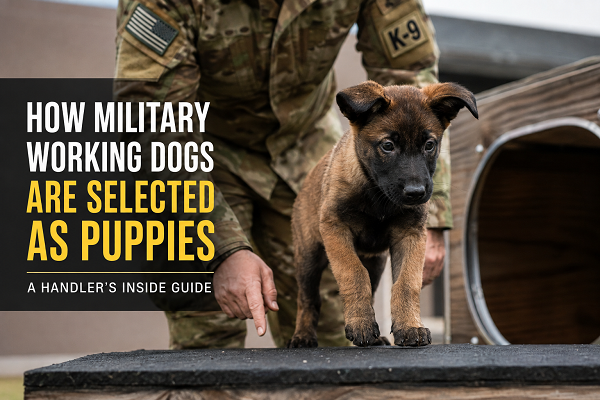
Military working dogs aren’t picked from a litter in one test. The best programs start with proven parents, raise the puppies in foster homes until about 7 months, and keep re-checking health, nerve, and drive until the dog is around 12 months old. Many militaries skip the puppy stage altogether and buy dogs aged 1 to 3 years after hands-on testing. Roughly half of all candidates fail somewhere along the way.
Table of Contents
- Introduction: Why “Picking the Best Puppy” Is a Myth
- Two Pipelines: Breeding Your Own vs. Buying Young Dogs
- It Starts With the Parents (and the First Weeks of Life)
- What Evaluators Actually Look For
- The Puppy-to-Dog Timeline, Stage by Stage
- Inside a Foster Home: The Part Most Articles Skip
- Can a Puppy Test Really Predict a Working Dog?
- How Bought Dogs Are Tested (Procurement Day)
- How the US, UK, and Israel Compare
- Why Dogs Wash Out, and What Selection Still Misses
- What Happens to Dogs Who Don’t Make the Cut
- A Handler’s Notes: What I Look For
- What You Can Copy When Choosing a Working-Line Puppy
- FAQs
- Conclusion
Introduction: Why “Picking the Best Puppy” Is a Myth
Ever watched a litter of Malinois puppies tumble around and wondered which one will end up sniffing out explosives? Here’s the honest answer: nobody can tell for sure at eight weeks. Not the breeders, not the trainers, not the vets.
That’s the problem every military dog program has to solve. A working dog costs a lot of money and time before it ever does a single day of real work. If you pick wrong, you find out a year later, after the kennel space, the vet bills, and the trainer hours are already spent.
So the smart programs don’t try to pick a winner on day one. They build a funnel. They choose the parents carefully, give the puppies a rich early life, test again and again as the dog matures, and only commit when the dog’s adult nerve and body are clear to see.
In this guide, I’ll walk you through that funnel with real numbers, ages, and research. You’ll learn what the US military does differently from the Swedish, British, and Israeli programs, what the science says about puppy tests (it’s less flattering than most articles admit), why so many dogs wash out, and what you can borrow if you’re choosing a working-line puppy yourself.
Two Pipelines: Breeding Your Own vs. Buying Young Dogs
Most articles on this topic describe only one path. In reality, there are two, and they work very differently.
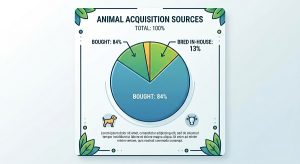
Pipeline 1: The in-house puppy program. Since 1998, the US Department of Defense has bred dogs at the 341st Training Squadron at Joint Base San Antonio-Lackland in Texas. It’s the only DoD military working dog breeding program. According to a 2025 veterinary study from the DoD’s own Military Working Dog Veterinary Service, it supplies about 13% of the force, with roughly 50 to 90 Belgian Malinois and Dutch Shepherd puppies whelped each year.
Pipeline 2: Buy young dogs from vendors. The rest, about 84% of the dogs in that same study, come from outside sources. Most are bred in Europe, where generations of sport and police dog culture have produced strong working lines. One Air Force breakdown reported by Bloomberg Government showed 427 dogs bought in a single year: 214 from domestic vendors and 213 from overseas. Of the domestic group, all but 20 had been born in Europe anyway. The same report put the dog-buying budget at about $5.3 million a year. That works out to roughly $12,000 per dog on average, though that’s my own back-of-the-envelope math, not an official price.
Why does the US rely so heavily on imports? The American Kennel Club’s Detection Dog Task Force has noted that over 80% of working and detection dogs in the US are imported from Eastern Europe. European lines come with competition records from sports like IGP (formerly Schutzhund) and KNPV, which act as a built-in “pre-test” of nerve and drive. Agencies there are also looking at dogs around 10 to 12 months old, and military buyers often prefer even older.
Here’s what that means for you as a reader: “Puppy selection” only applies to a small slice of military dogs. For the majority, selection happens later, on young adults, with a very different set of tests. I’ll cover both.
It Starts With the Parents (and the First Weeks of Life)
Selection begins before the puppies are born. At Lackland, the breeding stock are stud dogs and brood bitches chosen because they performed well as working dogs themselves. A program manager has described what the team wants to see in the pedigree: sound eyes, excellent hips and elbows, and a strong working lineage going back generations.
Then the puppies arrive, and the clock starts. Lackland’s “Puppy Development Specialists” work with the litter from birth, using imprinting and exposure activities to prepare them for the next phase. The Air Force is careful to say that none of this guarantees an adult working dog. It’s preparation, not prediction.
The mother matters more than most people think. Swedish researchers studied 22 German Shepherd mothers in the Swedish Armed Forces breeding program. They video recorded the mothers during the first three weeks after birth, then tested the grown puppies at 15 to 18 months with the armed forces’ standard temperament test. Mothers differed consistently in how much care they gave, and the grown offspring of the less attentive mothers showed more startle, less exploration in an open arena, and slower eating in a new place. Maternal care affected the adult dogs’ physical engagement, social engagement, and aggression scores.
One fair caution: a larger Swedish analysis of nearly 6,000 German Shepherds found that genetics carried most of the influence on personality traits, while the mother’s influence (genetic plus environmental) was small. Both things can be true. Genes load the dice, and early life shapes how they roll.
What Evaluators Actually Look For
Evaluators aren’t hunting for the friendliest or cutest pup. They’re looking for a working package. The DoD breeding program has described three core behaviors it wants to see: predatory behavior (the urge to chase and grab), boldness around people and new situations, and a willingness to work in any setting, even dark, noisy, or distracting ones.
Let me break that into the four things I’d say matter most.
1. Drive (not just energy)
A busy puppy isn’t the same as a driven puppy. Evaluators look at:
- Prey drive: chasing, grabbing, and holding a moving toy
- Hunt drive: staying with a search when the target is out of sight
- Reward motivation: will the dog work for a toy or food and keep working when it gets hard?
A dog with low drive can be a wonderful pet. It just won’t survive thousands of repetitions in detection or patrol training.
2. Nerve strength (recovery, not fearlessness)
This one surprises people. A good candidate doesn’t ignore a sudden noise. It startles, then recovers fast and goes to check it out. The red flags are a pup that freezes and stays frozen, or one that turns aggressive out of fear.
That second one is a big deal. In the DoD’s 2019-2021 discharge data, fear and anxiety (with aggression in 63% of those cases) accounted for about 9% of all dogs leaving service, and those dogs left after an average of only 3.4 years. Real nerve is worth more than raw sharpness.
3. Trainability and focus
Can the pup lock onto a person with distractions around? Does it problem-solve, or give up when the toy goes under the chair? This is the raw material for the obedience foundation covered in Mastering Obedience: The Backbone of Every Military Working Dog (MWD).
4. A body built for the job
Hips, elbows, spine, heart, and overall structure matter because the work is brutal on joints. In the same DoD study, neuromusculoskeletal disease caused about half of all discharges. Radiograph screening for hips, elbows, and the lower spine is a standard part of buying a dog.
The Puppy-to-Dog Timeline, Stage by Stage
Different programs vary, but here’s the US in-house path, pieced together from DoD, Air Force, and veterinary sources.
| Age | What happens | Pass/fail? |
|---|---|---|
| Birth to about 6 weeks | Whelping at Lackland; imprinting and gentle exposure by Puppy Development Specialists | No formal pass/fail |
| About 6 weeks to 7 months | Foster home; real-world socialization; monthly check-ins and training sessions | Ongoing observation |
| About 7 months | Puppy returns to Lackland for further evaluation and training | Early screen |
| About 12 months | Formal evaluation (often called a consignment test) for entry to training | Yes, the big one |
| 12 months+ | Dog Training School, roughly 120 days, for patrol plus a detection specialty | Qualification at the end |
A quick note on ages: you’ll see “8 weeks” in some articles and “6 weeks” in others. The Air Force’s own foster page says the commitment runs from age 6 weeks to 7 months. Other sources say 6 to 8 weeks, so the start varies by litter.
Inside a Foster Home: The Part Most Articles Skip
The foster program is the most clever piece of the system, and it solves a real problem: you can’t grow a confident dog in a kennel.
Lackland’s foster consultants have pointed out that kennel-raised pups arrive with no experience of a leash, a car ride, or a night alone. The program manager has said that placing puppies with a family is the best way to grow a bold, well-adjusted dog that isn’t rattled by new sights and sounds.
Here’s what the program asks of fosters, based on Air Force and local news sources:
- Live within about a two-hour drive of Lackland
- Commit to roughly five months, from about 6 weeks to 7 months old
- Apply and be selected (not everyone is accepted)
- Bring the puppy in for monthly check-ups and socialization or training sessions
- Expose the pup to stores, parks, cars, people, and new surfaces
The Air Force says a good foster is the key to the puppy making it through. One older news report said finding enough fosters, around 100 families a year, was the program’s biggest challenge. And yes, fosters get attached. If the dog doesn’t make it as a military working dog, the foster family typically gets the first chance to adopt.
Can a Puppy Test Really Predict a Working Dog?
This is the section most competitor articles can’t write, because it means admitting something uncomfortable: puppy tests are weak predictors.
Here’s what the research shows:
- A study of 630 German Shepherds found that results of an eight-week puppy test corresponded poorly with adult behavior and with service dog performance.
- A 2014 PLOS ONE study followed Border Collies from newborn to adult. Only one of ten traits, how much the dog explored a new room, stayed correlated between the puppy test at 6 to 7 weeks and the adult test.
- A meta-analysis of dog personality research found puppy personality is moderately consistent over time. Predictive power was most detectable for aggression and submissiveness, and less so for other traits.
- A guide dog study found retrieving at 8 weeks and aggression at 9 months were among the most significant predictors of success.
- A 2025 Finnish study suggested that puppy cognitive tests run at 3 to 7 months were more useful than very early tests, predicting adult energy level and impulsivity.
What do I take from all that? Later is better. Puppies change fast, and a 7-week-old’s behavior depends on sleep, hunger, teething, and mood. That’s exactly why serious programs re-test across months instead of trusting one session. It’s also why buying dogs at 12 to 36 months is such a popular hedge: the adult nerve and structure are visible, so there’s less guessing.
How Bought Dogs Are Tested (Procurement Day)
When a vendor brings a young dog to be considered, the dog faces a gauntlet. Here’s what the Lackland procurement documents and a DoD overseas buying trip describe.
Age window: Vendors’ dogs should be roughly 12 to 36 months old.
Step 1: The X-rays. Vets review radiographs before anything else, focusing on hips, elbows, and lower spine. A dog with bad joints is out before it ever bites a sleeve.
Step 2: Behavior and aptitude tests. On a buying trip to Poland, evaluators tested search and detection, bite work, and reactionary behaviors. Dogs that passed got a full physical exam and vaccinations for travel. The team bought 45 dogs on that trip.
Step 3: Gunfire. Dogs considered for patrol work are rated on how steady they are under gunfire. Tests are scored pass/fail.
Step 4: Arrival. Dogs that pass the pre-purchase exams arrive at Lackland, where they enter the training pipeline.
Notice the pattern: everything tested is something that ends careers later. Joint problems, fear, and weak drive all show up in those discharge statistics.
How the US, UK, and Israel Compare
The criteria are the same everywhere (health, nerve, drive), but the mechanics differ.
United States. Two pipelines, as covered above: about 13% bred in-house, the rest bought at 1 to 3 years old from vendors and overseas breeders. The force is mostly Belgian Malinois and German Shepherds, which made up about 46% and 43% of dogs in the 2025 discharge study.
United Kingdom. The British Army and RAF Police train their dogs through the Defence Animal Training Regiment at Melton Mowbray. According to a comparative study from Oklahoma State, the UK doesn’t run a breeding program like Lackland’s. Dogs come from donations or dealers instead. A UK Ministry of Defence tender shows dogs supplied by contractors must pass a veterinary and capability assessment before the military accepts them. Detection roles use more Labradors and Springer Spaniels, and sometimes surprising sources. Treo, a Labrador-Springer cross whose owners hoped the Army would sort him out, became an arms and explosives search dog and later won the Dickin Medal.
Israel. The Oketz unit sources about 99% of its dogs from European breeders, mostly Belgian Malinois. It buys around 70 dogs a year at about one year old, to balance maturity with trainability. The training then runs up to two years.
Sweden. The Swedish Armed Forces breed German Shepherds and send puppies to foster homes. At about 17 months, they run a standard temperament test. Swedish researchers have reported that about half of tested dogs are rejected for temperament and roughly 10% for medical reasons.
The shared pattern: proven working bloodlines beat any breed label, testing happens more than once, and nobody rushes a young dog onto the front line.
Why Dogs Wash Out, and What Selection Still Misses
How many puppies actually make it? Numbers vary, but they all point the same way. Lackland trainers have said the suitability rate runs around 50%, meaning they train about 200 dogs to produce 100 usable ones. Sweden’s numbers suggest even tougher odds. Roughly half rejected for temperament and another tenth for health leaves around 40% making it.
Why such a high failure rate? Let me give you four reasons.
- Predicting adult behavior from a puppy is hard. As you saw above, early tests are weak predictors. A bold 10-week-old can still develop noise sensitivity or lose drive by 18 months.
- Genetics isn’t destiny. Even puppies from proven parents can turn out wrong. Early rearing, maternal care, and socialization all carry weight.
- Missed windows are hard to fix. A puppy without enough varied experience early on often can’t fully catch up later.
- Bodies fail under load. Hip, elbow, and spine problems may only show up under real workload.
The bigger lesson comes from what happens after selection. The 2025 DoD study of 1,230 dogs discharged between 2019 and 2021 found that only about 34% reached the 8-year service target. The average was 6.4 years. The top causes of discharge were:
- Neuromusculoskeletal disease (about 50%)
- Training failure (about 14%)
- Fear and anxiety (about 9%)
- Cancer (about 7%)
- Heat injury (about 3%)
Fear-anxiety dogs left earliest and cost the most service years. Belgian Malinois were more likely than German Shepherds to be discharged for fear-anxiety and heat injury, though the researchers said many factors beyond breed could be involved. Smaller dogs were also more likely to be discharged for training reasons, a pattern the authors flagged for further study.
In other words, selection doesn’t end at selection. Every weakness a test misses shows up later, as money. If you’re curious about those costs, I broke them down in How Much Does It Cost to Train a Military Dog?
What Happens to Dogs Who Don’t Make the Cut
Good news: failing selection isn’t a dead end for most dogs.
Dogs released from the program are typically offered first to their foster family, then to the public through adoption programs. They may also move into other careers:
- Police or municipal K9 work
- Search and rescue
- Detection work outside the military
- Companion homes with experienced owners
In the DoD study, 84% of discharged dogs were adopted, 4% transferred to another agency, and 11% died (including natural deaths and euthanasia). The authors noted that dogs with fear-anxiety, especially with aggression, were less likely to be adopted, which is a good reminder that safe selection protects dogs as well as people.
A puppy that fails military selection hasn’t failed as a dog. It just didn’t match one very narrow job.
A Handler’s Notes: What I Look For
I’ve spent my career around military working dogs at the Nigerian Army Dog Centre, with experience in dog selection, foundation training, and performance evaluation. I also represented the Centre at the Nigerian Army Day Celebration (NADCEL) 2026, leading demonstrations in obedience, explosive detection, agility, and tactical movement. Here’s how I think about selection.
- I trust patterns over moments. One bad or brilliant day tells me very little. I want to see the same behavior in different places, on different days.
- I watch the recovery, not the reaction. Every dog startles. The ones I like get over it quickly and get curious.
- I ask what the dog does when it doesn’t get the toy. Frustration tolerance tells me whether the drive will hold up when training gets hard.
- I never judge a dog by its breed name alone. Lines and individuals matter far more.
What You Can Copy When Choosing a Working-Line Puppy
You don’t need a government budget to use the same logic. Here’s a practical checklist.
- Check the parents’ health and work. Ask for hip and elbow results and for proof of working titles or real work history, not just registration papers.
- See the litter more than once. Visit at different times of day. Watch how the pups handle new sounds and surfaces.
- Look for fast recovery. A pup that startles and bounces back is a better sign than a pup that never reacts or one that stays rattled.
- Test toy drive gently. See if the pup will chase and bring back a toy or tug, and whether it keeps trying when it fails.
- Socialize like a foster home. Plan weekly outings to new places, people, and surfaces for months, not one puppy class. Pair it with calm structure, like the routines in How to Crate Train a Puppy: K9 Trainer Tips for Faster Results.
- Re-check at adolescence. Real temperament often shows between 6 and 12 months. Treat the 8-week result as a first impression, not a verdict.
- Keep a plan B. Even elite programs lose about half. Choose a puppy you’d be happy to live with if it never becomes a working dog.
If you want a handler-tested approach to building drive, confidence, and obedience at home, my e-book Beyond the Bark: Inside a Pro Handler’s Playbook for Raising the Ideal Dog walks you through it.
FAQs
1. How old are military working dogs when they’re selected?
It depends on the pipeline. Puppies bred in the US program are watched from birth and face a formal evaluation around 12 months old. Dogs bought from vendors are usually 12 to 36 months old, and Israel’s Oketz unit typically buys at about one year.
2. What percentage of military working dogs are bred by the military?
In the US, about 13% come from the DoD breeding program at Lackland. The other 84% or so are bought from outside sources, mostly European breeders.
3. Why are Belgian Malinois so common in military programs?
They combine high drive, speed, athleticism, and a smaller, lighter build that handlers can carry or move easily. Malinois made up about 46% of the US dogs in a 2019-2021 discharge study, close behind German Shepherds at about 43%. That said, Malinois showed more fear-anxiety and heat-injury discharges, so they aren’t a risk-free pick.
4. Can a puppy test predict if a dog will be a good military dog?
Only partly. Research shows tests at 6 to 8 weeks have limited predictive value, and tests at older ages work better. That’s why programs test repeatedly and often wait until a dog is about a year old.
5. What happens to puppies that don’t pass military selection?
Most are offered to the foster family first, then adopted by the public or moved to other jobs like police work, search and rescue, or detection. In one DoD study of discharged dogs, 84% were adopted.
Conclusion
So how are military working dogs selected as puppies? Slowly, in layers, and with a lot of humility about how little a young puppy can show. The best programs start with proven parents, give puppies a rich early life in foster homes, and re-check nerve, drive, and body again and again until the dog is around a year old. Plenty of militaries skip the puppy stage and buy young adults so they can test what’s actually there.
Even then, about half don’t make it, and the dogs that do still face real risks from joints, fear, and heat. The takeaway for the rest of us: choose parents carefully, socialize on purpose, judge across weeks instead of minutes, and keep your goals flexible.
Want more handler-tested guides like this in your inbox? Subscribe to our weekly articles roundup at https://arfsk9team.com.ng/newsletter/.
Sources and Further Reading
- DoD / Air Force: JBSA-Lackland Military Working Dog Puppy Foster Program (37th Training Wing); 341st Training Squadron procurement statement of work; DVIDS report on the Poland buying trip
- Discepolo D, Farr B, et al. (2025). US military working dogs 2019-2021: causes of service discharge and decreased service life. Frontiers in Veterinary Science
- Foyer P, Wilsson E, Jensen P. (2016). Levels of maternal care in dogs affect adult offspring temperament. Scientific Reports
- Foyer P, et al. (2014). Behaviour and experiences of dogs during the first year of life predict the outcome in a later temperament test. Applied Animal Behaviour Science
- Riemer S, et al. (2014). The predictive value of early behavioural assessments in pet dogs. PLOS ONE
- Fratkin J, et al. (2013). Personality consistency in dogs: a meta-analysis. PLOS ONE
- Bloomberg Government: call for US-bred war dogs
- Modern War Institute (West Point): Lessons from Oketz
- American Kennel Club: Detection Dog Task Force and puppy temperament test articles

Her work centres on obedience, detection, protection and operational readiness. She favours proven methods built on repetition, consistency and real-world conditioning, so that both dogs and handlers are prepared for high-pressure tasks.
Rofiat represented the Nigerian Army Dog Centre at the Nigerian Army Day Celebration (NADCEL) 2026, where she led demonstrations in obedience, explosive detection, agility and tactical movement. Through articles, training content and documentaries, she shares field-based insight into how structured training, clear communication and trust between handler and dog affect performance and reliability.
She is the author of Beyond the Bark: Inside a Pro Handler's Playbook for Raising the Ideal Dog, a practical guide that helps dog owners and handlers apply professional training principles in everyday situations.
- Local Dog Breeds: Temperament, Health & Training Guide - October 6, 2026
- How Long Do Military Working Dogs Serve? Full Guide - October 5, 2026
- National Puppy Day 2026: Date, Best Deals & Freebies - October 4, 2026