How Are Military Dogs Protected in Combat? Full Guide

Military dogs are protected in combat through five layers working together: protective gear (ballistic vests, cooling vests, goggles, boots), conditioning that keeps them calm under fire, handler-level K9 combat medicine (K9 TCCC), smart tactics that keep them out of the line of fire, and veterinary evacuation chains. No single layer saves a dog. The research below shows that bullets, blasts, and heat all kill working dogs, so the protection has to cover more than armor. There are real gaps, too: dogs get little chemical or biological protection, and under most countries’ laws they count as equipment.
Table of Contents
- What Are the Real Threats to a Military Dog?
- Protective Gear: What Military Dogs Actually Wear
- Do Military Dogs Really Wear Bulletproof Vests?
- Heat: The Quiet Killer
- Combat Conditioning: Training a Dog to Stay Steady
- K9 TCCC: Combat Medicine for Dogs
- Smart Tactics: Protecting Dogs Through How They’re Used
- The Hidden Wound: Canine PTSD
- The Gaps Most Articles Skip
- Real Dogs, Real Protection: Case Studies
- A Handler’s Perspective
- Conclusion
- FAQs
Introduction
Ever see a Belgian Malinois in goggles and a tactical vest and think, “That’s a lot of gear for a dog”? I did too, the first time. Then I learned what that gear is up against.
Military working dogs (MWDs) clear buildings, find roadside bombs, and track people through terrain no machine handles well. Losing one costs a unit a capability it can’t replace overnight. Training a dog also takes months and a lot of money. One older U.S. estimate put it at about six months and $25,000 per dog, and today’s cost is higher.
So how do armies actually keep these dogs alive? This guide breaks it down using real research, real numbers, and real dogs. You’ll also see the parts most articles skip: heat, trauma, and the dog’s legal status.
What Are the Real Threats to a Military Dog?
Before gear, you need to know what the gear is fighting. The best data comes from a study of U.S. dogs in Iraq and Afghanistan. Of an estimated 2,600 dogs deployed between 2001 and 2013, 92 died, mostly from gunshot wounds and explosions.
| Cause of death (92 dogs, 2001–2013) | Share |
|---|---|
| Gunshot wounds | 31.5% |
| Explosions | 26.1% |
| Heat stress | 9.8% |
| Other (drowning, electrocution, vehicle impact, helicopter crash) | Remainder |
Source: Baker et al., Military Medicine, as reported by Stars and Stripes.
Look at that heat number. Nearly one in ten deaths came from heat, not enemy fire. That’s why a good protection plan covers weather and workload as seriously as it covers bullets.
Protective Gear: What Military Dogs Actually Wear
A fully equipped dog can carry several layers. Here’s what each one does.
1. Ballistic and stab-resistant vests
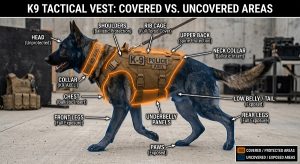
Armor for dogs follows the same logic as human armor. Layers of aramid fiber (Kevlar-type material) spread out the energy of a round. Many vests are rated against the U.S. National Institute of Justice (NIJ) ballistic standard, usually at Level II or IIIA. Vests cover the chest and torso, where the heart and lungs sit.
That matters because the research shows where fatal gunshot wounds land. In a study of 29 U.S. military dogs shot in combat, the leading cause of death was thoracic (chest) wounds, followed by head wounds. Only 11 of the 29 survived, and every survivor returned to full duty.
What vests don’t cover: the head, neck, and legs. Blast fragments and rifle rounds hit those areas too.
2. Cooling vests
Dogs cool down mainly by panting. They can’t sweat like we do. A 2022 study of 13 Spanish military police dogs tested evaporative cooling vests during exercise in warm conditions. The researchers found significant differences in core body temperature and pulse rate, and concluded cooling vests are useful for routine thermal control.
3. Goggles, hearing protection, and boots
“Doggles” protect eyes from rotor wash, sand, and debris. Hearing protection helps in blast and gunfire environments. Boots protect pads from hot ground, sharp rubble, and cold. The UK Ministry of Defence has reportedly invested in this kind of kit for its working dogs, which shows how mainstream canine PPE has become.
4. Harnesses, cameras, and GPS
Modern harnesses do more than hold a dog. They carry cameras, trackers, and handles for lifting a dog over walls or hoisting it from helicopters. For more on harness choice, see our guide to the best K9 harness for maximum control. If you want civilian and law-enforcement equivalents of this kit, check out Top 10 Tactical K9 Gear Every Working Dog Should Have in 2026.
Do Military Dogs Really Wear Bulletproof Vests?
Short answer: sometimes, not always. Vests exist and they work, but dogs don’t wear them on every patrol.
Here’s why. Armor adds weight, traps heat, and can slow a dog down. Older NBC reporting noted that dogs may wear bulletproof vests or booties, but most handlers have their dogs go natural for fear of overheating. A vest-wearing dog that overheats is in more danger than an unarmored one in a cool environment.
So handlers make a judgment call every time, based on:
- Temperature and humidity (the biggest factor)
- Threat level (direct-fire risk vs. a low-threat search)
- Mission length (a 20-minute search vs. an all-day patrol)
- The dog’s job (a sprinting assault dog needs speed more than a slow-moving detection dog)
Most blog posts treat the vest as the main protection, but in practice, it’s one tool that handlers use selectively.
Heat: The Quiet Killer
Because heat killed nearly one in ten deployed dogs in that U.S. data, it deserves its own section. A 2021 study on veterinary care for working dogs also found that heat-related injury is one of the more serious conditions affecting military working dogs.
What handlers do about it:
- Work in the cool hours. Schedule searches for early morning or evening when possible.
- Pre-cool and rest. Cool the dog before work and allow shade breaks.
- Use cooling vests. Soak them, wear them, re-soak them.
- Carry water. Offer small amounts often.
- Watch for early signs. Heavy drooling, a bright red tongue, wobbling, or slowing down.
- Act fast. Heat stroke is a medical emergency.
Heat also hurts the nose. A dog that’s overheated detects less. So cooling is protection and performance in one move.
Combat Conditioning: Training a Dog to Stay Steady
Gear fails if the dog panics inside it. That’s why training is the first real layer of protection.
Gunfire and blast exposure. Handlers introduce loud noise gradually, paired with food or play, so the dog learns that bangs aren’t a threat. A dog that bolts at the first shot endangers itself and the team.
Environmental conditioning. Dogs practice on rubble, ladders, slippery floors, in the dark, in tunnels, and in vehicles and helicopters. A dog that’s seen it before moves more safely.
Gear acclimation. Putting a vest on a dog for the first time on deployment is a mistake. Good programs introduce each item early, in short sessions, with rewards, so the dog doesn’t associate gear with stress.
Emergency recall. A rock-solid recall can pull a dog back from danger even mid-task. It’s one of the cheapest forms of protection there is.
Want to see how the whole pipeline works? Read How Are Military Working Dogs Trained?
K9 TCCC: Combat Medicine for Dogs
Here’s the biggest shift in modern dog protection. The military adapted Tactical Combat Casualty Care (TCCC) for dogs, called K9 TCCC. Instead of waiting for a vet, handlers and combat medics learn to treat wounds in the first minutes.
Why it matters: an official U.S. military article put it plainly, saying injured working dogs are expected to receive the highest level of resuscitative care as far forward as possible, often with no veterinary staff present. The same training covers airway management, shock, heat and cold injuries, head and spinal trauma, and CPR.
The framework follows the MARCH sequence used for people:
- Massive bleeding: tourniquets and hemostatic gauze
- Airway: clear and secure it
- Respiration: treat chest wounds
- Circulation: fluids and shock care
- Hypothermia / Head injury: keep the dog warm and monitor
Does early care work? The data suggests yes, with limits. In the 29-dog gunshot study, immediate battlefield care significantly influenced survival rates. Another small case series of 11 dogs treated in the field reported a 50% survival rate. Samples are small, so treat these as signals, not guarantees. Researchers have pushed for a proper trauma registry for working dogs so they can learn more. scribdjsomonline
What a handler’s dog first-aid kit usually includes: tourniquet, pressure bandage, hemostatic gauze, chest seal, muzzle (a hurt dog may bite), saline, and thermal wrap.
![handler applying a pressure bandage to a dog's leg during a training drill]](https://arfsk9team.com.ng/wp-content/uploads/2026/02/handler-applying-a-pressure-bandage-to-a-dogs-leg-during-a-training-drill-300x164.jpg "How Are Military Dogs Protected in Combat? Full Guide 3")
Smart Tactics: Protecting Dogs Through How They’re Used
Some of the best protection is a decision, not a product.
- Standoff searching. Where possible, the dog searches at distance (off-leash or on a long line) so the handler isn’t standing next to the danger.
- Cover and route planning. Dogs go where the risk is lowest first.
- Rest rotation. Tired dogs make mistakes. Teams rotate dogs on long operations.
- Safe transport. Secure, ventilated, shock-absorbing kennels in vehicles prevent injury and heat before work even begins.
- Casualty evacuation plans. Good units plan how a wounded dog gets out before the mission starts, often using the same medevac assets as people.
The Hidden Wound: Canine PTSD
This is the injury nobody sees, and few competitor articles cover it.
Military vets noticed dogs returning from war acting differently. They’d startle at noise, avoid contact, or forget commands they used to know. Veterinary behaviorists at Lackland Air Force Base in Texas began calling it canine post-traumatic stress disorder (C-PTSD).
How common is it? Estimates vary. Some reports say about 5 percent of working dogs returning from war zones, while Lackland’s behavior chief has cited around 10 percent of dogs sent overseas. One summary called it the single greatest cause of lost deployability in military dogs.
Treatment matters. According to a 2016 Lackland report, without intensive treatment less than 25 percent of affected dogs stay in service, but with a care plan at least 50 percent can.
Common signs handlers watch for:
- Strong reaction to sounds that never bothered the dog before
- Clinginess, or avoiding people and other dogs
- Sudden aggression or irritability
- Loss of focus on work it used to love
- Forgetting trained commands
The protection: early recognition, rest, desensitization and counter-conditioning, and sometimes medication under a vet’s care. This is also where the handler bond matters most.
The Gaps Most Articles Skip
Most top-ranking pages end at “vests and goggles.” Here’s what’s missing, and what I’d want you to know.
1. Chemical and biological protection is thin
Military.com reported that working dogs are often first into places where chemical and biological threats may be present, yet get little personal protective equipment compared to their handlers. The Pentagon has explored portable shelters for them. Gas masks and protective suits for dogs are still far less developed than for people.
2. Dogs have almost no legal protection
In the U.S., military dogs are labelled as equipment, and in Australia their status isn’t addressed in legislation. Legal scholars argue that this could mean a dog is treated as a lawful target like any other gear, rather than getting combatant or civilian protections. Australia did create a Canine Operational Service Medal in 2017 to honor working dogs, but a medal isn’t legal protection.
3. The data is small and scattered
Researchers repeatedly note how little published data exists on working-dog battlefield injuries. Without good records, it’s hard to prove which protection actually works best.
4. Gear is built for torso, threats hit everywhere
Vests don’t cover heads, legs, or necks. Helmet-style or limb protection exists in concept but isn’t standard.
5. Protection after service
A dog’s safety doesn’t end at the airfield. Retirement, adoption, and long-term care (joints, anxiety, injuries) are part of protecting a service dog’s life.
Real Dogs, Real Protection: Case Studies
Lucca (U.S. Marine Corps). This half German Shepherd, half Belgian Malinois completed about 400 patrols and found around 40 IEDs. In March 2012 in Afghanistan, she was seriously wounded by a blast after finding a device. Her handler applied a tourniquet immediately, a textbook example of K9 first aid. Lucca survived, lost a front leg, and later received the PDSA Dickin Medal.
Gabo (Jonesboro Police, Arkansas). Not military, but a widely cited example of K9 body armor doing its job. He reportedly survived multiple gunshot wounds because his vest stopped the rounds.
Chips (WWII). Long before modern armor, this sentry dog helped neutralize a machine-gun position in Sicily. He survived with minor wounds, proof that training and handler trust were protecting dogs even then.
A Handler’s Perspective
Written by Cpl. Rofiat Muritala, Nigerian Army military working dog instructor and handler with 14+ years at the Nigerian Army Dog Centre. She has completed advanced obedience, K9 patrol, and explosive detection courses, and demonstrated detection and tactical movement with working dogs at NADCEL 2026.
Here’s what 14 years around working dogs taught me: the best protection starts before the mission. A dog that trusts you, knows its job, and is fit and healthy has a much higher chance of coming home.
Three things I’d tell any handler:
- Learn your dog’s normal. Breathing, ear position, how it drinks, how it recovers. You can’t spot “off” if you don’t know “on.”
- Never trust gear over judgment. A vest in 40°C heat can hurt more than help.
- Train the emergency, not just the task. Practice muzzling, bandaging, and carrying your dog before you need to.
If you want the same foundation professional handlers use, my book Beyond the Bark: Inside a Pro Handler’s Playbook for Raising the Ideal Dog breaks it down in plain language.
Conclusion
Military dogs aren’t protected by one thing. They’re protected by a stack:
- Gear that fits the threat and the weather
- Training that keeps them calm and fit
- K9 TCCC so the first minutes after an injury count
- Smart tactics that keep them out of unnecessary danger
- Mental health care for wounds you can’t see
The numbers show why this matters. Bullets and blasts killed most of the 92 dogs lost in Iraq and Afghanistan, but heat killed nearly one in ten. And there are real gaps left: chemical protection, legal status, and thin data.
What you can do today:
- If you handle a working dog, learn canine first aid and heat-stroke signs now.
- Introduce gear gradually and check fit often.
- Keep a dog first-aid kit where you train.
- Watch behavior after stressful events, not just injuries.
Want more guides like this every week? Subscribe to our weekly roundup newsletter.
Frequently Asked Questions
1. Do military dogs wear bulletproof vests?
Sometimes. Vests rated to NIJ Level II or IIIA exist and can stop rounds, but handlers use them selectively because armor adds weight and heat. In hot climates, overheating can be a bigger risk than gunfire.
2. How many military dogs have died in combat?
In a study of U.S. dogs in Iraq and Afghanistan from 2001 to 2013, 92 of roughly 2,600 deployed dogs died. About 31.5% died from gunshot wounds, 26.1% from explosions, and 9.8% from heat stress.
3. What is K9 TCCC?
K9 Tactical Combat Casualty Care is battlefield first aid for dogs. It teaches handlers and medics to control bleeding, manage airways and shock, and treat heat injury before a vet arrives.
4. Do military dogs get PTSD?
Yes. Military veterinarians recognize canine PTSD. Estimates range from about 5% to 10% of deployed dogs. With a treatment plan, at least half can return to duty.
5. Are military dogs protected by law in war?
Not much. In the U.S. they’re classified as equipment, and in other countries, such as Australia, their status isn’t clearly set out in law. They’re honored with medals and treated like team members in practice, but the legal protections lag behind.
Sources
- Baker et al., Military Medicine (causes of death in MWDs, 2001–2013), via Stars and Stripes
- Baker et al., Journal of Veterinary Emergency and Critical Care (gunshot wounds in MWDs, 29 cases)
- Reeves et al., Journal of Special Operations Medicine (interventions on MWDs)
- Benito, Lozano & Miró, Animals (2022), cooling vests in military dogs
- Military.com (2022), chemical and biological protection for MWDs
- U.S. Air Force Reserve Command, “Combat Casualties aren’t Always Human”
- NBC News, “Soldiers find loyal comrades in war dogs”
- Scroll.in / The Conversation, legal status of military dogs
- Lackland Air Force Base canine PTSD reporting (NPR, Texas Public Radio, Los Angeles Times)

Her work centres on obedience, detection, protection and operational readiness. She favours proven methods built on repetition, consistency and real-world conditioning, so that both dogs and handlers are prepared for high-pressure tasks.
Rofiat represented the Nigerian Army Dog Centre at the Nigerian Army Day Celebration (NADCEL) 2026, where she led demonstrations in obedience, explosive detection, agility and tactical movement. Through articles, training content and documentaries, she shares field-based insight into how structured training, clear communication and trust between handler and dog affect performance and reliability.
She is the author of Beyond the Bark: Inside a Pro Handler's Playbook for Raising the Ideal Dog, a practical guide that helps dog owners and handlers apply professional training principles in everyday situations.
- Local Dog Breeds: Temperament, Health & Training Guide - October 6, 2026
- How Long Do Military Working Dogs Serve? Full Guide - October 5, 2026
- National Puppy Day 2026: Date, Best Deals & Freebies - October 4, 2026