Military Working Dog vs Police K9: 7 Key Differences Explained
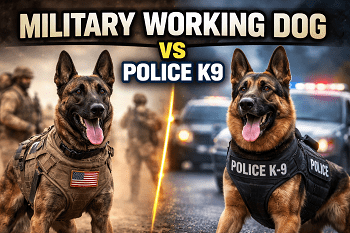
A military working dog (MWD) serves in the armed forces. It protects bases, finds explosives, and supports troops in combat zones under military law. A police K9 serves a civilian agency. It tracks suspects, finds drugs, and apprehends offenders in towns and cities under civilian law. Both are usually Belgian Malinois, German Shepherds, or Dutch Shepherds, but their training pipelines, legal rules, costs, and careers are quite different.
Table of Contents
- Military Working Dog vs Police K9: Quick Comparison
- Difference 1: Mission and Chain of Command
- Difference 2: The Laws They Work Under
- Difference 3: Where the Dogs Come From
- Difference 4: Training Length and Content
- Difference 5: The Handler Relationship
- Difference 6: Gear and Protection
- Difference 7: Cost, Career Length and Retirement
- Where Military and Police Dogs Overlap
- Common Myths
- Which Path Is Right for You?
- A Handler’s Take
- The Bottom Line
- FAQs
Introduction
Ever watched a movie where a Malinois jumps out of a helicopter and thought, “Is that the same dog my local police department uses?” You’re not alone. People use “K9,” “police dog,” and “military working dog” as if they mean the same thing. They don’t.
The mix-up causes real problems. Aspiring handlers pick the wrong career path. Readers expect a retired police dog to have combat training. And owners assume any “protection dog” went through the same program.
In this guide, I’ll break down the military working dog vs police K9 question into 7 clear differences, backed by numbers from official sources. You’ll learn how they’re trained, what they cost, which laws govern them, and what happens when they retire.
If you’re new to the topic, my guide on how military working dogs are trained is a good companion read.
Military Working Dog vs Police K9: Quick Comparison
| Feature | Military Working Dog (MWD) | Police K9 |
|---|---|---|
| Employer | Armed forces | City, county, state or national police |
| Main mission | Base security, patrol, explosive and drug detection, combat support | Tracking, narcotics detection, suspect apprehension, building and area searches |
| Legal framework | Military law and rules of engagement | Civilian criminal law, use-of-force rules, search-and-seizure law |
| Typical source | Mostly European vendors, plus an in-house breeding program | Private vendors, breeders, and sometimes donated dogs |
| Initial training | About 120 training days at the central US school (typically about six months) | Often 6 to 12 weeks, depending on the agency (six-week academy in one city, twelve weeks in another) |
| Cost per dog | Estimates range from $42,000 up to $65,000–$85,000 | Roughly $8,000–$25,000 including training |
| Career length | Around 8–10 years | Around 6–9 years |
| Where they live | Military kennels | Usually at the handler’s home |
Difference 1: Mission and Chain of Command
This is the big one. Everything else flows from it.
A military working dog supports a military mission. That might mean guarding an air base, clearing a route of explosives, or searching a compound. The US military alone has about 2,500 of these dogs in service, according to Department of Defense figures reported by JBSA.
A police K9 supports a policing mission. That means finding a missing person, locating a hidden stash of drugs, or helping an officer arrest a suspect who runs. Its “commander” is a police sergeant or chief, not a battalion officer.
An Air Force kennel master put it simply. Military and civilian dog teams share a lot, but the big gap is combat-related duties, while local police train their dogs for road work, law enforcement and SWAT support.
The takeaway: MWDs protect troops and bases. Police K9s protect communities and officers.
Difference 2: The Laws They Work Under
Here’s something most competitor articles skip. The law changes how a dog is trained, used, and even documented.
Military dogs
MWDs work under military regulations and rules of engagement. A handler answers to a military chain of command. The dog can deploy overseas, which a city police dog never will.
Police dogs
Police K9s work under civilian law, and the rules are strict. Here are three examples:
- Use of force: Police must be able to justify every bite or apprehension. Written policies, like this Alexandria Police Department directive, require warnings before deployment (with limited safety exceptions) and written reports afterward.
- Search law (US): In Florida v. Harris (2013), the US Supreme Court ruled that a drug dog’s alert can give police probable cause if the dog is reliably trained and certified. That’s why certification records matter so much in court. In Rodriguez v. United States (2015), the Court ruled that police can’t stretch out a traffic stop just to wait for a dog sniff.
- Standards vary by place: There’s no single national police K9 standard in the US. States set their own, such as the Delaware Council on Police Training K-9 standards.
UK example
In England and Wales, police dogs have extra legal protection. After a German Shepherd named Finn was stabbed while protecting his handler in 2016, Finn’s Law (2019) removed the “reasonable force” defence for people who harm service animals.
The takeaway: An MWD answers to military law. A police K9 answers to the courts and the public.
Difference 3: Where the Dogs Come From
Military sourcing
The US system is centralized. The Air Force’s 341st Training Squadron at Lackland, Texas, buys and trains dogs for all four branches. It trains about 350 dogs a year. Only about 10% are bred in-house. The rest come from nearly 30 vendors in the US and overseas.
Most dogs come from European breeders. That’s now a problem. A Senate Armed Services Committee report warned that a limited number of overseas breeders and rising demand are pushing costs “skyrocketing”.
The washout rate is high too. Only about 50% of the dogs assessed make it through training.
Police sourcing
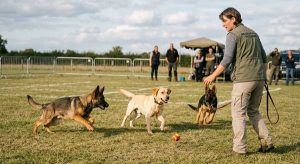
Police agencies don’t have one central school. They buy from private vendors, work with local breeders, or sometimes accept donated dogs. A Michigan patrol dog academy, for example, lists a pre-trained dog costing $8,000 to $9,000 depending on the vendor.
Many police dogs also come from European lines, so the genetics are often similar. The difference is the filter. Military selection is a national pipeline. Police selection varies by department.
The takeaway: MWDs come through one big, standardized pipeline. Police K9s come from many smaller sources.
Difference 4: Training Length and Content
Both start with obedience and drive work. After that, they split.
Military training
At Lackland, the standard course is about 120 training days, or roughly six months. Most graduates become dual-purpose dogs that patrol and also detect either explosives or drugs. After that, the dog goes to its unit and gets additional training.
Military dogs also practise skills police dogs rarely need. They work around gunfire, vehicles, helicopters, and unfamiliar terrain. Some detection dogs search for roadside explosives, and some train for special operations work. For a full breakdown, read my military working dog training guide.
Police training
Police courses are shorter, because the dog is often partly trained before it arrives.
- One city runs a six-week academy, with another 2–6 weeks for narcotics or firearms detection.
- Another small department reports twelve weeks of initial training, then one day a month with other agencies.
- A cost guide says a typical patrol handler course runs about four weeks, and detection courses about three weeks.
Maintenance training never stops. One department trains weekly and recertifies every year.
Training content compared
| Skill | MWD | Police K9 |
|---|---|---|
| Obedience | Yes, under heavy distraction | Yes, with public contact in mind |
| Explosive detection | Common, often field-based | Common in bomb squads and airports |
| Narcotics detection | Often dual-purpose | Very common |
| Tracking | Yes | Core skill |
| Apprehension | Yes | Yes, with strict use-of-force limits |
| Combat environments | Yes | No |
| Crowds and community events | Rare | Frequent |
Handler tip: Don’t judge a dog by the length of its course. A six-week academy for a dog that already had months of foundation work is not the same as six weeks from scratch.
Want to apply pro methods at home? You don’t need a combat dog to use handler-level principles like focus, drive control, and consistency. My book, Beyond the Bark: Inside a Pro Handler’s Playbook for Raising the Ideal Dog, shows how to apply them with a family dog.
The takeaway: MWD training is longer and built for harsher conditions. Police training is shorter but ongoing, and tied to certifications and court-ready records.
Difference 5: The Handler Relationship
Both types of dogs depend on a strong handler bond. The setup around that bond differs.
Police K9s usually live with their handler. One K9 unit overview notes that each dog lives with its unit partner, and officers commit to the department for at least six years. A Rock Island, Illinois, page says the Malinois is assigned to one handler, lives at his home, and the officer handles the dog’s care.
Military handlers work within a larger system. Their job includes kennel maintenance, veterinary care, daily training, and record-keeping. Dogs and handlers can be reassigned as the mission requires.
Becoming a handler differs too:
- Police: You usually become an officer first. For example, one department requires at least 2 years with the agency before you can apply to the K9 unit.
- Military: You can train for the handler role directly, such as the Army’s 31K specialty.
The rank tradition
Here’s one fun fact. US military dogs are, by tradition, non-commissioned officers. The dog is usually the same rank as its handler or one rank higher. There’s no official Army regulation requiring it. It’s a tradition. The story goes that it stops handlers from mistreating their dogs.
Police dogs don’t hold ranks. The closest thing is the honorary badge and a fallen-officer-style funeral some departments give.
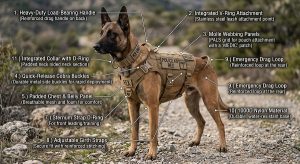
Difference 6: Gear and Protection
Gear follows the mission.
| Gear | Military | Police |
|---|---|---|
| Body armour | Heavily focused on blast and ballistic protection | Often ballistic or stab-resistant, depending on budget |
| Harness | Tactical, with attachment points for ropes and rigging | Patrol harness for control and tracking |
| Cooling | Heat management is critical in deserts | Needed, especially for hot-car and summer deployments |
| Communication | Radio or camera systems for special operations | Less common; used in specialist units |
| Extras | Goggles (“doggles”), hearing protection, parachute rigs | Cruiser heat alarms and kennel inserts |
A hot-car alarm sounds like a small thing. It isn’t. Police cruisers are a real heatstroke risk, and departments spend money on kennel inserts and alarms. One cost guide lists a cruiser insert at around $1,800, lasting about five years.
For a closer look at battlefield protection, see how military dogs are protected in combat.
Difference 7: Cost, Career Length and Retirement
What they cost
Cost numbers vary a lot, so here’s how the sources break down.
Military:
- A 2017 squadron study put the cost of each dog sent to a unit at about $42,000, with training around $20,000.
- A more recent Government Accountability Office (GAO) figure, as reported in coverage of the program, puts buying and training a dog at about $65,000 to $85,000.
Police:
- One California city lists about $12,000 for the dog plus about $13,000 for training, so about $25,000 total.
- A police magazine guide says a dual-purpose dog can cost $8,000–$10,000, while a single-purpose dog can cost $2,500–$4,000.
- And remember, money is the number one threat. The US Police Canine Association says insufficient public funding is the top reason K9 programs fail.
The dog is only the start. Handler pay, vet bills, vehicle changes, and certifications push the lifetime cost of a K9 team well into six figures over a six-to-nine-year career.
How long they work
Most dogs work about 8 to 10 years. One Air Force handler’s last partner, a German Shepherd, retired after nine years of service. Police sources cite six to nine years.
Retirement
Retirement is where the two systems differ most.
Military: Before 2000, many retired dogs were euthanized. Then Robby’s Law changed that. It lets private citizens adopt retired dogs that pass behaviour assessments. Handlers usually get first choice.
Police: Rules vary by department. In one city, the dog is sold to the handler for $1 at retirement. In others, ownership passes through a municipal process.
Retired dogs often carry the marks of the job. Some show stress symptoms after deployment, including trouble socialising and less playfulness. A good adopter needs patience and a vet who understands working dogs.
Where Military and Police Dogs Overlap
Yes, there’s real overlap. That’s why people mix them up.
- Same breeds: The Belgian Malinois, German Shepherd, and Dutch Shepherd lead both fields. Today’s military dogs are mostly German Shepherds, Dutch Shepherds and Belgian Malinois. See my guide to breeds used as military working dogs.
- Same foundations: Obedience, drive, scent work, and handler trust.
- Same trainers: Military and police units often train together. Local police have visited Air Force bases to share methods and compare training.
- Same hybrid roles: Border and customs agencies, airports, and security services sit between the two worlds.
- Same global pattern: In the UK, the Army and police both use German Shepherds and Malinois, with Spaniels common for detection. Across Europe, dogs often come from the same Dutch, German and Czech breeding lines.
Common Myths
Myth 1: “A retired MWD is a ready-made guard dog.”
Not really. Many are sensitive and need rehabilitation first. Retirees from combat roles may need months to settle.
Myth 2: “Police dogs are less trained.”
They’re trained for a different job. A police tracking dog finding a missing child in woodland is doing elite work.
Myth 3: “All K9s bite.”
Many don’t. Detection dogs, like a Labrador finding drugs at an airport, are often non-aggressive.
Myth 4: “A military dog can switch to police work.”
Sometimes, but it needs retraining and certification. Under Robby’s Law, adopted dogs can’t return to service, but some pass to law enforcement through a formal process.
Myth 5: “Bigger and tougher means better.”
The best working dogs are chosen for drive, nerve, and health, not size.
Which Path Is Right for You?
If you want to join the military as a handler:
- Look at your country’s military dog specialty (for example, the US Army’s 31K).
- Expect kennel duty, deployments, and a structured career.
- The skills transfer to federal law enforcement and security.
If you want to be a police K9 officer:
- Plan on becoming a sworn officer first.
- Expect long hours with your dog at home.
- Get ready for regular certifications.
If you just love dogs:
- Volunteer at a local K9 demonstration.
- Learn handler-level skills with your own dog.
- Join a working dog club.
A Handler’s Take
After more than 14 years as a military working dog instructor and handler, here’s what I tell every new trainee:
- The dog doesn’t know its job title. It only knows what pays off. Good training works the same, whether the dog serves an army or a city.
- Selection matters more than training. A dog without the right nerve won’t be saved by more hours.
- The handler is half the team. Many failures come from the human side: poor timing, rushed training, and no maintenance.
- Protect the dog’s body. Heat, joints, and hydration decide whether a dog works for eight years or four.
Get More K9 Insight, Weekly
Want practical K9 tips and fresh articles in your inbox? Subscribe to our weekly articles roundup newsletter.
The Bottom Line
So, what’s the real military working dog vs police K9 difference? It comes down to seven things: mission, law, sourcing, training, handler setup, gear, and cost and retirement.
- Choose the military route if you want deployments, a central training system, and combat-support work.
- Choose the police route if you want to serve a community, work alongside a dog at home, and work within civilian law.
- If you own a dog, borrow the handler mindset: strong foundations, consistency, and health care first.
Both dogs do dangerous, valuable work. Both deserve respect.
Frequently Asked Questions
1. What is the main difference between a military working dog and a police K9?
The main difference is the mission and the law. MWDs support military operations under military rules. Police K9s support civilian law enforcement under criminal and constitutional law.
2. Do military dogs outrank their handlers?
By tradition, yes. US military dogs are given non-commissioned officer ranks as an informal tradition for morale. It’s not a formal regulation.
3. Can you adopt a retired military working dog or police K9?
Often, yes. For military dogs, Robby’s Law allows adoption by private citizens if the dog passes behaviour assessments, and handlers usually get priority. Police rules vary by department.
4. Which costs more, a military dog or a police dog?
Military dogs usually cost more. Estimates range from $42,000 (2017 study) to $65,000–$85,000 (GAO, as reported). A police K9 often totals around $25,000 with training.
5. How long do military and police dogs work?
Most work about 6 to 10 years. Health decides retirement, not age alone. Joint wear, injury, and loss of drive are the usual reasons.
About the Author
Cpl. Rofiat Muritala is a Nigerian Army military working dog instructor and handler with more than 14 years of experience at the Nigerian Army Dog Centre. She has completed advanced obedience, K9 patrol, and explosive detection certification courses, and represented the Centre at NADCEL 2026. She is the author of Beyond the Bark.

Her work centres on obedience, detection, protection and operational readiness. She favours proven methods built on repetition, consistency and real-world conditioning, so that both dogs and handlers are prepared for high-pressure tasks.
Rofiat represented the Nigerian Army Dog Centre at the Nigerian Army Day Celebration (NADCEL) 2026, where she led demonstrations in obedience, explosive detection, agility and tactical movement. Through articles, training content and documentaries, she shares field-based insight into how structured training, clear communication and trust between handler and dog affect performance and reliability.
She is the author of Beyond the Bark: Inside a Pro Handler's Playbook for Raising the Ideal Dog, a practical guide that helps dog owners and handlers apply professional training principles in everyday situations.
- Local Dog Breeds: Temperament, Health & Training Guide - October 6, 2026
- How Long Do Military Working Dogs Serve? Full Guide - October 5, 2026
- National Puppy Day 2026: Date, Best Deals & Freebies - October 4, 2026