Top 5 Military Working Dog Breeds & Why They Are Chosen
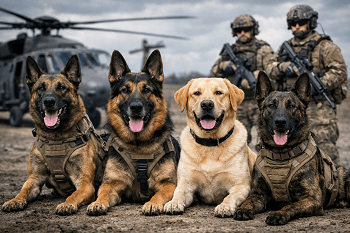
What are the top military working dog breeds? The five breeds most used by armed forces worldwide are the Belgian Malinois, German Shepherd, Labrador Retriever, Dutch Shepherd and Springer Spaniel. Armies choose them for drive, trainability, scenting ability, health and size. Malinois and German Shepherds handle patrol and attack work. Labradors and Springers handle detection. Dutch Shepherds are a rising all-rounder.
The part most articles skip: the breed is only the starting point. In the US program, only about 10–13% of dogs are bred in-house, and in one inspection trip the buyers looked at more than 300 dogs and brought back about 130. Individual temperament decides who makes it, not the breed label.
Table of Contents
- Introduction
- What Makes a Dog “Military Grade”?
- Quick Comparison Table
- The Top 5 Military Working Dog Breeds
- How Armies Actually Choose Their Dogs
- Breeds That Just Missed the Top 5
- Common Myths About Military Dog Breeds
- A Handler’s Perspective
- What Civilian Owners Can Learn
- FAQs
- The Bottom Line
Introduction
Ever wonder why you see the same two or three breeds every time a military dog makes the news?
It’s not a coincidence, and it’s not just fashion. Armed forces have tested dozens of breeds over the last 100 years. Most didn’t make the cut. Some were excellent in World War I and quietly disappeared afterward.
So what’s left? A short list of breeds that combine drive, nerve, a great nose, a sound body and a willingness to work with one person.
In this guide, you’ll learn:
- Which five military working dog breeds armies rely on most, and why
- How the selection process works, including costs, washout rates and training timelines
- Which famous dogs earned medals, and what breed they were
- Why the “best” breed depends on the job
- What breed lists often get wrong
I’ll write this the way I’d explain it to a new handler standing at the kennel gate.
What Makes a Dog “Military Grade”?
A military working dog (MWD) is a trained professional. Patrol, explosive detection, narcotics detection, tracking and search all demand the same core package:
- Drive. This is the dog’s hunger to work for a toy or ball. Drive does most of the heavy lifting in training, because the reward is play.
- Nerve. The dog stays steady around gunfire, helicopters, crowds and slippery floors. A nervous dog can’t be fixed with more training.
- Scenting ability. Detection work lives or dies on the nose.
- Physical soundness. Hips, elbows and spine matter. A US government report (GAO-17-358) noted that bone and joint problems are common in the main MWD breeds: Labradors, Malinois and German Shepherds.
- Handler focus. The dog must work with a human, off leash, under stress.
- Size and heat tolerance. The dog has to fit into vehicles, boats and aircraft, and work in hot climates.
Here’s the catch. A breed gives you better odds, not a guarantee. A Malinois with no nerve is a liability. A Labrador with a fire in its belly for a tennis ball is gold.
Quick Comparison Table
| Breed | Typical weight | Best known for | Main roles | Key trade-off |
|---|---|---|---|---|
| Belgian Malinois | 40–80 lb (18–36 kg) | Speed, drive, compact size | Patrol, apprehension, special ops, detection | Very high energy; needs skilled handlers |
| German Shepherd | 50–90 lb (23–40 kg) | Versatility, stable temperament | Patrol, tracking, detection, protection | Joint health; heavier than a Malinois |
| Labrador Retriever | 55–80 lb (25–36 kg) | Nose, calm nature | Explosive and weapons detection, search | Not built for bite work |
| Dutch Shepherd | 50–70 lb (23–32 kg) | Tough, adaptable all-rounder | Patrol, tracking, detection | Harder to source |
| Springer Spaniel | 40–50 lb (18–23 kg) | Small size, endless stamina | Explosive and arms search | Not for patrol or attack |
The Top 5 Military Working Dog Breeds
1. Belgian Malinois: The Special Forces Favorite
Ask why special forces use Belgian Malinois and you’ll hear the same words: fast, fearless, relentless.
The Malinois is one of four Belgian Shepherd varieties and looks like a leaner, lighter German Shepherd. That lighter frame matters in the field. Handlers can tandem-parachute with them or rappel with them from aircraft. That’s a practical edge, not a marketing line.
Real-world proof:
- Cairo, a roughly 70-pound Malinois, went on the raid that took down Osama bin Laden.
- Kuno served with British special forces. During a 2019 raid in Afghanistan he tackled an armed insurgent and took gunshot wounds to both hind legs. He later became the first UK military dog fitted with prosthetics and received the PDSA Dickin Medal in 2020.
- Several other Malinois have also earned Dickin Medals, including Mali, Diesel, Kuga, Bass and Leuk.
The US Department of Defense (DoD) breeding program at Lackland, Texas, focuses on Malinois (with some Dutch Shepherds), and 50–90 puppies join it each year. Some Air Force sources also say Malinois are favored partly because they tend to have longer working lives, which makes them more cost-efficient.
Why they’re chosen: speed, agility, ball-crazy drive, compact size.
The catch: they’re not pets. A bored Malinois will wreck your house. If you’d like the full head-to-head, read our German Shepherd vs Belgian Malinois comparison.
2. German Shepherd: The All-Rounder That Started It All
The German Shepherd is still the breed most people picture when they hear “military dog.” Captain Max von Stephanitz began building the breed in Germany in the late 1890s, aiming for a herding dog with intelligence and a stable mind. Armies noticed, and the breed has served in conflicts since World War I.
Why does it still hold its place in a world full of Malinois? Balance. A good German Shepherd tracks well, bites with control, handles crowds and bonds closely with its handler. One US Air Force source describes it as the most common dog in military service.
Real-world proof: Lucca, a Marine Corps dog credited with finding more than 40 hidden explosives across 400 patrols in Iraq and Afghanistan, lost a leg to a blast in 2012. She received the Dickin Medal in 2016. (The PDSA lists her as a German Shepherd, though some records describe her as a Malinois mix.) PDSA also lists German Shepherds Sam, Lucky and Appollo among its Dickin Medal dogs.
Why they’re chosen: reliable temperament, tracking skill, intimidating presence, huge global supply.
The catch: heavier, with known joint concerns. Show-line dogs often can’t handle the physical work, so armies buy from working lines.
3. Labrador Retriever: The Nose Everyone Trusts
Labs don’t look tough. That’s exactly the point.
In airports, checkpoints and crowded streets, a friendly Lab can search without scaring anyone. They’re calm, eager and driven by food and toys. And their noses are superb.
Labs are common in “off-leash” search work for the military, which means the dog works ahead of the troops, sniffing for bombs.
Real-world proof:
- Treo, a black Lab–Springer cross, found a “daisy chain” improvised explosive device (IED) in Sangin, Afghanistan, in 2008. He won the Dickin Medal in 2010. Here’s the twist: his previous owners donated him because he snapped and growled at people. The right job turned a problem dog into a hero.
- Sadie and Sasha, two more Labradors, also hold Dickin Medals for Afghanistan service.
Why they’re chosen: nose, calm temperament, public-friendly look, strong food and toy drive.
The catch: not suited to attack work, and heavy-bodied lines can develop hip and elbow problems.
4. Dutch Shepherd: The Rising Star
The Dutch Shepherd looks a bit like a brindle German Shepherd, and it comes in short, long and wire coat types. It has long been used for police work in the Netherlands, and now many militaries are paying attention.
It sits between the German Shepherd and the Malinois: strong, quick, trainable and less over-the-top than a Malinois. The US breeding program uses Dutch Shepherd puppies too, and Dutch Shepherds are listed among the DoD’s approved working breeds.
Why they’re chosen: toughness, agility, and a good balance of drive and control.
The catch: fewer breeders, so supply is tight and prices are high.
5. English Springer Spaniel: The Small Dog With a Giant Job
Our old version of this article put the Belgian Tervuren here. Honestly, that was weak. Tervurens are rarely used. Springer Spaniels do real work, and they deserve the spot.
Springers are compact, athletic and obsessed with hunting. Search work is basically a game for them. Their size lets them slip into vehicles, under bunks and between cargo, places a 75-pound shepherd can’t go easily. They’re widely used in arms and explosive search roles, including by the British Army, often alongside Labradors.
Why they’re chosen: small body, huge stamina, endless drive to hunt.
The catch: they need a firm, consistent handler, and they’re not for patrol or apprehension.
How Armies Actually Choose Their Dogs
Here’s what most breed lists leave out.
Where the dogs come from
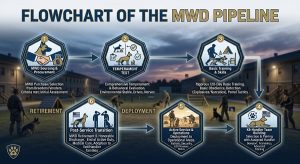
For the US DoD, most dogs come from outside the in-house program:
- Roughly 10–13% are bred in-house at Lackland by the 341st Training Squadron.
- The rest come from about 30 vendors in the US and overseas.
- One government procurement analysis reported that about 93% of US government working dogs are imported from Europe. Another review put European dogs at about $5,500 each versus roughly $9,100 for domestically bred dogs. (These figures date from around 2018–2020, so prices have likely risen. Vendors told reporters Malinois sometimes cost far more.)
The selection test
A buying team travels abroad several times a year. In one trip, they looked at over 300 dogs and brought back about 130. That’s a pass rate under 45% before training even starts.
Young dogs are tested on trainability, gun shyness and aggression. Puppies in the breeding program also get blood tests and X-rays of their hips and elbows.
The training clock
- Dogs arrive at about 1–3 years old.
- Initial training takes roughly 120 training days, close to six months.
- Handlers train for around 11 weeks.
- An older Air Force fact sheet said fewer than half the dogs that enter basic training end up as working MWDs. Those that fail may become training aids or get adopted.
The cost
A 2017 squadron study put the cost of each dog sent to an operational unit at around $42,000. That includes purchase, training and support. Add handler time and vet care, and it’s easy to see why armies guard these dogs.
How long they serve
Recent veterinary research puts the average US MWD service at about 8 years. Some older military articles cite 10–12 years for the best dogs. Either way, a dog’s career is shorter than many people expect. In the US, retired dogs can be adopted, and the law gives the handler first priority (Robby’s Law, 2000). To learn more about the process itself, see our guide on how military working dogs are trained.
Breeds That Just Missed the Top 5
- German Shorthaired Pointer. Used for detection, especially by security agencies like the US TSA, which relies mostly on Pointers, German Shepherds, Labs and Malinois.
- Doberman Pinscher. Famous in World War II and the US Marine Corps. Some breed guides say Dobermans fell out of favor because they handle harsh weather less well than shepherds.
- Rottweiler. Strong and loyal, with a long history as a guard dog.
- Bloodhound. Unmatched at long-trail tracking, but not an all-purpose military dog.
- Boxer and Airedale Terrier. Used heavily in World War I for messages and communication, back when there were no reliable radios. They’re now mostly historical.
- Belgian Tervuren. A Malinois cousin, rarely used today.
Here’s a quick way to see how roles shape the breed: an army wanting attack and patrol buys shepherds. One wanting a bomb search buys retrievers and spaniels. That’s why a pure “top 5” always blends the two.
Common Myths About Military Dog Breeds
Myth 1: “Only Malinois and German Shepherds are used.”
Some US military voices say only those two breeds can be MWDs. In practice, Labradors, Dutch Shepherds and Pointers all serve, especially in detection.
Myth 2: “Bigger and meaner is better.”
Not in modern armies. Control and nerve beat size every time. A heavy dog that can’t run for 30 minutes in the heat is a liability.
Myth 3: “A great breed makes a great dog.”
A great breed only raises your odds. Individual dogs wash out all the time.
Myth 4: “Mixed breeds can’t serve.”
They can. Treo was part Lab and part Springer. Military and police programs judge the dog in front of them, not the pedigree.
Myth 5: “These dogs make great family pets.”
Many retired dogs adapt well, but they usually go to experienced homes. A high-drive Malinois isn’t a first-time-owner dog.
A Handler’s Perspective
This article was prepared by the ARFS K9 Team and reviewed against the experience of Cpl. Rofiat Muritala, a Nigerian Army military working dog instructor and handler with more than 14 years at the Nigerian Army Dog Centre. Her work covers dog selection, foundation training, behaviour shaping and performance evaluation. She led obedience, explosive detection, agility and tactical movement demonstrations for the Nigerian Army at NADCEL 2026.
What I want every reader to take from the field is this: breed gets a dog through the door, but temperament and handler skill keep it employed. A dog’s willingness to work for a reward, its recovery after a loud noise, and its comfort with new surfaces tell you more than a pedigree.
What Civilian Owners Can Learn
Whether you own a security dog or a family dog, the military model offers lessons:
- Choose the dog for the job. Don’t buy a Malinois because it looks cool.
- Test temperament before you buy. Check for noise stability and recovery, toy drive and confidence.
- Ask for health clearances. Hip and elbow scores matter.
- Plan the exercise. High-drive breeds need daily mental and physical work.
- Invest in the handler, not just the dog. Good handling decides most outcomes.
If you want a practical, handler-written guide to raising a balanced working-type dog, grab my book, Beyond the Bark: Inside a Pro Handler’s Playbook for Raising the Ideal Dog.
FAQs
1. What are the top 5 military working dog breeds?
The Belgian Malinois, German Shepherd, Labrador Retriever, Dutch Shepherd and English Springer Spaniel. The first two dominate patrol and special operations. Labradors and Springers dominate explosive and arms detection. Dutch Shepherds are a growing all-rounder.
2. Why do special forces prefer the Belgian Malinois?
Their speed, drive and lighter frame suit demanding missions. Their compact size makes tandem parachuting and rappelling from aircraft easier for handlers. Malinois like Cairo and Kuno also have a proven record in high-risk operations.
3. Are Labradors really used as military dogs?
Yes. Labs are widely used for explosive and weapons detection because of their nose and calm, public-friendly nature. Labradors such as Treo, Sadie and Sasha have earned the PDSA Dickin Medal.
4. Can a mixed-breed dog become a military working dog?
It’s possible. Treo, a Lab–Springer cross, became one of Britain’s most decorated detection dogs. Programs judge each dog on drive, nerve and health.
5. How much does a military working dog cost?
Purchase prices have ranged from around $5,500 to $9,100 in older government data, with some vendors charging much more for Malinois. A 2017 study put the total cost of each dog delivered to an operational unit at about $42,000.
The Bottom Line
The Malinois, German Shepherd, Labrador, Dutch Shepherd and Springer Spaniel top the list because each one does a specific job better than the rest. Shepherds and Malinois patrol, track and apprehend. Labs and Springers find bombs. Dutch Shepherds fill the gap in between.
But breed is only the first filter. Armies test hundreds of dogs, accept only a fraction, and spend months and tens of thousands of dollars turning them into working partners.
Your next steps:
- If you’re choosing a working dog, pick for the job and test the individual dog.
- If you’re a handler, study the training pipeline. You’ll find more in our guide on military working dogs vs police K9s.
- Subscribe to our weekly articles roundup newsletter at https://arfsk9team.com.ng/newsletter/ for new handler-written guides.
Sources (add as a “References” block under the article)
- US Department of Defense / JBSA-Lackland, 341st Training Squadron: MWD breeding and training program reports (dvidshub.net, jbsa.mil)
- US Government Accountability Office, GAO-17-358: Military Working Dogs
- PDSA Dickin Medal records (pdsa.org.uk)
- UK Ministry of Defence / US Army Reserve coverage of Kuno
- Wisdom Panel, Hepper and We Are The Mighty military breed overviews
- Frontiers in Veterinary Science (2025), study of US MWD service length
- National Contract Management Association, “Good Stock” working-dog supply analysis
- Military Times / Air Force Times, reporting on MWD procurement

Her work centres on obedience, detection, protection and operational readiness. She favours proven methods built on repetition, consistency and real-world conditioning, so that both dogs and handlers are prepared for high-pressure tasks.
Rofiat represented the Nigerian Army Dog Centre at the Nigerian Army Day Celebration (NADCEL) 2026, where she led demonstrations in obedience, explosive detection, agility and tactical movement. Through articles, training content and documentaries, she shares field-based insight into how structured training, clear communication and trust between handler and dog affect performance and reliability.
She is the author of Beyond the Bark: Inside a Pro Handler's Playbook for Raising the Ideal Dog, a practical guide that helps dog owners and handlers apply professional training principles in everyday situations.
- Local Dog Breeds: Temperament, Health & Training Guide - October 6, 2026
- How Long Do Military Working Dogs Serve? Full Guide - October 5, 2026
- National Puppy Day 2026: Date, Best Deals & Freebies - October 4, 2026