How Much Does It Cost to Train a Military Dog?
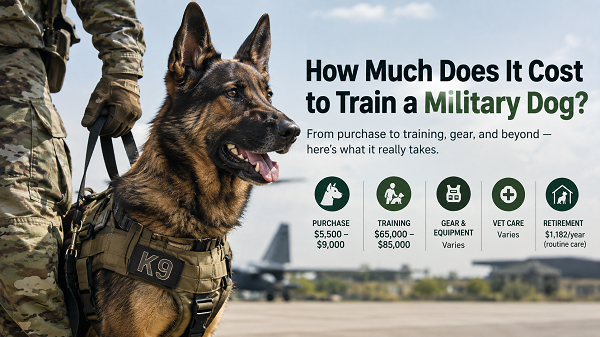
Buying and training a U.S. military working dog costs about $65,000 to $85,000 per dog, based on the estimate officials gave the Government Accountability Office (GAO) in 2022. Older figures ran lower, around $50,000 in 2019 and $20,000 to $40,000 around 2011, so the cost to train a military dog depends on the year and on what a source counts. That range doesn’t include a handler’s pay, deployments, or retirement care, and no agency publishes one official lifetime total.
Table of Contents
- The Short Answer: What Does It Cost to Train a Military Dog?
- Cost Breakdown: Where the Money Goes
- Cost by Job: Patrol, Detection, Specialized Search and SAR
- Military Dog vs Police K9 vs Private Protection Dog
- How Other Countries Handle the Bill
- Hidden Costs: Deployment, Retirement and Aftercare
- Is the Price Worth It?
- What Regular Owners Can Learn From the Military Budget
- Who Wrote This and How We Checked the Numbers
- Frequently Asked Questions
- Conclusion: What It Really Costs to Train a Military Dog
Introduction
Ask five websites how much it costs to train a military dog and you’ll get five answers: $20,000, $40,000, $60,000, $85,000, even $150,000. So which one is right? Honestly, they all are, for different dogs, different years, and different things being counted.
Here’s the problem. Most articles repeat one price range and never tell you what’s inside it. That leaves you guessing whether the number covers just the dog, the training, the handler, or the dog’s whole life.
This guide sorts it out using published government figures. You’ll see where the money goes, what washouts do to the math, how police K9s and other countries compare, and what retirement really costs. You’ll also see which parts of the military’s puppy-to-partner pipeline a regular owner can copy on a normal budget.
A quick note on sources: the United States publishes the most cost data, so most numbers below are in U.S. dollars. We add UK and India context where the public record allows.
The Short Answer: What Does It Cost to Train a Military Dog?
The cost to train a military dog in the U.S. is roughly $65,000 to $85,000 per dog once you include buying the dog and training it. GAO reported that range in October 2022, citing program officials. It covers getting a dog ready for duty, not the dog’s career or retirement.
Why You See $20,000, $50,000 and $85,000 for the Same Job
Different numbers come from different years and different offices. Here’s the timeline:
| Year | Who said it | Figure | What it covers |
|---|---|---|---|
| Around 2011 | News coverage of the bin Laden raid (HowStuffWorks traces it to reporter Elisabeth Bumiller) | $20,000–$40,000 | Training one animal, depending on specialty |
| 2019 | Maj. Matthew Kowalski, commander of the 341st Training Squadron, to Yahoo Finance | About $50,000 | Procuring, training, and shipping a dog to the field |
| 2020 | U.S. Air Force, via Military.com and Bloomberg Government | About $60,000 | Training per dog, with purchase quoted separately at $5,500–$9,000 |
| 2022 | Program officials, via GAO report GAO-23-104489 | $65,000–$85,000 | Procuring and training a dog |
Three things explain the climb.
- Time. Prices rose. A Senate defense report in 2020 warned that the cost of buying European-bred working dogs was rising fast.
- Scope. Some numbers count only training. Others add purchase and shipping.
- Source type. A commander’s quote, a spokesperson’s email, and an audit aren’t the same kind of number.
One more thing. Some sites label the GAO range the “lifetime cost” of a military dog. It isn’t. GAO’s wording covers procuring and training only.
Cost Breakdown: Where the Money Goes
Let’s follow one dog from puppy to working partner. Here’s the quick view first, then the detail.
| Cost piece | Best public figure | How solid is it? |
|---|---|---|
| Buying the dog | About $5,500 (Europe) or about $9,000 (U.S.) in 2020 | Air Force data, a few years old |
| Buying plus training | $65,000–$85,000 | GAO, from officials’ estimates |
| Handler training | No per-dog figure published | Treat as extra |
| Gear, kennels, vet care | No per-dog figure for military dogs | Police budgets give a rough proxy |
| Retirement care | Routine care around $1,182 a year (2017 report, routine only) | Dated, excludes surgeries |
Step 1: Buying the Dog
The dog itself is a surprisingly small slice. In 2020, the Air Force said it paid about $5,500 for a dog from Europe and about $9,000 from a U.S. vendor. That year the Pentagon bought 427 working dogs, 214 from domestic vendors and 213 from overseas.
Do the subtraction. If the purchase price is $5,500 to $9,000 and the combined range is $65,000 to $85,000, the dog is only about 6 to 14 percent of the total. That’s our arithmetic, not an official split. The rest pays for training, kenneling, veterinary care, instructors, and shipping.
Where do the dogs come from? GAO found that roughly 85 percent of the dogs the Air Force buys come from breeders in Germany or the Netherlands. The standard breeds are German Shepherds, Dutch Shepherds, and Belgian Malinois. Labradors and other retrievers show up mostly in detection work.
Age matters too. Bloomberg Government reported that detection programs rarely take puppies under 10 months, and the military often waits until about 18 months. Raising a dog that long costs the breeder real money, and that cost lands in the price.
Step 2: Raising the Puppy (The Cheap Part That Matters Most)
The Department of Defense breeds its own Belgian Malinois at Lackland Air Force Base in Texas. Here’s the pipeline, as described by program staff and the American Veterinary Medical Association:
- Puppies go to volunteer foster families at about 6 weeks old.
- They come back at about 7 months for their first evaluation.
- They spend roughly 5 months in adolescent training.
- Around 12 months, they’re evaluated for entry into the formal training course.
Here’s what stands out. The foster program is how the military builds confidence and socialization, and the program’s veterinarian called it an inexpensive method. Volunteers do the most valuable early work for almost nothing.
The program aims to supply about a third of the DoD’s need, roughly 270 dogs. Bloomberg Government reported that only about 10 percent of active military working dogs were bred at Lackland as of 2022. Want to see how dogs get picked for this path? Read our guide on how military working dogs are selected as puppies.
Step 3: Formal Training (About 120 Days for the Core Course)
The main U.S. course at Lackland runs about 120 days: 60 days of detection work and 60 of patrol work, per AVMA reporting. Other programs are shorter or more specialized:
- Specialized Search Dog course: 93 days, with 76 at Lackland and 17 in Yuma, Arizona (Army description). It teaches off-leash explosives searches.
- TSA explosives detection: 6 weeks of training before a dog meets its handler, then 11 weeks together (GAO).
- TSA passenger screening: 8 weeks before pairing, then 16 weeks together (GAO).
Then comes the test. According to the Army, a dog must hit at least 95 percent accuracy to certify, and new handlers must certify their team within 90 days of reaching a unit. Miss too many planted aids or give too many false alerts, and the team fails.
Add the people and places. Lackland holds about 900 dogs at a time across two kennel sites, and the 341st Training Squadron had a separate operating budget of roughly $8 million in 2020. Much of the “training cost” is instructors, kennels, and a dog hospital, not just treats and toys.
Want the full picture of what happens during those training days? Our guide explains how military working dogs are trained, step by step.
Step 4: The Washout Tax
Not every dog makes it. This is the cost most articles skip.
Bloomberg Government reported that 15 to 25 percent of puppies that pass initial screening still don’t finish training. An older Army description of the Lackland school put the suitability rate near 50 percent, meaning trainers start about 200 dogs to get about 100 serviceable ones. The gap between those numbers likely reflects different stages and different years.
Here’s why it matters. Say a program spends $30,000 on every candidate and half fail. Each graduate now carries its own $30,000 plus one failed dog’s $30,000, so the effective cost jumps to $60,000. Those aren’t official figures. They just show why the sticker price climbs.
Washouts aren’t wasted, though. Program staff say dogs that miss one job can land in another, and foster families can adopt dogs that don’t make the cut.
Step 5: Handler Training and Pay
A great dog with a poor handler is a wasted dog. Handler instruction and salary rarely appear inside per-dog numbers, and the public figures don’t say whether they do, so treat them as extra.
For a sense of scale, the British Army’s recruiting page lists a minimum of £26,334 in pay during handler training. The UK’s initial handler course runs seven weeks, then new handlers start an 18-month animal-care apprenticeship.
Step 6: Gear, Kennels and Vet Care
Military dogs get their veterinary care through military veterinary services. Army policy, for example, calls for semiannual exams. Air Force rules set kennel standards for ventilation, cooling, heating, and noise. Because the military provides this in-house, no public per-dog price exists.
The best stand-in is police K9 budgeting, which we cover in the comparison below. Want to see what handlers actually buy? Our list of essential K9 training equipment every working dog handler needs breaks it down.
Cost by Job: Patrol, Detection, Specialized Search and SAR
Does the role change the price? Yes, though public numbers by role are thin. Here’s what we can say.
| Role | What’s different | What the record shows |
|---|---|---|
| Patrol and dual-purpose | Detection plus biting work and obedience at a distance | The core 120-day course splits into 60 days of detection and 60 of patrol |
| Explosives or narcotics detection | Scent discrimination, one target odor group per dog | GAO says individual dogs usually work one detection type |
| Specialized Search Dog | Off-leash explosives searching for standoff distance | 93-day course, with dogs and handlers training together |
| Search and rescue (nonprofit example) | Rubble, scent, and endurance work | The National Disaster Search Dog Foundation reports about $75,000 and 10–12 months per dog-and-handler team |
A word of caution on detection. You’ll see claims online that an explosives dog can cost up to $150,000. We couldn’t trace that figure to a primary source, so treat it carefully.
Military Dog vs Police K9 vs Private Protection Dog
How do military costs stack up against other working dogs?
| Type | Buying the dog | Training | Notes |
|---|---|---|---|
| U.S. military | About $5,500–$9,000 (2020) | $65,000–$85,000 combined with purchase (GAO) | Global shipping, in-house vet care, formal certification |
| Police K9 | About $8,000 or more, including airfare for Europe-sourced dogs | $12,000–$15,000 for patrol, detection and tracking | Per the National Police Dog Foundation |
| Private protection (Malinois example) | Puppy about $600–$2,000 | Patrol training about $12,000–$15,000 | Per Rover’s pricing guide; quality varies widely |
Police budgets show what the “extras” look like. One U.S. county’s K9 cost sheet listed these numbers:
| Item | Cost |
|---|---|
| Police service dog | $14,600 |
| Vehicle K9 insert | $7,361 |
| Kennel and doghouse | $1,103 |
| Food (per year) | $3,600 |
| Handler schools (per year) | $1,700 |
| Dog and handler training (per year) | $800 |
| Vet bills (per year) | $530 |
| Equipment (per year) | $400 |
| First-year total | $30,094 |
Notice the recurring costs. In that county’s sheet, yearly expenses come to roughly $7,000 after the first year. It’s one county, so use it as an example, not a rule.
So why does the military pay more per dog? The public record points to a few reasons:
- Scale and infrastructure. Hundreds of dogs, kennels, and a dedicated veterinary hospital.
- Deployability. Dogs must work anywhere and ship worldwide.
- Failure rates. Washouts raise the cost of every graduate.
- Certification. Dogs must pass tough accuracy standards before they work.
How Other Countries Handle the Bill
Most governments don’t publish a per-dog price. Here’s what we can see.
United Kingdom. The Defence Animal Training Regiment at Melton Mowbray has a requirement to deliver more than 200 trained military working dogs per year. In January 2026, the Ministry of Defence’s procurement arm published a notice for a 10-year contract covering four dog types: two levels of protection and detection dogs, specialist search dogs, and mobile ground sensor dogs. No per-dog price appeared in the public notice.
India. The Army’s Remount Veterinary Corps Centre in Meerut trains hundreds of dogs for army units, according to ThePrint’s 2022 reporting. A separate 2020 report on a customs dog-training center at Attari said it cost ₹1 crore to build, trains 20 dogs at a time, and needs about eight months per dog.
The lesson? Infrastructure and time drive the bill everywhere. Dog prices are only the start.
Hidden Costs: Deployment, Retirement and Aftercare
Deployment
Older versions of this topic claim deployment costs “tens of thousands” per dog per mission. We couldn’t find an official per-mission figure, so be skeptical of any site that gives one without a source.
Retirement
Before 2000, working dogs that couldn’t serve any longer were euthanized, regardless of temperament. Robby’s Law changed that in November 2000, allowing adoption of suitable dogs. Adopted dogs can’t return to service. Wondering how many working years a dog gives before retiring? See our guide on how long military working dogs serve.
Here’s what adopting costs:
- The adoption fee: None for a suitable retired dog. The adopter pays transportation.
- Medical care: After adoption, the dog’s vet bills become the adopter’s responsibility, as GAO reported in 2017.
- Routine care: A 2017 government report put routine care for a retired military dog at about $1,182 a year. That figure leaves out specialty care and surgeries.
- Help from nonprofits: A national chapter of the U.S. War Dogs Association offers help with prescriptions and mobility devices like dog wheelchairs.
Congress is looking at the gap. H.R. 3144, the Honoring Our K9 Heroes Act (2025), would authorize $1 million a year from fiscal year 2026 through 2030 for grants toward retired federal working dogs’ medical care. H.R. 9664, the K-9 Hero Act of 2026, was introduced in July 2026 with a similar aim. As far as we found, neither has become law yet.
Is the Price Worth It?
Consider the numbers. GAO counted about 5,600 working dogs across the federal government in 2022, with explosives and narcotics detection as the most common jobs. General David Petraeus told Army leaders in 2008 that a dog’s capability couldn’t be replicated by man or machine.
But dogs aren’t equipment. A strong dog-and-handler team works because of trust, repetition, and daily care. The price buys a potential partner, not a guaranteed one.
What Regular Owners Can Learn From the Military Budget
You won’t spend $75,000 on your dog. But the military’s spending pattern teaches useful lessons:
- Plan for the failure rate. If you buy a working-line puppy for protection or sport, have a plan B if it doesn’t fit the job. A great pet is still a win.
- Spend early on socialization. The foster model works because early exposure builds confident dogs. You can’t buy that time back later.
- Pay for skilled instruction. Most of the military’s money goes to trainers and facilities, not gadgets. Invest in foundation training with a qualified trainer.
- Test like a pro. Military teams certify against a 95 percent standard with planted aids. Run blind tests, not just easy ones.
- Build a retirement fund. Even routine senior care runs over $1,000 a year. Start saving while your dog is young.
Want the handler’s-eye view of raising a disciplined dog at home? My e-book, Beyond the Bark: Inside a Pro Handler’s Playbook for Raising the Ideal Dog, walks through the professional habits behind these lessons.
Who Wrote This and How We Checked the Numbers
Author: Cpl. Rofiat Muritala is a Nigerian Army military working dog instructor and handler with more than 14 years at the Nigerian Army Dog Centre. Her background covers dog selection, foundation training, behavior shaping, and performance evaluation, including advanced obedience, K9 patrol, and explosive detection courses.
How we built the numbers:
- We used government and audit sources first: the GAO’s 2022 working dog report and 2017 end-of-service report, Air Force statements, and Army and UK Ministry of Defence pages.
- We used news reports and program descriptions to fill gaps, and labeled older figures by year.
- We treated vendor blogs and forums as leads, not proof.
- Where no public number exists, we said so rather than guess.
Last updated: September 30, 2026. Costs and policy change, so check the sources linked below before you budget.
Frequently Asked Questions
How much does it cost to train a military working dog?
It costs roughly $65,000 to $85,000 per dog to buy and train a U.S. military working dog, according to a 2022 GAO report. Older estimates were lower, around $50,000 in 2019. Handler pay, deployment, and retirement care come on top.
How long does it take to train a military working dog?
The core course at Lackland runs about 120 days, with 60 days of detection and 60 of patrol work. For dogs bred in the DoD program, add foster care and adolescent training, and you’re at roughly 16 months from birth to a fielded dog (12 months plus the 120-day course, our arithmetic). Dogs bought from outside breeders are often older.
Why are military dogs so expensive?
Several costs stack up: buying a high-quality dog, months of instructor-led training, kennels and veterinary care, and shipping. Washouts raise the price of each graduate, since programs must start more dogs than they finish. Certification standards, like the 95 percent accuracy requirement, add to the training burden.
Is a military dog more expensive than a police K9?
Usually, yes. A police K9 often costs about $8,000 or more to buy and $12,000 to $15,000 to train, per the National Police Dog Foundation. That’s around $20,000 before gear, vehicle setup, and handler time. The military’s $65,000 to $85,000 range reflects larger infrastructure and worldwide deployment.
How much does it cost to adopt a retired military dog?
There’s no adoption fee for a suitable retired military working dog, but adopters pay transportation to their home. After adoption, you’re responsible for all vet care, which a 2017 government report put at about $1,182 a year for routine care alone.
Conclusion: What It Really Costs to Train a Military Dog
So what does it cost to train a military dog? The best public answer is $65,000 to $85,000 to buy and train one dog in the U.S., based on the 2022 GAO report. Earlier numbers were lower, but they measured different things in different years.
Here’s the big picture:
- The dog is a small slice. Purchase price runs roughly 6 to 14 percent of the combined total.
- Training and infrastructure drive the bill. Instructors, kennels, vet care, and a roughly 120-day course add up.
- Washouts raise every graduate’s price. Programs start more dogs than they finish.
- Retirement costs don’t end at service. Adopters carry vet bills, and Congress is debating grants.
Ready to put this to use? Start by setting a realistic budget for your own working dog: plan for early socialization, skilled training, and a senior-care fund. Then read the sources below before trusting any single number you see online.
Want more handler-tested advice? Subscribe to our weekly articles roundup newsletter and get new K9 guides in your inbox.
Sources
- GAO, Working Dogs: Federal Agencies Need to Better Address Health and Welfare (GAO-23-104489, October 2022): https://www.gao.gov/products/GAO-23-104489
- GAO, Medical Conditions and Care for End-of-Service Military Working Dogs (GAO-17-358, 2017): https://www.gao.gov/products/gao-17-358
- Military.com, “US Military Working Dogs Should Be American-Born, Senator Says” (2020): https://www.military.com/daily-news/2020/09/18/us-military-working-dogs-should-be-american-born-senator-says.html
- Bloomberg Government, “Call for U.S.-Bred War Dogs Grows to End ‘Outsourced’ Security” (2022): https://about.bgov.com/insights/news/call-for-u-s-bred-war-dogs-grows-to-end-outsourced-security/
- Yahoo Finance, “What it takes to become a U.S. Special Forces dog” (2019): https://finance.yahoo.com/news/dog-special-forces-baghdadi-cost-train-174816488.html
- HowStuffWorks, “How War Dogs Work”: https://science.howstuffworks.com/war-dog.htm
- U.S. Army, “Military Working Dogs: Guardians of the Night”: https://www.army.mil/article/56965/military_working_dogs_guardians_of_the_night
- AVMA, “Inside the headquarters for military dogs” (2016): https://www.avma.org/javma-news/2016-06-01/inside-headquarters-military-dogs
- DVIDS, “Breeding Program Turns Puppies Into Troops”: https://www.dvidshub.net/news/511485/breeding-program-turns-puppies-into-troops
- National Police Dog Foundation FAQ: https://www.nationalpolicedogfoundation.org/faq
- County K9 unit estimated cost sheet (2022): https://public.destinyhosted.com/wilcodocs/2022/COM/20220329_1667/28843_K9_Unit_Estimated_Cost.pdf
- Rover, Belgian Malinois cost guide (2025): https://www.rover.com/blog/belgian-malinois-cost-guide/
- British Army, Defence Animal Training Regiment: https://www.army.mod.uk/learn-and-explore/about-the-army/corps-regiments-and-units/army-medical-services/royal-army-veterinary-corps/defence-animal-training-regiment/
- British Army, Dog Handler role: https://jobs.army.mod.uk/roles/army-medical-service/dog-handler/
- UK Find a Tender, Military Working Dogs notice (January 2026): https://www.find-tender.service.gov.uk/Notice/008648-2026
- ThePrint, “Run, train, groom, repeat” (2022): https://theprint.in/in-pictures/run-train-groom-repeat-a-day-in-the-life-of-a-dog-at-armys-training-centre-in-meerut/1116529/
- Congress.gov, H.R. 3144, Honoring Our K9 Heroes Act: https://www.congress.gov/bill/119th-congress/house-bill/3144/text
- GovTrack, H.R. 9664, K-9 Hero Act of 2026: https://www.govtrack.us/congress/bills/119/hr9664
- National Police Association statement on the K-9 Hero Act (September 2026): https://www.prnewswire.com/news-releases/the-national-police-association-endorses-the-k9-hero-act-of-2026-302874752.html

Her work centres on obedience, detection, protection and operational readiness. She favours proven methods built on repetition, consistency and real-world conditioning, so that both dogs and handlers are prepared for high-pressure tasks.
Rofiat represented the Nigerian Army Dog Centre at the Nigerian Army Day Celebration (NADCEL) 2026, where she led demonstrations in obedience, explosive detection, agility and tactical movement. Through articles, training content and documentaries, she shares field-based insight into how structured training, clear communication and trust between handler and dog affect performance and reliability.
She is the author of Beyond the Bark: Inside a Pro Handler's Playbook for Raising the Ideal Dog, a practical guide that helps dog owners and handlers apply professional training principles in everyday situations.
- Dog Agility Course Layout: Easy DIY Setup - October 7, 2026
- Local Dog Breeds: Temperament, Health & Training Guide - October 6, 2026
- How Long Do Military Working Dogs Serve? Full Guide - October 5, 2026