Home Remedies for Light Skin Scrapes on Family Small Dog
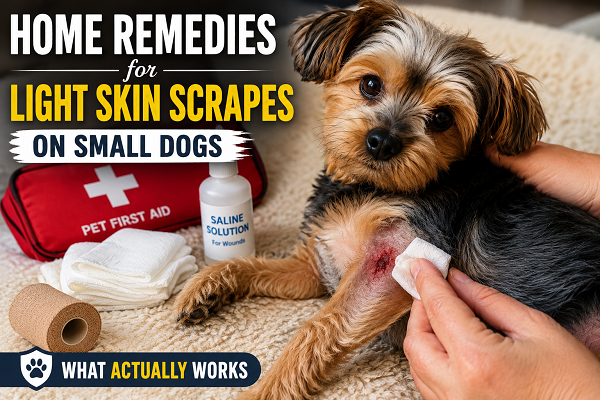
For a light scrape on a small dog, gently flush the area with warm water or saline, pat it dry, apply a thin layer of medical-grade honey or a vet-approved antiseptic like diluted chlorhexidine, and keep your dog from licking it for 24–48 hours. Skip hydrogen peroxide, alcohol, and essential oils, they slow healing and can be toxic to dogs. Most light scrapes on small dogs close up within 3 to 7 days with basic home care; anything deeper, still bleeding after ten minutes, or showing swelling and odor needs a vet visit.
Table of Contents
- Introduction
- What Counts as a “Light” Scrape (And What Doesn’t)
- Step-by-Step: Cleaning a Minor Scrape at Home
- Safe Home Remedies That Actually Help
- Home Remedies to Avoid (Even Though They’re Popular)
- Why Small Dogs Need Extra Care With Skin Injuries
- Healing Timeline: What Normal Recovery Looks Like
- Signs a Scrape Needs a Vet, Not a Home Remedy
- Building a Simple First-Aid Kit for Your Small Dog
- FAQs
- Conclusion
Introduction
So here’s the thing: most scrapes like this aren’t emergencies. Small dogs get scraped up doing normal dog things, playing rough, sliding on tile, brushing past a rose bush, tumbling off the couch. Their skin is thinner than a big dog’s, which means scrapes happen more easily, but it also means most of them are shallow and manageable right at home.
In this guide, you’ll learn exactly how to tell a “light” scrape from something that needs professional care, which home remedies genuinely help (and which ones are internet myths that can actually hurt your dog), how small-breed skin behaves differently during healing, and how to build a simple first-aid kit so you’re never caught off guard again.
A quick but important note before we start: this article covers minor, superficial scrapes only, the kind where the skin is scuffed or lightly broken but there’s no significant bleeding, no deep tissue exposed, and your dog is otherwise acting normal. If you’re ever unsure how serious an injury is, call your vet. It costs nothing to ask, and it can save you a much bigger bill later.
What Counts as a “Light” Scrape (And What Doesn’t)
Before you reach for anything, take thirty seconds to actually look at the injury. Part the fur, get good light (a phone flashlight works fine), and check these things:
- Depth: A light scrape only affects the top layer of skin. You’ll see redness, maybe some raw or pink tissue, but no fat, muscle, or deeper structures visible.
- Bleeding: Little to none, or it stops within a few minutes of light pressure.
- Size: Generally smaller than a coin. Anything larger, or anything that looks like a flap of skin, is outside “light scrape” territory.
- Location: Scrapes on the legs, side, or back are usually lower-risk than anything near the eyes, mouth, joints, or genitals, those areas warrant a vet call regardless of how minor it looks.
- Your dog’s behavior: Is your dog walking normally, eating, and acting like themselves? That’s a good sign. Limping, whining when touched, or hiding suggests more pain than the wound appears to justify, which is worth a vet’s opinion.
Veterinarians I’ve worked with over the years use a simple rule of thumb that I’ve come to rely on too: minor cuts or scrapes can usually be managed at home if they’re shallow, not bleeding heavily, and the dog is acting normally, but anything deep, actively bleeding, swollen, or showing signs of infection needs a vet exam. That’s the line we’ll work from throughout this article.
Step-by-Step: Cleaning a Minor Scrape at Home
Once you’ve confirmed the scrape is genuinely minor, here’s the process I walk clients through:
- Wash your hands or put on clean disposable gloves. You don’t want to introduce new bacteria into an open scrape.
- Trim the fur around the area if it’s matting into the wound. Small, blunt-tipped scissors work well, go slowly, small dogs have loose, mobile skin that’s easy to nick if you’re not careful.
- Flush the wound. Gentle restraint, mild direct pressure if there’s any bleeding, and a careful flush with warm water or saline are the standard first steps for a genuinely minor wound. A large plastic syringe (no needle) is perfect for creating a gentle stream that pushes out dirt and debris without scrubbing the tissue.
- Pat, don’t rub, the area dry with a clean gauze pad or paper towel.
- Apply a thin layer of an appropriate wound product (see the next section).
- Prevent licking. This is the step almost everyone skips, and it’s the one that causes the most repeat vet visits. A soft recovery cone, an inflatable collar, or even a snug baby sock taped gently over a paw scrape can buy you the 20–30 minutes it takes for a topical product to actually work.
- Check it twice a day for the first three days. You’re watching for increasing redness, swelling, discharge, or a smell, all signs that a “light” scrape is heading toward infection.
Safe Home Remedies That Actually Help
Not every “natural remedy” floating around dog owner forums has real evidence behind it. Here’s what I actually keep in my own kit and recommend to owners, based on both hands-on experience and current veterinary guidance:
1. Saline Solution (the gold standard)
A simple mix of 1 teaspoon of table salt to 2 cups of warm water makes an effective, gentle flush. A saline solution made this way is a gentle and effective option for daily wound cleaning, applied by gently flushing the area, patting it dry, and following up with a vet-recommended ointment if needed. It won’t sting the way some antiseptics do, which matters a lot for a wiggly, anxious ten-pound dog.
2. Medical-Grade Manuka Honey
This one surprises a lot of first-time dog owners, but it has genuine science behind it. Medical-grade Manuka honey has real antibacterial evidence supporting its use on wounds, though ordinary grocery-store honey does not carry the same properties. Look for products specifically labeled “medical grade” or “wound care” honey rather than reaching for the jar in your pantry.
3. Diluted Chlorhexidine or Povidone-Iodine
If your vet has already recommended one of these for a previous injury, they’re safe and effective when properly diluted. The general guidance among vets is to dilute chlorhexidine to around 0.05% and iodine to about 0.1%, roughly the color of weak tea, since full-strength solutions are too harsh for open tissue. If you’re not confident measuring dilutions, saline alone is a safer default.
4. A Recovery Collar or Soft Cone
Not a “remedy” in the traditional sense, but arguably the single most effective tool in this whole list. Small dogs are notorious lickers, and constant licking reintroduces bacteria and physically reopens the wound edges every time it starts to scab.
5. Keeping the Wound Uncovered (in most cases)
Contrary to what a lot of people assume, light scrapes usually heal better exposed to air rather than wrapped tightly, unless the location makes the dog likely to lick or rub it against furniture and bedding. If you do need to protect it briefly, use a loose, breathable gauze wrap and remove it after a few hours.
Home Remedies to Avoid (Even Though They’re Popular)
This is honestly the section I wish more dog owners read before they went searching Pinterest for “natural dog wound care.” A few products get recommended constantly online, and they’re genuinely bad ideas:
- Hydrogen peroxide. It foams dramatically, which makes people feel like it’s “working,” but hydrogen peroxide and alcohol are both substances vets advise against on wounds because they delay healing rather than help it.
- Rubbing alcohol. Same problem as peroxide, plus it stings enough to make an already stressed dog more anxious about future wound care.
- Tea tree oil and other undiluted essential oils. Tea tree oil is genuinely toxic to dogs and should never be used on or near a wound, no matter how many “natural remedy” blogs suggest it.
- Human triple-antibiotic ointments in large amounts. A small dab is sometimes fine (ask your vet first), but dogs lick, and swallowing a lot of any ointment isn’t good for their stomach.
- Turmeric paste, apple cider vinegar, or coconut oil rubbed directly on open skin. These show up constantly in “natural pet remedy” articles, but there’s little to no veterinary evidence they help an open wound, and vinegar in particular can sting and irritate already-broken skin.
- Tight bandages on legs or tails. Small-dog limbs are thin, and even a well-meaning wrap can cut off circulation faster than you’d expect. Tight home bandages on legs or tails should be avoided unless a vet has specifically shown you how to place them.
Why Small Dogs Need Extra Care With Skin Injuries
I’ve handled everything from Belgian Malinois to Chihuahuas over the years, and one thing stands out every time: small-breed skin behaves differently.
- Thinner dermis. Toy and small breeds (Yorkies, Chihuahuas, Italian Greyhounds, Miniature Pinschers) generally have thinner, more delicate skin than medium and large breeds, which is part of why they scrape more easily on rough surfaces, pavement, carpet burns, even enthusiastic play with a bigger dog.
- Less body fat as padding. A fall that a Labrador shrugs off can leave a visible scrape on a five-pound dog because there’s simply less cushioning between skin and bone.
- Faster heat loss around wounds. Small dogs lose body heat faster in general, which matters if you’re flushing a wound with water, keep it warm, not cold, to avoid an uncomfortable chill during cleaning.
- Harder to restrain gently. It takes practice to hold a small, wiggly dog securely enough to clean a wound without frightening them further. Wrapping your dog snugly in a towel (“burrito style”), leaving only the injured area exposed, works well and keeps both of you calmer.
- They hide pain differently. Small dogs sometimes mask discomfort by freezing or trembling rather than obviously limping, don’t mistake stillness for “they’re fine.”
If you’re raising a small breed from puppyhood, building good handling habits early makes wound care so much easier later. Our guide on essential grooming habits for a healthy puppy covers exactly this kind of early, low-stress handling.
Healing Timeline: What Normal Recovery Looks Like
Here’s roughly what to expect once you’ve cleaned and started treating a light scrape:
- Days 1–2: The area looks red and raw, possibly with a thin scab forming at the edges. Some mild swelling is normal.
- Days 3–5: A proper scab should be forming across the wound. Swelling should be going down, not up.
- Days 5–7: New pink skin often becomes visible at the edges. Fur may start growing back around the perimeter.
- Days 7–14: Most light scrapes on small dogs are fully closed and simply need the fur to regrow, which can take a few extra weeks depending on breed and coat type.
If you’re not seeing steady improvement by day 3 or 4, that’s your cue to stop watching and start calling your vet.
Signs a Scrape Needs a Vet, Not a Home Remedy
Please don’t try to “wait it out” if you notice any of these:
- Bleeding that doesn’t slow down after 10 minutes of firm, direct pressure
- A wound deep enough to see fat, muscle, or bone
- Increasing swelling, warmth, or redness after day 2 or 3
- Yellow or green discharge, or a noticeably bad smell
- The wound is on the face, near an eye, in the mouth, or over a joint
- Your dog is limping, guarding the area, or seems more painful than the wound looks
- Any sign of a fever, lethargy, or loss of appetite alongside the injury
- The scrape came from an animal bite of any kind, even a “small” one from another pet
Vets are clear that a vet visit is required if bleeding is heavy, the wound is deep enough to reach muscle or bone, there’s debris that won’t come out, or there are signs of infection, and that help should always be sought if the wound is on the face, near joints or paw pads, or the dog is in visible pain or distress. None of that is meant to scare you, it’s just the honest line between “handle it yourself” and “let a professional look at it.”
Building a Simple First-Aid Kit for Your Small Dog
You don’t need a huge kit, just the right basics kept somewhere you’ll actually remember. A solid small-dog first-aid kit includes:
- Saline solution or sterile eye wash
- A large syringe (no needle) for flushing
- Gauze pads and self-adhesive vet wrap
- Blunt-tipped grooming scissors
- Non-latex gloves
- Medical-grade honey wound gel or a vet-approved antiseptic
- A soft recovery cone or inflatable collar sized for a small dog
- Tweezers for splinters, thorns, or grass seeds
- Your vet’s number and the nearest 24-hour emergency clinic’s number, saved in your phone, not just written down somewhere
If you’re looking for a broader rundown of what belongs in a working dog’s medical kit (a lot of it scales down nicely for a family pet), our piece on maintaining good health in working dogs breaks down exactly what handlers keep on hand and why. And if you’re the type who prefers gear recommendations laid out clearly, our essential K9 equipment guide covers first-aid kit components in more depth too.
If your small dog also spends time outdoors and you’re trying to keep scrapes, ticks, and irritation to a minimum in the first place, it’s worth reading our natural flea protection guide, since a lot of the same skin-friendly, chemical-light philosophy applies to prevention too. And if you’re still deciding what kind of small breed fits your household and lifestyle, our low-maintenance dog breed guide is a helpful starting point.
FAQs
Can I put Neosporin on my dog’s scrape?
A small amount is generally considered low-risk for a minor scrape, but check with your vet first, especially for small dogs, since they’re more likely to lick a treated area and ingest more of it relative to their body weight. Plain formulas without added pain relievers are safer than combination products.
How do I stop my small dog from licking a scrape without a cone?
A soft inflatable “donut” collar, a snug t-shirt or bodysuit, or simply supervising closely and redirecting with a favorite chew toy can work for short periods. For overnight or unsupervised time, a proper recovery cone is still the most reliable option.
Is coconut oil good for dog wounds?
It’s popular in home-remedy circles, but there’s limited veterinary evidence that it helps an open scrape heal faster, and it can leave the area greasy enough to attract dirt. Saline and medical-grade honey have far stronger evidence behind them for actual wound care.
How long should a light scrape take to heal on a small dog?
Most superficial scrapes close within 3 to 7 days with basic home care, with full fur regrowth sometimes taking a couple of extra weeks depending on breed and coat.
Should I cover my dog’s scrape with a bandage?
Usually not necessary for a light, exposed scrape on the body. Cover it only if your dog is likely to rub or lick it, and use a loose, breathable wrap, removing it after a few hours rather than leaving it on continuously, since a hidden wound is harder to monitor for infection.
Conclusion
Light scrapes are one of those small dog-ownership moments that feel scarier than they usually are. In most cases, a gentle saline flush, a dab of medical-grade honey or vet-approved antiseptic, and a little vigilance against licking is genuinely all it takes. What actually matters most isn’t finding some miracle remedy, it’s sticking to the basics that have real evidence behind them, avoiding the popular “natural” products that quietly do more harm than good, and knowing exactly when a scrape has crossed the line into “call the vet” territory.
Keep a simple first-aid kit stocked, check healing progress daily for the first few days, and trust your gut. You know your dog’s normal behavior better than any article ever could, so if something feels off beyond what the wound itself explains, that instinct is worth listening to.
This article is intended for general education and does not replace a hands-on veterinary exam. When in doubt about any wound, always check with your veterinarian.

Her work centres on obedience, detection, protection and operational readiness. She favours proven methods built on repetition, consistency and real-world conditioning, so that both dogs and handlers are prepared for high-pressure tasks.
Rofiat represented the Nigerian Army Dog Centre at the Nigerian Army Day Celebration (NADCEL) 2026, where she led demonstrations in obedience, explosive detection, agility and tactical movement. Through articles, training content and documentaries, she shares field-based insight into how structured training, clear communication and trust between handler and dog affect performance and reliability.
She is the author of Beyond the Bark: Inside a Pro Handler's Playbook for Raising the Ideal Dog, a practical guide that helps dog owners and handlers apply professional training principles in everyday situations.
- Australian Cattle Dog vs Blue Heeler: Any Difference? - October 1, 2026
- Bousnic Dog Training Collar Review: Is It Safe? - September 30, 2026
- Gravy Train Dog Food Review: Ingredients & Recalls - September 30, 2026