Bravecto for Dogs: Field Use & Dosing Schedule
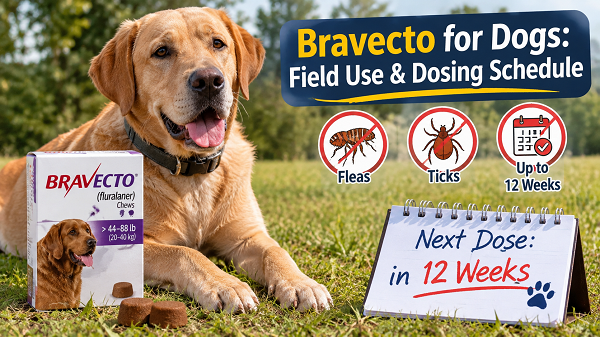
Bravecto for dogs is a prescription flea and tick medicine that uses the drug fluralaner. One dose lasts up to 12 weeks against fleas and most ticks, and 8 weeks against lone star ticks. You dose by body weight, give the chew with food, and you can start from 6 months of age. For working, hunting and outdoor dogs, the smart move is to put the 12-week dates on a calendar, add tick checks for weeks 9 to 12 in lone star country, and talk to your vet first if your dog has ever had a seizure.
Table of Contents
- What Is Bravecto and How Does It Work?
- Bravecto Products Compared: Chew, 1-Month Chew, Topical and Quantum
- Bravecto Dosage Chart by Weight
- Bravecto Dosing Schedule: How Often to Give It
- Bravecto Field Use: Working Dogs, Hunters and Kennels
- Bravecto Safety: Seizure Warning, Side Effects and Who Should Be Careful
- Bravecto vs Other Flea and Tick Options
- Seven Mistakes Handlers Make With Bravecto
- How This Guide Was Built
- FAQs About Bravecto for Dogs
- Final Thoughts and Next Steps
Introduction
You’ve got a dog that spends real time outside. Maybe it’s a patrol dog working grass and brush, a hunting partner crossing creeks, or a family dog that lives on the trail. Ticks and fleas don’t care about your training schedule. And here’s the problem: most Bravecto articles online stop at “one chew every 12 weeks.” That’s the easy part.
The hard parts are the ones nobody covers. What if your dog lives where lone star ticks are common? What if the dog vomits an hour after dosing? How do you track doses across a kennel of eight dogs? What if your dog has a seizure history?
In this guide, you’ll get the full Bravecto dosing schedule, a Bravecto dosage chart by weight in pounds and kilograms, a clear comparison of every Bravecto product, and field-use rules built for working dogs. You’ll also get the safety facts, including the FDA’s neurologic warning, so you can make a calm, informed decision with your vet.
Quick note: I’m giving you label facts and handler-style planning tips here. I’m not a vet, and your vet makes the final call on your dog’s dose and product.
What Is Bravecto and How Does It Work?
Bravecto is a brand of flea and tick medicine made by Merck Animal Health (known as MSD Animal Health outside the US and Canada). The active ingredient is fluralaner, which belongs to a drug class called isoxazolines.
Here’s the simple version. When a flea or tick bites your dog, it takes in a tiny amount of the drug through the blood. Fluralaner attacks the parasite’s nervous system, and the parasite dies. The label says it starts killing fleas and ticks within hours.
What Bravecto Kills
The US label for the 12-week chew lists these targets:
- Fleas, including flea infestations
- Black-legged ticks (deer ticks)
- American dog ticks
- Brown dog ticks
- Asian longhorned ticks
- Lone star ticks, but only for 8 weeks
What Bravecto Does Not Do
This part matters for field dogs. Bravecto doesn’t prevent heartworm and doesn’t treat intestinal worms. It also doesn’t repel insects. A tick can still bite, and it has to feed before the drug kills it. So you still need tick checks after field work. Think of Bravecto as a strong safety net, not a force field.
Bravecto Products Compared: Chew, 1-Month Chew, Topical and Quantum
Most people say “Bravecto” as if it’s one product. It isn’t. In the US you’ll see four versions, and the schedule changes with each one.
| Product | How it’s given | Protection | Who can use it | Key notes |
|---|---|---|---|---|
| Bravecto Chew (12-week) | By mouth, with food | Up to 12 weeks for fleas and most ticks; 8 weeks for lone star ticks | Dogs 6 months and older | Prescription. Dosed by weight |
| Bravecto 1-Month Chew | By mouth, with food | One dose per month; can run year-round | Dogs by weight band; lone star protection not shown in puppies under 6 months | Label says you can start any time of year. About $28.99 per month at one major US retailer |
| Bravecto Topical | Liquid on the skin | 12 weeks for fleas and most ticks; 8 weeks for lone star ticks | Dogs 6 months and older | Prescription. Resists swimming and bathing. For skin use only. About $69 to $71 per 12-week dose at one major US retailer |
| Bravecto Quantum | One injection under the skin, given by a vet | 12 months for several tick species; 8 months for lone star ticks | Dogs 6 months and older | Approved in the US in July 2025. Vet-administered only |
Prices change. Treat them as examples, not quotes.
Which One Fits a Working Dog?
- The chew is the easiest for most handlers. It’s quick, there’s nothing to wipe off, and swimming won’t affect it.
- The topical helps if your dog refuses chews. Keep other dogs from licking the dose spot until it dries.
- The 1-month chew suits handlers who like a monthly routine tied to heartworm dates.
- Quantum suits handlers who forget doses. You skip the calendar, but you can’t undo a shot if your dog reacts badly. Talk through that trade-off with your vet.
Bravecto Dosage Chart by Weight
Bravecto is dosed by body weight, not by breed or age. The US chew comes in five weight bands. The table below shows the 12-week chew.
| Dog weight (lb) | Dog weight (kg) | Fluralaner per chew | Box size |
|---|---|---|---|
| 4.4 to 9.9 lb | 2 to 4.5 kg | 112.5 mg | Toy |
| Over 9.9 to 22 lb | 4.5 to 10 kg | 250 mg | Small |
| Over 22 to 44 lb | 10 to 20 kg | 500 mg | Medium |
| Over 44 to 88 lb | 20 to 40 kg | 1,000 mg | Large |
| Over 88 to 123 lb | 40 to 56 kg | 1,400 mg | Extra large |
Dogs over 123 lb get a combination of chews that adds up to their body weight. Your vet should work that out with you.
Real-World Examples
- A 55 lb Belgian Malinois goes in the 44 to 88 lb band (the 1,000 mg chew).
- A 70 lb German Shepherd goes in the same band.
- A 100 lb Mastiff cross goes in the 88 to 123 lb band (the 1,400 mg chew).
- A 40 lb Border Collie uses the 22 to 44 lb band (the 500 mg chew).
Weigh Your Dog, Don’t Guess
Here’s a trick I’d tell any new handler: weigh the dog on the day you open the box. Dogs lose weight during hard working seasons and gain it in the off-season. A dog sitting right at a band edge (say 44 lb) needs a quick vet check before you pick a box.
Dosing Rules That Never Change
- Give the chew with food.
- Make sure your dog eats the whole dose.
- Start at 6 months or older for the 12-week products.
- Don’t split or combine boxes yourself unless your vet tells you to.
- Don’t give a second dose “just in case.”
Do Weight Bands Change in Other Countries?
Yes, they can. The bands and box colors above come from the US label. In the UK, EU and elsewhere, the weight bands, product names and tick species may differ. Always read the leaflet in your own country’s box and follow your local vet.
Bravecto Dosing Schedule: How Often to Give It
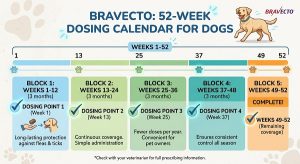
How often do you give Bravecto to a dog? For the 12-week chew or topical, give one dose every 12 weeks (about every 3 months). For the 1-month chew, give one dose every month. Bravecto Quantum is a single injection from your vet that lasts up to 12 months against most ticks.
A Sample 12-Month Calendar
A 12-week cycle doesn’t line up with the calendar year. That surprises people. Four doses cover 48 weeks, so you’ll need a fifth dose slightly before the end of the year.
| Dose | Week it’s given | What it covers |
|---|---|---|
| 1 | Week 0 | Weeks 1 to 12 |
| 2 | Week 12 | Weeks 13 to 24 |
| 3 | Week 24 | Weeks 25 to 36 |
| 4 | Week 36 | Weeks 37 to 48 |
| 5 | Week 48 | Weeks 49 to 60 |
So for year-round protection, you’ll give about 4.3 doses a year. Set a repeating phone reminder for every 12 weeks from the first dose date, not “every three months.” Three calendar months can run 13 weeks, and that leaves a gap.
The Lone Star Tick Gap (Most Articles Skip This)
This is the detail I’d put on a sticky note. The label says Bravecto kills lone star ticks for 8 weeks, not 12. If you dose on a 12-week schedule in lone star country, weeks 9 to 12 may have weaker tick cover.
Lone star ticks live across the southeastern, south-central and eastern United States, so this matters for many hunting and working dogs there. Here’s what you can do:
- Ask your vet whether a different product or a shorter interval suits your area. Don’t shorten the interval on your own.
- Run daily tick checks in weeks 9 to 12.
- Use the 1-month chew if your vet agrees. It gives you a monthly reset.
- Keep a tick log. Notes on where and when ticks turn up help your vet advise you.
Year-Round or Seasonal?
Ticks and fleas don’t always disappear in winter. Indoor fleas can survive cold weather, and some ticks stay active on mild days. The 1-month label says treatment may begin at any time of the year and can run year-round without a break. Most vets recommend year-round cover for dogs that work outdoors. Ask your own vet, because climate matters.
Bravecto Quantum: The 12-Month Shot
Bravecto Quantum is a long-acting injection given by a vet. In the US, it’s approved for dogs 6 months and older. It covers black-legged, American dog and brown dog ticks for 12 months, and lone star ticks for 8 months. The label was expanded in March 2026 to add Asian longhorned and Gulf Coast ticks for 12 months.
In a US field study, 2 of 225 dogs (0.9%) had seizures, and the maker says that matches what you’d expect in the general dog population. Common reactions included tiredness, lower appetite, vomiting, diarrhea, raised liver enzymes and itching. In safety testing, dogs also tolerated 5 times the dose given every 4 months for 6 doses.
What If You Miss a Dose?
The 1-month chew label is clear: give the missed dose as soon as you remember, then wait the full interval before the next one. Never give two doses at once.
For the 12-week products, the same logic applies. Give it when you realize, then restart the 12-week count from that day. Call your vet if you’re more than a couple of weeks late and your dog has been in tick country. Your vet may want to check for ticks.
What If Your Dog Vomits After Taking It?
Don’t re-dose on your own. Vomiting soon after a dose is a call to your vet. The vet can tell you whether your dog kept enough of the dose down. If your dog keeps vomiting or can’t hold water down, get a same-day check.
A small trick that helps: give the chew with a real meal, not an empty stomach, and let the dog rest for an hour or two instead of starting hard work right away.
Bravecto Field Use: Working Dogs, Hunters and Kennels
This is where most guides go quiet. Field dogs face different risks than a house pet. They’re in thick brush, they swim, they sleep in kennels and trucks, and they travel. Here’s how to handle each part.
Before Deployment or a Hunting Season
- Book a vet check at least 3 to 4 weeks before the season starts.
- Give the dose early enough that the drug is already working. The label says it starts killing within hours, but don’t time it for the morning you leave.
- Weigh the dog and check the dose band.
- Write down the dose date and the product lot number.
- Plan for the end date. If a 12-week dose runs out mid-season, dose before you leave, not after.
Water, Rain and Bathing
Swimming dogs are common in retriever and patrol work. The chew works from the inside, so water can’t wash it off. The topical label also says it resists swimming and bathing for the full 12 weeks. That’s a real edge over products that fade after a few dunks.
Tick Checks Still Count
Bravecto kills ticks after they bite. It doesn’t stop the bite. After every field session, run your hands over the dog from nose to tail:
- Ears, inside and behind
- Between toes and pads
- Armpits and groin
- Under the collar and harness straps
- Around the eyes and lips
- Base of the tail
Pull off any attached tick with fine tweezers, close to the skin, and keep the dog’s record. Don’t assume “no ticks” just because the dog is on medicine.
Kennels and Multi-Dog Teams
When you handle several dogs, the biggest risk isn’t the drug. It’s the paperwork. Use one simple sheet:
| Dog | Weight (lb) | Product and box size | Dose date | Next dose date | Notes |
|---|---|---|---|---|---|
| Example: Rex | 72 | Chew 1,000 mg | Jan 5 | Mar 30 | Ate with dinner |
Give each dog its own dose. Never share chews between dogs, even if two dogs weigh the same. Feed dogs separately on dosing day so nobody steals a chew. And keep a second person double-checking names against boxes. It sounds basic, but a mix-up costs far more than the extra minute.
Storage in Hot Trucks and Field Kits
Store Bravecto in its original packaging, in a cool, dry place, away from direct sun. A glove box in summer can get very hot. Check your box for its exact storage temperature. Keep it out of children’s reach and away from pets that might raid your bag.
Traveling Across Regions or Countries
Tick species change by region. A dog that works in Texas faces different ticks than one in the UK countryside. Some destinations ask for proof of parasite treatment before entry, so check the rules for your route. Ask your vet for a signed record of every dose date and the product used.
Don’t Forget Heartworm and Worms
Bravecto doesn’t cover heartworm or intestinal worms. Ask your vet to set up separate prevention and keep those dates in the same calendar.
Bravecto Safety: Seizure Warning, Side Effects and Who Should Be Careful
Let’s be honest about safety. You’ll see scary posts online, and you’ll also see vets who use Bravecto every day. Both are part of the picture, so here’s what the record actually says.
The FDA Neurologic Warning
In September 2018, the US Food and Drug Administration (FDA) warned that isoxazoline flea and tick drugs can cause neurologic problems in some pets. The warning covered Bravecto, Nexgard, Simparica and Credelio. The signs reported were muscle tremors, loss of balance (ataxia) and seizures. The FDA asked for clearer label warnings but said these products remain safe and effective for most animals. Merck, Bravecto’s maker, says neurologic events are very rare.
Today’s Bravecto label says seizures have been reported in dogs given this class of drug, even dogs with no seizure history. It also says to use caution in dogs with a seizure history or other neurologic disorders.
Common Side Effects
The most common reactions on the labels are:
- Vomiting
- Diarrhea
- Tiredness (lethargy)
- Lower appetite
- Itching
- Hair loss or moist skin rash (topical)
Most dogs have none of these. If a mild reaction lingers beyond a day or two, call your vet.
Red Flags: Call Your Vet Right Away
- Tremors or twitching
- Wobbling or trouble standing
- A seizure of any kind
- Swelling of the face, hives or trouble breathing
- Repeated vomiting or no interest in water
For a working dog, I’d add one habit: note your dog’s normal energy, focus and gait before dosing. A handler who knows the baseline spots a change faster.
MDR1 Breeds (Collies, Shepherds and Friends)
Some herding breeds carry the MDR1 gene change, which makes them sensitive to certain drugs. This matters for many working dogs, including Collies, Shetland Sheepdogs, Australian Shepherds and, less often, German Shepherds.
The good news comes from a published study. Researchers gave 16 MDR1 Collies a single dose of fluralaner chewable tablets at 168 mg/kg, which is 3 times the highest expected clinical dose, and watched them for 28 days. They saw no adverse events in the treated dogs. That’s one small study, so still tell your vet if your dog is MDR1 positive or untested.
Pregnant, Breeding or Nursing Dogs
The Bravecto labels note adverse events after use in breeding females, and the 1-month label says safety hasn’t been evaluated in breeding, pregnant or lactating dogs. If you run a breeding program, ask your vet before you dose.
Drug Interactions
One vet-resource guide reports no interaction between fluralaner and milbemycin oxime–praziquantel or ivermectin, and no displacement of carprofen or warfarin. Heartworm, dewormer, antibiotic, pain and seizure medicines are generally listed as compatible, but your vet confirms for your dog. Never give human pain relievers like ibuprofen or acetaminophen to a dog.
Who Should Talk to the Vet First?
- Dogs with any seizure or neurologic history
- Breeding, pregnant or nursing females
- Puppies under 6 months
- Dogs on several medicines
- Dogs under 4.4 lb (2 kg)
- Dogs with a past bad reaction to any flea or tick product
Bravecto vs Other Flea and Tick Options
Bravecto isn’t the only tool. Here’s a quick way to think about the choice.
| Question | Bravecto (chew or topical) | Monthly topical like K9 Advantix II |
|---|---|---|
| How often? | Every 12 weeks (1-month chew every month) | Every month |
| How does it work? | Kills parasites after they bite | Repels and kills ticks, fleas, mosquitoes and biting flies, per the product description |
| Prescription in the US? | Yes | No, sold over the counter |
| Cat in the house? | Check the label and ask your vet | Dangerous for cats because it contains permethrin |
| Best for | Handlers who want fewer dose dates | Handlers who want repelling action and a monthly rhythm |
I’ve covered the monthly option in detail in our K9 Advantix Dosage Chart & Safety Guide and our K9 Advantix II full tick care guide for working dogs. Read both before you decide.
Some handlers also combine a repellent collar or spray with an oral medicine for heavy tick seasons. Don’t mix products without asking your vet first.
Seven Mistakes Handlers Make With Bravecto
- Dosing by the calendar month. Use 12 weeks (84 days), not “every three months.”
- Skipping the lone star plan. Eight weeks of cover means weeks 9 to 12 need extra care.
- Guessing the weight. Weigh on the dosing day.
- Giving it on an empty stomach. The label says give with food.
- Re-dosing after vomiting without asking. Call your vet first.
- Skipping tick checks. The drug kills ticks after they bite. It doesn’t stop the bite.
- Forgetting heartworm. Bravecto doesn’t cover it.
How This Guide Was Built
I wrote this guide with a working-dog handler’s eye, and I built every number on it from sources you can check:
- Dosing and duration: Manufacturer and retailer label pages for Bravecto Chew, 1-Month Chew, Topical and Quantum.
- Safety history: The FDA’s 2018 neurologic alert and the current label warnings.
- MDR1 data: A published fluralaner study in MDR1 Collies.
- Prices: One major US retailer, as examples only.
What I haven’t done is replace your vet. Labels change, countries differ, and every dog has its own history. Take this guide to your vet appointment and ask for the exact product, dose and dates in writing.
FAQs About Bravecto for Dogs
How long does Bravecto last in dogs?
The 12-week chew and topical last up to 12 weeks against fleas and most ticks, and 8 weeks against lone star ticks. The 1-month chew lasts one month. Bravecto Quantum lasts up to 12 months against most tick species and 8 months against lone star ticks.
Can puppies take Bravecto?
The 12-week chew and topical are for dogs 6 months and older, and they haven’t been shown to work for 12 weeks in younger puppies. The 1-month chew says it isn’t effective against lone star ticks in puppies under 6 months. Ask your vet what’s right for a young puppy.
Is Bravecto safe for dogs with seizures?
The label says to use caution in dogs with a history of seizures or neurologic disorders. Seizures have also happened in dogs with no history. Your vet should decide, and may suggest a different class of flea and tick product.
Do I need a prescription for Bravecto?
In the US, yes. Bravecto chews and topical are prescription-only, and Quantum is given by a vet. Rules differ in other countries, so check locally.
Can I give Bravecto with heartworm medicine?
Usually yes, and it’s common. One vet-resource guide reports no interaction between fluralaner and ivermectin or milbemycin-praziquantel. Bravecto doesn’t prevent heartworm, so your dog still needs its own prevention. Confirm the pairing with your vet.
Final Thoughts and Next Steps
Bravecto for dogs gives long, low-effort protection, and that’s why handlers like it. But the best results come from the details: the right weight band, a dose given with food, an 84-day calendar, a plan for lone star ticks, and a tick check after every field session.
Here’s your quick action list:
- Weigh your dog and match the weight band.
- Ask your vet about seizure history, MDR1 status and local tick species.
- Put every dose on a 12-week repeating reminder.
- Add tick checks in weeks 9 to 12 if lone star ticks live near you.
- Keep a dose record for each dog, and carry it when you travel.
- Keep your dog fit and healthy overall. Our guide on how often to exercise a working dog will help.
Want more guides like this? Subscribe to our weekly articles roundup at arfsk9team.com.ng/newsletter and get new working-dog health and training tips in your inbox.
Sources
- Bravecto Chew for Dogs, weight bands and duration (PetSmart listing)
- Bravecto Topical for Dogs (Merck Animal Health)
- Bravecto Chews for Dogs (Merck Animal Health)
- Bravecto 1-Month Chew listing (PetSmart)
- FDA approves Bravecto Quantum, label expansion (Business Wire, March 2026)
- FDA neurologic warning coverage, September 2018 (Boston 25 News)
- Safety of fluralaner in MDR1 Collies (PubMed)
- Bravecto for Dogs medication guide (Puppilot)

Her work centres on obedience, detection, protection and operational readiness. She favours proven methods built on repetition, consistency and real-world conditioning, so that both dogs and handlers are prepared for high-pressure tasks.
Rofiat represented the Nigerian Army Dog Centre at the Nigerian Army Day Celebration (NADCEL) 2026, where she led demonstrations in obedience, explosive detection, agility and tactical movement. Through articles, training content and documentaries, she shares field-based insight into how structured training, clear communication and trust between handler and dog affect performance and reliability.
She is the author of Beyond the Bark: Inside a Pro Handler's Playbook for Raising the Ideal Dog, a practical guide that helps dog owners and handlers apply professional training principles in everyday situations.
- Food Aggression Dog Training: Pro K9 Guide - November 21, 2026
- DIY Dog Scent Training: Easy 4-Week Home Guide - November 20, 2026
- Buckeye Puppies Review: 5 Red Flags to Check - November 19, 2026