Cavapoochon Puppies: Full Breed Guide, Pros & Cons
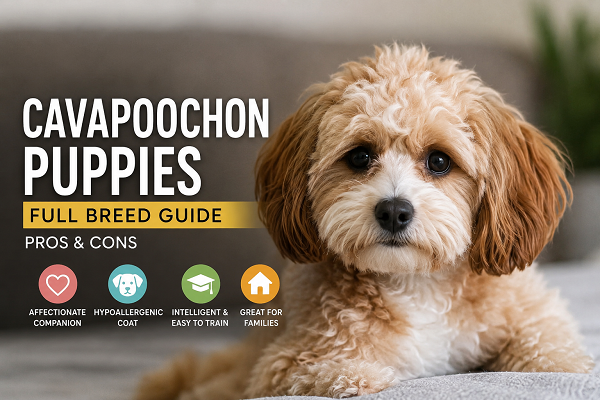
A Cavapoochon is a small, hypoallergenic triple-cross of the Cavalier King Charles Spaniel, Bichon Frise, and Toy or Miniature Poodle. They typically stand 9–14 inches tall, weigh 10–20 pounds, live 12–15 years, and are best suited to families or individuals who can offer daily companionship, regular grooming (every 4–6 weeks), and a moderate training budget. The main downsides are a high price tag ($2,000–$5,000+ from a reputable breeder), inherited heart and joint conditions from the Cavalier and Poodle lines, and a tendency toward separation anxiety if left alone too often.
Table of Contents
- Introduction
- What Exactly Is a Cavapoochon?
- Appearance, Size & Coat
- Temperament: What Living With One Is Really Like
- Pros of Owning a Cavapoochon
- Cons & Real Challenges
- Health Issues & Life Expectancy
- Grooming Needs & Costs
- Training & Exercise Requirements
- Cavapoochon Price: What You’ll Actually Pay
- Finding a Responsible Breeder (Or Rescue)
- Is a Cavapoochon Right for You?
- FAQs
- Final Thoughts
Introduction
A lot of families bring one of these dogs home based on the cute factor alone, and then get blindsided by grooming bills, a clingy streak that turns into real separation anxiety, or health costs nobody warned them about. We’ve worked with enough small companion breeds and their owners over the years to know that the “forever puppy” reputation only tells half the story.
In this guide, we’re going to walk through everything, the good, the expensive, and the stuff most “cute puppy” articles skip entirely. By the end, you’ll know whether a Cavapoochon actually fits your lifestyle, not just your Instagram feed.
What Exactly Is a Cavapoochon?
Let’s start with the basics, because “Cavapoochon” is a mouthful and most people have never heard it before they see one in person.
A Cavapoochon is a three-way cross, technically, a Cavachon (Cavalier King Charles Spaniel x Bichon Frise) bred with a Toy or Miniature Poodle. That’s where the “triple cross” nickname comes from. The idea was to combine three things: the Cavalier’s soft, affectionate nature, the Bichon’s cheerful, people-loving personality, and the Poodle’s intelligence and low-shedding coat.
This isn’t some random backyard mix that happened by accident, either. The breed’s roots trace back to Steve and Linda Rogers of Timshell Farm in Arizona, who developed the cross in the early 2000s working alongside a veterinary reproduction specialist. Their goal wasn’t just “cute puppy”, it was a deliberately planned companion dog with reduced shedding and, ideally, fewer of the inherited health problems that plague some purebred lines. The breed picked up serious momentum in 2013 after a handful of Timshell Farm puppies appeared on The Today Show, and it’s been climbing in popularity across the US, UK, and Australia ever since.
One important thing to know upfront: no major kennel club, not the AKC, not The Kennel Club in the UK, not the Australian National Kennel Council, recognizes the Cavapoochon as an official breed. It’s a designer crossbreed, which means there’s no strict breed standard, and you’ll see real variation between litters, and even between puppies in the same litter.
Appearance, Size & Coat
Cavapoochons are small dogs with a big presence. Here’s what to expect physically:
| Trait | Typical Range |
|---|---|
| Height | 9–14 inches at the shoulder |
| Weight | 10–20 lbs (some toy lines stay closer to 8–12 lbs) |
| Coat type | Soft, wavy to curly, low-shedding |
| Colors | Cream, apricot, red, white, chocolate/brown, tricolor |
| Lifespan | 12–15 years |
| Litter size | Usually 3–5 puppies |
The size mostly depends on which Poodle parent was used. A Cavapoochon bred with a Toy Poodle will run smaller and lighter than one bred with a Miniature Poodle, so if a breeder can’t tell you which Poodle size was in the cross, that’s worth asking about directly.
Their signature look, the one that made them go viral in the first place, is that “forever puppy” face. Big round eyes, floppy ears, and a soft, plush coat that keeps them looking pup-like well into adulthood. It’s genuinely one of the most distinctive things about the breed, and it’s a big reason people fall for them at first sight.
Temperament: What Living With One Is Really Like
Here’s where the Cavapoochon really earns its fan base. This is not a dog that tolerates you, it’s a dog that wants to be involved in whatever you’re doing, all day, every day.
With families and kids: Cavapoochons tend to be gentle, patient, and playful, which makes them a solid match for households with children. They rarely show aggression when they’ve been properly socialized early on. That said, their small size means young kids need to be taught how to handle them carefully, a rough tumble with a toddler can genuinely injure a 12-pound dog.
With other pets: Because the Bichon and Cavalier sides of the family tree are both naturally sociable, most Cavapoochons get along fine with other dogs and even cats, especially with early exposure.
With strangers: They lean friendly rather than watchful. If you’re picturing a dog that’ll bark at the mail carrier and stand guard, this isn’t it, a Cavapoochon is far more likely to greet a stranger like a long-lost friend than to alert you to anything.
Independence level: This is the one area where new owners get caught off guard. Cavapoochons bond hard and fast, and that devotion has a flip side, they don’t do well being left alone for long stretches. Left unaddressed, that clinginess can develop into genuine separation anxiety, with symptoms like destructive chewing, excessive barking, or house-soiling when you’re out. If you work long hours away from home and don’t have a plan for company (a dog walker, doggy daycare, or a second pet), it’s worth thinking hard before committing to this breed. We’ve put together a guide on the best anti-anxiety products for dogs that’s worth a read if your schedule means your pup will be alone sometimes.
Pros of Owning a Cavapoochon
- Hypoallergenic, low-shedding coat — a real plus for allergy sufferers, though “hypoallergenic” never means zero-allergen, so always spend time with a Cavapoochon before committing if allergies are a concern.
- Great with kids and other pets when properly socialized.
- Highly trainable — the Poodle genes bring real intelligence and eagerness to please, so basic obedience tends to click fast.
- Adaptable to apartment living — their small size and moderate exercise needs (around 30–60 minutes a day) make them a good fit for city dwellers.
- Affectionate, people-focused personality — if what you want is a devoted companion who wants to be near you constantly, this is a huge selling point, not a drawback.
- Long, youthful appearance — that “forever puppy” look genuinely doesn’t fade much with age, which a lot of owners find charming for the dog’s whole life.
- Hybrid vigor — crossing three distinct gene pools can, in some cases, reduce the concentration of inherited conditions compared to a purebred line, though this is a general tendency, not a guarantee.
Cons & Real Challenges
- High upfront cost. Reputable breeders typically charge $2,000–$5,000+ per puppy, and prices can climb higher for rare colors or toy-sized lines.
- Grooming is a real, recurring expense. Budget for professional grooming every 4–6 weeks (more on costs below).
- Separation anxiety risk. This breed was built to be a companion, and that comes with real dependency needs.
- Inherited health conditions. Both the Cavalier and Poodle sides carry known genetic risks (we cover this in detail in the next section).
- Not a great match for very active households. If you’re looking for a jogging partner or a dog that can keep up with serious hiking, a Cavapoochon’s small frame and moderate energy just aren’t built for it.
- No breed standard. Because it’s a designer cross with no kennel club recognition, puppies from the same litter can vary noticeably in size, coat texture, and temperament.
- Fragile with rough handling. Their small size means accidental injury is a real risk around toddlers or larger, boisterous dogs.
Health Issues & Life Expectancy
This is the section most “cute puppy” articles gloss over, and it’s honestly the most important one if you’re serious about bringing one of these dogs home.
Cavapoochons generally live 12 to 15 years, and crossbreeding does tend to add some genetic diversity compared to a purebred Cavalier or Poodle. But that doesn’t mean they’re immune to the conditions common in their parent breeds. Here’s what responsible owners need to watch for:
Mitral valve disease (MVD). This is the single biggest health concern tied to the Cavalier side of the family. In purebred Cavalier King Charles Spaniels, MVD affects roughly half the population by age 5 and the vast majority by age 10, it’s one of the most breed-defining heart conditions in the dog world. Cavapoochons don’t inherit the risk at that same rate, but because it’s so deeply embedded in the Cavalier line, regular cardiac check-ups (your vet listening for a heart murmur at annual visits) matter a lot here. Treatment can range from a few hundred dollars for ongoing medication management to well over $10,000 for advanced cardiac care.
Patellar luxation. A dislocating kneecap, common in small breeds generally. Watch for a skipping gait or intermittent limping. Surgical correction, when needed, typically runs $1,500–$3,000 per knee.
Progressive retinal atrophy (PRA). An inherited, degenerative eye condition from the Poodle side that can eventually lead to blindness. Reputable breeders should screen for this through eye certification testing.
Syringomyelia. A painful neurological condition, inherited from the Cavalier line, where fluid-filled cavities develop near the spinal cord. It’s less common but serious enough that it’s worth asking a breeder directly whether their Cavalier lines have been screened for it.
Hip dysplasia, ear infections, and dental disease. Fairly standard small-breed concerns. The floppy, hair-covered ears trap moisture easily, so regular ear cleaning is non-negotiable, not optional.
The bottom line: a Cavapoochon is not necessarily a “sicklier” dog than either parent breed, in some respects, the genetic mixing works in its favor. But because it inherits from two breeds with well-documented hereditary conditions, health testing on the parent dogs isn’t a nice-to-have. It’s the single biggest factor in how healthy your puppy is likely to be over its lifetime.
Grooming Needs & Costs
That soft, wavy-to-curly coat doesn’t maintain itself, and this is where a lot of new owners underestimate the real cost of ownership.
At home: Plan on brushing 3–4 times a week minimum to prevent matting, especially behind the ears and around the legs where the coat tends to tangle first. Daily brushing is even better if you can manage it.
Professional grooming: Most owners need a full groom, trim, bath, ear cleaning, nail trim, every 4 to 6 weeks. Depending on where you live, that typically runs $50–$90 per visit, which adds up to roughly $600–$1,000 a year just in grooming alone.
Ear care specifically: Because of those floppy, hair-covered ears, regular cleaning is essential to prevent moisture buildup and infection, this is one of the more overlooked parts of Cavapoochon ownership. If you want a full walkthrough of building good grooming habits early, our guide to essential dog grooming tips for a healthy puppy covers the exact routine we recommend starting from week one.
If regular grooming bills sound like more commitment than you’re up for, it’s worth being honest with yourself before you bring a puppy home, this isn’t a wash-and-go breed, and skipping grooming isn’t just a cosmetic issue. Matted, moisture-trapped coats around the ears and paws can lead to skin infections.
Training & Exercise Requirements
Good news here: Cavapoochons are genuinely one of the easier small breeds to train. That Poodle intelligence shows up early, and most puppies pick up basic commands such as sit, stay, come, house-training within the first few months with consistent, reward-based training.
A few practical tips from what we’ve seen work best with this type of companion breed:
- Start crate training immediately. Because of their attachment tendencies, a Cavapoochon that learns the crate is a safe, calm space early on handles alone-time far better as an adult. If you’re setting this up for the first time, our step-by-step crate training guide walks through the exact timeline that gets fastest results.
- Keep training sessions short and positive. Ten to fifteen minutes, treats and praise, done. Long, repetitive drills bore this breed fast.
- Exercise needs are moderate, not extreme. Aim for 30–60 minutes a day between walks and play. A game of fetch in the living room genuinely counts.
- Socialize early and often. Puppy classes between 8 and 16 weeks make a real difference in how confidently your dog handles new people, dogs, and environments as an adult.
If you want to go a level deeper on building genuine trust and communication with a new puppy, not just commands, but the relationship underneath them, our team put together an e-book on exactly that. You can grab it here: Beyond the Bark.
Cavapoochon Price: What You’ll Actually Pay
Let’s talk real numbers, because this is where a lot of families get sticker shock.
Puppy purchase price: $2,000–$5,000 from a reputable, health-testing breeder in the US. Prices in the UK often run similarly when converted, sometimes higher for toy-sized or rare-colored litters. Puppies from unscreened, high-volume breeders may be cheaper, but that lower price tag often means skipped health testing, a gamble that can cost far more down the line in vet bills.
First-year costs (food, vaccinations, spay/neuter, crate, grooming setup, initial vet visits): typically $2,000–$3,500 on top of the purchase price.
Ongoing annual costs: food, routine vet care, grooming, and pet insurance generally run $1,500–$2,500 a year for a healthy dog, more if a hereditary condition develops.
Pet insurance: Given the known hereditary risks on both sides of the Cavapoochon’s family tree, enrolling early, ideally before any symptoms appear, is one of the smartest financial moves a new owner can make. Waiting until after a diagnosis usually means the condition gets excluded as “pre-existing.”
Finding a Responsible Breeder (Or Rescue)
Because the Cavapoochon isn’t kennel-club recognized, there’s no official registry to check credentials against, which means the responsibility for vetting a breeder falls entirely on you.
Look for breeders who:
- Health-test both parent breeds, not just one side. Ask specifically about cardiac screening (for MVD), patellar evaluations, and eye certification (for PRA).
- Let you meet the parent dogs in person or over video call, and can answer direct questions about temperament and health history.
- Provide health guarantees in writing and can show documentation of genetic testing.
- Don’t have multiple litters constantly available. A breeder with puppies “always in stock” across several breeds is usually running a volume operation, not a careful one.
- Ask you questions too. A good breeder wants to know about your home, your schedule, and your experience, they’re screening you as much as you’re screening them.
If the price tag feels out of reach, rescue is absolutely worth exploring. Designer breed-specific rescues do exist, and general small-breed rescues occasionally place Cavapoochons and Cavachons that have been surrendered. It takes more patience to find one this way, but it’s a genuinely good option if you’re flexible on timing.
Is a Cavapoochon Right for You?
Ask yourself these honestly before you commit:
- Can you commit to grooming every 4–6 weeks (or learn to do it well yourself)?
- Is someone home most of the day, or can you arrange company for your dog when you’re out?
- Can you budget $2,000+ upfront and $1,500–$2,500 a year ongoing, with a cushion for unexpected vet care?
- Are you looking for a companion dog rather than a guard dog, jogging partner, or hands-off pet?
- Do you have young kids who’ve been taught gentle handling around small animals?
If you answered yes to most of these, a Cavapoochon could be a genuinely wonderful fit. If several of these give you pause, it might be worth considering a lower-maintenance breed instead, we’ve rounded up 10 of the best low-maintenance dog breeds for busy owners if that sounds more like your situation.
FAQs
1. Are Cavapoochons good for first-time dog owners?
Yes, generally. Their high trainability, moderate exercise needs, and affectionate nature make them one of the more forgiving small breeds for someone new to dog ownership, as long as you’re prepared for the grooming and companionship commitment.
2. Do Cavapoochons shed?
Very little. Their coat is considered low-to-non-shedding and hypoallergenic, which is one of the main reasons the breed became so popular. Still, spend time with the dog first if you have serious allergies, since no dog is 100% allergen-free.
3. How big do Cavapoochons get?
Most adults reach 9–14 inches tall and weigh between 10 and 20 pounds, though the exact size depends heavily on whether a Toy or Miniature Poodle was used in the cross.
4. How much does a Cavapoochon cost?
Expect $2,000–$5,000 from a reputable, health-tested breeder, plus roughly $2,000–$3,500 in first-year costs and $1,500–$2,500 a year after that for food, grooming, and routine vet care.
5. Do Cavapoochons have separation anxiety?
They can, more than many other breeds. Cavapoochons bond closely with their people and don’t do well left alone for extended periods without preparation. Early crate training and gradual alone-time conditioning go a long way toward preventing anxiety-driven behavior later on.
Final Thoughts
A Cavapoochon isn’t just a cute face, it’s a genuine, long-term companion that asks for real commitment in return for the affection it gives you. If you can handle the grooming schedule, budget for the ongoing costs, and give this dog the company it craves, you’ll likely end up with one of the most devoted, trainable, and family-friendly small dogs out there.
Where people run into trouble is skipping the homework, buying from a breeder who doesn’t health-test, underestimating the grooming bill, or leaving a pup alone for eight-hour workdays without a plan. Do the research on the breeder, budget honestly for the full first year (not just the purchase price), and start training and socialization from day one, and a Cavapoochon can genuinely be that “forever puppy” companion families fall in love with, teddy-bear face and all.

Her work centres on obedience, detection, protection and operational readiness. She favours proven methods built on repetition, consistency and real-world conditioning, so that both dogs and handlers are prepared for high-pressure tasks.
Rofiat represented the Nigerian Army Dog Centre at the Nigerian Army Day Celebration (NADCEL) 2026, where she led demonstrations in obedience, explosive detection, agility and tactical movement. Through articles, training content and documentaries, she shares field-based insight into how structured training, clear communication and trust between handler and dog affect performance and reliability.
She is the author of Beyond the Bark: Inside a Pro Handler's Playbook for Raising the Ideal Dog, a practical guide that helps dog owners and handlers apply professional training principles in everyday situations.
- Is K9 Advantix Safe for Dogs? A Handler’s Honest Review - October 2, 2026
- Australian Cattle Dog vs Blue Heeler: Any Difference? - October 1, 2026
- Bousnic Dog Training Collar Review: Is It Safe? - September 30, 2026