Essential Guide to Covering Your Puppy Crate for Comfort
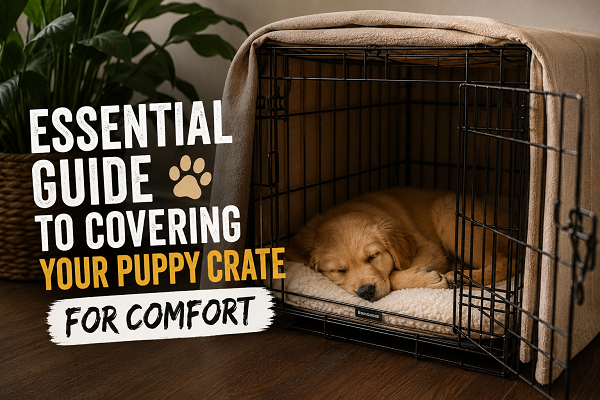
Yes, covering your puppy’s crate is generally safe and can genuinely help your pup settle faster, as long as you use a breathable fabric, leave at least one side uncovered for airflow, and never let the cover trap heat or become something your puppy can chew and swallow. A well-covered crate mimics a den, blocks distracting visual stimulation, and helps anxious or overstimulated puppies fall asleep faster and stay calmer during the day.
Table of Contents
- Why Puppies Respond So Well to a Covered Crate
- Is It Actually Safe to Cover a Puppy Crate?
- The Real Benefits of a Crate Cover
- Choosing the Right Crate Cover Material
- How Much of the Crate Should You Cover?
- DIY Crate Cover vs. Store-Bought: Which Is Better?
- Step-by-Step: Introducing a Covered Crate to Your Puppy
- Breed, Climate, and Season Considerations
- Common Mistakes That Undo All the Comfort
- FAQs
- Final Thoughts
Introduction
If you’ve just brought a puppy home, you’ve probably already had one of those nights. The whining starts around 11 p.m., the crate rattles as your pup paces in circles, and by 2 a.m. you’re standing in the dark wondering if you did something wrong. Here’s the thing, you probably didn’t. Your puppy just hasn’t figured out yet that the crate is safe.
One of the simplest, most overlooked fixes for this is something a lot of new owners never even consider: covering the crate. It sounds almost too basic to matter, but ask any experienced trainer or breeder and they’ll tell you the same thing, a properly covered crate can be the difference between a puppy who settles in ten minutes and one who cries for an hour.
The problem is most of what’s written about crate covers online is either a product ad in disguise or vague “just throw a blanket over it” advice that skips the actual safety details. So in this guide, I’m going to walk you through exactly why covering works, how to do it without risking your puppy’s safety, what materials actually breathe versus which ones just look like they do, and how to adjust your approach based on your dog’s breed and your local climate.
You’ll leave this article knowing exactly how to turn a bare wire crate into a den your puppy actually wants to be in, not because you forced them, but because it finally feels like somewhere they can relax.
Why Puppies Respond So Well to a Covered Crate
Ever wonder why your puppy seems to calm down the second you throw a towel over part of the crate? It’s not a coincidence, and it’s not just about darkness either.
Domestic dogs descend from den animals. Wolves and wild canids raise their pups in enclosed burrows, tight, dim spaces with only one entrance, surrounded on all sides. That instinct hasn’t disappeared just because your puppy sleeps on a dog bed instead of underground. An open wire crate sitting in the middle of a busy living room is, from your puppy’s point of view, the opposite of a den. It’s exposed on every side. Every person walking past, every car headlight through the window, every sound from another room becomes a reason to get up, bark, or pace.
Covering three or four sides of the crate closes off that visual noise. Suddenly your puppy isn’t tracking every movement in the house, they’re in a quiet, semi-enclosed space that feels more like the burrow their instincts are wired for. If you’ve ever worked with a nervous rescue dog or a high-drive breed like a Belgian Malinois or Border Collie, you already know how much visual stimulation affects behavior. Covering the crate is basically environmental management, the same principle handlers use to keep working dogs focused, just applied to a puppy who needs to sleep.
This is also why crate covers pair so well with structured crate training rather than replacing it. If your puppy hasn’t learned to associate the crate with safety yet, a cover alone won’t fix chronic anxiety, it’s a comfort tool, not a training shortcut. For the full step-by-step process of building that trust from day one, our detailed walkthrough on how to crate train a puppy breaks down the exact timeline professional K9 trainers use.
Is It Actually Safe to Cover a Puppy Crate?
Yes, with conditions. This is where a lot of well-meaning advice online gets dangerously vague, so let’s be precise about it.
Veterinary behaviorists and organizations like the Humane Society generally support crate covers as a comfort tool, but they come with real, non-negotiable safety rules:
- Never cover all four sides completely. At least one side, usually the front or a mesh panel, needs to stay open for airflow. A fully sealed crate traps exhaled air, raises humidity from panting, and can push internal temperature up several degrees within an hour.
- Keep the cover away from heaters, radiators, and direct sunlight. Fabric plus a heat source is a fire and overheating risk you don’t need.
- Watch for chewing. Puppies in the teething phase (roughly 3 to 6 months) will absolutely try to pull fabric through the bars. Ingested fabric can cause an intestinal blockage, which is a genuine emergency vet visit, not a minor inconvenience.
- Monitor temperature, especially in summer. A crate cover can raise the internal temperature by several degrees compared to an uncovered crate. Brachycephalic (flat-faced) breeds like Bulldogs, Pugs, and Boxers are especially vulnerable to heat buildup because they can’t pant as efficiently to cool themselves.
- Secure the cover so it can’t collapse into the crate if your puppy jumps or headbutts the bars.
If you follow those five rules, a crate cover is one of the lowest-risk, highest-reward tools in your puppy comfort kit. The mistake isn’t covering the crate, it’s covering it carelessly.
The Real Benefits of a Crate Cover
I’ve worked with enough anxious and overstimulated puppies to say this with confidence: a cover genuinely changes behavior, and not just anecdotally.
- Faster settling at night. Puppies fall asleep quicker when visual stimulation is reduced. Less to react to means less to bark or whine about.
- Reduced reactivity to household movement. If you’ve got kids, other pets, or a busy household, a covered crate stops your puppy from treating every footstep as an event worth announcing.
- A stronger sense of “this is my space.” Dogs that view the crate as private territory (rather than a fishbowl in the corner of the room) tend to self-settle there voluntarily, even with the door open.
- Noise dampening. A quilted or double-layer cover takes the edge off loud noises like thunderstorms, fireworks, or vacuum cleaners, genuinely helpful for noise-sensitive breeds.
- Travel consistency. If your puppy learns their covered crate at home, that same cover in a hotel room, car, or at a family member’s house gives them an instantly recognizable “safe zone” in an unfamiliar environment.
If your puppy already shows signs of separation anxiety, panting, drooling, or destructive chewing when left alone, a cover is a good supporting tool but shouldn’t be your only intervention. It’s worth reading our roundup of vet-backed anti-anxiety products for dogs to see what pairs well alongside a covered crate for more severe cases.
Choosing the Right Crate Cover Material
This is where most people go wrong, and it’s the single biggest factor in whether a cover helps or harms.
Here’s the simple rule: if a material doesn’t let air pass through it easily, it doesn’t belong on a crate. A lot of cheap covers sold online are polyester coated in a thin layer of PVC or vinyl to make them “wipeable” and that coating is exactly what turns a crate into a greenhouse.
Good material choices:
- 100% cotton or cotton-canvas — breathes well, holds its shape, and is machine washable. This is generally considered the gold standard for year-round use.
- Cotton-linen blends — slightly more breathable than pure cotton, good for warmer climates.
- Lightweight fleece — cozy for colder regions, but avoid using it as the sole material in warm weather since it insulates heat as well as it insulates cold.
- Mesh panel inserts — many purpose-built crate covers include a mesh window on one or two sides specifically for ventilation. Look for this feature if you’re buying rather than DIY-ing.
Materials to avoid:
- Coated or laminated polyester (“wipeable” fabric)
- Vinyl or PVC-backed covers
- Thick quilted blankets used as the only layer in hot weather
- Anything with loose threads, fringe, or knit construction your puppy could snag a claw or tooth in
One detail almost nobody mentions: fabric weight actually affects airflow more than most people assume. A too-lightweight, clingy sheet drapes directly against the crate bars and seals the gap air needs to move through. A slightly heavier canvas actually holds its shape away from the bars, preserving that air gap, so heavier isn’t automatically worse, as long as the weave itself is breathable.
If your puppy has a heavy double coat, Huskies, Malamutes, German Shepherds, they naturally run warmer inside a crate and need extra attention to ventilation regardless of season. Breeds with lower grooming and heat-management needs are covered in our guide to low-maintenance dog breeds, which also touches on coat type and how it affects a dog’s tolerance for enclosed, covered spaces.
How Much of the Crate Should You Cover?
There’s no single right answer here, it depends on your puppy’s temperament and the crate’s location but a solid starting rule most trainers use:
- Cover the top and two or three sides. Leave the front (or the side facing the most open air in the room) uncovered.
- If your crate has a solid plastic top (like an airline-style crate), you need even more attention to side ventilation since heat can’t escape upward as easily.
- For wire crates, covering three sides plus part of the top usually strikes the right balance between “den-like” and “well ventilated.”
Some owners prefer a partial cover that only drapes over the top and back, leaving both the front and one side fully open. This works well for puppies who aren’t anxious but just get startled by overhead light or ceiling fan noise.
Quick test: put your hand inside the covered crate after 20–30 minutes and feel for stuffiness or heat buildup compared to the room. If it feels noticeably warmer or stale inside, open up more ventilation.
DIY Crate Cover vs. Store-Bought: Which Is Better?
Both work fine, the decision usually comes down to budget, your puppy’s chewing habits, and how much customization you want.
DIY (a spare sheet, lightweight blanket, or breathable throw):
- Pros: Free or cheap, easy to wash, easy to swap out seasonally
- Cons: Doesn’t fit snugly, can shift or sag into the crate, harder to keep away from chew-prone puppies
Store-bought fitted crate covers:
- Pros: Sized to your exact crate model, usually include mesh ventilation panels, roll-up sides for adjustable coverage, and tie-downs to stop chewing access
- Cons: Costs more (typically in the $25–$60 range depending on crate size and brand)
My honest recommendation for teething puppies specifically: spend the money on a fitted cover with secured ties. A loose DIY blanket is exactly the kind of thing a bored six-month-old puppy will pull through the bars and shred within a week and fabric scraps are a real choking and blockage hazard.
Step-by-Step: Introducing a Covered Crate to Your Puppy
- Start with the crate uncovered during the first few days so your puppy gets used to the crate itself before adding new visual changes.
- Add the cover gradually. Cover just the top first for a day or two, then add the back panel, then the sides, watch for any signs of stress like scratching at the fabric or increased whining.
- Feed meals near or inside the partially covered crate to build a positive association during the transition.
- Introduce the fully covered setup during a calm period of the day, not right after a stressful event or a walk full of exciting new smells.
- Watch body language for the first few sessions. A puppy that settles down, sighs, or curls up is responding well. A puppy that paces, scratches at the fabric, or barks more than usual may need less coverage or a slower introduction.
- Keep the routine consistent. Cover the crate the same way every night so your puppy learns to predict what “bedtime” looks like.
Most puppies adjust to a covered crate within 3 to 7 days of consistent use. If yours is still highly resistant after two full weeks, it’s worth stepping back and revisiting foundational crate comfort before layering a cover into the mix.
Breed, Climate, and Season Considerations
Not every puppy needs the same covering approach, and this is where a lot of generic advice falls apart.
Brachycephalic breeds (Bulldogs, Pugs, French Bulldogs, Boston Terriers, Boxers) run a real risk of overheating in a covered crate because they can’t pant as efficiently as longer-nosed breeds. For these breeds, prioritize maximum ventilation over full den-style coverage, a partial cover with a large mesh opening is safer than a snug all-around fit.
Thick-coated northern breeds (Huskies, Malamutes, Akitas) generate more body heat and benefit from lighter, more breathable fabric year-round, especially in summer.
Working and high-drive breeds (Malinois, German Shepherds, Dutch Shepherds) often respond dramatically well to full coverage because it reduces the environmental stimulation that keeps them alert and reactive. These are dogs bred to notice everything, a den-style covered crate genuinely helps them switch off.
Hot climate owners (Southern US, Middle East, tropical regions, and yes, here in West Africa too) should lean toward lightweight cotton, partial coverage, and a fan or air conditioning nearby rather than heavier fabric, regardless of breed. If overheating is a recurring concern for your dog even outside the crate, our dog cooling vest guide covers additional heat-management tools that pair well with a properly ventilated crate setup.
Cold climate owners can use a heavier cotton-flannel blend or add a second breathable layer during winter nights, as long as airflow is preserved on at least one side.
Common Mistakes That Undo All the Comfort
- Using the cover as a punishment tool. Covering the crate to “make the puppy stop barking” during a tantrum teaches the wrong association. The cover should be part of a calm, predictable routine, not a reaction to bad behavior.
- Choosing coated or vinyl fabric because it’s easier to wipe clean. Convenience isn’t worth the overheating risk.
- Forgetting to check the crate on hot days, even if it’s covered correctly. Temperature swings happen fast, especially in direct sun or a poorly ventilated room.
- Leaving loose, untied fabric within chewing range. Secure every cover with ties or clips your puppy can’t reach from inside.
- Covering the crate 100% on all sides, even briefly. This is the single most common and most dangerous mistake, it takes surprisingly little time for oxygen levels and heat to build up in a fully sealed crate.
- Assuming one cover setup works forever. As your puppy grows out of the teething phase and settles into adult temperament, you may be able to loosen up coverage or switch fabrics seasonally.
FAQs
1. Should I cover my puppy’s crate every night?
Yes, for most puppies, consistent nightly covering (with proper ventilation) helps build a predictable sleep routine. Some owners scale back once the puppy is fully crate trained and calm without it, but plenty of adult dogs still prefer a covered crate for life.
2. Can covering a crate make separation anxiety worse?
For most puppies, no, reduced visual stimulation generally lowers anxiety. However, a small number of dogs feel more trapped or claustrophobic with full coverage. Watch your puppy’s reaction during the first few sessions and back off coverage if they seem more distressed, not less.
3. What’s the best fabric for a puppy crate cover in hot weather?
Lightweight, breathable 100% cotton or a cotton-linen blend is the safest choice for warm climates. Avoid anything coated, laminated, or vinyl-backed, since these trap heat and humidity.
4. Is it safe to cover a crate during the day when I’m at work?
Yes, as long as the room isn’t overheating (direct sun through a window can raise crate temperature significantly over several hours) and at least one side stays open for airflow. Check the room temperature before you leave for extended periods.
5. At what age can I start using a crate cover?
You can introduce a crate cover as soon as your puppy starts crate training, typically 8 weeks and older. Just supervise closely during the teething phase (around 3–6 months) since chewing risk is highest during this window.
Final Thoughts
Covering your puppy’s crate isn’t a gimmick, it’s one of the simplest, most research-backed ways to turn an ordinary wire cage into something that actually feels like a den. The formula is straightforward: breathable material, partial coverage that always leaves airflow open, a secure fit your puppy can’t chew through, and a bit of patience while they adjust.
Get those basics right, and you’ll likely notice the difference within the first week, fewer nighttime cries, faster settling, and a puppy who starts walking into that crate on their own instead of needing to be coaxed.
If you’re still working through the fundamentals of crate training itself, timing, sizing, potty breaks, and building trust from scratch, our team put together a full practical breakdown of the exact methods professional handlers use in our training e-book, covering everything from the first week home through advanced obedience work.
Insights from the ARFS K9 Team: real-world crate training and comfort tips drawn from years of hands-on work with working dogs, family pets, and everything in between.

Her work centres on obedience, detection, protection and operational readiness. She favours proven methods built on repetition, consistency and real-world conditioning, so that both dogs and handlers are prepared for high-pressure tasks.
Rofiat represented the Nigerian Army Dog Centre at the Nigerian Army Day Celebration (NADCEL) 2026, where she led demonstrations in obedience, explosive detection, agility and tactical movement. Through articles, training content and documentaries, she shares field-based insight into how structured training, clear communication and trust between handler and dog affect performance and reliability.
She is the author of Beyond the Bark: Inside a Pro Handler's Playbook for Raising the Ideal Dog, a practical guide that helps dog owners and handlers apply professional training principles in everyday situations.
- Australian Cattle Dog vs Blue Heeler: Any Difference? - October 1, 2026
- Bousnic Dog Training Collar Review: Is It Safe? - September 30, 2026
- Gravy Train Dog Food Review: Ingredients & Recalls - September 30, 2026