Therapy Dog Training Costs & Steps: 2026 Guide
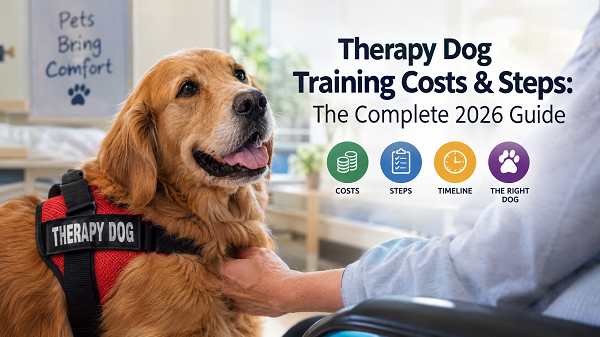
Training and certifying a therapy dog typically costs between $200 and $5,000 total, depending on whether you train the dog yourself or hire a professional. Most handlers land somewhere around $400–$800 when they combine a group obedience class, a Canine Good Citizen test, and registration with a nonprofit like Pet Partners or the Alliance of Therapy Dogs. The full process, from a wiggly puppy to an active visiting team, usually takes 6 to 18 months.
This guide breaks down every dollar you’ll realistically spend, every step you’ll go through, and a few things the other “how much does it cost” articles floating around Google either skip entirely or get flat-out wrong (looking at you, articles that quote $30-per-session pricing that hasn’t been accurate in years).
Table of Contents
- What Is a Therapy Dog? (And What It Isn’t)
- How Much Does Therapy Dog Training Cost?
- Registration Costs by Organization (US, UK & Canada)
- The 7 Steps to Training and Certifying a Therapy Dog
- How Long Does It Actually Take?
- Does Your Dog Have What It Takes?
- DIY vs. Group Class vs. Private Trainer vs. Board-and-Train
- Three Real Budget Scenarios
- Is Therapy Dog Training Tax-Deductible?
- A Trainer’s Honest Take: Where People Waste Money
- Frequently Asked Questions
- Final Thoughts
What Is a Therapy Dog? (And What It Isn’t)
Here’s where almost every article on this topic trips up: it lumps therapy dogs, service dogs, and emotional support animals into one confused mess. They are three completely different things with three completely different training paths and price tags, so let’s clear it up before we talk numbers.
A therapy dog visits other people, patients in hospitals, students during exam week, residents in a nursing home, survivors at a disaster site, to offer comfort. The dog isn’t working for its own owner’s disability. It’s a volunteer role, plain and simple, and that’s exactly why it needs a temperament evaluation and liability insurance through a registered organization.
| Therapy Dog | Service Dog | Emotional Support Animal (ESA) | |
|---|---|---|---|
| Who benefits | Other people (patients, students, residents) | The handler, who has a disability | The owner’s emotional wellbeing |
| Training required | Obedience + temperament evaluation | Extensive task-specific training | None legally required |
| Public access rights | Facility invitation only | Full ADA access almost everywhere | Housing protections only (no public access) |
| Legal certification | Registration with a therapy org | No official government certification exists | ESA letter from a licensed therapist |
| Typical cost | $200–$5,000 | $15,000–$50,000+ (program-trained) or $500–$3,000+ (self-trained) | $0–$200 (letter fee) |
If your dog needs a job that helps you personally manage a diagnosed condition, you’re actually looking at service dog or ESA territory, and the cost and legal landscape are very different, worth reading up on separately before you commit.
How Much Does Therapy Dog Training Cost?
Direct answer: Most handlers spend $200 to $800 total using the nonprofit-registry route (group class + CGC test + registration), while handlers who use private lessons or a board-and-train program typically spend $1,500 to $5,000. There is no single “correct” price because it depends entirely on how much your dog already knows and how much hands-on help you want along the way.
Here’s the full cost breakdown, gathered from real 2026 pricing across US trainers and the major registries:
| Cost Item | Typical Range | Notes |
|---|---|---|
| Group obedience class (6–8 weeks) | $150 – $500 | Best value if your dog just needs polish |
| Private training sessions | $75 – $200 per session | For dogs with specific gaps or nerves to work through |
| Board-and-train program (1–4 weeks) | $1,500 – $4,500 | Fastest option, but the dog learns without you present |
| Canine Good Citizen (CGC) test | $10 – $20 | Prerequisite for most (not all) therapy registries |
| Therapy team evaluation/testing fee | $20 – $90 | Charged by the registry or its local evaluator |
| First-year registration/membership | $25 – $115 | Varies heavily by organization (see table below) |
| Annual renewal | $25 – $400 | Some orgs let you swap volunteer hours for the fee |
| Vet health screening/exam | $0 – $75 | Often just your annual wellness visit paperwork |
Add it up on the low end (group class + CGC + a budget registry) and you’re at roughly $200–$300. Add it up on the high end (board-and-train + a full-service program like a regional therapy-dog school) and you’re comfortably past $3,000, sometimes $5,000, before you’ve done a single visit.
One thing worth flagging: several older articles still circulating online quote therapy dog training at “$30 per session,” a figure that’s more than a decade out of date. At 2026 rates, that number simply doesn’t hold up anywhere in the US, UK, or Canada.
Registration Costs by Organization (US, UK & Canada)
This is the part most cost guides gloss over, and it’s the part that actually determines your final bill. Registering with the wrong organization for your goals means paying twice.
United States
| Organization | First-Year Cost | What’s Required | Recognition |
|---|---|---|---|
| Pet Partners | ~$95 | Online/in-person handler course, vet health screening, in-person team evaluation | Widely considered the gold standard; strongest facility recognition nationwide |
| Alliance of Therapy Dogs (ATD) | ~$35–$55 | Three supervised visits with an existing member team, plus an evaluation | Strong in the Midwest and South; simpler entry process |
| Therapy Dogs International (TDI) | ~$40–$50 | CGC certificate, then the TDI hands-on temperament/obedience test | One of the oldest registries (founded 1976); requires an annual vet check |
| Love on a Leash | ~$25–$100 | Evaluation plus a screening interview | Smaller, regional chapter model |
A few regional “full-service” schools bundle actual training with the certification, rather than just testing a dog you’ve already trained elsewhere. For comparison, one well-known regional program structures it as a one-time $745 training package, a $90 evaluation renewed every three years, and a $400 annual membership (waivable with 20 volunteer hours a year), a useful benchmark if you’re weighing “train it myself and register separately” against “pay one organization to do both.”
United Kingdom
Pets As Therapy (PAT) is the UK’s largest therapy animal charity, and it runs on a strikingly simple fee structure: £25 a year for an individual membership, or £35 for a joint one. Your dog needs to be at least 9 months old and have lived with you for a minimum of 6 months before applying. A local, PAT-accredited temperament assessor evaluates the dog in a neutral setting for things like accepting handling, ignoring dropped food, and walking calmly on a loose lead. Therapy Dogs Nationwide is the other major UK registry, running a nearly identical £19–£29 annual fee structure.
Canada
St John Ambulance runs Canada’s national therapy dog program, with a similar model: an application, a temperament evaluation, and an annual membership fee that’s considerably lower than most US private-trainer routes.
The 7 Steps to Training and Certifying a Therapy Dog
Every reputable path, US, UK, or Canada, follows roughly the same seven-step arc. Organizations phrase it differently, but the bones are identical.
Step 1: Honestly Evaluate Temperament First
Before you spend a dollar on classes, watch how your dog handles the world. Does it stay loose and relaxed around wheelchairs, walkers, and crutches? Can it sit through a loud, unexpected noise without bolting? Does it enjoy being touched by strangers, including having its paws, ears, and tail handled? These aren’t trainable behaviors in the way “sit” is trainable, they’re baseline temperament traits, and no amount of paid training reliably installs comfort where there’s real fear or reactivity. This is the single biggest reason dogs get turned away at evaluation, and it’s a step people skip because they’re excited, not because they don’t know better.
Step 2: Nail Basic Obedience
Sit, stay, down, come, leave it, and loose-leash walking need to be second nature, not something you’re bribing your dog through with treats held at nose height. Most organizations don’t formally require a specific obedience class, but in practice, a dog that hasn’t mastered these fundamentals will not pass a therapy evaluation. This is where group classes ($150–$500) earn their keep, since they also expose your dog to distraction and other dogs, which the evaluation will test directly.
This is also the stage where understanding the difference between trained obedience and instinctive behavior matters, a dog that “sits” out of habit in a quiet living room can fall apart the first time it meets a real hospital hallway. We cover that gap in detail in our piece on obedience versus instinct, and it’s worth a read before you book any evaluation.
Step 3: Pass the Canine Good Citizen (CGC) Test
Not every registry requires this, but TDI and several others do, and it’s cheap ($10–$20) and worth doing regardless, it’s essentially the entry-level proof that your dog can behave in public. AKC-approved evaluators run these tests nationwide, and you can usually find one within a short drive.
Step 4: Choose Your Organization
This is the decision that shapes your whole budget and where you’ll be allowed to volunteer. Pet Partners has the broadest facility recognition if you want flexibility in where you visit. ATD is popular for handlers who’d rather shadow an existing team through supervised visits than sit through a formal course. TDI leans on its long-standing hands-on test. Pick based on which facilities you actually want to visit, call ahead and ask which registries they accept, because not every hospital or school recognizes every organization.
Step 5: Complete Handler Training
This is the part first-timers underestimate. You’re not just training a dog, you’re being trained. Pet Partners’ handler course (roughly 4–6 hours online) covers reading your dog’s stress signals in real time, infection control basics for clinical settings, safe interactions with patients who have limited mobility, and knowing when to end a visit early. A dog with perfect obedience and a handler who misses early stress signals is a bad combination in a hospital room.
Step 6: Pass the Team Evaluation
This is the real test, and it’s evaluated as a team, not just the dog. Expect scenarios like sudden loud noises, unfamiliar equipment (wheelchairs, walkers, oxygen tanks), being approached and hugged by strangers, food dropped on the floor and ignored, and recovery from a startled reaction. Evaluators aren’t looking for a robot, they’re looking for a dog that startles, recovers, and moves on, and a handler who reads the moment correctly. Fees for this step run $20–$90 depending on the registry.
Step 7: Register, Get Insured, and Start Visiting
Once you pass, you’ll pay the registration fee, receive your ID badge and vest, and critically, be covered under the organization’s liability insurance for your visits. This is the step people forget matters: a dog wearing a $15 “therapy dog” vest bought online with no registry behind it has zero liability coverage and zero facility recognition. Registration isn’t paperwork for its own sake; it’s what actually gets you through the hospital door and protects you if something goes wrong.
How Long Does It Actually Take?
For a dog that already has solid obedience, budget 3 to 6 months from “let’s do this” to your first supervised visit, most of that time is scheduling classes, waiting for evaluation dates, and processing registration paperwork, not actual training time.
For a dog starting from puppyhood, the realistic timeline stretches to 12 to 18 months, simply because:
- Most US registries require the dog to be at least 1 year old (PAT in the UK allows 9 months)
- Nearly every organization requires the dog to have lived with you for a minimum of 6 months
- Basic obedience needs to be genuinely reliable, not just “usually works,” which takes most dogs several months of consistent practice
Handlers who try to rush this timeline are exactly the ones who show up to evaluation day with a dog that isn’t ready and then pay for a second attempt.
Does Your Dog Have What It Takes?
Basic Eligibility Checklist
- At least 1 year old (9 months for UK’s PAT program)
- Lived with you for a minimum of 6 months
- Up to date on core vaccinations (rabies, DHPP) and a clean recent fecal/heartworm test
- Spayed or neutered (recommended, and required by most, not all, registries)
- Comfortable being handled by strangers, including paws, ears, and tail
- Calm around medical equipment, wheelchairs, and sudden noise
- No history of resource guarding, fear-based reactivity, or aggression
Here’s something a lot of guides get wrong: there are no official breed restrictions with any major therapy registry. That said, temperament varies by breed on average, which is why certain breeds show up disproportionately in therapy programs.
Breeds That Excel at Therapy Work (And Why)
Labrador and Golden Retrievers dominate therapy rosters worldwide, and it’s not just popularity, their breed history as steady, biddable gundogs bred to work calmly alongside people translates directly to hospital and classroom settings. German Shepherds, despite their reputation as protection and police dogs, are common therapy dogs too, precisely because a well-bred, well-socialized Shepherd is enormously stable and handler-focused. Cavalier King Charles Spaniels, Poodles, and even small breeds like Cavaliers and Yorkshire Terriers do meaningful work in settings where a lap-sized dog is easier to manage around hospital beds.
Worth knowing: the very first documented therapy dog wasn’t a big, calm retriever at all. Smoky, a four-pound Yorkshire Terrier found in a foxhole in New Guinea during World War II, spent years visiting wounded soldiers in hospital wards, boosting morale at a time when the concept of “animal-assisted therapy” didn’t even have a name yet. Temperament, not size or breed stereotype, is still the deciding factor eight decades later.
DIY vs. Group Class vs. Private Trainer vs. Board-and-Train
Nobody else covers this comparison properly, and it’s the question that actually determines your budget, so here’s the honest breakdown:
DIY training (you, a leash, and consistency): Works well if your dog already has a naturally easy temperament and you have real training knowledge or patience for research. Cost: near $0 beyond testing and registration fees. Risk: without outside eyes on your dog, it’s easy to miss small gaps that show up on evaluation day.
Group classes: The best value-for-money option for most handlers. You get structured instruction and built-in distraction training (other dogs, new environments) that a private session at home can’t replicate. Cost: $150–$500 for a 6–8 week course.
Private lessons: Worth the premium ($75–$200/session) if your dog has a specific issue, leash reactivity, nervousness around men, noise sensitivity, that needs focused, one-on-one correction before it’s ready for a group setting or evaluation.
Board-and-train: The fastest path, and the most expensive ($1,500–$4,500 for 1–4 weeks), but it comes with a real trade-off: the dog is learning to behave for a professional trainer in the trainer’s environment, not for you in yours. You’ll still need transfer sessions afterward to make sure the training holds when you’re the one holding the leash. Skip this route unless your dog needs intensive behavioral work a group class won’t fix, or your schedule genuinely doesn’t allow for weekly classes.
Three Real Budget Scenarios
The Budget Path — ~$75–$150 total Dog already has solid house-manners obedience. Owner self-studies using free resources and a public park for distraction practice, takes the $10–$20 CGC test, registers with a lower-cost registry like ATD or Love on a Leash ($25–$55). No professional trainer involved.
The Balanced Path — ~$400–$650 total An 8-week group obedience class ($250–$400), the CGC test ($15), and Pet Partners registration including the handler course ($95). This is the most common route for first-time handlers who want structure but don’t need intensive one-on-one help.
The Premium Path — ~$2,500–$5,000 total A private lesson package for a dog that needs focused confidence-building around strangers or noise ($1,300–$2,000), plus a full-service regional therapy-dog program that bundles training and certification (roughly $745–$1,200), plus annual membership ($400). This path suits dogs with a rockier starting point or handlers who want a guided hand through every step.
Is Therapy Dog Training Tax-Deductible?
Short answer: usually not as a medical expense, but there’s a nuance worth knowing that most articles skip entirely. Service dog costs can qualify as a deductible medical expense under IRS rules because the dog performs tasks for the handler’s disability. Therapy dogs don’t fit that category, since the dog benefits other people, not the handler.
However, if you’re volunteering through a registered 501(c)(3) nonprofit (many therapy dog organizations qualify), unreimbursed out-of-pocket expenses directly tied to that volunteer work, think mileage to and from visits, or supplies purchased specifically for visiting duties, can sometimes be claimed as a charitable deduction, separate from your dog’s training costs. This isn’t tax advice, and rules shift, so talk to an accountant about your specific situation before filing anything based on this.
A Trainer’s Honest Take: Where People Waste Money
After years working hands-on with working and companion dogs, including guiding military working dogs through public demonstrations and obedience work, the pattern I see most with therapy dog hopefuls isn’t undertraining. It’s misdirected spending. Handlers buy a $4,000 board-and-train package for a dog whose real problem is that it’s simply too young, too unsocialized, or genuinely not suited temperamentally for the work, no program fixes that, because it isn’t a training gap, it’s a fit problem.
The smarter spend, every time, is putting money into an honest temperament assessment before committing to a training package. A single session with an experienced trainer who will tell you truthfully “this dog isn’t a fit for therapy work, but here’s what would suit them instead” saves you the $2,000 you’d have spent finding that out the hard way at evaluation.
If you’re unsure whether your dog’s quirks are trainable gaps or genuine temperament limits, our guide on choosing the right behavior therapist for your dog walks through exactly how to tell the difference and who to call.
It’s also worth understanding how therapy work compares to other working-dog paths your dog might genuinely be better suited for, search and rescue, for instance, draws on a very different drive and temperament profile, and some dogs that wash out of therapy programs thrive there instead.
For handlers who want a structured, step-by-step foundation before attempting any certification path, our e-book Beyond the Bark: Inside a Pro Handler’s Playbook for Raising the Ideal Dog walks through the exact obedience and temperament groundwork professional trainers use before a dog ever sees an evaluator.
Frequently Asked Questions
How much does it cost to train and certify a therapy dog?
Most handlers spend $200 to $800 using group classes and a nonprofit registry, while private lessons or board-and-train programs push the total to $1,500–$5,000. The exact number depends on your dog’s starting point and how much hands-on help you choose.
How long does therapy dog training take from start to finish?
For a dog with existing obedience skills, 3 to 6 months from start to first certified visit. For a young dog starting from scratch, plan on 12 to 18 months, mostly due to minimum age requirements (9–12 months) and the 6-month “lived with you” rule most registries enforce.
Can any breed become a therapy dog?
Yes, no major registry restricts by breed. Temperament, not pedigree, determines readiness. That said, breeds bred for biddability and people-focus, like retrievers, tend to pass evaluations at higher rates simply because their instincts already align with the job.
What’s the real difference between a therapy dog, a service dog, and an emotional support animal?
A therapy dog comforts other people and needs registry certification plus liability insurance. A service dog performs specific tasks for its own handler’s disability and has full legal public access rights under the ADA. An ESA supports its owner’s emotional wellbeing, requires no training, and only carries housing protections, no public access rights at all.
Is therapy dog certification legally required to visit facilities?
There’s no government-mandated certification, but in practice, almost every hospital, school, and care facility will only allow dogs registered with a recognized organization, because that registration is what provides the liability insurance covering the visit. Showing up with an uncertified dog and a vest bought online typically won’t get you past the front desk.
Final Thoughts
Therapy dog training doesn’t have to be a $5,000 commitment, and it doesn’t have to be a $75 shortcut either, it has to match the dog you actually have. Start with an honest temperament read, invest in the training your specific dog needs (not the most expensive package on offer), and pick a registry based on where you actually want to volunteer, not just the cheapest sign-up fee.
If your dog has the right temperament, the process from here is straightforward: obedience, evaluation, registration, and you’re visiting within a matter of months. If you’re still weighing whether therapy work is the right path for your dog at all, that’s worth figuring out before you spend a dollar on training.
Want more real-world, no-fluff K9 training breakdowns like this one delivered weekly? Subscribe to our newsletter for hands-on tips from working handlers, no filler, just what actually works.

Her work centres on obedience, detection, protection and operational readiness. She favours proven methods built on repetition, consistency and real-world conditioning, so that both dogs and handlers are prepared for high-pressure tasks.
Rofiat represented the Nigerian Army Dog Centre at the Nigerian Army Day Celebration (NADCEL) 2026, where she led demonstrations in obedience, explosive detection, agility and tactical movement. Through articles, training content and documentaries, she shares field-based insight into how structured training, clear communication and trust between handler and dog affect performance and reliability.
She is the author of Beyond the Bark: Inside a Pro Handler's Playbook for Raising the Ideal Dog, a practical guide that helps dog owners and handlers apply professional training principles in everyday situations.
- Therapy Dog Training Costs & Steps: 2026 Guide - October 8, 2026
- Dog Agility Course Layout: Easy DIY Setup - October 7, 2026
- Local Dog Breeds: Temperament, Health & Training Guide - October 6, 2026