How Much Exercise Does a Great Dane Need Daily?
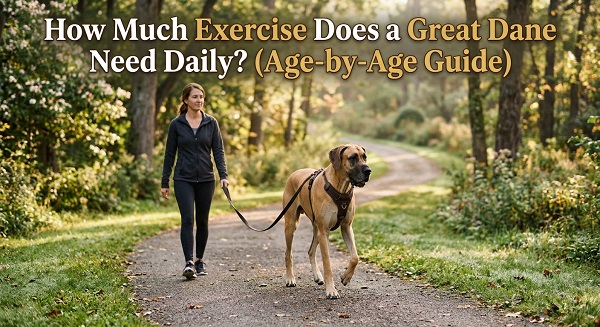
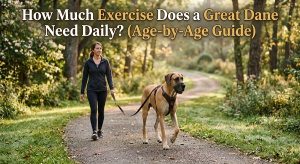
An adult Great Dane needs about 1 to 2 hours of exercise a day, split into two or three easy sessions. Think two brisk walks of 30 to 45 minutes, plus some play and short training games. Puppies under 18 months need much less (roughly 30 to 60 minutes a day in short bursts), and they should skip running, jumping and stairs while their bones are still growing. Aim for steady and low-impact, not hard and fast.
Table of Contents
- The Quick Answer: Great Dane Exercise by Age
- Why Great Danes Need Exercise (But Not Like a Malinois)
- Great Dane Puppy Exercise: Protect Those Growth Plates
- Adult Great Dane Daily Exercise Schedule
- Best and Worst Exercises for a Great Dane
- Bloat and Exercise Timing: What the Research Really Says
- Hot Weather, Cold Weather and Surfaces
- Mental Exercise: The Missing Half
- Senior Great Dane Exercise
- Signs of Too Little or Too Much Exercise
- Trainer Notes: What I Tell Every Great Dane Owner
- FAQs
- Conclusion
Introduction
You’re standing in the hallway with a leash in your hand, and a 140-pound dog is leaning on your legs like a sofa that learned to breathe. So how far do you actually need to walk him?
That’s the problem most Great Dane owners hit in the first week. Search online and you’ll find answers that jump from “30 minutes” to “2 hours” with no real explanation. Some articles tell you Danes are lazy. Others warn you not to over-exercise them. Both are partly right, and that’s exactly why people get confused.
Here’s the thing. The Great Dane is the tallest dog breed in the world, but it’s built for short bursts and long naps, not marathons. Their joints, hearts and deep chests all change the rules. Too little exercise leads to weight gain and boredom. Too much, or the wrong kind, can hurt a growing puppy for life.
In this guide, you’ll learn:
- exactly how much exercise a Great Dane needs at every age, with a clear table
- sample daily schedules you can copy, even if you work all day or live in an apartment
- how to time exercise around meals to lower bloat risk (and where the research disagrees)
- the warning signs that tell you you’re doing too much or too little
I’ll keep it simple, so first-time owners and experienced handlers can both use it.
The Quick Answer: Great Dane Exercise by Age
Before we get into the details, here’s a quick reference. These numbers combine the ranges most vets and breed sources agree on with the practical limits I’d use as a handler. Treat them as a starting point, then adjust with your vet.
| Age | Total daily exercise | How to split it | What to avoid |
|---|---|---|---|
| 8 to 12 weeks | 10 to 15 minutes | Several tiny sessions on soft grass | Stairs, slippery floors, forced walks |
| 3 to 6 months | 20 to 30 minutes | 2 to 3 short walks plus free play | Jumping, long walks, rough play with big dogs |
| 6 to 12 months | 30 to 45 minutes | 2 walks plus play | Running on pavement, ball chasing |
| 12 to 18 months | 45 to 60 minutes | 2 walks plus training games | Jogging, agility jumps, hiking steep trails |
| 18 to 24 months | 60 to 90 minutes | Build up slowly | Regular running until about 2 years old |
| Adult (2 to 6 years) | 1 to 2 hours | 2 to 3 sessions | Hard exercise in heat, right after big meals |
| Senior (6+ years) | 30 to 60 minutes | 3 to 4 short, gentle sessions | Slippery floors, sudden sprints, long hikes |
One note on the sources. Common breed guides put adult Great Danes at around 1 to 2 hours daily, and the American Kennel Club describes two to three brisk walks a day as a good baseline. For puppies, the standard advice is 30 to 60 minutes a day up to about 18 months. My table simply breaks that range into steps so you don’t have to guess.
Why Great Danes Need Exercise (But Not Like a Malinois)
Great Danes came from Germany, where they were bred to hunt wild boar and guard estates. That history gives them power and a strong nose. But modern Danes aren’t built for endurance work.
Compare them with a working breed. A Belgian Malinois on a police team may need a couple of hours of hard, purposeful work every single day. We cover that in our guide on how often to exercise a working dog. A Great Dane is the opposite type. It wants a calm, steady routine, and then it wants to flop down next to you.
So why does a dog this calm still need daily exercise? Four solid reasons:
- Weight control. A male Dane can reach 175 pounds. Extra weight puts heavy strain on joints that already carry a lot.
- Joint and muscle health. Moderate movement keeps muscles strong, which protects hips, elbows and the spine.
- Digestion and bloat management. Regular, calm activity and a steady routine help keep the dog’s whole system working well.
- Behavior. A bored, under-exercised Dane can chew a couch, counter-surf (easy at that height) or become pushy. A tired Dane is usually a calm one.
And remember the lifespan. Most Great Danes live only 7 to 10 years. Good exercise habits won’t change genetics, but they can help your dog stay lean, strong and comfortable for as many of those years as possible.
Great Dane Puppy Exercise: Protect Those Growth Plates
This is the section most articles rush through, and it’s where the most damage happens. Great Dane puppies grow incredibly fast. A puppy can look like an adult by six months, yet his skeleton is still soft and unfinished.
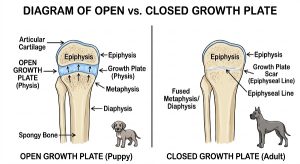
What are growth plates, and why do they matter?
Growth plates are soft areas at the ends of a puppy’s long bones. They make the bones longer. Until hormones tell them to close, they’re weaker than the muscles and tendons around them. In giant breeds like the Great Dane, they close late, often somewhere between 18 and 24 months.
That means a 10-month-old Dane that looks like a grown dog is not ready to jog next to your bike. Hard impact can injure the plates, and that can lead to lifelong lameness or uneven bone growth.
Stairs, floors and early hip health
Here’s a real finding that surprises many owners. A Norwegian study led by Krontveit (published in 2012) followed large and giant breed puppies from birth and found that puppies who climbed stairs in their first three months had a higher risk of hip dysplasia. The same study found that puppies allowed to run off leash on soft, uneven ground in those early months had a lower risk.
What does that mean for you?
- Block or carry your puppy on stairs for the first three months, and keep stairs limited for the rest of the growing period.
- Put rugs or yoga mats on slippery floors. Puppies that slip a lot stress their joints.
- Let your puppy explore grass, soft dirt and gentle slopes at his own pace. That’s good for him.
Great Dane puppy exercise by stage
8 to 12 weeks: Keep it tiny. Short play sessions in a safe yard, gentle exploring and plenty of sleep. Only start outdoor walks after your vet confirms vaccines are done.
3 to 6 months: Think 5 to 10 minutes per outing, two or three times a day. You may have heard the “5 minutes per month of age” rule. It’s a rough guide, not a law. A better rule is to let the puppy choose the pace and stop when he slows down or lies down.
6 to 12 months: Move up to two walks of 15 to 20 minutes, plus play and training. Keep the ground soft when you can. Avoid long walks on pavement and avoid repeated ball chasing with sharp turns and stops.
12 to 18 months: Your Dane looks grown, but he isn’t. Walks can reach 20 to 30 minutes, twice a day. Add basic obedience, scent games and calm swimming if he likes water.
18 to 24 months: Increase time slowly over several weeks. If you want a running partner, wait until at least 2 years of age, which matches the AKC’s guidance.
The neutering note nobody tells you
Sex hormones help signal growth plates to close. Early neutering, before about 18 months, can delay that closure and may lead to taller, looser-jointed dogs. Talk to your vet about timing for a giant breed. This is a health decision, so don’t rely on a blog to make it for you, including this one.
If you’re raising a puppy for the first time and want a calm structure for the whole first year, our ebook Beyond the Bark walks new owners through building consistent routines from day one.
Adult Great Dane Daily Exercise Schedule
Once your Dane is about two years old, you can build up to the full 1 to 2 hours. Here are three real-world schedules. Pick the one closest to your life.
Schedule 1: The 9-to-5 owner
- Morning (30 to 40 minutes): Brisk, steady walk on a loose leash. Let him sniff. Sniffing counts as mental work.
- Midday (10 to 15 minutes): A dog walker, neighbor or quick break from home for a potty trip and a short stroll.
- Evening (30 to 45 minutes): Second long walk. Add 10 minutes of training or a food puzzle at home.
Total: about 80 to 100 minutes.
Schedule 2: The apartment owner
Great Danes can live happily in apartments because they’re calm indoors. But there’s a catch: an apartment gives you zero “accidental” exercise, so your walks matter more.
- Morning: 35-minute walk with a few slow sniff breaks.
- Afternoon: 15 to 20 minutes at a fenced park or dog-friendly field for loose, easy play.
- Evening: 40-minute walk, then a calm indoor game like “find it.”
Indoor play with a dog this size gets risky fast. A wild tug match in a small living room can end with a broken lamp or a sore dog. Keep indoor activity slow and controlled.
Schedule 3: The weekend adventure day
- Morning: 45-minute walk
- Midday: Easy swim session if your Dane enjoys water (low impact and great for joints)
- Late afternoon: 30-minute walk or gentle hike on flat or rolling trails
Keep your Dane’s pace as the speed limit. If he’s lagging behind you on a hike, you’ve gone too far.
Best and Worst Exercises for a Great Dane
Best exercises for Great Danes
- Brisk leashed walks. The foundation of everything. Two a day is ideal.
- Swimming. Low impact and easy on joints. Not every Dane likes water, so never force it, and always supervise.
- Sniff walks. Let him follow his nose for 10 to 15 minutes. It tires a dog more than you’d think.
- Gentle fetch on grass. Short sessions only, with a ball large enough to be safe (a ball that fits behind the back teeth is a choking risk).
- Obedience and trick training. It builds focus and control. See our list of 10 K9-approved tricks to teach your dog for easy ideas that suit large breeds.
- Carting or pulling sports (for adults with a vet’s okay). These are a natural fit for a strong, steady dog.
Exercises to limit or avoid
- Jogging or cycling before 2 years of age. Your dog’s bones aren’t ready.
- Repeated jumping, including jumping out of cars or off decks. Use a ramp.
- Hard fetch with sharp turns on hard ground.
- Rough play with much smaller dogs. A friendly bump from a Dane can injure a small dog. The reverse can happen too, if a smaller dog is aggressive.
- Long runs on pavement. The impact adds up on big joints.
- Hard exercise in hot weather. More on that below.
Bloat and Exercise Timing: What the Research Really Says
If you take one safety lesson from this article, make it this one. Bloat, also called gastric dilatation-volvulus (GDV), is when the stomach fills with gas and can twist. It’s a life-threatening emergency.
The numbers are scary. Research out of Purdue University found that Great Danes have the highest lifetime bloat risk of any breed studied, at about 42%. About 30% of dogs that get bloat die or are euthanized. For giant breeds, risk climbs by roughly 20% each year after age 3.
Does exercise cause bloat?
Here’s where most articles go quiet, and where honest information matters.
The old advice says to avoid hard exercise for one hour before and two hours after meals. Many vets still give that advice, and some Purdue-based recommendations included it. But the research isn’t clear:
- One Purdue analysis reported no link between exercise around mealtime and bloat, noting that many dogs bloated in the middle of the night with an empty, gas-filled stomach.
- A University of Pennsylvania study of more than 2,500 questionnaires found the opposite pattern: moderate activity, like playing with other dogs or running the fence, was linked to nearly half the risk. Researchers stressed this showed an association, not proof of cause.
So what do I do? I stay on the safe side without panicking. Here’s the routine I’d recommend:
- Feed two or three smaller meals instead of one large meal. Single daily meals were linked to higher risk.
- Skip hard, fast exercise (sprinting, rough wrestling) for at least an hour before and two hours after eating.
- Gentle walking is fine. Calm movement after a meal isn’t the enemy.
- Slow down fast eaters with a slow-feeder bowl or a lick mat.
- Don’t use raised bowls unless your vet tells you to. One study linked them to a much higher bloat risk.
- Ask your vet about a preventive gastropexy. This surgery tacks the stomach in place and is often done with a spay or neuter in high-risk breeds.
Know the warning signs
Go to an emergency vet immediately if your Great Dane shows:
- a swollen, tight belly
- retching without bringing anything up
- pacing, restlessness or drooling
- pale gums or collapse
Don’t wait to see if it passes. Minutes matter.
Hot Weather, Cold Weather and Surfaces
Heat
Big dogs overheat. A Great Dane’s body is huge, and it takes a long time to cool down once it heats up. In warm climates, walk at dawn and after sunset. Skip midday walks completely.
Watch for heavy panting that won’t settle, thick drool, a bright red tongue, glassy eyes or wobbling. If you see these, stop, move to shade, offer small sips of cool (not ice-cold) water and call your vet. Our guide to dog cooling vests and which ones actually work can help you pick gear for hot-climate walks.
Cold
The Great Dane has a thin, short coat and little body fat. Vets note that the breed doesn’t tolerate cold well. In winter, use a coat on walks and keep outings shorter on freezing days.
Surfaces
Surface matters more than most people think. Soft grass, packed dirt and sand are kind to joints. Hardwood and tile are slippery, so put rugs down where your dog runs. Hot asphalt can burn paws, so check it with the back of your hand for five seconds.
Mental Exercise: The Missing Half
Most owners focus only on legs. But a 30-minute training and sniffing session can wear a Dane out as much as a longer walk.
Try these, especially on rainy days:
- Find it: Hide treats around a room and let him hunt.
- Food puzzles and lick mats: Great for slowing down eating, too.
- Short training bursts: Five minutes of sit, down, stay and leave it, three times a day.
- Nose work: Hide a scented item and teach him to find it.
- Calm exposure: Visit a quiet cafe patio or park bench and practice relaxing around people.
This is the same idea we use with working dogs: purposeful activity beats mindless running. A dog that has to think comes home calmer.
Senior Great Dane Exercise
Great Danes age earlier than most breeds. Many show stiffness by age 6 or 7. Seniors still need to move, because inactivity speeds muscle loss. But the plan changes.
- Split walks into smaller pieces. Three or four 10 to 15 minute walks beat one long outing.
- Choose soft, flat ground and avoid steep slopes.
- Add traction. Rugs, non-slip mats and paw wax or grip socks help dogs with weak back legs.
- Keep weight lean. Every extra pound hits aging joints hard.
- Watch for signs of pain: slowing down, reluctance to rise, limping, licking joints or sleeping more.
- Talk to your vet about joint supplements, pain relief and physical therapy such as hydrotherapy.
A wobbly gait can also point to serious conditions such as wobbler syndrome (a spinal problem seen in giant breeds) or heart disease. Don’t write it off as old age. Get it checked.
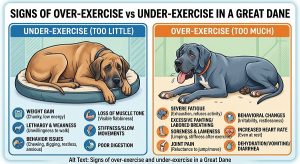
Signs of Too Little or Too Much Exercise
How do you know if you’ve got the balance right? Use this checklist.
Signs your Great Dane needs more exercise
- Chewing, digging or counter-surfing
- Pacing, whining or constant attention-seeking
- Weight gain, or ribs you can’t feel
- Jumping on people or pulling hard on the leash
- Can’t settle in the evening
Signs your Great Dane is getting too much
- Limping or stiffness that lasts after rest
- Sore, heavy walking the next morning
- Refusing to walk or lying down mid-walk
- Heavy panting that takes a long time to calm
- Cranky mood, or a puppy that crashes and can’t eat
The simple recovery test
Here’s a test I use. About 15 minutes after a walk, check your dog. He should be breathing normally, drinking calmly and settling down. The next morning, he should get up and move without stiffness. If not, shorten tomorrow’s walk and see your vet if it keeps happening.
Trainer Notes: What I Tell Every Great Dane Owner
At ARFS K9 Team, we work with working dogs and handlers, and the lessons carry over to giant companions. Dogs do best with routine, structure and a clear purpose, and that matters as much for a 140-pound Dane as for a police dog.
Here’s what I’d tell any owner standing in that hallway with a leash:
- Consistency beats intensity. Two calm walks every day will do more for your Dane than one huge weekend outing.
- Stop while he still wants more. Especially with puppies. Finishing on a high note keeps joints safe and keeps him eager.
- Weigh him monthly. Slow weight creep is the number one thing owners miss.
- Teach leash manners early. A 150-pound dog that pulls is a safety problem. Start loose-leash walking at 10 weeks, not 10 months.
- Pair vet advice with your own eyes. Your dog’s comfort the next day is better data than any chart.
Sources and references used for this guide: Purdue University bloat research (Glickman and colleagues), the University of Pennsylvania and AKC bloat study, Krontveit et al. (2012, American Journal of Veterinary Research), American Kennel Club breed guidance, VCA Animal Hospitals breed profile, and breed guides from Hepper, Dogster and BorrowMyDoggy. This article is educational and doesn’t replace your vet’s advice.
FAQs
How many hours a day should I walk my Great Dane?
For most adults, plan on 1 to 2 hours of total activity a day, split into two or three sessions. A typical day is two walks of 30 to 45 minutes plus some play and training. Seniors and puppies need less.
Can you over-exercise a Great Dane?
Yes, and it’s more common than people think, especially with puppies. Too much impact before the growth plates close (around 18 to 24 months) can cause joint problems. In adults, signs include limping, stiffness the next day and heavy panting that doesn’t settle. Build up slowly and watch recovery.
When can I start running or jogging with my Great Dane?
Wait until your Dane is at least 2 years old, which matches AKC advice. Even then, start with short, slow runs on soft ground, avoid hot weather and have your vet check hips and elbows first if your dog has any risk signs.
Do Great Danes need a yard?
No. Many Danes thrive in apartments because they’re calm indoors. What they need is daily walks, safe off-leash time in fenced areas and mental games. A yard helps but it doesn’t replace walks, because walks give him smells, social time and structure.
Should I exercise my Great Dane before or after meals?
The research is mixed, so play it safe. Avoid hard, fast exercise for about an hour before and two hours after eating, feed smaller meals, and keep post-meal activity calm. Gentle walking is usually fine. Talk to your vet about a gastropexy, since Great Danes have about a 42% lifetime bloat risk.
Conclusion
So, how much exercise does a Great Dane need? For most adults, about 1 to 2 hours a day, split into easy sessions. For puppies, much less, kept low-impact until growth plates close at around 18 to 24 months. For seniors, shorter and gentler walks spread through the day.
Here’s your action plan:
- Find your dog’s age on the table and set a starting routine today.
- Keep puppies off stairs, slippery floors and hard running.
- Split meals into two or three smaller feedings, and keep hard exercise away from mealtimes.
- Walk early and late in hot weather, and carry water.
- Add 10 to 15 minutes of mental work every day.
- Use the recovery test: if he’s stiff or sore the next day, cut back.
- Ask your vet about gastropexy, hip screening and the right weight for your dog.
A well-exercised Great Dane isn’t a tired dog. He’s a calm, balanced, comfortable one, and that’s what we’re after.
Want more expert dog and K9 tips every week? Subscribe to our weekly articles roundup newsletter at https://arfsk9team.com.ng/newsletter/ and get new guides straight to your inbox.

Her work centres on obedience, detection, protection and operational readiness. She favours proven methods built on repetition, consistency and real-world conditioning, so that both dogs and handlers are prepared for high-pressure tasks.
Rofiat represented the Nigerian Army Dog Centre at the Nigerian Army Day Celebration (NADCEL) 2026, where she led demonstrations in obedience, explosive detection, agility and tactical movement. Through articles, training content and documentaries, she shares field-based insight into how structured training, clear communication and trust between handler and dog affect performance and reliability.
She is the author of Beyond the Bark: Inside a Pro Handler's Playbook for Raising the Ideal Dog, a practical guide that helps dog owners and handlers apply professional training principles in everyday situations.
- How Much Exercise Does a Great Dane Need Daily? - November 23, 2026
- How to Safely Approach Stray Dogs: 5 Field Rules - November 22, 2026
- Food Aggression Dog Training: Pro K9 Guide - November 21, 2026