Purina Pro Plan Sport 30/20 Review: Is It Safe for K9s?
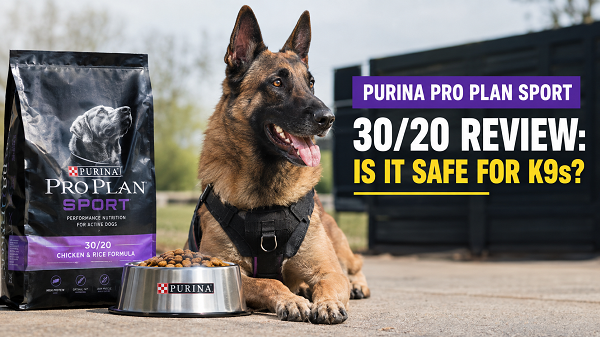
Yes, Purina Pro Plan Sport Performance 30/20 is generally safe for healthy working K9s. It’s AAFCO-approved, backed by Purina’s in-house nutrition team, and used widely across sporting, detection, and service-dog programs in the US, UK, and Canada. That said, “safe” doesn’t automatically mean “ideal for every job.” Detection dogs, patrol dogs, and large-breed puppies each have slightly different needs, and this guide walks you through exactly where 30/20 fits, and where it doesn’t.
Table of Contents
- What Is Purina Pro Plan Sport 30/20?
- Guaranteed Analysis: What the Numbers Actually Mean
- Ingredient Breakdown: What’s Really in the Bag
- Is It Safe for K9s? The Science Behind the Ratio
- Real-World Performance: What Handlers Are Reporting
- Purina Pro Plan Sport 30/20 vs. Other Performance Foods
- Cost Breakdown: What You’ll Actually Pay
- Feeding Guidelines for Working Dogs
- Pros and Cons at a Glance
- Who Should (and Shouldn’t) Feed This Formula
- Frequently Asked Questions
- Final Verdict
Introduction
If you’ve ever stood in a pet store aisle staring at a 40-lb bag of Purina Pro Plan Sport 30/20, wondering whether it’s actually built for a dog that works for a living, you’re not alone. I get asked this question constantly, by handlers prepping a Malinois for patrol certification, by breeders raising litters for detection work, and by regular owners whose “weekend warrior” retriever suddenly needs more fuel than a couch potato diet can give.
In this article, I’m going to pull apart the label, the guaranteed analysis, and the actual research behind high-protein/high-fat diets for working dogs, not just repeat what’s printed on the bag. You’ll get the real ingredient breakdown, the science on how this ratio affects scent detection versus bite work, honest pricing, feeding charts, and where this food falls short.
What Is Purina Pro Plan Sport 30/20?
Purina Pro Plan Sport is the performance tier of Purina’s Pro Plan lineup, built specifically for dogs that burn serious calories: field trial dogs, sled dogs, protection dogs, SAR (search and rescue) K9s, and police and military working dogs. The “30/20” in the name refers to the guaranteed minimums on the bag: 30% crude protein and 20% crude fat.
Purina actually runs several formulas under the Sport banner, and it’s easy to grab the wrong one if you’re not paying attention:
- Sport Performance 30/20 – Chicken & Rice, Salmon & Rice, Beef & Bison, and Turkey, Duck & Quail formulas. This is the one most handlers mean when they say “30/20.”
- Sport Active 26/16 – A moderate-energy option (26% protein, 16% fat) for dogs that are active but not doing sustained hard labor.
- Sport All Ages 27/17 – A middle-ground formula.
- Sport Performance 7+ – The senior version, with glucosamine and EPA dialed up for joint support.
I’ll focus this review on the flagship Sport Performance 30/20 Chicken & Rice, since Purina and independent reviewers use it as the representative recipe for the whole 30/20 line, and it’s the version I get the most questions about from handlers.
One thing worth flagging early: Purina’s field team includes a dedicated Police K-9 Segment specialist (currently Mark Cascio) whose job is sponsoring the trials, certifications, and seminars that police, military, and border patrol K9 units attend across the US, Canada, and Mexico. That’s not a random marketing claim, it tells you this formula wasn’t designed in a vacuum for weekend agility dogs. Purina has skin in the working-dog world specifically.
Guaranteed Analysis: What the Numbers Actually Mean
Here’s the label breakdown for Sport Performance 30/20 Chicken & Rice, straight from Purina’s own spec sheet:
| Nutrient | Guaranteed Minimum/Maximum |
|---|---|
| Crude Protein | 30.0% (min) |
| Crude Fat | 20.0% (min) |
| Crude Fiber | 3.0% (max) |
| Moisture | 12.0% (max) |
| Linoleic Acid | 1.8% (min) |
| EPA (omega-3) | 0.12% (min) |
| DHA (omega-3) | 0.12% (min) |
| Calcium | 1.1% (min) |
| Phosphorus | 0.9% (min) |
| Calorie content | ~4,390–4,397 kcal/kg, roughly 485–507 kcal per 8-oz cup (varies slightly by batch/retailer) |
Here’s where it gets interesting, and where a lot of reviews online stop short. The label percentages are on an “as-fed” basis, which includes moisture. Once you strip the water out and look at it on a dry matter basis (the only fair way to compare kibble brands), the numbers shift to roughly:
- Protein: ~34% dry matter
- Fat: ~23% dry matter
- Carbohydrates: ~32% dry matter
And if you look at it by calories rather than weight, which is arguably the most useful lens for athletic performance, the profile works out to approximately 27% of calories from protein, 44% from fat, and 28% from carbs. That fat-heavy calorie split is the real story of this food, and it matters a lot for the safety question we’re getting to next.
Ingredient Breakdown: What’s Really in the Bag
The ingredient list for Sport Performance 30/20 Chicken & Rice reads: chicken, corn protein meal, rice, beef fat (preserved with mixed tocopherols), poultry by-product meal, whole grain corn, corn germ meal, dried egg product, fish meal, natural flavor, fish oil, mono and dicalcium phosphate, calcium carbonate, potassium chloride, salt, vitamins, choline chloride, l-lysine monohydrochloride, minerals, and garlic oil.
Let’s go through the ingredients that actually matter for a working dog’s health:
Chicken (1st ingredient). Fresh chicken is roughly 70% water before cooking, so while it sounds impressive as the top ingredient, it contributes less actual protein mass to the finished kibble than its position suggests. It’s a quality item, just not the whole story.
Corn protein meal (2nd ingredient). This is corn gluten, a plant-based protein concentrate. It’s not a bad ingredient, but it does inflate the total protein number on the label without carrying the same amino acid profile or digestibility as animal muscle meat. If you’re chasing a “30% protein” number, know that a chunk of it is coming from corn, not chicken.
Beef fat and fish oil. These are genuinely good additions. Beef fat (tallow) is a legitimate, palatable energy source, and fish oil supplies EPA and DHA, the omega-3s with the highest bioavailability for dogs. This combination is a big part of why coat condition shows up so often in owner reviews.
Poultry by-product meal. This gets a bad reputation online, but it’s actually a concentrated protein source, by-product meals run roughly triple the protein content of fresh poultry by weight. The catch is quality control varies by batch since “by-product” covers organs, undeveloped eggs, and other non-muscle parts.
Garlic oil. This is the one ingredient I’d flag for extra attention. Garlic has been linked to Heinz body anemia in dogs in peer-reviewed veterinary literature, though the amount used in commercial kibble is very small and considered safe by AAFCO standards. Still, if your K9 is also on garlic-containing supplements (some handlers use garlic for flea/tick “folk remedies,” which I don’t recommend anyway), the doses can stack. Worth mentioning to your vet if your dog has ever had unexplained anemia.
Minerals. The trace minerals here (zinc sulfate, ferrous sulfate, manganese sulfate, etc.) are not chelated. Chelated minerals bind to protein molecules and absorb more efficiently; non-chelated forms still work but are somewhat less bioavailable. This isn’t a safety issue, just a quality ceiling that separates this formula from some higher-end performance diets.
Independent reviewers who specialize in ingredient analysis (Dog Food Advisor among them) rate the overall Sport Performance line at 3.5 out of 5 stars, “recommended with reservations,” largely because of the corn-heavy filler content diluting an otherwise solid meat-and-fish protein base.
Is It Safe for K9s? The Science Behind the Ratio
This is the actual question you came here for, so let’s get specific instead of hand-waving.
AAFCO Compliance and Life Stage
Sport Performance 30/20 carries an AAFCO “All Life Stages” nutritional adequacy statement, meaning it’s formulated to support growth as well as adult maintenance. That’s genuinely useful for K9 programs raising a litter of Malinois or GSD pups destined for patrol work, since you don’t have to switch foods mid-training.
But here’s the catch every handler with a large-breed puppy needs to know: AAFCO tightened its rules so that any “growth” or “all life stages” food must specify whether it’s safe for large-breed puppies (70 lbs or more as an adult) or not, based on calcium content. Excess calcium during rapid bone growth in large breeds is linked to developmental orthopedic disease. Before you start a GSD, Malinois, Rottweiler, or Cane Corso puppy on this formula, check the exact AAFCO statement printed on your specific bag (it can vary by SKU and region) and confirm with your vet or breeder that it’s cleared for large-breed growth. Don’t assume; verify.
What Detection and Working-Dog Research Actually Shows
Here’s the part most reviews of this food completely skip: there’s real, DOJ-funded research on exactly this macronutrient question, done at Auburn University’s Canine Performance Sciences program in partnership with Cornell University’s College of Veterinary Medicine.
Dr. Joseph Wakshlag’s team ran a $1 million study (funded by the U.S. Department of Justice) on certified detection dogs, testing low-protein/high-fat, high-protein/high-fat, and high-protein/low-fat diets. Two findings matter enormously here:
- A high-protein, high-fat diet (around 27% of calories from protein, 57% from fat) reduced serum cortisol and improved recovery markers after exercise, compared to lower-fat diets.
- A separate study from the same lab found that increasing dietary fat (specifically corn oil supplementation) improved thermoregulation and, in earlier work, olfactory performance in detection dogs, while cutting protein and boosting fat helped dogs perform better in both exercise and scent-detection tests.
Now compare that to Pro Plan Sport 30/20’s actual calorie-weighted profile: roughly 27% protein, 44% fat. The protein number lines up almost exactly with what the research recommends. The fat percentage, at 44% of calories, sits meaningfully below the 57% fat level used in the detection-dog studies that produced the best olfactory and recovery results.
What this means practically: for scent-detection K9s (narcotics, explosives, SAR), 30/20 is a solid, safe baseline, but handlers chasing peak olfactory performance might reasonably consider a slightly higher-fat top dress (a small amount of fish oil or a vet-approved fat supplement), under veterinary guidance. For patrol, protection, and general fitness K9s, whose job depends more on strength, lean muscle, and anaerobic power than on scent discrimination, the 30/20 ratio as-is fits comfortably within evidence-based recommendations for canine athletes (most veterinary nutritionists recommend performance dogs get at least 24% of calories from protein).
VO2 Max Claims
Purina markets this formula around “optimizing oxygen metabolism (VO2 max) for increased endurance.” VO2 max is a legitimate physiological measure of how efficiently an animal uses oxygen during sustained exercise, and Purina’s R&D team (500+ nutritionists, vets, and scientists company-wide) has published internal and third-party-reviewed work on canine athletic performance. That said, treat marketing language like this as directionally true rather than a guaranteed performance boost for your specific dog. Genetics, training volume, and conditioning matter more than any single kibble formula.
Recall History and Grain Safety
As of this writing, Purina Pro Plan Sport Performance 30/20 itself has no active recall. Purina’s broader Pro Plan brand has had isolated recalls in the past, a 2023 Vitamin D issue and a 2022 mislabeling issue, but both were tied to the Veterinary Diets EN line, a completely different product, not the Sport Performance formula. It’s also worth noting this formula is grain-inclusive (rice and corn), which puts it outside the FDA’s ongoing investigation into a possible link between grain-free, legume-heavy diets and dilated cardiomyopathy (DCM) in dogs. That’s a real safety point in this food’s favor, not a marketing spin.
Real-World Performance: What Handlers Are Reporting
Numbers on a bag only tell you so much, so here’s what’s actually happening in the field. Across major retailers, the 50-lb bag of Pro Plan Sport Performance 30/20 Chicken & Rice carries a 4.8-out-of-5 rating from over 2,400 verified buyers, with the most common praise points being sustained energy, coat condition, and consistent weight management in high-drive breeds.
A recurring theme in reviews from working-line Belgian Malinois and Dutch Shepherd owners: dogs that stayed visibly underweight (“ribby”) on other high-calorie diets held solid body condition on far less food when switched to 30/20, often 3 cups a day instead of 5–6. That’s consistent with the higher fat-calorie density of the formula, more energy per cup means less volume needed, which matters if your K9 has a smaller stomach capacity relative to its workload (common in Malinois-type dogs).
Breeders raising working litters also report using it from weaning through adulthood without digestive issues, and professional handlers, including guide-dog and service-dog training programs, list it as a standard maintenance diet. Purina Pro Plan overall has been the food of choice for 11 of the past 12 Best in Show winners at the Westminster Kennel Club show, which, while not a working-dog credential specifically, does speak to consistency across demanding canine athletic careers.
Trainer’s Note
I’ve fed variations of the Pro Plan Sport line to working-line dogs in training programs, and the pattern I see most often matches what the research above predicts: dogs doing bite work, agility, and patrol conditioning do well on 30/20 as a standalone diet. Dogs doing pure scent-detection work sometimes benefit from a small fat top-dress on hot, high-output training days, always cleared with a vet first, since sudden fat increases can trigger pancreatitis in sensitive dogs. If you want a deeper dive into structuring a full training and conditioning program around your dog’s actual job (not just its breed), it’s worth reading up on how military working dogs are trained, since nutrition and conditioning load go hand in hand.
Purina Pro Plan Sport 30/20 vs. Other Performance Foods
| Formula | Protein / Fat | Best For | Approx. Price (33–40 lb bag) |
|---|---|---|---|
| Purina Pro Plan Sport 30/20 | 30% / 20% | Patrol, protection, all-around working dogs | $75–$100 |
| Purina Pro Plan Sport Active 26/16 | 26% / 16% | Moderately active dogs, not full-time working K9s | $70–$90 |
| Eukanuba Premium Performance 30/20 | 30% / 20% | Similar niche, more chicken-forward, higher price point | $85–$110 |
| Purina ONE SmartBlend | 26% / 16% | Budget-conscious owners of active pets (not working-level) | $45–$60 |
| Royal Canin Sporting Life Active 4800 | ~30% / ~20% | Premium tier, vet-channel only in some regions | $100+ |
Where Pro Plan Sport 30/20 wins: it’s widely available (grocery, pet specialty, and online, not locked behind a vet-exclusive channel like some Royal Canin sport lines), backed by a large in-house research team, and priced noticeably below Eukanuba and Royal Canin’s equivalent tiers while landing in a similar macronutrient bracket. Where it loses ground: the ingredient panel leans more on corn-based protein and non-chelated minerals than some premium competitors, so it sits in the “solid mid-tier” category rather than the ultra-premium bracket.
Cost Breakdown: What You’ll Actually Pay
Pricing varies by retailer and region, but here’s a realistic range based on current listings:
- 6-lb bag: roughly $18–$22 (trial size, not economical long-term)
- 33–37.5-lb bag: roughly $75–$103
- 50-lb bag: roughly $90–$113
For a 70-lb working dog eating around 3–3.5 cups per day, a 40-lb bag lasts approximately 3–4 weeks, putting the daily cost at roughly $2.50–$3.50 per day, or $75–$105 per month. That’s competitive for a 30/20 performance tier, notably cheaper than Royal Canin’s equivalent and generally on par with or below Eukanuba’s Premium Performance line.
Feeding Guidelines for Working Dogs
Purina’s official feeding chart (based on an 8-oz cup holding about 115 g of kibble):
| Body Weight | Daily Amount |
|---|---|
| 3–12 lbs | ⅓ – 1 cup |
| 13–20 lbs | 1 – 1¼ cups |
| 21–35 lbs | 1¼ – 1¾ cups |
| 36–50 lbs | 2 – 2¼ cups |
| 51–75 lbs | 2¼ – 3 cups |
| 76–100 lbs | 3 – 3½ cups |
| Over 100 lbs | 3½ cups + ¼ cup per additional 10 lbs |
These are starting points, not gospel. A K9 doing 4 hours of daily bite work, obstacle training, and vehicle patrol burns considerably more than a dog that gets a single evening walk, so adjust up and monitor body condition score (you should be able to feel ribs easily without a heavy fat layer over them, and see a visible waist tuck from above).
If you’re switching from another food, transition gradually over 7–10 days: 25% new/75% old for two days, 50/50 for two days, 75% new/25% old for two days, then 100% new. Skipping this step is the single most common cause of “this food gave my dog diarrhea” complaints, and it’s almost never actually about the food itself.
Feeding load should scale with your dog’s actual exercise output, not just its breed. If you’re not sure how much daily activity your working dog genuinely needs (it’s usually more than owners think), this breakdown on exercising a working dog pairs well with the feeding chart above.
Pros and Cons at a Glance
Pros:
- AAFCO-approved 30% protein / 20% fat ratio, in line with evidence-based recommendations for canine athletes
- Grain-inclusive formula, sidesteps the FDA’s grain-free DCM concern entirely
- Real chicken, beef fat, and fish oil deliver genuine omega-3 and energy density
- Widely available and priced below most premium competitors
- No recall history tied to the Sport Performance line specifically
- Backed by Purina’s dedicated Police K-9 and Sporting Dog field programs
Cons:
- Corn protein meal and corn germ meal inflate the protein number without matching animal-protein quality
- Minerals aren’t chelated, slightly lower absorption than top-tier competitors
- Garlic oil inclusion warrants caution if your dog is on other garlic-containing products
- Fat-calorie percentage (44%) sits below the level shown optimal for peak scent-detection performance in published research
- Large-breed puppy owners must double-check the specific AAFCO growth statement on their bag
Who Should (and Shouldn’t) Feed This Formula
Good fit: Patrol and protection K9s, sporting and field dogs, active adult working dogs of any breed, and dogs recovering their condition after being underweight on lower-calorie diets.
Proceed with a vet’s input: Large-breed puppies in training programs (confirm the calcium/growth statement), dogs with a history of pancreatitis (the fat content is meaningfully higher than maintenance diets), and pure detection/scent-work specialists where a fat-forward performance diet might extract a bit more olfactory performance.
Not ideal: Sedentary pets, senior dogs without a job requiring this calorie density, and dogs with confirmed sensitivities to corn or poultry by-products.
Frequently Asked Questions
Is Purina Pro Plan Sport 30/20 good enough for police and military K9s?
Yes. It meets AAFCO standards for high-performance nutrition, and Purina runs a dedicated Police K-9 sponsorship program supporting certification trials across the US, Canada, and Mexico. Many patrol and protection K9 units use it as a standard maintenance diet.
What’s the real difference between Sport 30/20 and Sport Active 26/16?
Sport 30/20 has more protein and fat (30%/20%) and roughly 15–20% more calories per cup, built for dogs doing sustained hard work daily. Sport Active 26/16 suits dogs that are active but not working full shifts, agility hobbyists or weekend hikers, for example.
Can large-breed K9 puppies safely eat this formula?
Generally yes, since it carries an All Life Stages statement, but you must check the specific AAFCO clause on your bag confirming it’s safe for growth of large-size dogs (70 lbs+ as an adult), since calcium tolerance during rapid bone growth differs by breed size. Confirm with your vet before starting a GSD, Malinois, or Cane Corso puppy on it.
Has Purina Pro Plan Sport 30/20 ever been recalled?
No recalls have been issued for the Sport Performance 30/20 line specifically. Purina’s Veterinary Diets EN line had isolated recalls in 2022 and 2023, but that’s an entirely separate product category.
How much does it cost to feed a 70-lb K9 per month?
Expect roughly $75–$105 per month for a 70-lb working dog eating around 3 cups daily, based on current 40–50-lb bag pricing.
Final Verdict
Purina Pro Plan Sport 30/20 earns its reputation as a dependable, science-backed performance diet for working dogs. It’s not the most premium bag on the shelf, the corn-based fillers and non-chelated minerals keep it out of the top tier, but it’s genuinely well-matched to the protein needs research shows canine athletes require, it’s grain-inclusive (avoiding the DCM controversy entirely), and it’s priced sensibly for handlers feeding multiple dogs or running a K9 program on a real budget.
If your dog does patrol, protection, or general working-dog conditioning, 30/20 is a safe, well-supported choice straight out of the bag. If your dog’s job is scent detection specifically, talk to your vet about whether a modest fat top-dress could help you squeeze out extra olfactory performance, the research suggests it might. And if you’re raising a large-breed puppy for future K9 work, don’t skip checking that growth statement on the bag before day one.
Nutrition is only one leg of the stool for a working K9, training structure and recovery matter just as much. If you want a genuinely useful deep dive into the full picture of raising and conditioning a working dog, from the ground up, my top recommendation is the “Beyond the Bark“ e-book, which pairs well with what we’ve covered here on feeding.
And while we’re on the topic of coat and body condition, since it comes up constantly in Pro Plan reviews, if shedding season is hitting your K9 hard right now, this handler’s guide to managing dog shedding is worth bookmarking alongside your feeding plan.
Want more breakdowns like this one delivered straight to your inbox? Subscribe to our weekly K9 newsletter for trainer-tested nutrition, gear, and handling insights, no fluff, just what actually works in the field.

Her work centres on obedience, detection, protection and operational readiness. She favours proven methods built on repetition, consistency and real-world conditioning, so that both dogs and handlers are prepared for high-pressure tasks.
Rofiat represented the Nigerian Army Dog Centre at the Nigerian Army Day Celebration (NADCEL) 2026, where she led demonstrations in obedience, explosive detection, agility and tactical movement. Through articles, training content and documentaries, she shares field-based insight into how structured training, clear communication and trust between handler and dog affect performance and reliability.
She is the author of Beyond the Bark: Inside a Pro Handler's Playbook for Raising the Ideal Dog, a practical guide that helps dog owners and handlers apply professional training principles in everyday situations.
- Purina Pro Plan Sport 30/20 Review: Is It Safe for K9s? - October 3, 2026
- Is K9 Advantix Safe for Dogs? A Handler’s Honest Review - October 2, 2026
- Australian Cattle Dog vs Blue Heeler: Any Difference? - October 1, 2026